Pennsylvania Small Business Accounting Package
What is this form package?
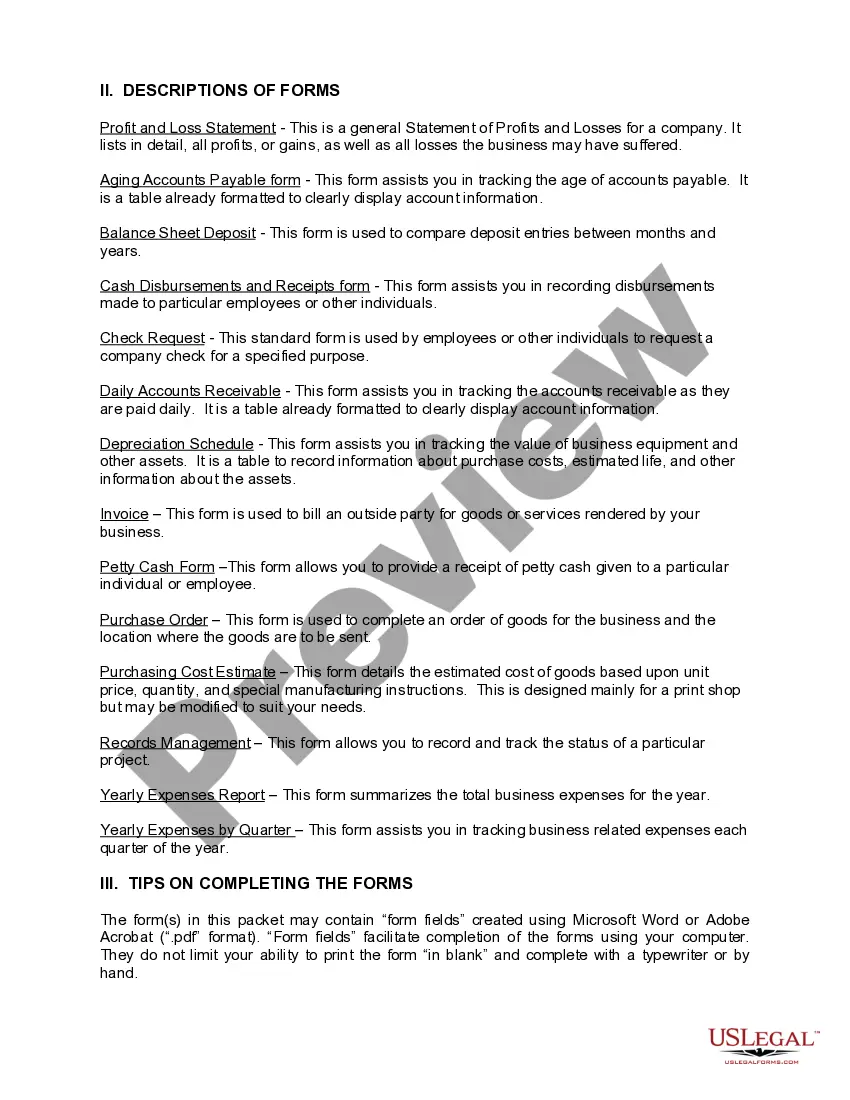
The Pennsylvania Small Business Accounting Package is a comprehensive collection of essential accounting forms designed to help small business owners effectively manage their financial records. This package differs from others by providing a tailored set of forms specifically suited for small businesses operating in Pennsylvania. Included forms range from profit and loss statements to depreciation schedules, ensuring you have the necessary tools to track and manage your business finances efficiently.
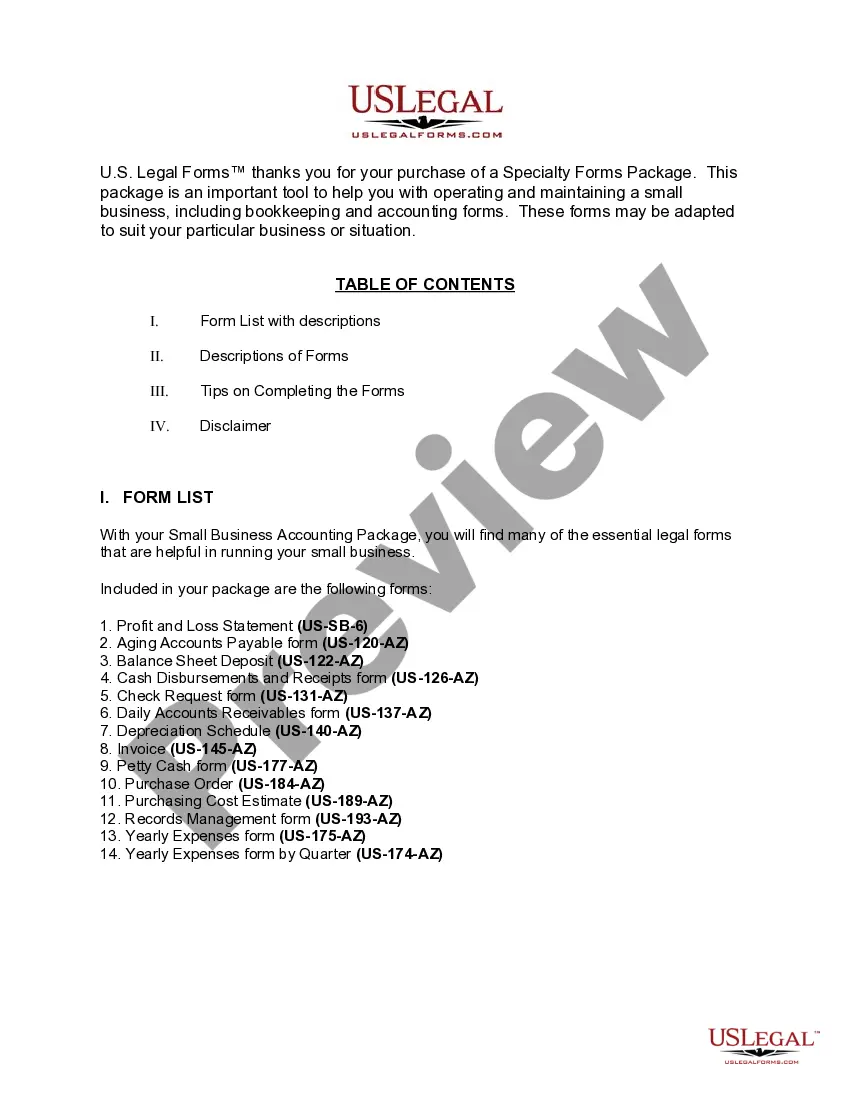
Forms included in this package
- Aging Accounts Payable
- Balance Sheet Deposits
- Cash Disbursements and Receipts
- Check Request
- Daily Accounts Receivable
- Depreciation Schedule
- Job Invoice - Short
- Yearly Expenses by Quarter
- Yearly Expenses
- Petty Cash Form
- Purchasing Cost Estimate
- Records Management
- Profit and Loss Statement
- Purchase Order for Invoice
When to use this document
This package is ideal for small business owners who need structured forms to help with financial reporting, expense tracking, and cash flow management. You would benefit from this package when:
- You are starting a new small business and need templates for essential accounting documents.
- You want to streamline your financial process with standardized forms.
- You need to prepare financial statements for tax purposes or seeking funding.
- You want to keep detailed records of your business transactions and assets.
Who should use this form package
- Small business owners in Pennsylvania.
- Accounting professionals managing small business finances.
- Startups looking for cost-effective accounting solutions.
- Individuals with limited accounting knowledge seeking easy-to-use templates.
How to prepare this document
- Review all included forms to understand their purposes and requirements.
- Gather the necessary financial information for each form.
- Use a computer to enter details into the form fields or print them out for hand completion.
- Ensure all transactions are accurately documented in the respective forms.
- Save completed forms for your records and future reference.
Notarization requirements for forms in this package
Most forms in this package do not require notarization. However, local laws or specific situations may demand it. Our online notarization service, powered by Notarize, lets you complete the process through a verified video call, available anytime.
Get your form ready online
Our built-in tools help you complete, sign, share, and store your documents in one place.
Make edits, fill in missing information, and update formatting in US Legal Forms—just like you would in MS Word.
Download a copy, print it, send it by email, or mail it via USPS—whatever works best for your next step.
Sign and collect signatures with our SignNow integration. Send to multiple recipients, set reminders, and more. Go Premium to unlock E-Sign.
If this form requires notarization, complete it online through a secure video call—no need to meet a notary in person or wait for an appointment.
We protect your documents and personal data by following strict security and privacy standards.

Make edits, fill in missing information, and update formatting in US Legal Forms—just like you would in MS Word.

Download a copy, print it, send it by email, or mail it via USPS—whatever works best for your next step.

Sign and collect signatures with our SignNow integration. Send to multiple recipients, set reminders, and more. Go Premium to unlock E-Sign.

If this form requires notarization, complete it online through a secure video call—no need to meet a notary in person or wait for an appointment.

We protect your documents and personal data by following strict security and privacy standards.
Common mistakes
- Failing to accurately enter financial data, leading to imprecise reports.
- Not updating forms regularly to reflect current financial situations.
- Overlooking the need for supporting documentation for entries in forms.
Benefits of completing this package online
- Convenience of downloading and accessing forms anytime, anywhere.
- Editability allows you to customize forms to fit your specific business needs.
- Reliability of using professionally drafted forms to ensure compliance with legal standards.
Looking for another form?


Form popularity
FAQ
You use Schedule C to report profits or losses from a sole proprietorship. A sole proprietorship is any business you operate and control that is not set up as a legal business entity such as a corporation or partnership.It does not have to be a business with employees or an office, but it can.
Schedule C is a place to report the revenue from your business, as well as all the types of expenses you incurred to run your business. Your business income minus your business expenses is your net profit (or loss). You then report your net profit as income on your Form 1040.
Anyone who operates a business as a sole proprietor must fill out Schedule C when filing their annual tax return. Schedule C accompanies the main tax return form, 1040, for taxpayers who must report a profit or loss from their business.
To start a business in Pennsylvania, you will likely have to pay application and licensing fees. To obtain a Pennsylvania LLC Certificate of Organization, for example, costs about $125. Additional fees might be required if your business is structured as a corporation, sole proprietorship or partnership.
PA SCHEDULE A (LINE 2) If your total PA-taxable interest income(taxpayer, spouse and/or joint) is more than $2,500, you must complete PA Schedule A, with the name and PA-taxable interest of the payer from each Form 1099 or other statement.
Applying for an Employer Identification Number (EIN) is a free service offered by the Internal Revenue Service. Beware of websites on the Internet that charge for this free service.
Report all transactions directly related to your business or profession on PA Schedule C.Even if you have no differences between your federal and Pennsylvania expenses, you must complete and include PA Schedule C to report your income for Pennsylvania personal income tax purposes.
To cover your federal taxes, saving 30% of your business income is a solid rule of thumb. According to John Hewitt, founder of Liberty Tax Service, the total amount you should set aside to cover both federal and state taxes should be 30-40% of what you earn.
Generally, businesses need an EIN. You may apply for an EIN in various ways, and now you may apply online. This is a free service offered by the Internal Revenue Service and you can get your EIN immediately.