Vermont Roofing Contractor Package
What this form package covers
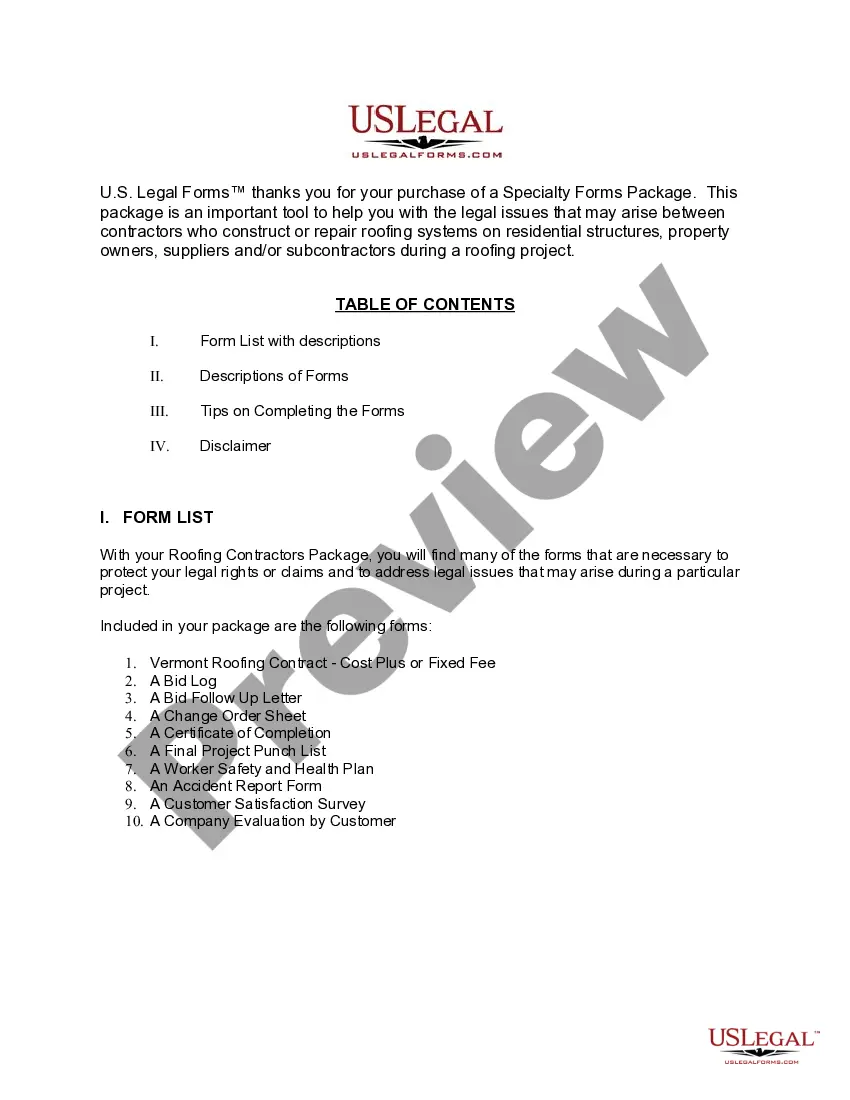
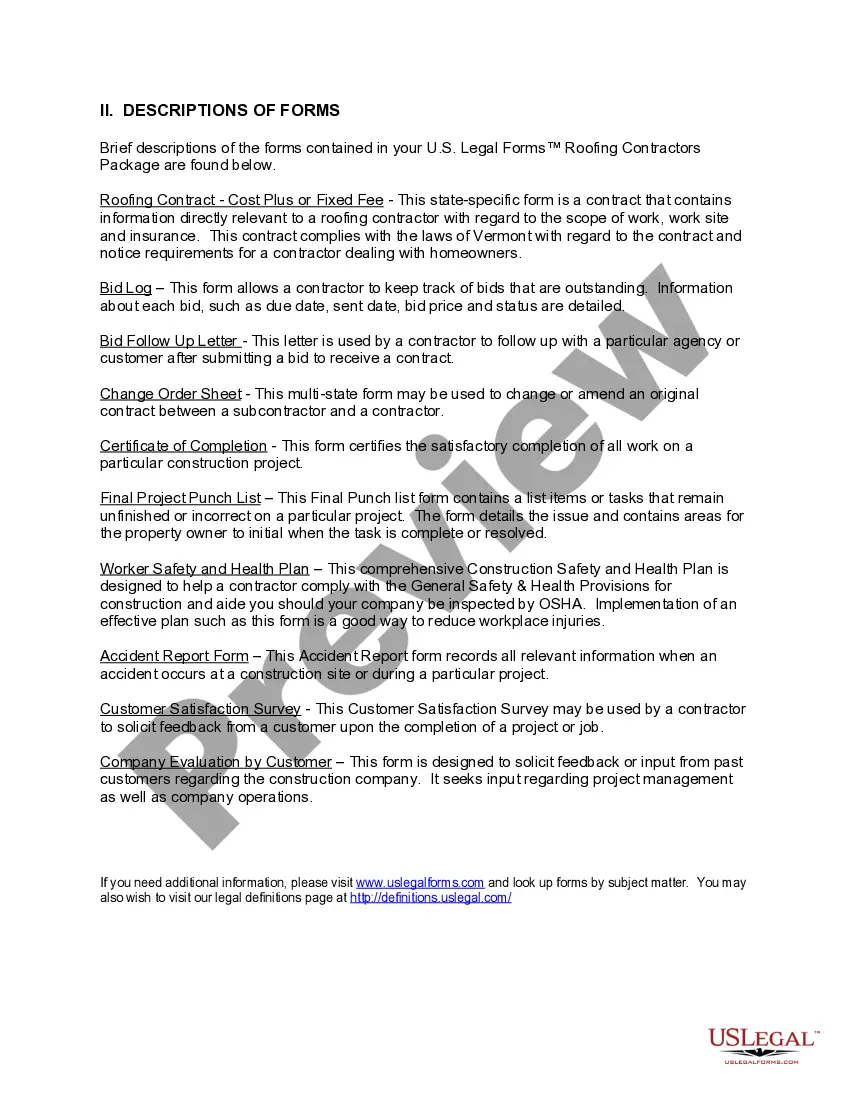
The Vermont Roofing Contractor Package is a comprehensive collection of legal documents specifically designed to address the unique needs of roofing contractors, property owners, suppliers, and subcontractors involved in roofing projects in Vermont. This package includes essential forms such as a compliant roofing contract, change orders, and safety plans, setting it apart from other generic form packages by ensuring adherence to Vermont state laws.
Documents contained in this package
- Roofing Contract for Contractor
- Contractor's Bid Log
- Contractor's Bid Follow Up Letter
- Contractor's Job Progress Sheet
- Customer Satisfaction Survey
- Construction Company Evaluation by a Customer
- Construction Accident Report
- Construction Safety and Health Plan
- Change Order for Construction or Repairs by Contractor
- Certification of Completion by Contractor
When to use this document
This package is useful in various scenarios, including:
- When starting a new roofing project, either for new construction or repairs.
- When drafting contracts that clearly define terms between contractors and property owners.
- When tracking bids and managing project changes through formal change orders.
- When prioritizing worker safety and health on construction sites.
- When seeking customer feedback to improve service delivery.
Who needs this form package
- Roofing contractors operating in Vermont.
- Property owners starting a roofing project.
- Suppliers and subcontractors involved in roofing work.
- Construction project managers seeking to formalize agreements and ensure compliance.
- Legal professionals needing standardized forms for client use in the construction industry.
How to complete these forms
- Review included forms to understand their purpose and requirements.
- Identify the parties involved in the roofing project, such as contractors and property owners.
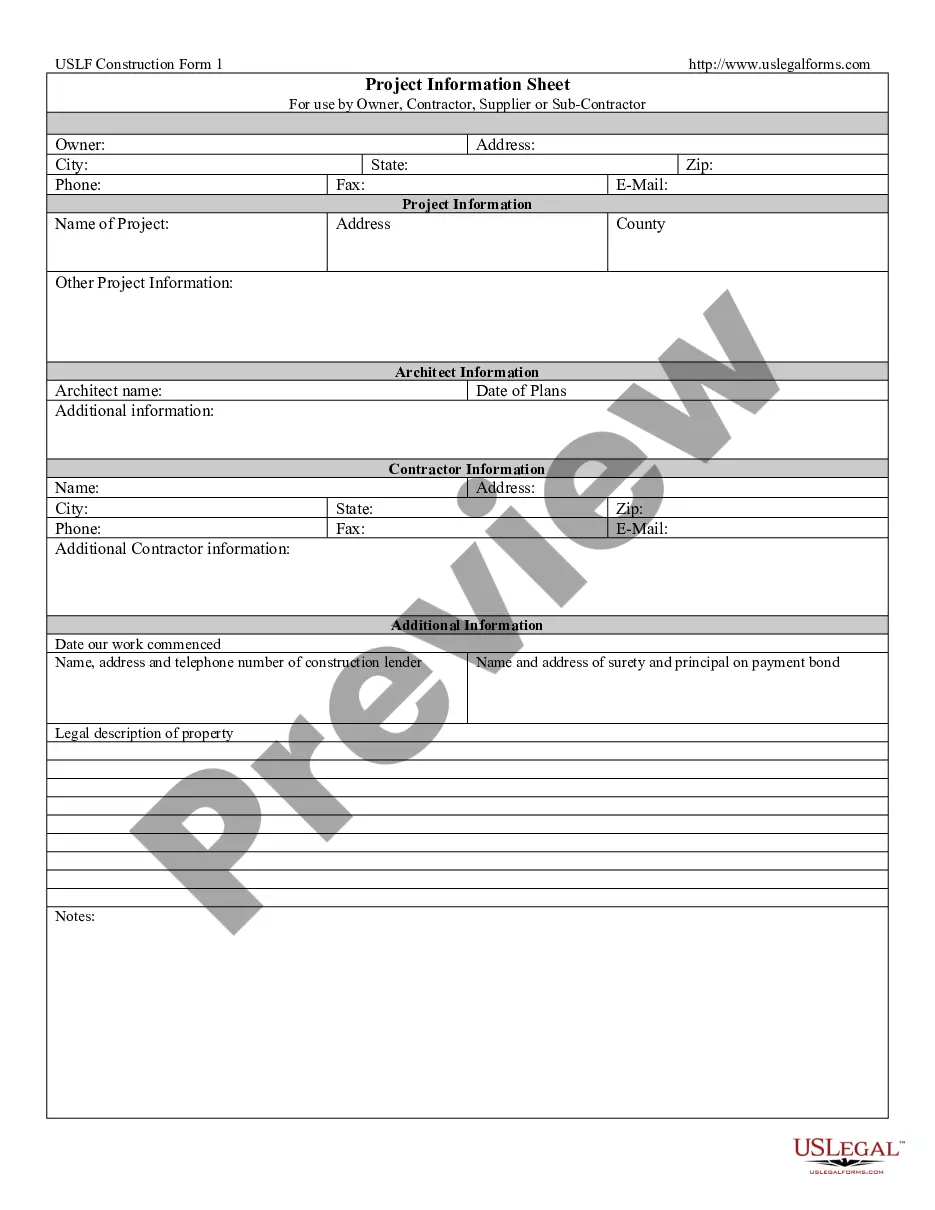
- Fill in the necessary details, including dates, descriptions of work, and financial terms.
- Use the Change Order Sheet and Bid Log to track any alterations to the work or costs.
- Ensure all parties sign the relevant forms where necessary to formalize agreements.
Notarization guidance for this package
Forms in this package typically do not require notarization. However, certain states or document types may still need it. US Legal Forms provides online notarization powered by Notarize, available 24/7 for your convenience.
Get your form ready online
Our built-in tools help you complete, sign, share, and store your documents in one place.
Make edits, fill in missing information, and update formatting in US Legal Forms—just like you would in MS Word.
Download a copy, print it, send it by email, or mail it via USPS—whatever works best for your next step.
Sign and collect signatures with our SignNow integration. Send to multiple recipients, set reminders, and more. Go Premium to unlock E-Sign.
If this form requires notarization, complete it online through a secure video call—no need to meet a notary in person or wait for an appointment.
We protect your documents and personal data by following strict security and privacy standards.

Make edits, fill in missing information, and update formatting in US Legal Forms—just like you would in MS Word.

Download a copy, print it, send it by email, or mail it via USPS—whatever works best for your next step.

Sign and collect signatures with our SignNow integration. Send to multiple recipients, set reminders, and more. Go Premium to unlock E-Sign.

If this form requires notarization, complete it online through a secure video call—no need to meet a notary in person or wait for an appointment.

We protect your documents and personal data by following strict security and privacy standards.
Common mistakes
- Failing to include all necessary parties in the Contract.
- Neglecting to document changes with a Change Order Sheet.
- Omitting signatures or dates on important forms, which can lead to disputes.
- Not tracking bid submissions accurately using the Bid Log.
- Overlooking safety compliance requirements when drafting the Worker Safety and Health Plan.
Why complete this package online
- Convenient access to all necessary legal forms in one comprehensive package.
- Editability allows for customized contracts and documents fitting specific project needs.
- Reliability of documents prepared by licensed attorneys ensures legal compliance.
- Immediate download capabilities save time and eliminate shipping costs.
Looking for another form?

Form popularity
FAQ
Your roofing contract must include the specifics of the project including details about materials to be used (their brand, type, color, and price), and start and end date of the project. The contract must also include details about the removal of the old roof and installing the replacement.
Balance: Roofers work on roofs, which might have very steep pitches. Strength: Roofers need to be able to carry heavy materials, like bundles of shingles, up ladders and onto roofs. Stamina: Roofers spend most of their day on their feet outside, sometimes during intense heat or cold.
Your roof estimate should include the number of penetrations and the specific kind of boot that'll go around them. The estimate should also include any flashing your roof needs. Flashing is metal placed anywhere the shingles butt up against something, such as a wall, chimney, or in open valleys.
You can always negotiate with your contractor on the price of a successful project before signing a contract. Discuss your budget with your roofing contractor. Agree that any unexpected project expenses will be presented in writing to help you remain within your budget.
Step 1: Get Clear on the Scope of Work. Step 2: Measure the Roof. Step 3: Estimate Material Cost. Step 4: Estimate Labor Costs. Step 5: Calculate Your Overhead Costs. Step 6: Tally All Roofing Costs. Step 7: Add Your Markup for Desired Profits. Step 8: Bid the Roofing Job.
You can always negotiate with your contractor on the price of a successful project before signing a contract. Discuss your budget with your roofing contractor.
Get local referrals. Look for manufacturer designations. Research Better Business Bureau (BBB) ratings. Get an extensive warranty. Be concerned about safety. Check for proper licensing and insurance. Pay your deductible. Handle your own claim.
Most homeowners spend between $300 and $1,100 for a roof repair, or an average of $650 per repair call. Typically, a job is to repair leaks. Seal the leak, replace shingles, seal the shingles. If there is a small area and few shingles being repaired, it will likely be on the low end, or as little as $150.
Company Contact Info. All estimates should have the roofing company contact information that includes the company name, address, phone number, and email address. A Full Work Description. Start and Completion Date. Materials to Be Used. The Total Cost. Warranties.