10.4 Elements of FMLA Retaliation Claim
Understanding this form
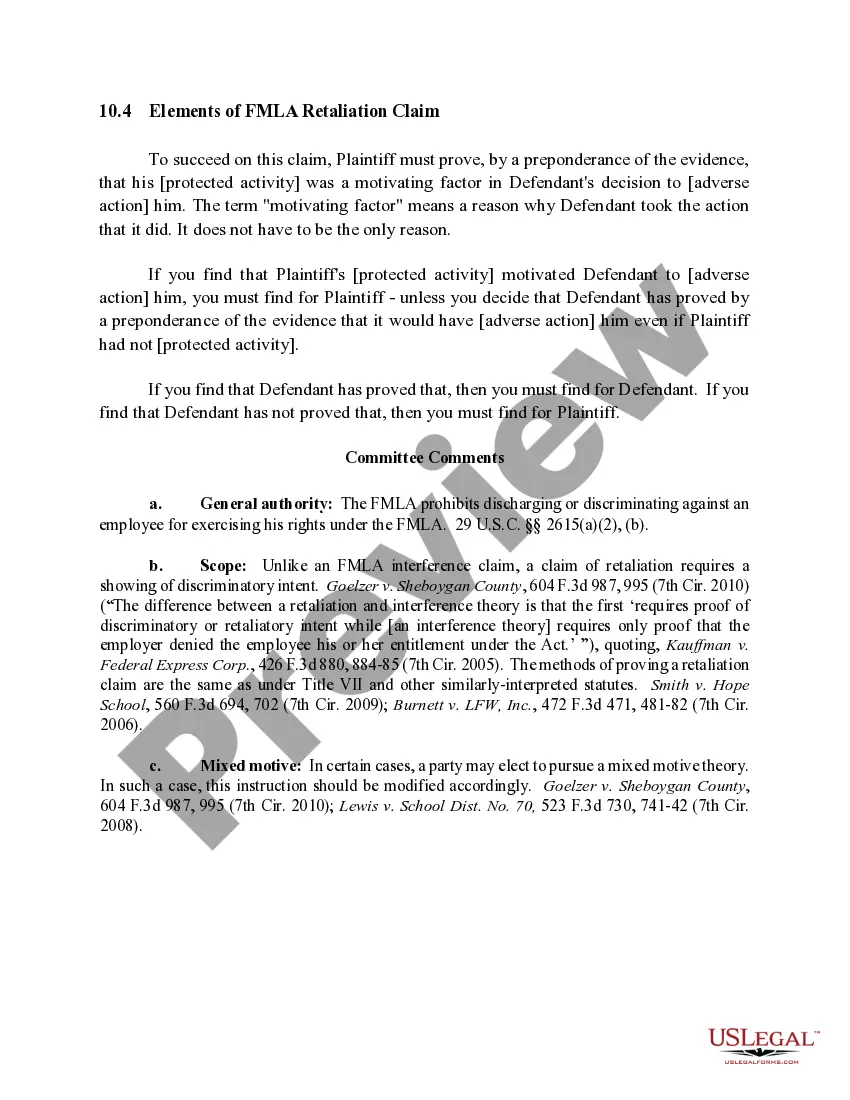
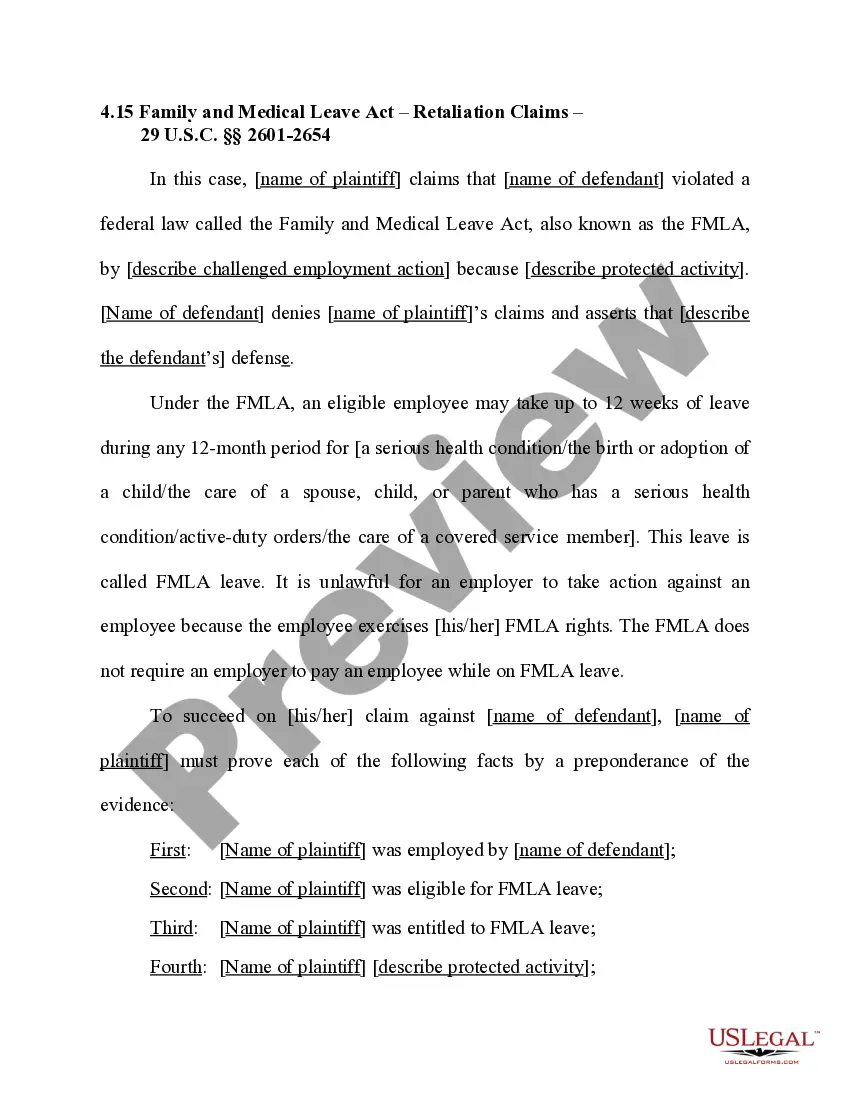
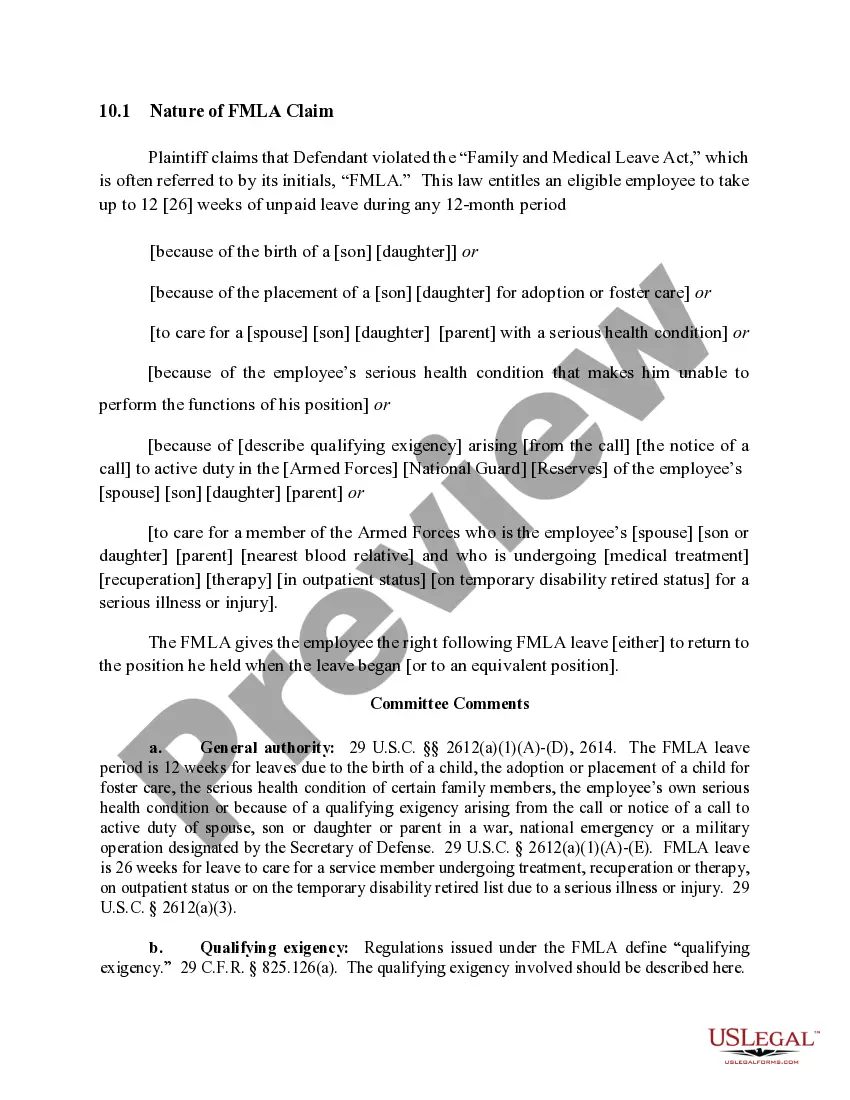
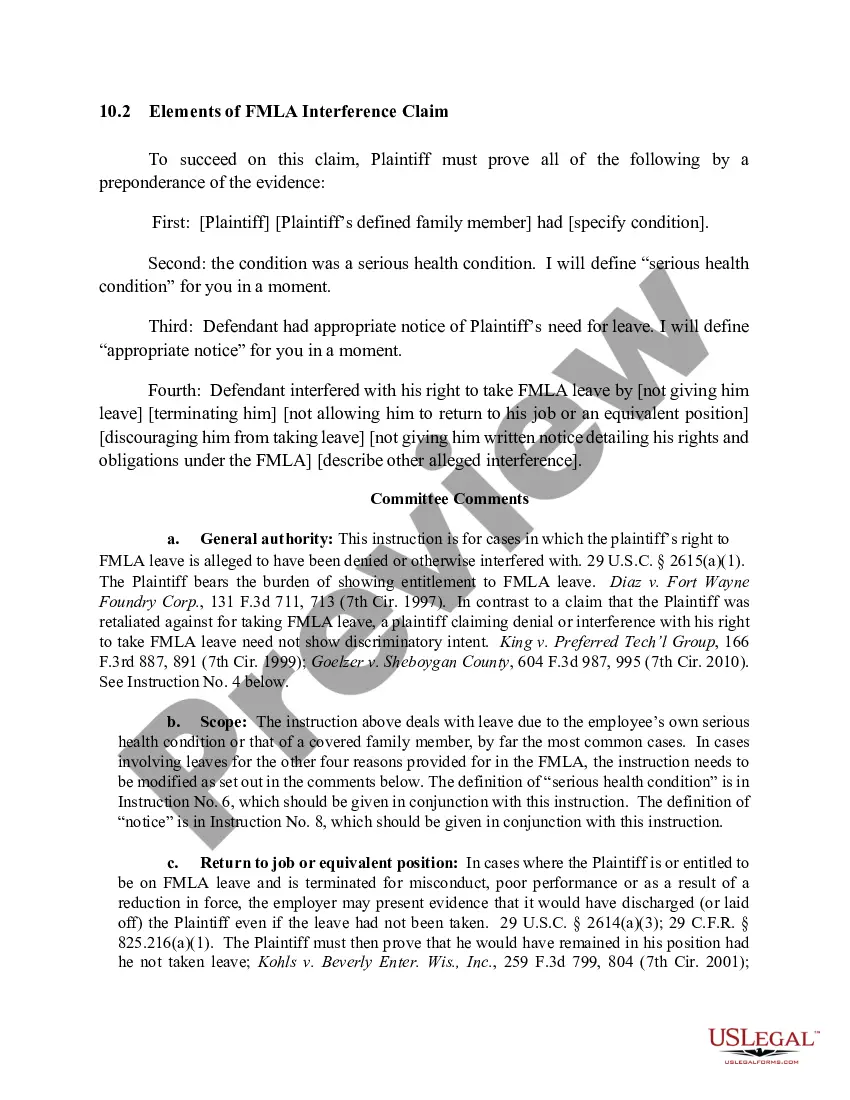
The 10.4 Elements of FMLA Retaliation Claim form is a legal guideline used in the context of Family and Medical Leave Act (FMLA) cases. It establishes the criteria that must be met to prove a retaliation claim under the FMLA, which protects employees from being discriminated against for taking leave. Unlike FMLA interference claims, this form specifically addresses claims where discriminatory intent must be demonstrated.
What’s included in this form
- Definition of "protected activity" and "adverse action" relevant to the claim.
- Criteria for proving that the protected activity motivated the adverse action.
- Explanation of the "motivating factor" standard and how it applies.
- Guidance on proceeding with a mixed motive theory if applicable.
- Reference to legal precedents and statutory authority regarding FMLA retaliation.
When to use this document
This form is used when an employee believes that they have faced retaliation from their employer for exercising rights under the Family and Medical Leave Act. Situations may include being fired, demoted, or denied benefits after taking FMLA leave or complaining about FMLA violations. It provides a framework for understanding the legal requirements to prove such a claim in court.
Who can use this document
- Employees who have taken leave under the FMLA and suspect retaliation.
- Legal representatives assisting clients with FMLA retaliation claims.
- Employers seeking to understand the legal standards associated with FMLA claims.
How to prepare this document
- Clearly identify the plaintiff and defendant involved in the claim.
- Specify the dates and details of the protected activity undertaken by the plaintiff.
- Outline the adverse action taken by the defendant against the plaintiff.
- Gather evidence supporting the claim that the protected activity motivated the adverse action.
- Submit the completed form to the appropriate court as part of the legal proceedings.
Is notarization required?
Notarization is not commonly needed for this form. However, certain documents or local rules may make it necessary. Our notarization service, powered by Notarize, allows you to finalize it securely online anytime, day or night.
Get your form ready online
Our built-in tools help you complete, sign, share, and store your documents in one place.
Make edits, fill in missing information, and update formatting in US Legal Forms—just like you would in MS Word.
Download a copy, print it, send it by email, or mail it via USPS—whatever works best for your next step.
Sign and collect signatures with our SignNow integration. Send to multiple recipients, set reminders, and more. Go Premium to unlock E-Sign.
If this form requires notarization, complete it online through a secure video call—no need to meet a notary in person or wait for an appointment.
We protect your documents and personal data by following strict security and privacy standards.

Make edits, fill in missing information, and update formatting in US Legal Forms—just like you would in MS Word.

Download a copy, print it, send it by email, or mail it via USPS—whatever works best for your next step.

Sign and collect signatures with our SignNow integration. Send to multiple recipients, set reminders, and more. Go Premium to unlock E-Sign.

If this form requires notarization, complete it online through a secure video call—no need to meet a notary in person or wait for an appointment.

We protect your documents and personal data by following strict security and privacy standards.
Typical mistakes to avoid
- Failing to clearly define what constitutes the protected activity.
- Omitting key details about the adverse action taken by the employer.
- Not providing sufficient evidence to support the claim of retaliation.
- Confusing retaliation claims with interference claims under the FMLA.
Why use this form online
- Convenient downloadable format allows for immediate use.
- Easy to edit and personalize to fit specific circumstances.
- Access legal templates drafted by licensed attorneys, ensuring reliability.
Legal use & context
- This form provides essential legal standards for pursuing an FMLA retaliation claim.
- Understanding the differences between retaliation and interference claims helps protect employee rights.
- Complies with federal laws under the Family and Medical Leave Act for proper enforcement.
Looking for another form?
Form popularity
FAQ
For purposes of an FMLA retaliation claim, the legal definition of an adverse employment action is ?any action by the employer that is likely to dissuade a reasonable worker in the plaintiff's position from exercising his legal rights.? Millea v.
?then the employee will have a claim of interference. An interference claim requires that the employee was actually prevented from taking the full, protected leave, while a retaliation can be brought even if the employee managed to take the full leave.
Therefore, if an employee would have been terminated or disciplined prior to, or regardless of, their leave status, employers can take action while an employee is on active FMLA, including those on intermittent leave, for appropriate disciplinary reasons independent of the FMLA leave.
To prove interference, the employee must show entitlement to leave (and that he or she gave proper notice); that the employer took adverse action against the employee that interfered with the ability to take leave; and that the adverse action was related to the taking, or attempting to take, FMLA leave.
To establish an FMLA retaliation claim based on circumstantial evidence, a plaintiff must show: (1) she availed herself of a protected right under the FMLA; (2) she suffered an adverse employment action; and (3) there was a causal connection between the adverse action and protected activity. Wallner v.
As long as you have qualifying medical conditions and are otherwise eligible, you can take FMLA leave twice a year for two different conditions as long as the total amount of leave is less than 12 weeks.
For purposes of an FMLA retaliation claim, the legal definition of an adverse employment action is ?any action by the employer that is likely to dissuade a reasonable worker in the plaintiff's position from exercising his legal rights.? Millea v.