10.40 ELEMENTS OF CLAIM: RETALIATION FOR PARTICIPATION IN PROCEEDINGS UNDER EMPLOYMENT STATUTES
What this document covers
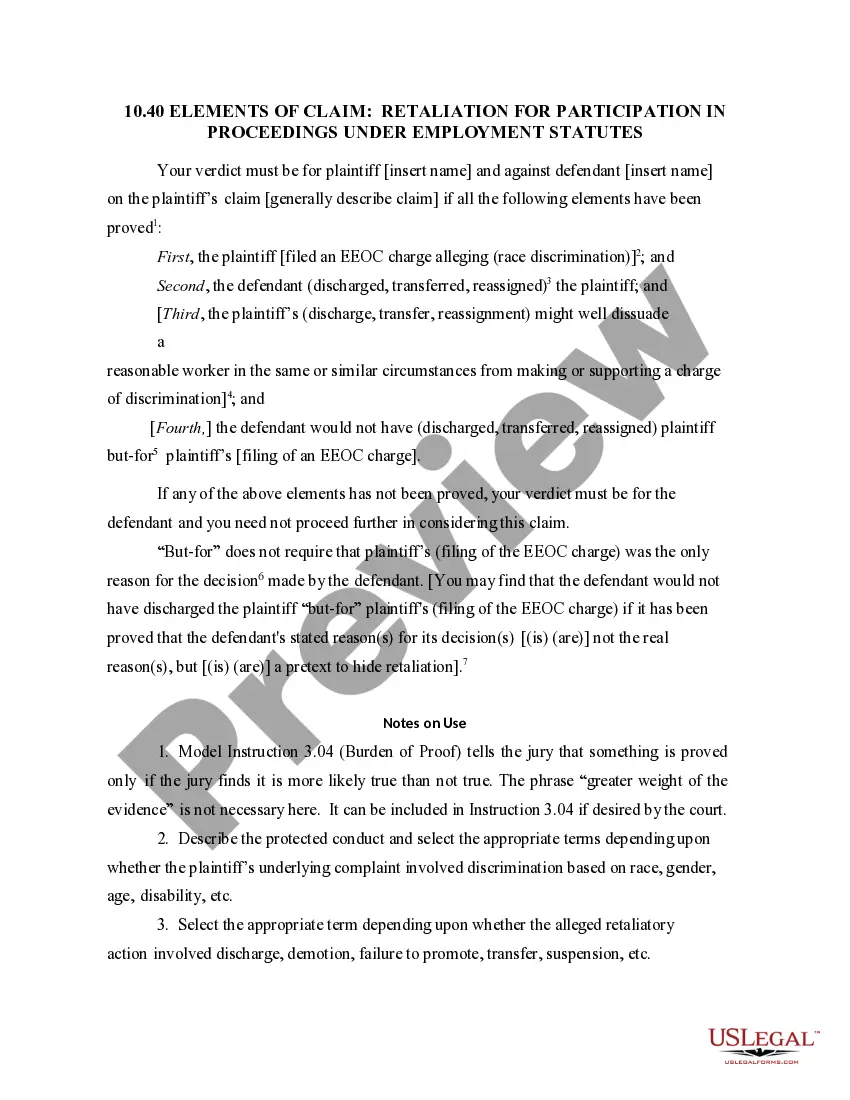
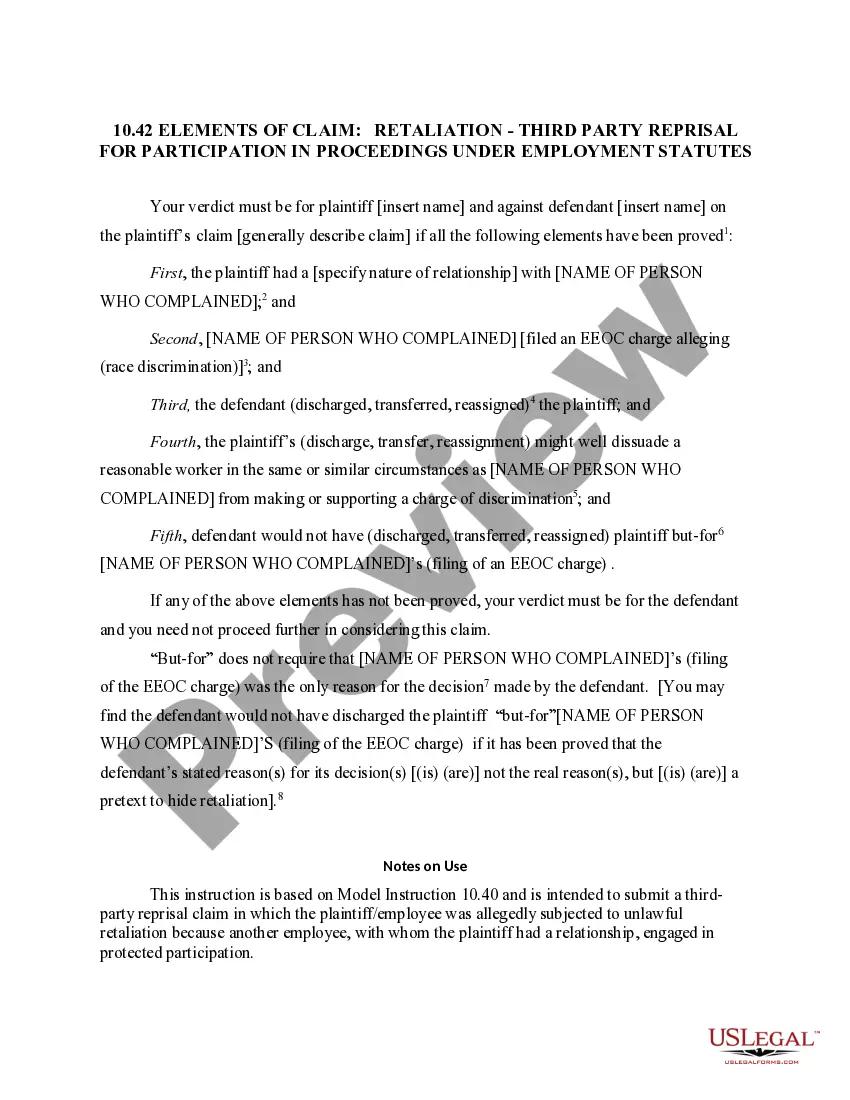
The 10.40 Elements of Claim: Retaliation for Participation in Proceedings Under Employment Statutes form is a legal document used in retaliation claims against employers. It outlines the necessary elements that a plaintiff must prove in a legal case involving workplace retaliation, particularly after filing a charge with the Equal Employment Opportunity Commission (EEOC). This form is essential for individuals seeking to establish their rights under employment protection laws, distinguishing it from other claims focused on workplace discrimination alone.
Key components of this form
- Identification of the plaintiff and defendant in the case.
- Details of the alleged retaliation, such as discharge or reassignment.
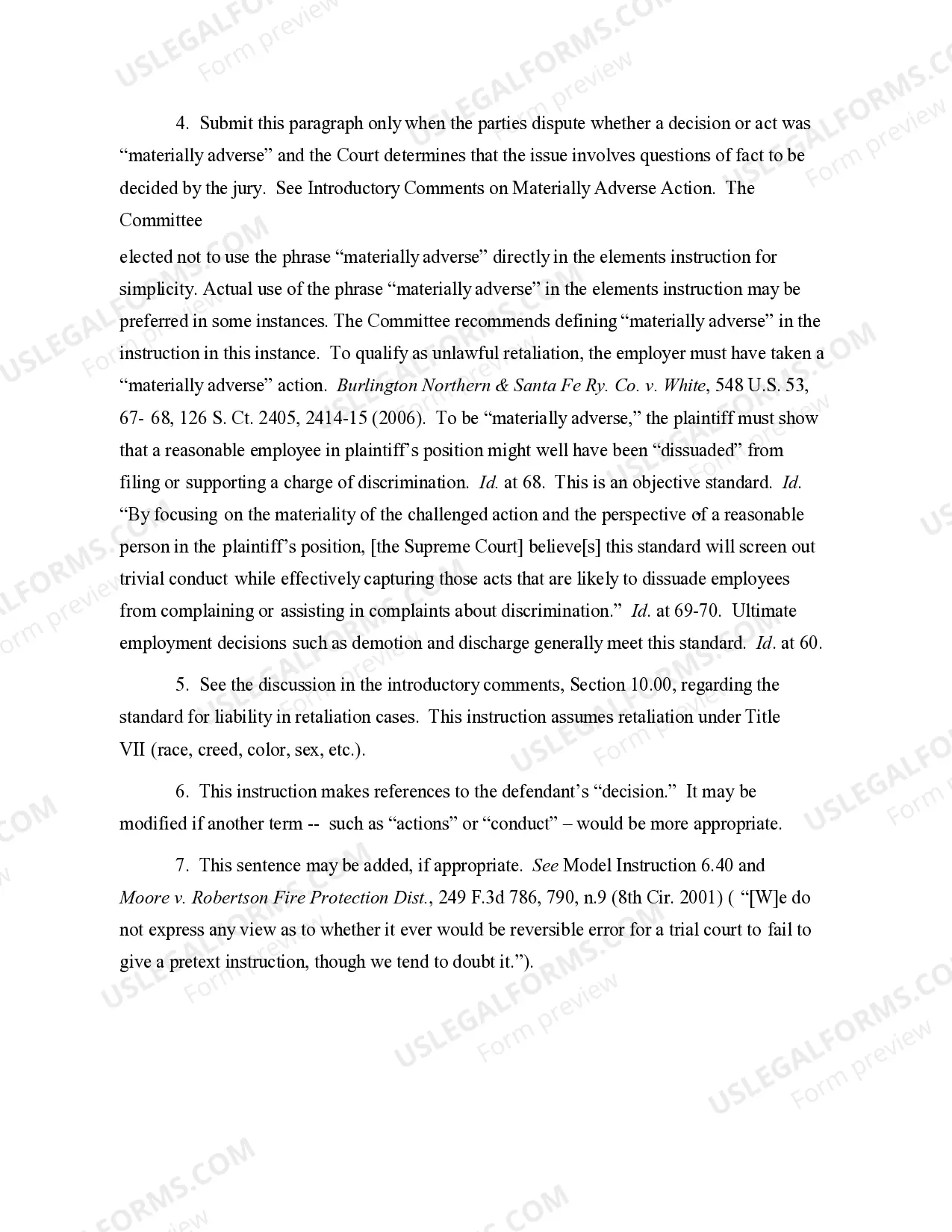
- Requirements to prove that the employer's action was materially adverse.
- Clarification of the "but-for" standard that determines causation.
- Instructions on how to present evidence regarding the retaliation claim.
Common use cases
This form should be used when a worker experiences retaliation from their employer due to their participation in proceedings to address workplace discrimination. Scenarios include after filing an EEOC charge or participating in an investigation regarding employment practices related to race, gender, age, or disability discrimination. It is relevant when a worker believes that their job status or responsibilities have been negatively affected as a result of their protected actions.
Who needs this form
- Employees who have filed a charge with the EEOC.
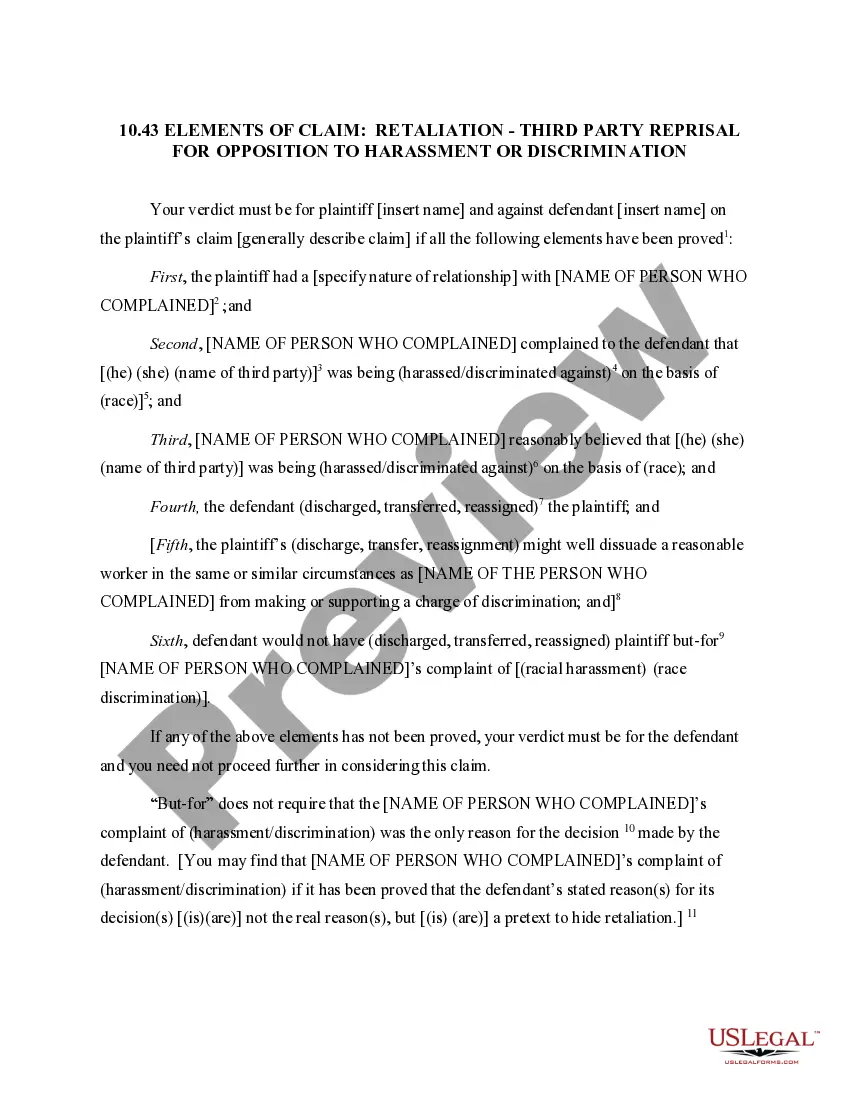
- Individuals who believe they have been retaliated against for supporting an employeeâs discrimination claim.
- Legal representatives assisting clients in making retaliation claims against employers.
- Workers facing adverse actions from employers after filing discrimination complaints.
How to prepare this document
- Identify the names of the plaintiff and defendant clearly.
- Specify the exact nature of the retaliation actions taken by the employer.
- State the context of the EEOC charge or other protected activity that occurred.
- Provide evidence or documentation supporting the claim of materially adverse action.
- Compile and present the factual basis for proving the "but-for" causation standard.
Does this form need to be notarized?
This form does not typically require notarization unless specified by local law. Always check your jurisdiction's specific regulations regarding the notarization of legal documents to ensure compliance.
Get your form ready online
Our built-in tools help you complete, sign, share, and store your documents in one place.
Make edits, fill in missing information, and update formatting in US Legal Forms—just like you would in MS Word.
Download a copy, print it, send it by email, or mail it via USPS—whatever works best for your next step.
Sign and collect signatures with our SignNow integration. Send to multiple recipients, set reminders, and more. Go Premium to unlock E-Sign.
If this form requires notarization, complete it online through a secure video call—no need to meet a notary in person or wait for an appointment.
We protect your documents and personal data by following strict security and privacy standards.

Make edits, fill in missing information, and update formatting in US Legal Forms—just like you would in MS Word.

Download a copy, print it, send it by email, or mail it via USPS—whatever works best for your next step.

Sign and collect signatures with our SignNow integration. Send to multiple recipients, set reminders, and more. Go Premium to unlock E-Sign.

If this form requires notarization, complete it online through a secure video call—no need to meet a notary in person or wait for an appointment.

We protect your documents and personal data by following strict security and privacy standards.
Common mistakes to avoid
- Failing to clearly establish the timeline of events related to the EEOC charge.
- Neglecting to specify actions taken by the employer that are considered materially adverse.
- Overlooking key evidence that supports the retaliation claim.
- Using vague terms that do not clearly describe the retaliatory actions.
Benefits of completing this form online
- Immediate access to a professionally drafted legal template.
- Convenience of completing the form at your own pace.
- Ability to easily edit or customize the form as needed.
- Access to reliable legal advice and support through the platform.
Legal use & context
- This form is essential in proving retaliation under Title VII of the Civil Rights Act.
- It establishes the burden of proof necessary for a successful retaliation claim.
- Users must demonstrate that employer actions were taken in response to protected activities.
- Understanding local employment laws is crucial as this can affect the legal standing of the claim.
Main things to remember
- The form helps articulate and support a claim of retaliation in the workplace.
- Key elements must be proven: participation in protected activities and adverse employer actions.
- Using the form can enhance the clarity and legality of your retaliation claim.
- A legal consultation may further clarify your specific situation and rights.
Looking for another form?

Form popularity
FAQ
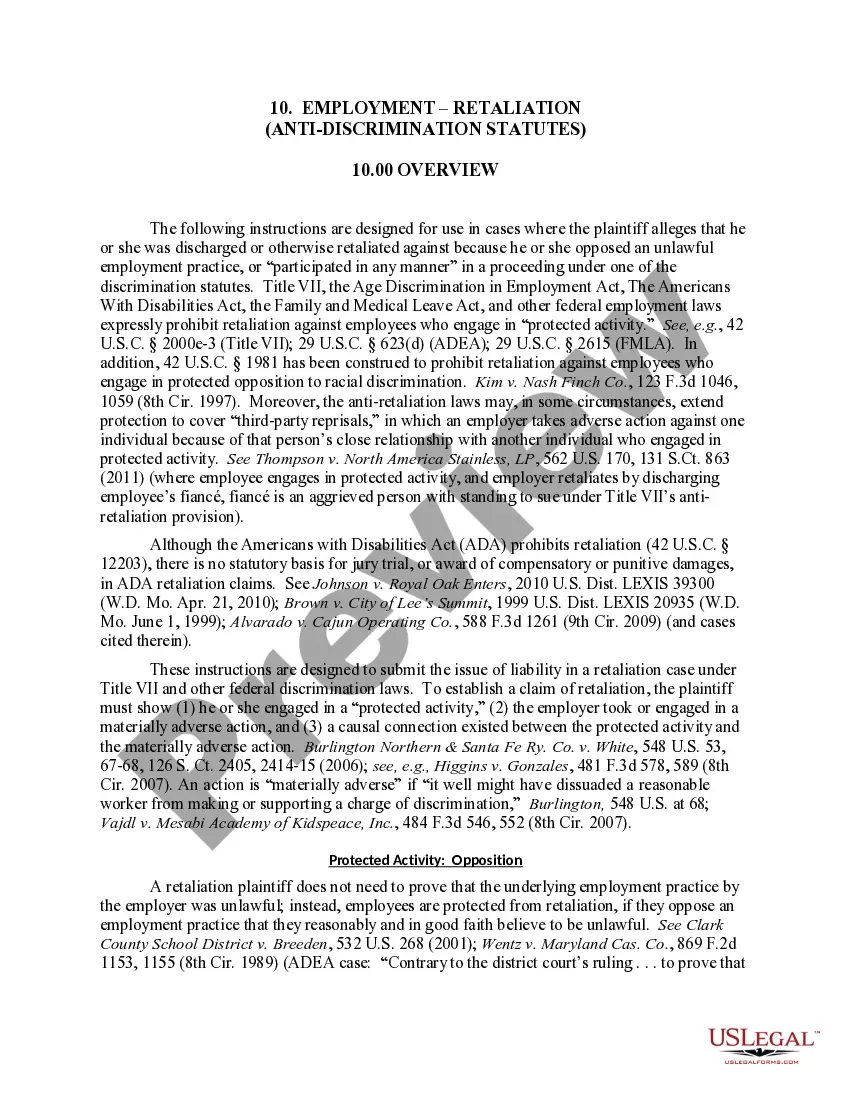
In order to establish a retaliation claim under Title VII, a plaintiff must demonstrate that: (1) she engaged in statutorily protected activity; (2) her employer took a materially adverse employment action against her; and (3) the protected activity and adverse job action are causally connected.
For example, depending on the facts, it could be retaliation if an employer acts because of the employee's EEO activity to: reprimand the employee or give a performance evaluation that is lower than it should be; transfer the employee to a less desirable position; engage in verbal or physical abuse;
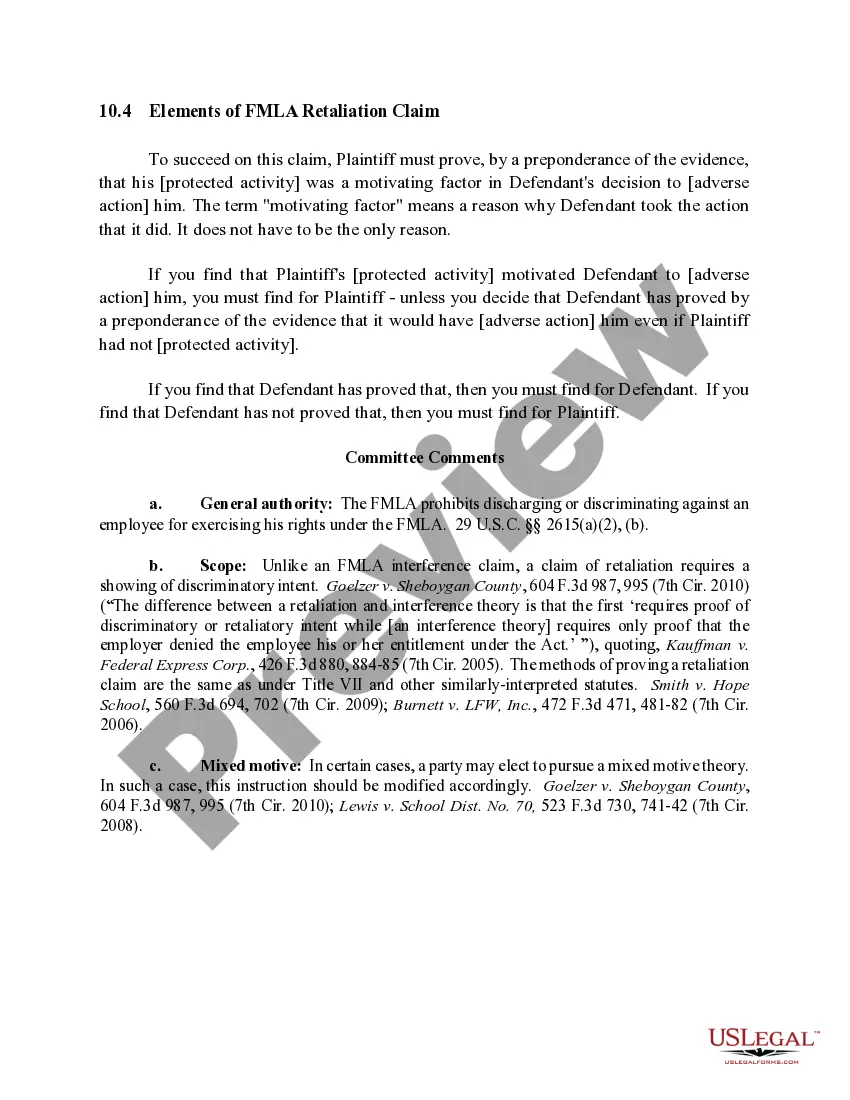
Retaliation occurs when an employer (through a manager, supervisor, administrator or directly) fires an employee or takes any other type of adverse action against an employee for engaging in protected activity.
Per federal case law and regulatory agency guidance, there are three essential elements in a claim of retaliation: Protected activity. Adverse action. Causal connection.
Title VII prohibits employment discrimination based on race, color, religion, sex and national origin. The Civil Rights Act of 1991 (Pub. L. 102-166) ( CRA ) and the Lily Ledbetter Fair Pay Act of 2009 (Pub. L. 111-2) amend several sections of Title VII.
In order to assert a prima facie claim of retaliation under the FLSA, a plaintiff must prove: (1) that he or she engaged in an activity protected by the FLSA; (2) that he or she suffered adverse action by the employer subsequent to or contemporaneous with such protected activity; and (3) a causal connection existed
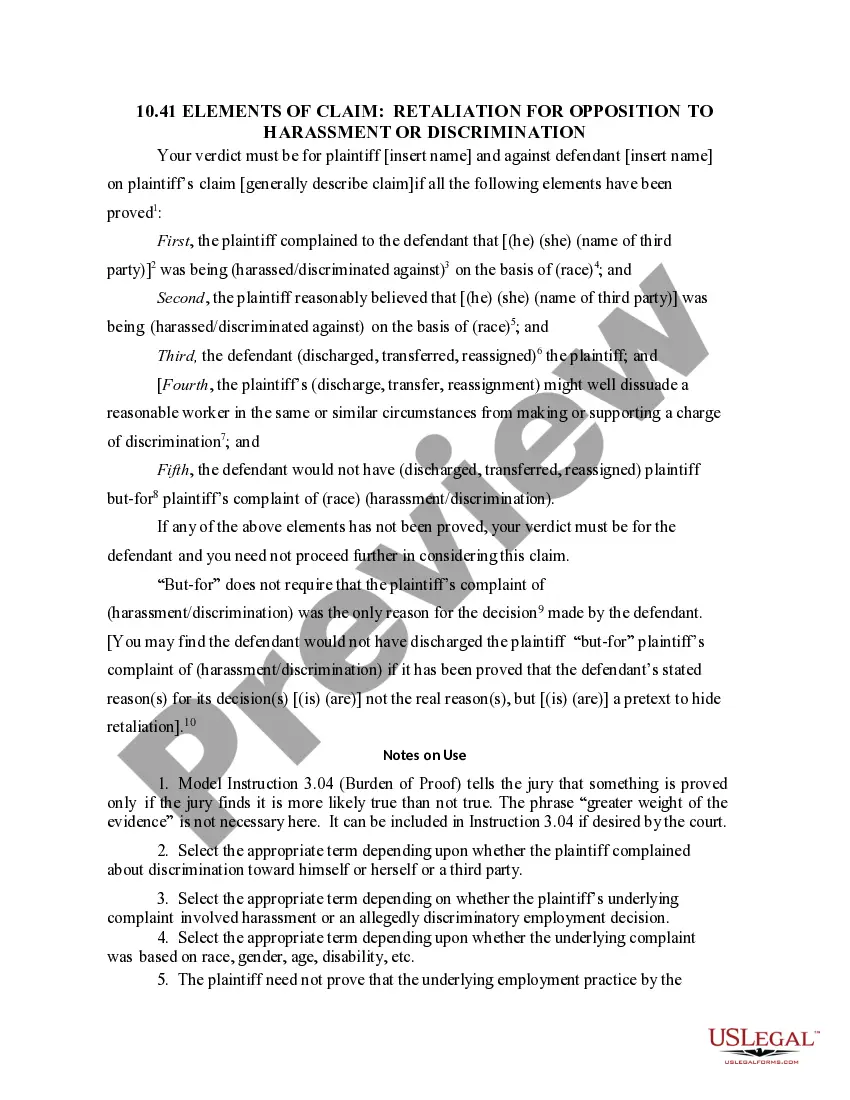
Retaliation claims result when an employee alleges discrimination based on protected status (e.g., race, gender, disability) and, in retaliation for making such a claim, the employee is treated adversely (e.g., the employee receives a demotion).
To establish a prima facie case of retaliation, a plaintiff must show that (1) he or she engaged in a protected activity; (2) the employer subjected the plaintiff to an adverse employment action; and (3) the protected activity and the employer's adverse action were causally connected.