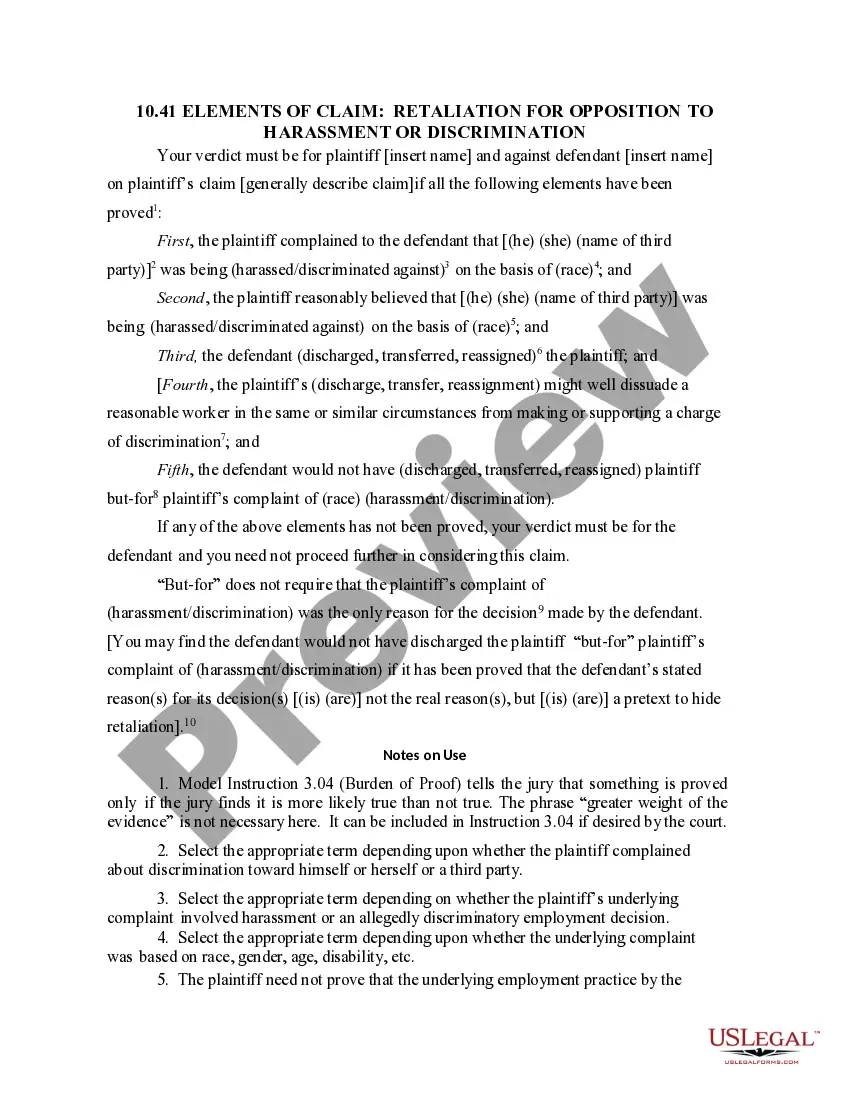
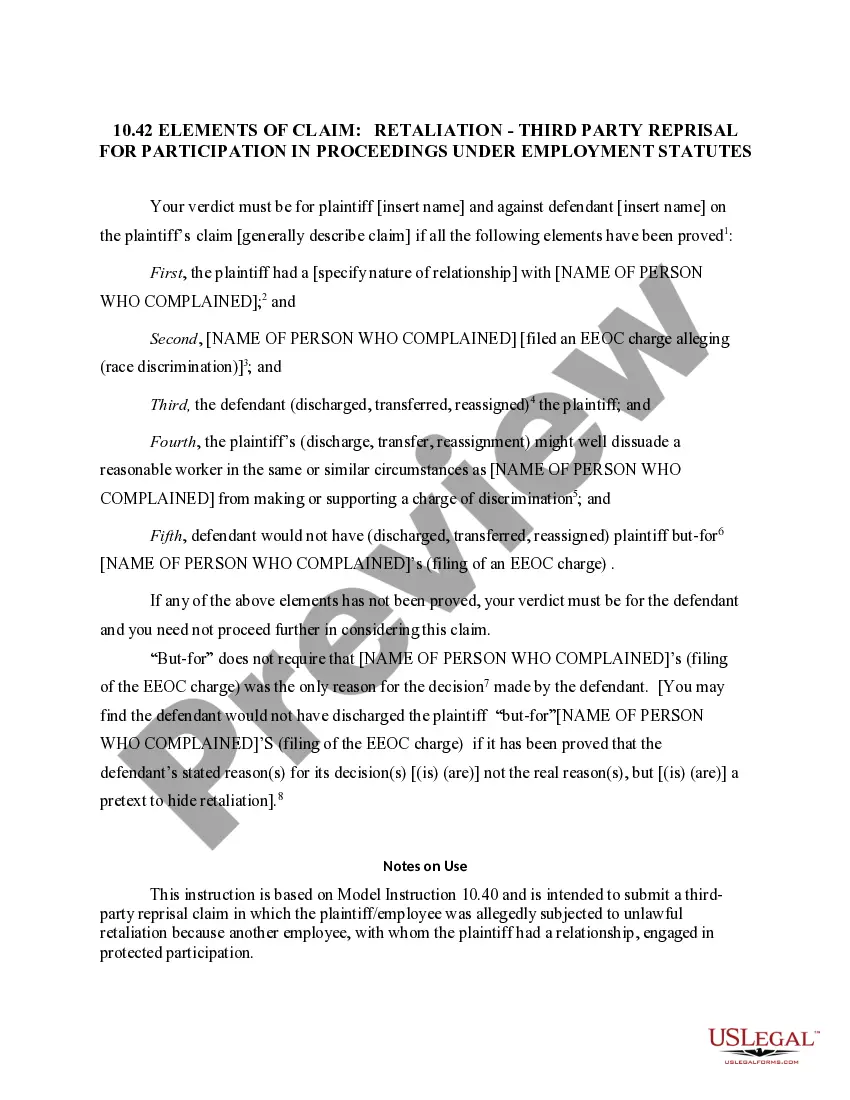
10.43 ELEMENTS OF CLAIM: RETALIATION - THIRD PARTY REPRISAL FOR OPPOSITION TO HARASSMENT OR DISCRIMINATION
Understanding this form
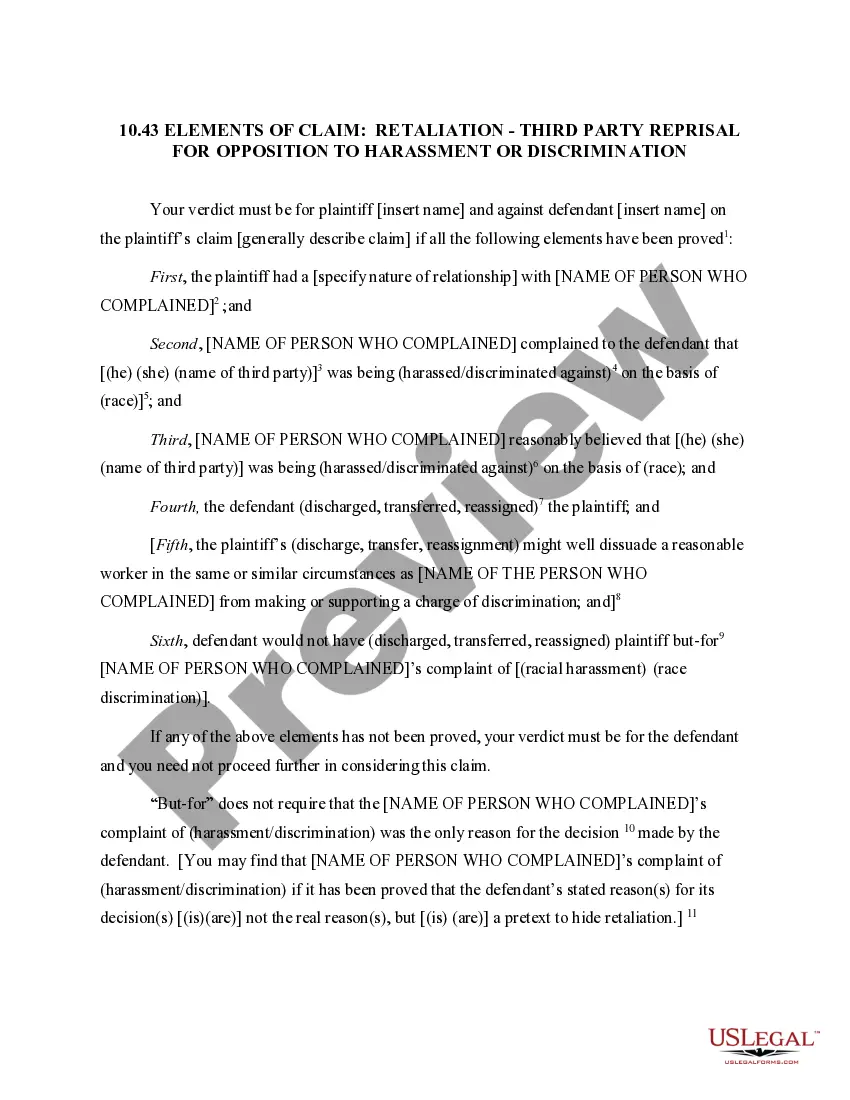
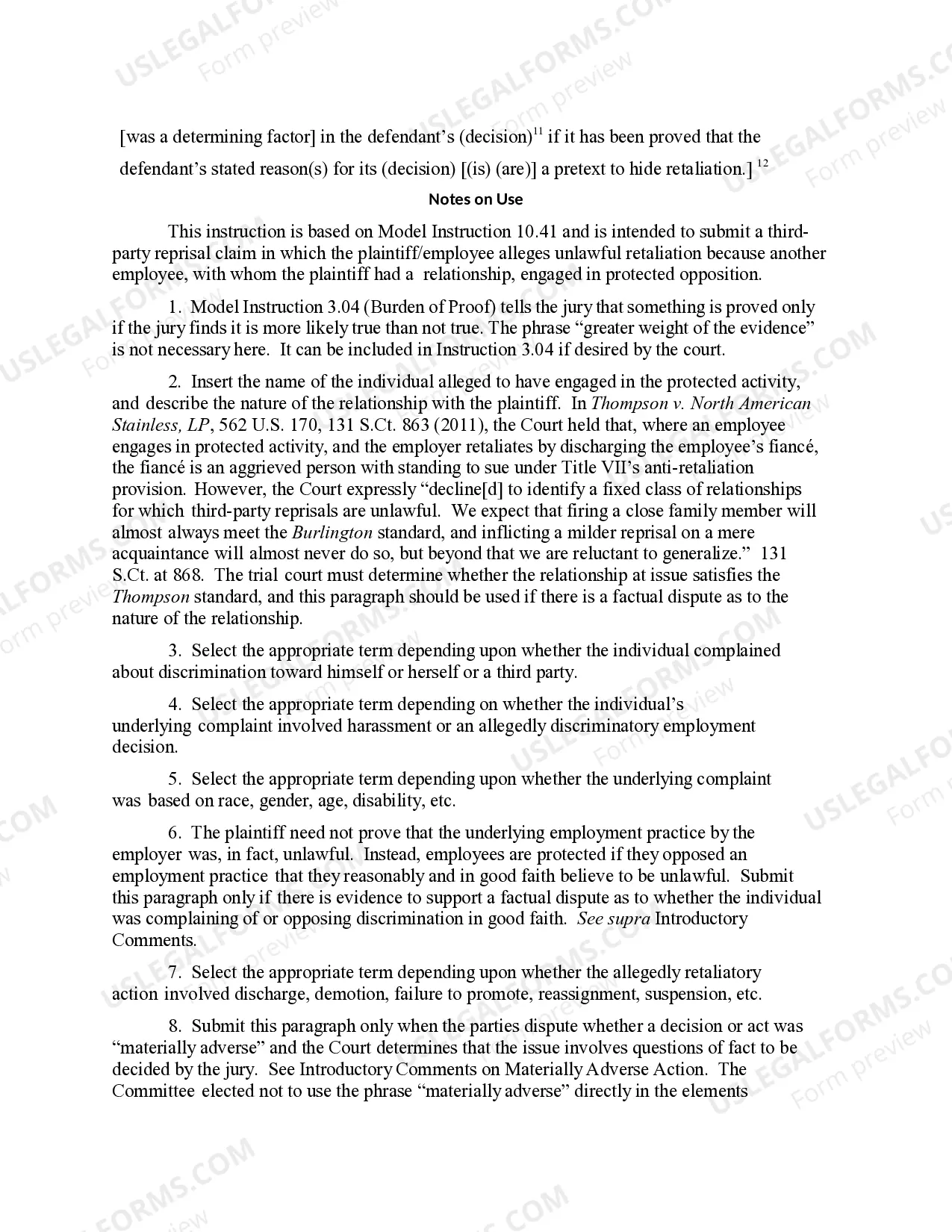
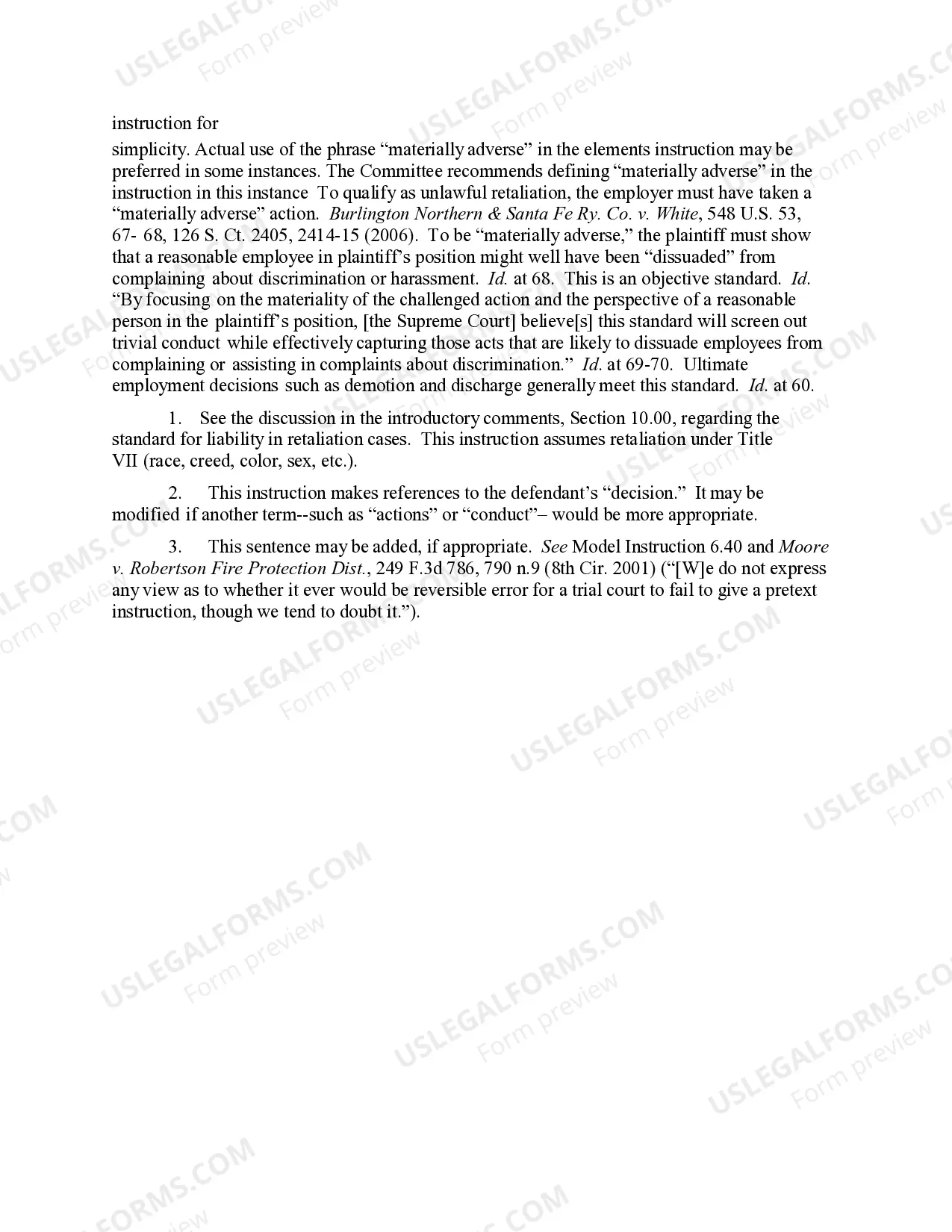
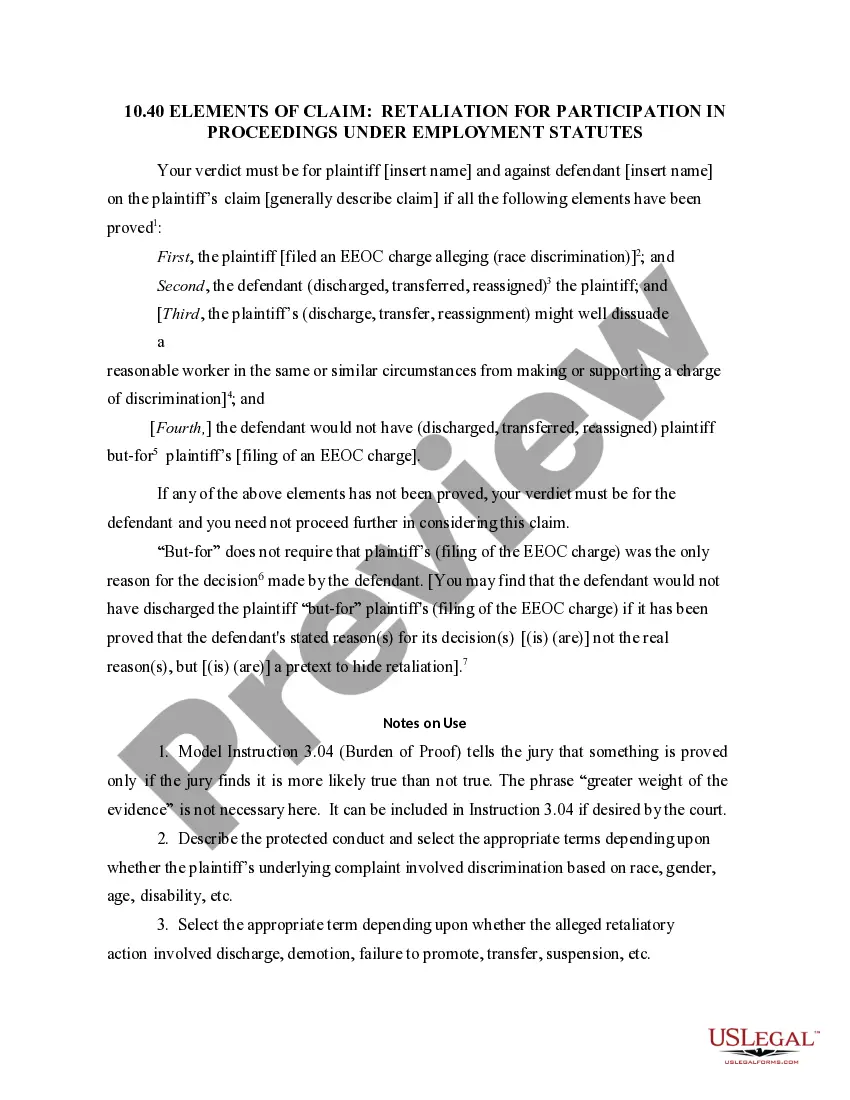
The "Elements of Claim: Retaliation - Third Party Reprisal for Opposition to Harassment or Discrimination" form helps individuals assert legal claims when they face retaliation for opposing discriminatory practices on behalf of someone else. This form outlines the necessary elements a plaintiff must prove in a retaliation claim, specifically focusing on third-party reprisals where an individual suffers adverse actions due to another person's complaints about harassment or discrimination based on a protected characteristic, such as race.
Main sections of this form
- Identification of the plaintiff and the defendant involved in the claim.
- Details about the relationship between the plaintiff and the individual who complained.
- Documentation of the complaint made by the individual regarding harassment or discrimination.
- Evidence of the defendant's adverse actions against the plaintiff, such as discharge or reassignment.
- Assessment of whether the defendant's actions would deter a reasonable worker from filing a discrimination complaint.
- Evaluation of the connection between the adverse actions and the complaint made by the individual.
Situations where this form applies
This form is used when an employee experiences retaliation after supporting or opposing discriminatory practices on behalf of another individual. For instance, if a worker is terminated because their spouse filed a discrimination complaint against their employer, this form can be utilized to establish a legal claim for retaliation. It is particularly relevant in workplaces where employees feel negatively impacted by standing up against harassment or discrimination faced by others.
Who needs this form
- Employees who believe they have faced retaliation for supporting a claim made by a colleague.
- Individuals with a close relationship to someone who filed a discrimination complaint and suffered adverse employment actions.
- Legal representatives assisting clients in filing retaliation claims related to third-party complaints.
Steps to complete this form
- Identify all parties involved by entering the names of the plaintiff and the defendant.
- Specify the nature of the relationship with the individual who complained about discrimination.
- Document the details of the complaint made by the individual regarding harassment or discrimination.
- Enter the specific adverse action taken by the defendant against the plaintiff.
- Provide evidence that the adverse action would deter a reasonable employee from opposing discrimination in similar circumstances.
- Summarize how the defendant's action was motivated by the complaint made by the individual.
Notarization requirements for this form
This form does not typically require notarization unless specified by local law. However, ensure that all signatures are properly collected and that you follow any jurisdiction-specific regulations concerning witness statements and notarization.
Get your form ready online
Our built-in tools help you complete, sign, share, and store your documents in one place.
Make edits, fill in missing information, and update formatting in US Legal Forms—just like you would in MS Word.
Download a copy, print it, send it by email, or mail it via USPS—whatever works best for your next step.
Sign and collect signatures with our SignNow integration. Send to multiple recipients, set reminders, and more. Go Premium to unlock E-Sign.
If this form requires notarization, complete it online through a secure video call—no need to meet a notary in person or wait for an appointment.
We protect your documents and personal data by following strict security and privacy standards.

Make edits, fill in missing information, and update formatting in US Legal Forms—just like you would in MS Word.

Download a copy, print it, send it by email, or mail it via USPS—whatever works best for your next step.

Sign and collect signatures with our SignNow integration. Send to multiple recipients, set reminders, and more. Go Premium to unlock E-Sign.

If this form requires notarization, complete it online through a secure video call—no need to meet a notary in person or wait for an appointment.

We protect your documents and personal data by following strict security and privacy standards.
Mistakes to watch out for
- Failing to clearly define the relationship between the plaintiff and the individual who complained.
- Omitting important details about the adverse actions taken by the employer.
- Not providing sufficient evidence that the adverse action would dissuade a reasonable worker from opposing discrimination.
- Confusing retaliation claims with other types of employment disputes.
Why use this form online
- Convenient access to legally compliant templates drafted by professionals.
- Ability to download and edit the form to fit specific legal circumstances.
- Streamlined process for asserting legal claims without navigating the complexities of legal jargon.
Looking for another form?


Form popularity
FAQ
Under the opposition clause, it is unlawful for an employer to discriminate against an employee because the employee has ?opposed? any practice made unlawful by Title VII. The term ?oppose? is undefined by the statute, and thus carries its ordinary meaning.
Damages for FLSA Retaliation If you were terminated in violation of the FLSA, you may be entitled to significant damages, including: Back pay (past lost wages) Front pay (future lost wages) Liquidated damages (an amount equal to total lost wages)
Retaliatory actions are not limited to formal personnel actions such as termination, demotion, non-promotion, or non-selection. Retaliatory actions are broadly defined to harassing behavior, significant changes to job duties or working conditions, and even threats to take personnel actions.
It has four elements: Unwelcome; Sexual conduct or conduct directed at a protected category; Offensive to the recipient and to a ?reasonable person;? and, Conduct that is severe or pervasive (repeated).
The Fair Labor Standards Act (FLSA) establishes minimum wage, overtime pay, recordkeeping, and child labor standards affecting full-time and part-time workers in the private sector and in Federal, State, and local governments.
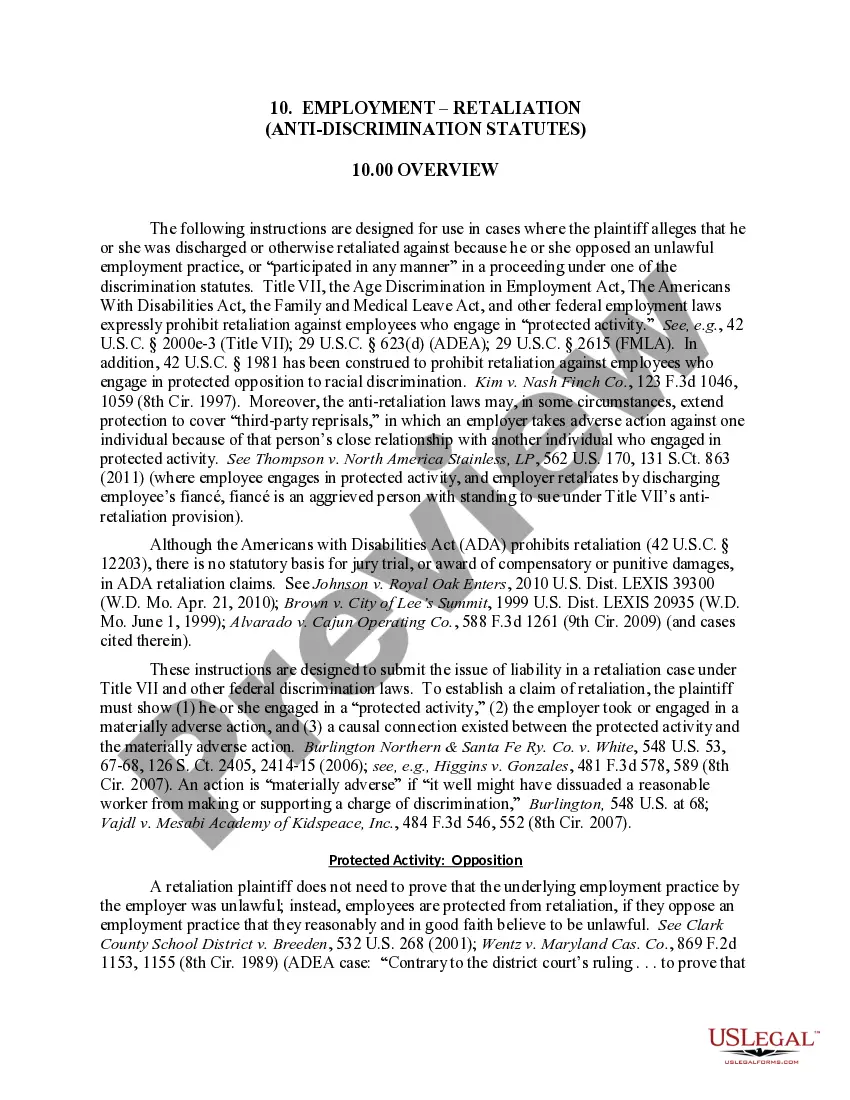
Per federal case law and regulatory agency guidance, there are three essential elements in a claim of retaliation: Protected activity. Adverse action. Causal connection.
In order to assert a prima facie claim of retaliation under the FLSA, a plaintiff must prove: (1) that he or she engaged in an activity protected by the FLSA; (2) that he or she suffered adverse action by the employer subsequent to or contemporaneous with such protected activity; and (3) a causal connection existed