Operational adoption challenges
Understanding this form
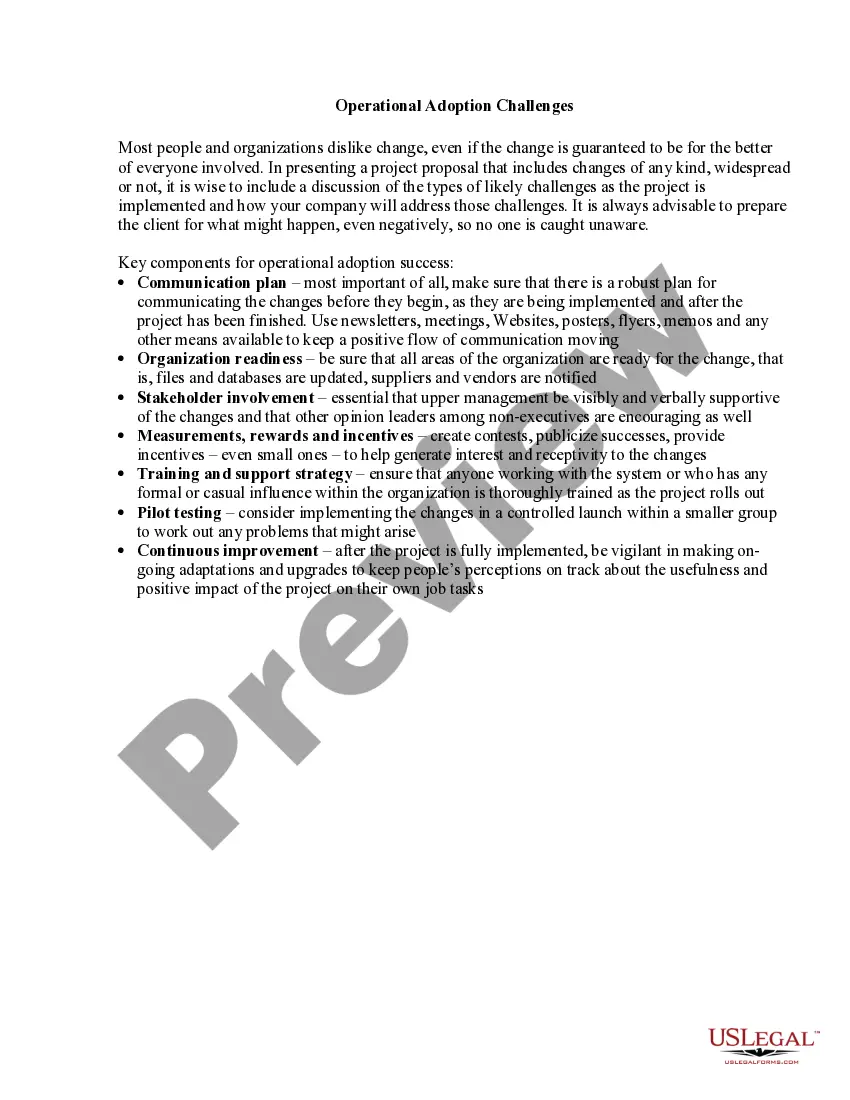
The Operational Adoption Challenges form helps organizations outline potential barriers when implementing changes within their operations. This form is essential for preparing stakeholders for the transition, detailing how to address significant hurdles that may arise during the project. Unlike other operational templates, this form focuses specifically on the nuances of managing change and ensuring a smooth adoption process.
What’s included in this form
- Communication plan: Establishes methods for effectively conveying changes to all stakeholders.
- Organization readiness: Ensures all departments are prepared and equipped for the transition.
- Stakeholder involvement: Encourages support from upper management and influential team members.
- Measurements, rewards, and incentives: Creates systems to recognize effort and celebrate successes.
- Training and support strategy: Outlines training processes for employees to navigate new systems.
- Pilot testing: Suggests launching changes in a controlled environment to identify issues.
- Continuous improvement: Encourages ongoing evaluations and adjustments post-implementation.
Common use cases
This form is suitable when an organization plans to implement operational changes, such as introducing new technologies, altering processes, or restructuring teams. It helps identify and anticipate challenges to ensure a smoother transition, making it a valuable tool for project managers and leaders during the planning phase.
Who can use this document
- Project managers leading operational change initiatives.
- Team leaders responsible for implementing new systems or processes.
- Corporate trainers designing training programs for employees.
- Upper management seeking to support and guide change efforts.
Instructions for completing this form
- Identify the operational changes being proposed.
- Outline a clear communication plan for informing stakeholders about the changes.
- Assess organizational readiness and list required updates or notifications.
- Detail how stakeholders will be involved in the transition process.
- Establish metrics for measuring success, including rewards and incentives.
- Create a training schedule to ensure staff are equipped to manage new systems.
Does this form need to be notarized?
Notarization is not commonly needed for this form. However, certain documents or local rules may make it necessary. Our notarization service, powered by Notarize, allows you to finalize it securely online anytime, day or night.
Get your form ready online
Our built-in tools help you complete, sign, share, and store your documents in one place.
Make edits, fill in missing information, and update formatting in US Legal Forms—just like you would in MS Word.
Download a copy, print it, send it by email, or mail it via USPS—whatever works best for your next step.
Sign and collect signatures with our SignNow integration. Send to multiple recipients, set reminders, and more. Go Premium to unlock E-Sign.
If this form requires notarization, complete it online through a secure video call—no need to meet a notary in person or wait for an appointment.
We protect your documents and personal data by following strict security and privacy standards.

Make edits, fill in missing information, and update formatting in US Legal Forms—just like you would in MS Word.

Download a copy, print it, send it by email, or mail it via USPS—whatever works best for your next step.

Sign and collect signatures with our SignNow integration. Send to multiple recipients, set reminders, and more. Go Premium to unlock E-Sign.

If this form requires notarization, complete it online through a secure video call—no need to meet a notary in person or wait for an appointment.

We protect your documents and personal data by following strict security and privacy standards.
Common mistakes
- Failing to communicate changes effectively to all stakeholders.
- Not involving key stakeholders early in the process.
- Overlooking the need for adequate training and support.
- Underestimating the importance of continuous feedback after implementation.
Benefits of completing this form online
- Convenience of immediate access and downloadable format.
- Editability allows customization for specific organizational needs.
- Reliability with professionally drafted content by licensed attorneys.
Legal use & context
- This form provides a structured approach to addressing potential operational adoption challenges.
- It is important to document the anticipated hurdles to protect the organization during the transition.
Key takeaways
- The Operational Adoption Challenges form is crucial for successful change management.
- Effective communication and stakeholder involvement are essential components.
- Continuous improvement and support strategy enhance the adoption process.
Looking for another form?



Form popularity
FAQ
5 Factors That Influence Technology Adoption Rates Relative Advantage ? How improved an innovation is over the previous generation.Compatibility ? The level of compatibility that an innovation has to be assimilated into an individual's life.
CRM adoption challenges include convincing employees to adopt changes, handling data security, migrating away from old software and processes, and finding the right CRM for your business needs and budget. Software underutilization and priority misalignment constitute the biggest reasons for failure.
Before you can get the benefits of adopting new technology in business, you have to overcome some of these challenges. Legacy culture thinking/Reluctance to change in staff and management. Staff untrained on how to use new technology. Price and time to procure the new tools and technology.
What are some common barriers to success? Technological challenges. Financial challenges. Organizational challenges. Psychological challenges.
Lack of Technology Exposure Lack of awareness is one of the common reasons for slow adoption. As businesses are always busy keeping the lights on, they are not exposed to emerging technologies.
So with that in mind, here are 8 Common Problems of Adoption: Separation from the Birth Family.Preadoption Terminations.Difficulties of Attachment.Resilience of Trauma.Conflicting Upbringings.Quest for Identity.Perceptions of Others.Disrupted Adoptions.
Technology adoption refers to the process of accepting, integrating, and using new technology in society. The process follows several stages, usually categorized by the groups of people who use that technology. For instance: Innovators represent the very first developers of a technology.