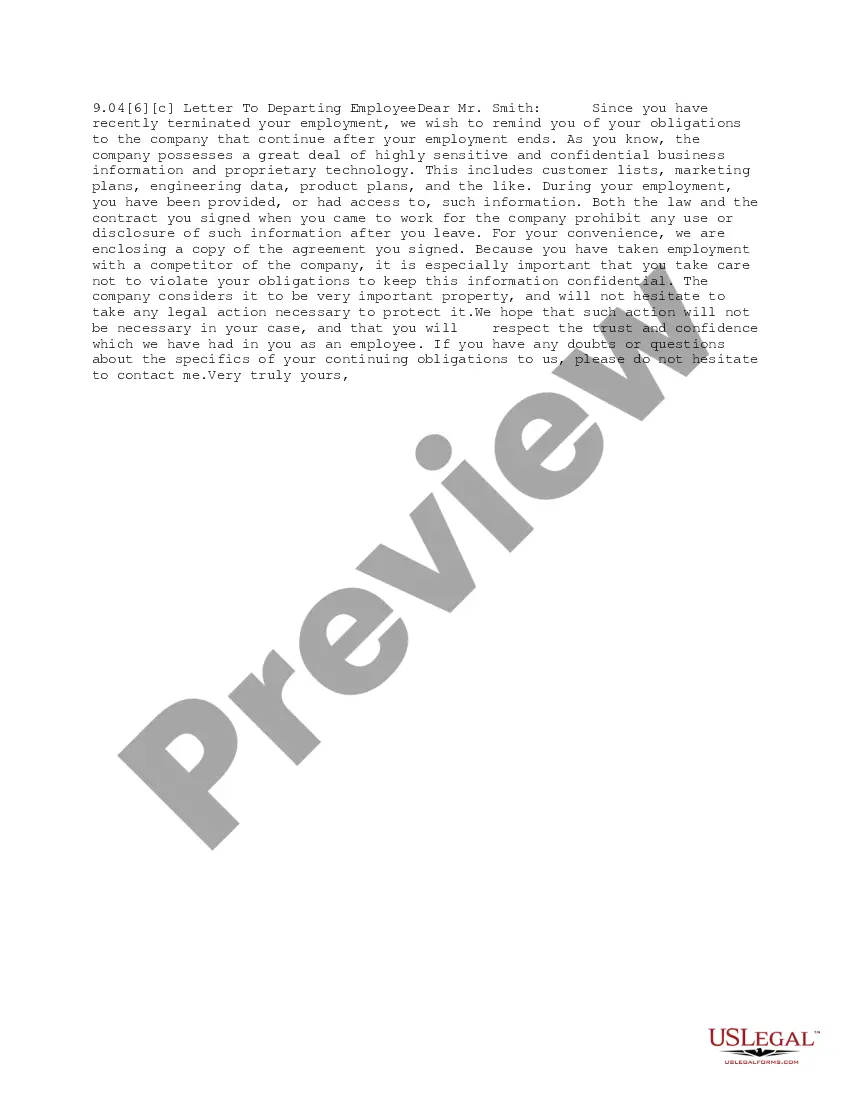
Termination Statement by Employee to Software Developer regarding return of Equipment, and Confidential Information
Understanding this form
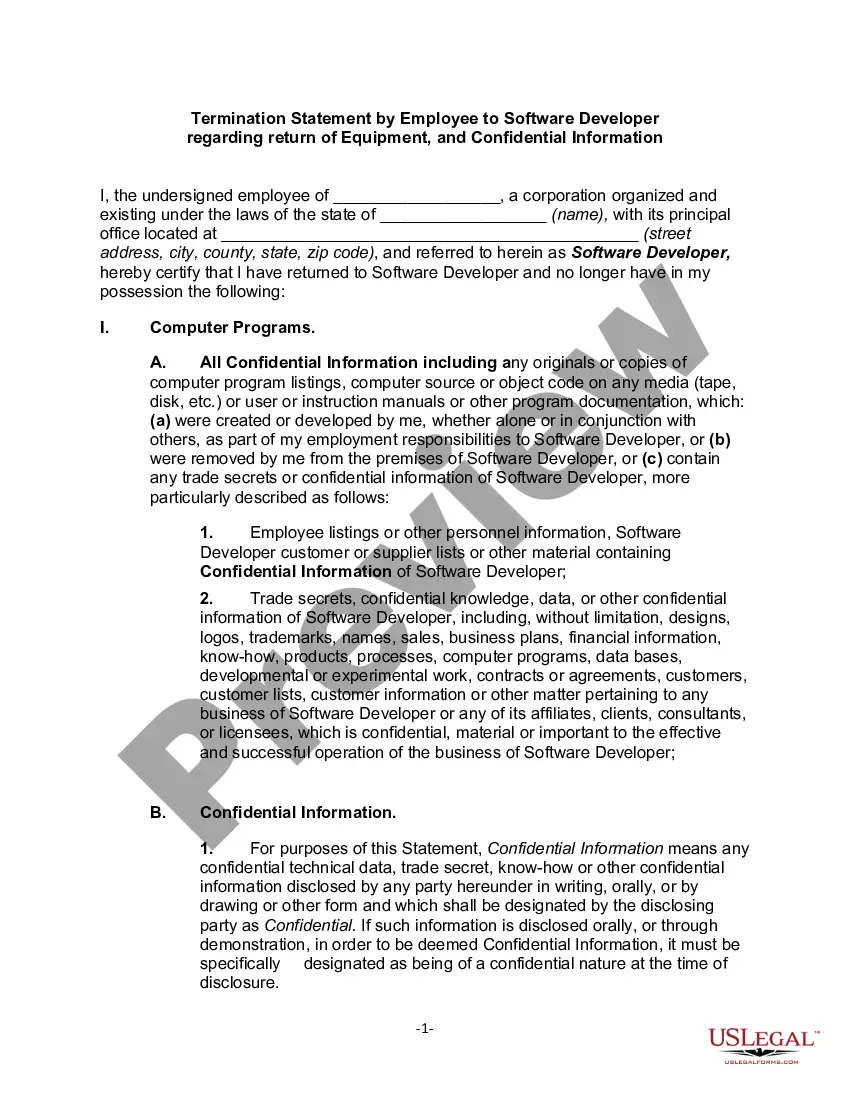
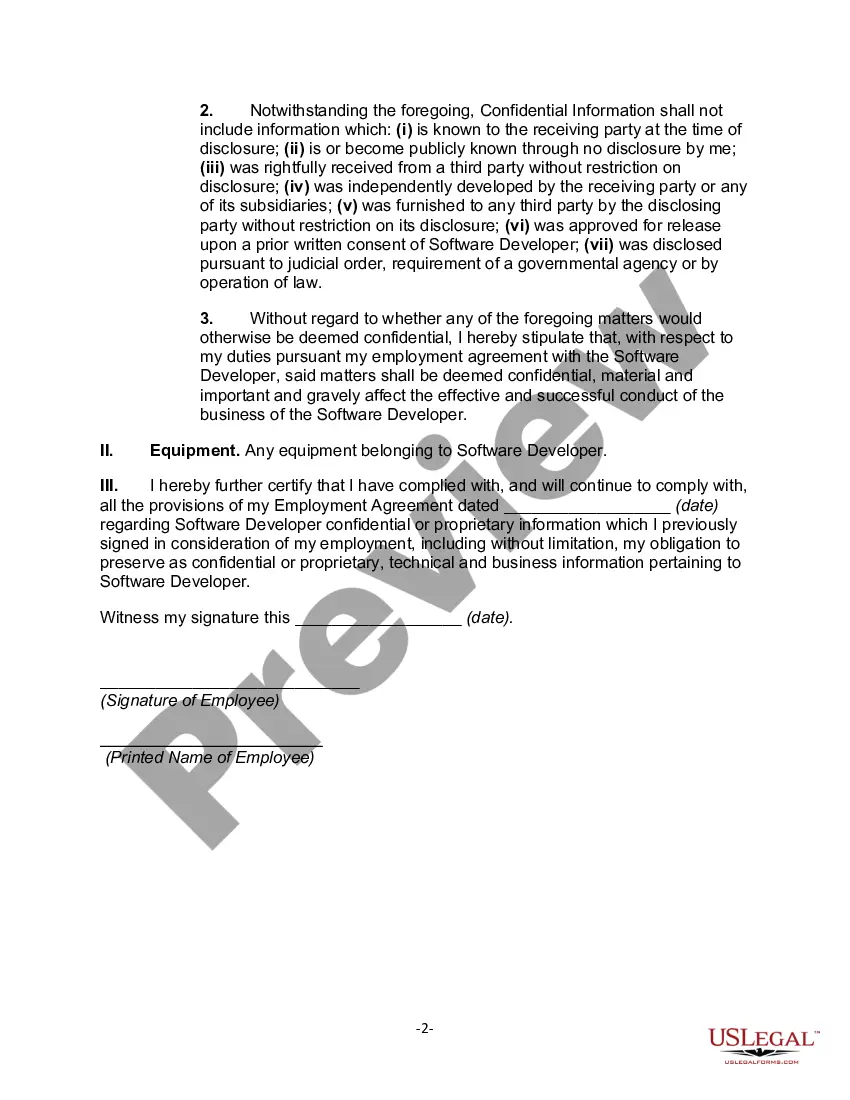
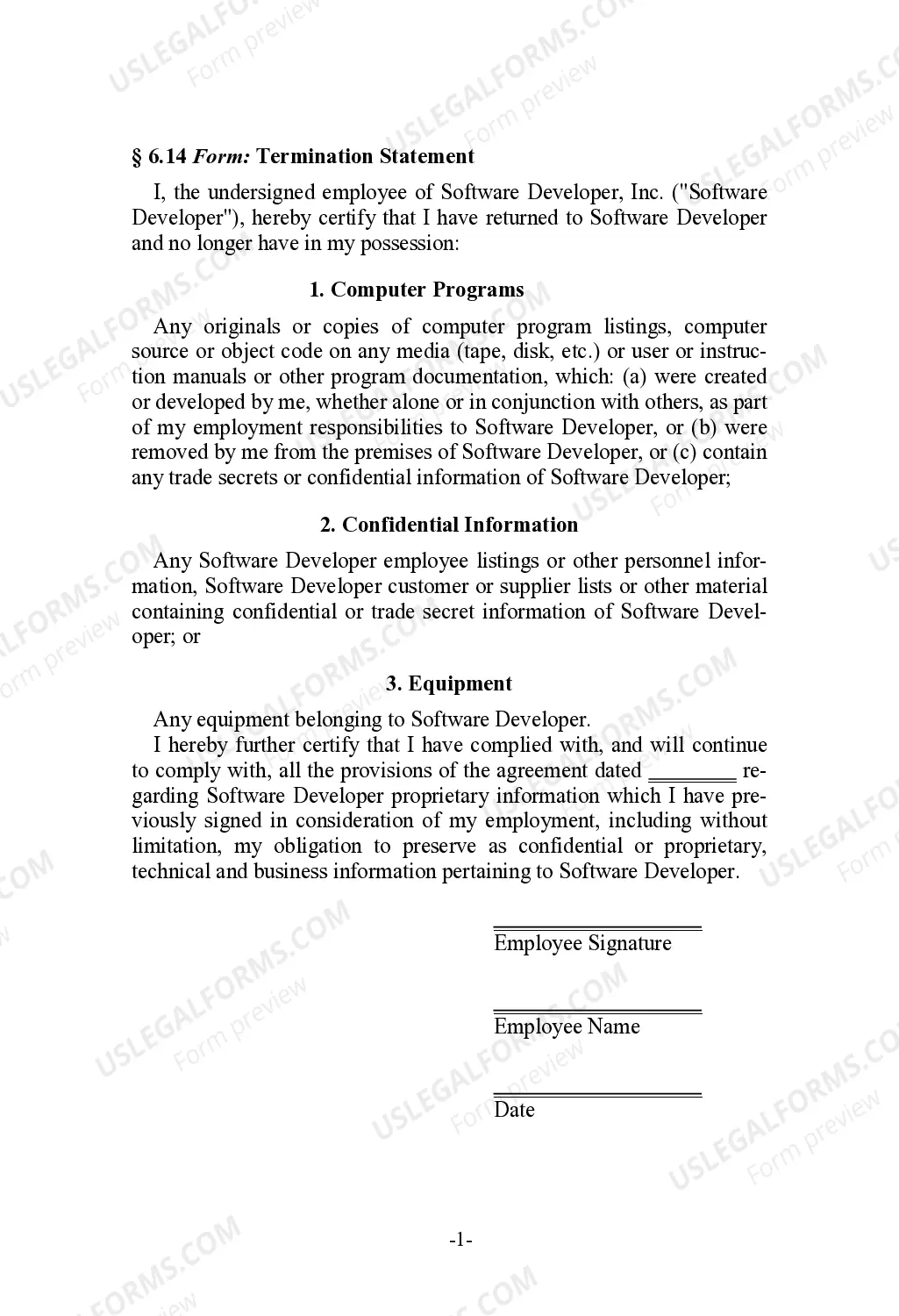
The Termination Statement by Employee to Software Developer regarding return of Equipment, and Confidential Information is a legal document that verifies the return of company property and confidential materials by an employee to a software development company. This form is essential to ensure that sensitive company information is safeguarded after an employee's departure, differentiating it from general termination notices by focusing specifically on the return of assets and compliance with confidentiality agreements.
Key components of this form
- Identification of the employee and the software developer, including business details and signature line.
- Certification of return of all confidential information and computer programs.
- Definition of Confidential Information and stipulations regarding what it includes.
- Certification that the employee complies with the employment agreement regarding proprietary information.
- Date for signing and printed name of the employee for records.
When to use this form
This form should be used when an employee is terminating their relationship with a software development company. It is specifically applicable when the employee needs to return any company property, including software, documents, and any other sensitive materials that may contain confidential information. It helps ensure that the companyâs intellectual property and trade secrets are protected after the employee's exit.
Who can use this document
- Employees who are leaving a software development company and need to confirm the return of equipment and confidential information.
- Employers in the software industry who want to ensure compliance with confidentiality provisions from departing employees.
- Legal professionals assisting clients in fulfilling employment termination procedures.
Completing this form step by step
- Identify the parties involved by filling in the name of the employee and the software developer's corporation details.
- List all items, including confidential information and equipment, that are being returned to the software developer.
- Specify the date of the employment agreement and the date of the statement.
- Sign the document to certify that all information is accurate and that you have returned all necessary items.
- Print your name below your signature for clear identification.
Does this document require notarization?
This form does not typically require notarization unless specified by local law. However, having the document notarized can add an extra layer of verification and may be advisable for company records.
Get your form ready online
Our built-in tools help you complete, sign, share, and store your documents in one place.
Make edits, fill in missing information, and update formatting in US Legal Forms—just like you would in MS Word.
Download a copy, print it, send it by email, or mail it via USPS—whatever works best for your next step.
Sign and collect signatures with our SignNow integration. Send to multiple recipients, set reminders, and more. Go Premium to unlock E-Sign.
If this form requires notarization, complete it online through a secure video call—no need to meet a notary in person or wait for an appointment.
We protect your documents and personal data by following strict security and privacy standards.

Make edits, fill in missing information, and update formatting in US Legal Forms—just like you would in MS Word.

Download a copy, print it, send it by email, or mail it via USPS—whatever works best for your next step.

Sign and collect signatures with our SignNow integration. Send to multiple recipients, set reminders, and more. Go Premium to unlock E-Sign.

If this form requires notarization, complete it online through a secure video call—no need to meet a notary in person or wait for an appointment.

We protect your documents and personal data by following strict security and privacy standards.
Mistakes to watch out for
- Failing to include all items returned, which could lead to disputes later.
- Not signing or dating the document properly, making it potentially unenforceable.
- Missing the clear definition of what constitutes confidential information.
Benefits of using this form online
- Convenient download and completion from anywhere, saving time and resources.
- Editability allows for customization to fit specific company needs or scenarios.
- Reliability with templates drafted by licensed attorneys, ensuring legal correctness.
Summary of main points
- This form is essential for protecting a software developer's confidential information upon an employee's departure.
- All company property should be returned and documented to avoid legal challenges.
- Complete the form carefully, ensuring all necessary information is accurately filled out before signing.
Looking for another form?

Form popularity
FAQ
Examples of confidential information include, but are not limited to: Information about the Company's operations, results, earnings projections, strategies, clients or client relationships, proprietary products or employee records.
In a work environment that takes privacy and confidentiality seriously, a manager's breach of confidentiality is a serious matter that may result in just cause for termination. This is particularly true when the manager is aware of the employer's policy emphasizing the confidentiality obligations.
Company Confidential Information means information known to the Executive to constitute trade secrets or proprietary information belonging to the Company or other Company confidential financial information, operating budgets, strategic plans or research methods, personnel data, projects or plans, or non-public
In cases of breach of confidentiality, the employer must consider whether the breach is a serious enough case of deliberate misconduct or gross negligence as to justify instant dismissal (as a gross misconduct event) or a severe enough risk to the employer's reputation or breakdown in trust and confidence as to
As an employee, the consequences of breaking confidentiality agreements could lead to termination of employment. In more serious cases, they can even face a civil lawsuit, if a third party involved decides to press charges for the implications experienced from the breach.
Yes, absolutely! There are many cases where sharing confidential information can make you lose your job, or even worse!Many inadvertently share or even snoop around such information, and they can be fired, fined, or even might face jail time due to these violations.
What is a breach of confidentiality? In short, a confidentiality breach is the disclosure of information to someone without the consent of the person who owns it. In other words, failing to respect a person's privacy or the confidence in which they gave the information or data to you, by passing it onto someone else.
Proper labelling. Insert non-disclosure provisions in employment agreements. Check out other agreements for confidentiality provisions. Limit access. Add a confidentiality policy to the employee handbook. Exit interview for departing employees. Consider notifying the new employer.
Also known as Proprietary Information and Inventions Assignment Agreements (or PIIAAs), Confidential Information and Inventions Assignment Agreements ensure that intellectual property and other proprietary rights created by employees during the course of their employment are assigned to the employer.