Wyoming Commercial Contractor Package
What this form package covers
The Wyoming Commercial Contractor Package is a comprehensive collection of legal documents tailored for commercial contractors, owners, suppliers, and subcontractors dealing with construction projects. This form package is designed to assert legal rights, address construction-related issues, and streamline communication and documentation processes. It differs from residential packages as it specifically caters to commercial construction contracts and related activities.
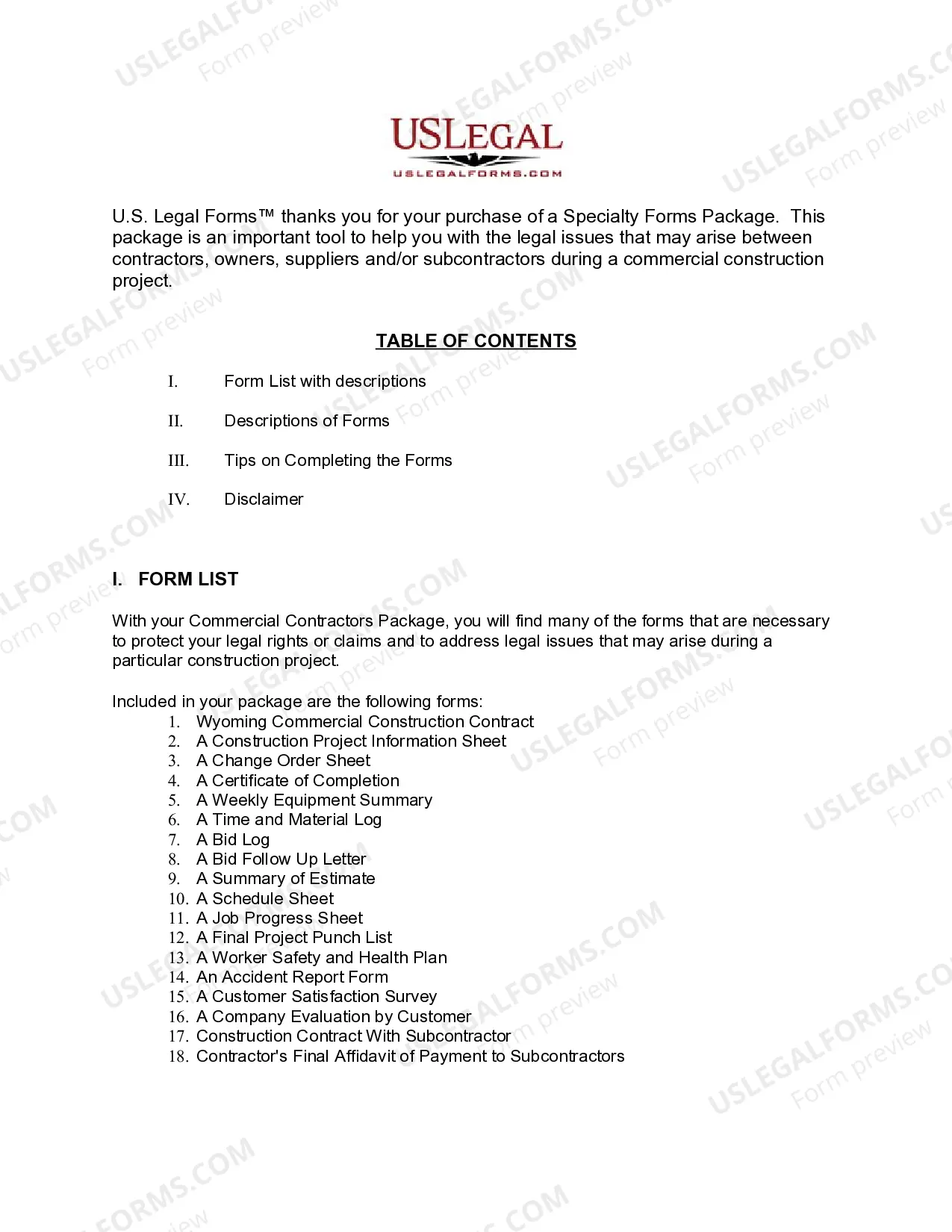
Forms you’ll find in this package
- Commercial Contract for Contractor
- Contractor's Weekly Equipment Summary
- Contractor's Time and Materials Log
- Contractor's Bid Log
- Contractor's Bid Follow Up Letter
- Contractor's Final Affidavit of Payment to Subcontractors
- Contractor's Summary of an Estimate
- Contractor's Schedule Sheet
- Contractor's Job Progress Sheet
- Contractor's Final Punch List
- Customer Satisfaction Survey
- Construction Company Evaluation by a Customer
- Construction Accident Report
- Construction Safety and Health Plan
- Construction Contract with Subcontractor
- Change Order for Construction or Repairs by Contractor
- Certification of Completion by Contractor
- Construction Project Information Sheet
Common use cases
This form package is beneficial in various scenarios, including:
- When seeking a formal agreement between contractors and clients on commercial projects.
- When modifications or changes need to be documented with a change order.
- At the completion of a project, to certify the finished work and ensure customer satisfaction.
- During the bidding process, to track offers and communicate with subcontractors and clients.
- When monitoring project progress and safety measures to comply with regulations.
Intended users of this form package
- Commercial contractors undertaking projects in Wyoming.
- Property owners looking to establish contracts with contractors.
- Suppliers and subcontractors involved in commercial construction.
- Anyone involved in managing or overseeing construction projects requiring formal documentation.
How to prepare this document
- Review all included forms thoroughly to understand their purposes.
- Identify the key parties involved in your construction project.
- Fill in the necessary details, such as dates, names, and project specifics.
- Sign and date each form where required, ensuring all parties are in agreement.
- Keep copies of all completed forms for your records and future reference.
Notarization details for included forms
Some included forms must be notarized to ensure validity. US Legal Forms provides secure online notarization powered by Notarize, allowing you to complete the process through a verified video call anytime.
Get your form ready online
Our built-in tools help you complete, sign, share, and store your documents in one place.
Make edits, fill in missing information, and update formatting in US Legal Forms—just like you would in MS Word.
Download a copy, print it, send it by email, or mail it via USPS—whatever works best for your next step.
Sign and collect signatures with our SignNow integration. Send to multiple recipients, set reminders, and more. Go Premium to unlock E-Sign.
If this form requires notarization, complete it online through a secure video call—no need to meet a notary in person or wait for an appointment.
We protect your documents and personal data by following strict security and privacy standards.

Make edits, fill in missing information, and update formatting in US Legal Forms—just like you would in MS Word.

Download a copy, print it, send it by email, or mail it via USPS—whatever works best for your next step.

Sign and collect signatures with our SignNow integration. Send to multiple recipients, set reminders, and more. Go Premium to unlock E-Sign.

If this form requires notarization, complete it online through a secure video call—no need to meet a notary in person or wait for an appointment.

We protect your documents and personal data by following strict security and privacy standards.
Common mistakes
- Failing to specify all parties involved in the contracts.
- Not documenting changes properly with a change order.
- Omitting signatures which can invalidate the forms.
- Using outdated forms or not updating project specifics when necessary.
- Neglecting to complete safety and health plans required for compliance.
Advantages of online completion
- Convenience of downloading and filling out forms at your own pace.
- Editability allows you to customize forms according to your specific project needs.
- Reliable templates that are drafted by licensed attorneys ensure legal compliance.
- Saves costs compared to purchasing each form separately, providing over 50 percent savings.
- Instant access to necessary documentation eliminates delays in project timelines.
Looking for another form?

Form popularity
FAQ
Class A: A Class A general contractor license/certificate holder is authorized to construct or demolish, or deconstruct, any building or structure in the City that is regulated under the building code, including all work authorized by license types below this level.
The assessee is a Government approved AA class contractor. As such, it carries out projects like construction of hospitals, roads, bridges, etc. for Government, semi-government and other institutions, etc.
Licensure laws maintain safety and quality standards for contractors in the state. Business registration. Years of experience. Pass an exam. General liability insurance. Worker's compensation insurance. Application and fee. Every company must have a qualified supervisor.
Small Renovation Contractors. General Contractors. Owner-Builder. Real Estate Developer. Professional Construction Manager. Program Manager. Package Builders. Sponsor-Builder.
Virginia Class A Contractor License: Requires Minimum Net Worth of $45,000. Qualified Individual needs at least 5 years experience. Maximum Project Size is unlimited. Maximum Annual Revenue is unlimited.
Class B General Building Contractors, unlike both a Class A General Engineering Contractor and a Class C Specialty Contractor, may enter into direct contracts and subcontracts involving: (1) Projects involving framing or carpentry only; (2) Projects involving two or more unrelated trades other than framing or
General Contractor Company licensure is not required on the State level in Wyoming. There is no state level license for general contractor firms in Wyoming, however, local licensing requirements may apply.
Class B General Building Contractor The principal business is in connection with any structure built, being built, or to be built, requiring in its construction the use of at least two unrelated building trades or crafts.
Class B General Building Contractors, unlike both a Class A General Engineering Contractor and a Class C Specialty Contractor, may enter into direct contracts and subcontracts involving: (1) Projects involving framing or carpentry only; (2) Projects involving two or more unrelated trades other than framing or