Matching Gift Form
Understanding this form
The Matching Gift Form is a legal document that allows a company to match an employee's charitable contribution to a nonprofit organization. This form facilitates the process of ensuring that both the employee's donation and the matching amount from the employer meet necessary guidelines, differentiating it from standard donation receipts or forms used for personal contributions.
Key parts of this document
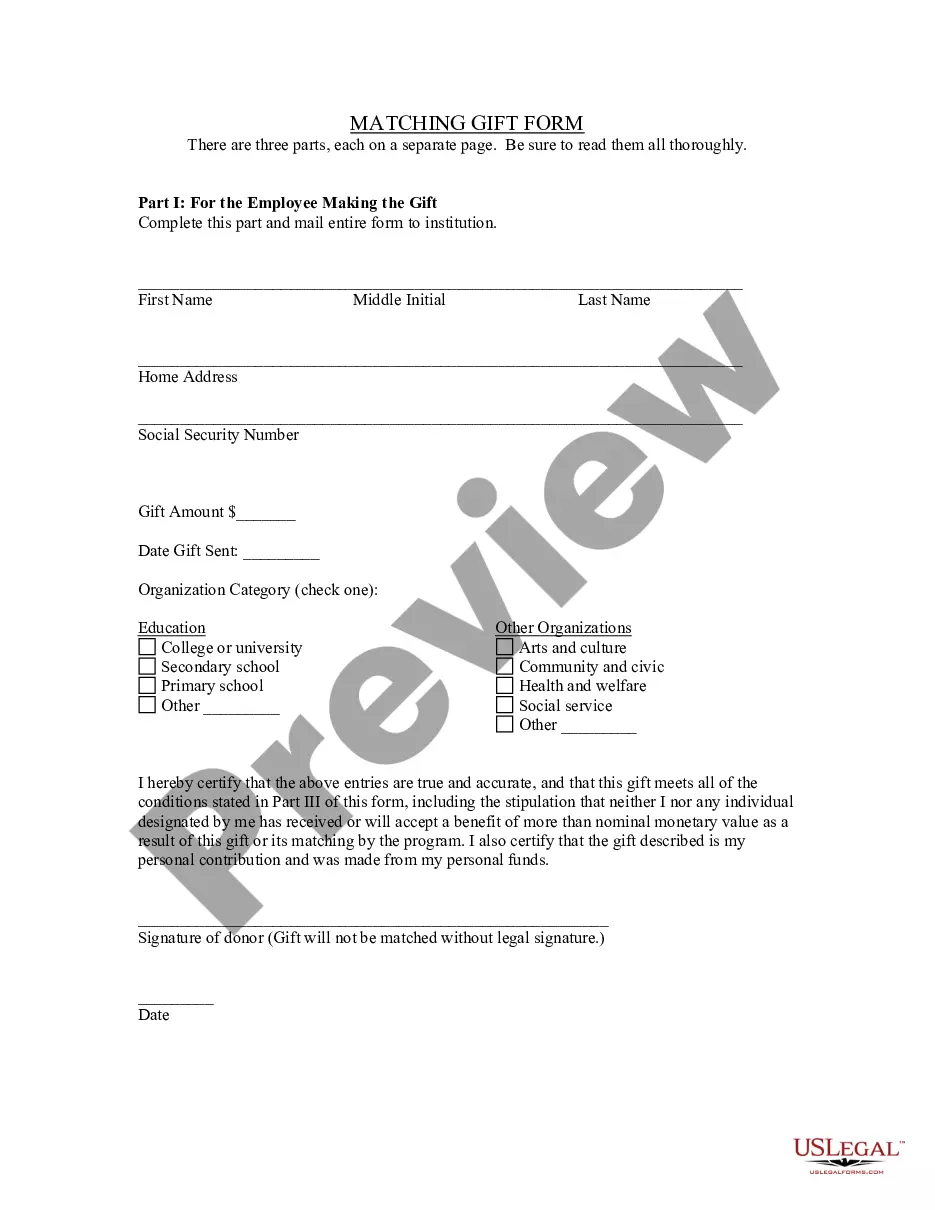
- Part I: Employee details, including name, address, gift amount, and organization category.
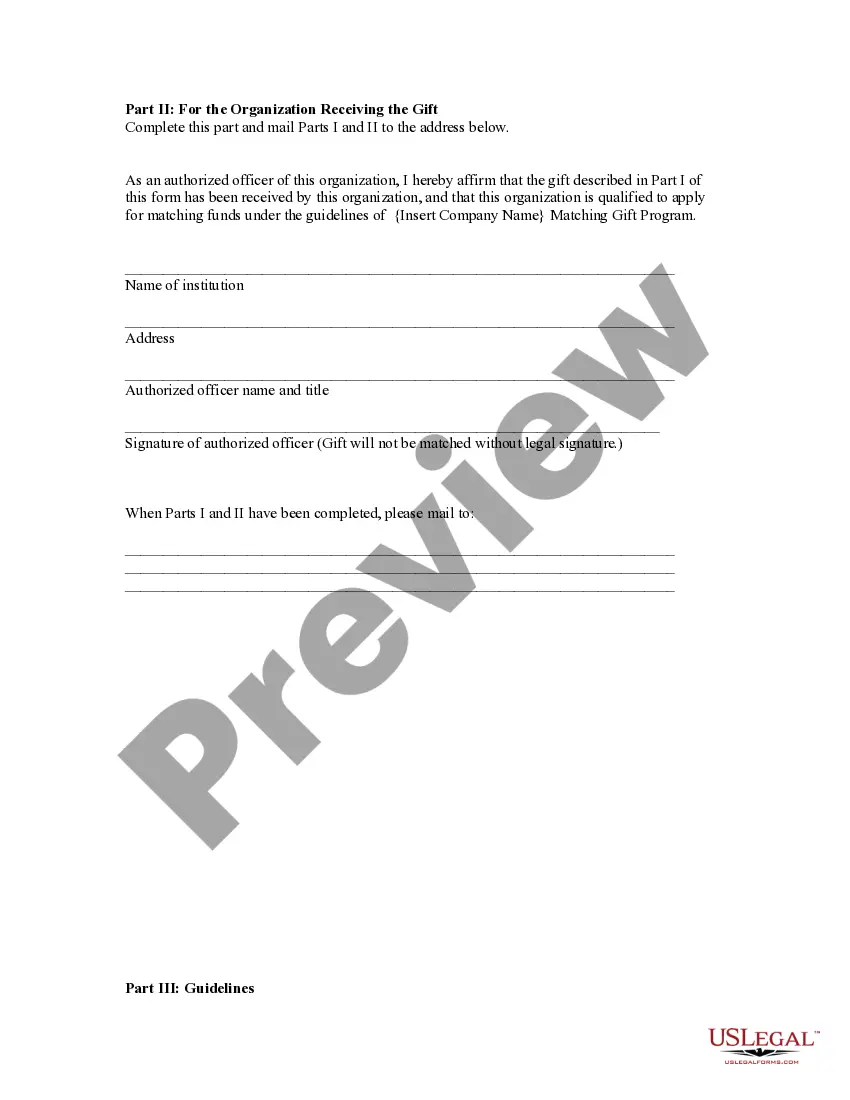
- Part II: Information for the organization receiving the gift, confirming receipt and eligibility.
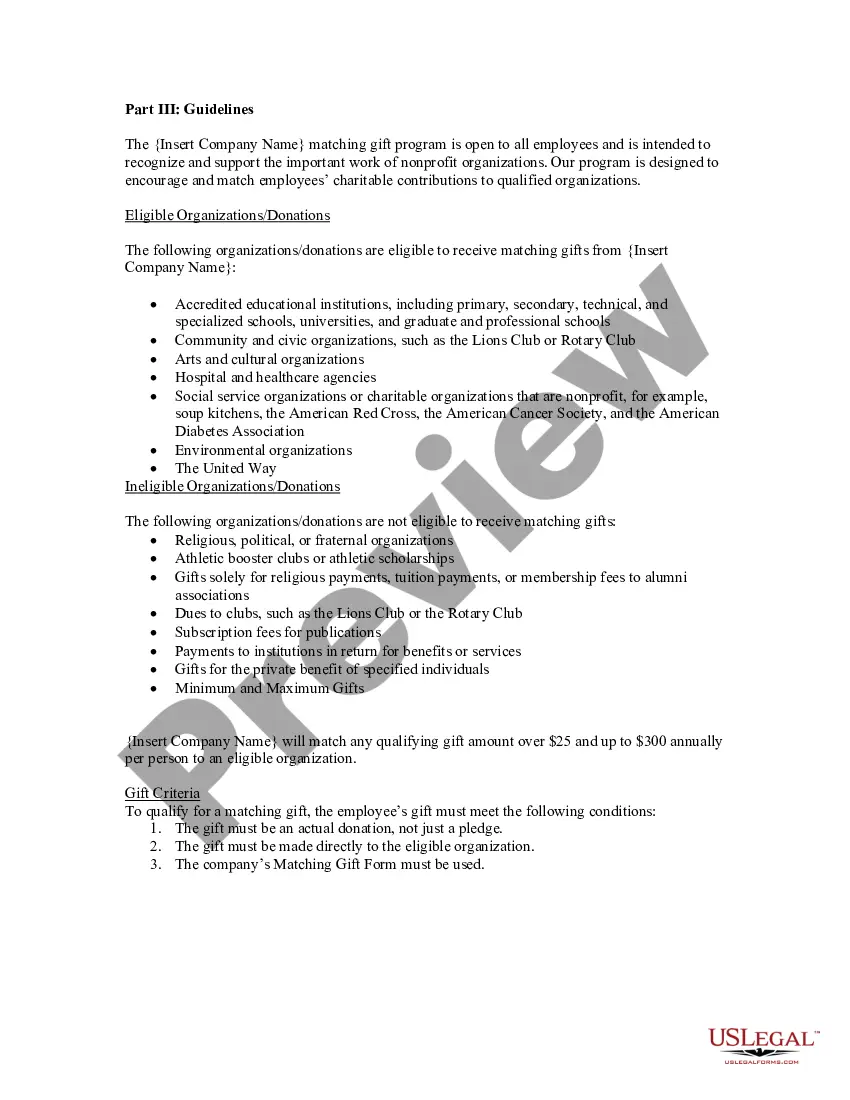
- Part III: Guidelines outlining eligible organizations, donation criteria, and minimum and maximum matching gift amounts.
Situations where this form applies
This form is used when an employee wishes to donate to a qualifying nonprofit organization and wants their employer to match that contribution. It ensures that the donation is eligible for matching funds and helps streamline the process of obtaining those funds from the employer.
Who needs this form
- Employees who are making charitable contributions to eligible nonprofit organizations.
- Organizations that are authorized to receive matching donations from specific employers.
- Nonprofit institutions that wish to affirm receipt of donations for matching gift purposes.
Instructions for completing this form
- Fill out Part I with your personal details, the amount of your gift, and categorize the organization.
- Sign Part I to certify the accuracy of your information and the charitable nature of your donation.
- Pass the completed Part I to the organization receiving the gift, which will then complete Part II.
- Ensure the authorized officer of the organization signs Part II to confirm receipt of the donation.
- Submit the completed form as instructed to receive the matching contribution from your employer.
Does this document require notarization?
This form does not typically require notarization to be legally valid. However, some jurisdictions or document types may still require it. US Legal Forms provides secure online notarization powered by Notarize, available 24/7 for added convenience.
Get your form ready online
Our built-in tools help you complete, sign, share, and store your documents in one place.
Make edits, fill in missing information, and update formatting in US Legal Forms—just like you would in MS Word.
Download a copy, print it, send it by email, or mail it via USPS—whatever works best for your next step.
Sign and collect signatures with our SignNow integration. Send to multiple recipients, set reminders, and more. Go Premium to unlock E-Sign.
If this form requires notarization, complete it online through a secure video call—no need to meet a notary in person or wait for an appointment.
We protect your documents and personal data by following strict security and privacy standards.

Make edits, fill in missing information, and update formatting in US Legal Forms—just like you would in MS Word.

Download a copy, print it, send it by email, or mail it via USPS—whatever works best for your next step.

Sign and collect signatures with our SignNow integration. Send to multiple recipients, set reminders, and more. Go Premium to unlock E-Sign.

If this form requires notarization, complete it online through a secure video call—no need to meet a notary in person or wait for an appointment.

We protect your documents and personal data by following strict security and privacy standards.
Mistakes to watch out for
- Not signing Part I or Part II of the form, which is required for processing.
- Incorrectly categorizing the nonprofit organization, which may affect eligibility for matching funds.
- Failing to mail the completed form to the proper address, delaying the matching gift process.
Benefits of completing this form online
- Immediate access to downloadable forms, allowing for quick completion and submission.
- Easy editing of details to ensure accuracy before finalizing the submission.
- A streamlined process for both the employee and the organization receiving the donation.
Looking for another form?
Form popularity
FAQ
Focusing on matching gift awareness can benefit nonprofits beyond just the incremental revenue. It turns out that 84% of donors are more likely to donate if their gifts are eligible to be matched, and mentioning matching in fundraising appeals results in 71% more donations and 51% higher donation amounts.
Corporate matching gifts are a type of philanthropy in which companies financially match donations that their employees make to nonprofit organizations. When an employee makes a donation, they'll request the matching gift from their employer, who then makes their own donation.
To receive a matching gift, donors just have to submit a request to their employers. If the donor's gift and your organization qualify, the company will send you a check for the same amount (or larger depending on the corporation's matching gift program).
Instead, choose words like partner, give, and support. "Donate" gives the impression that you only want (or need) their money. Words like "support" and "partner," followed by the name of your cause or campaign, can increase your donations significantly because they invite people into a relationship.
A matching gift is a charitable donation by a corporation that matches an employee's donation to an eligible nonprofit organization, most often dollar for dollar.A $100 donation to your organization is eligible to be matched by a corporate employer, literally doubling the donation for a total of $200.
When an employee makes a donation, they'll request the matching gift from their employer, who then makes their own donation. Companies usually match donations at a 1:1 ratio, but some will match at a 2:1, 3:1, or even a 4:1 ratio.
Since a matching gift is technically a donation, companies can deduct the matches they make from their reported income. Decreasing reported income means a company will not have to pay taxes on the donated money. Plus, the 10 percent rule doesn't apply to these donations.
Review your major donors for the right donor(s) Look for a donor who either a) hasn't given a gift yet this year, or b) you think has the capacity to give another gift at year-end. Approach the donor with a question. Share the stats with them. Give them a deadline.
Create a bold subject line. Make the ask near the beginning. Explain and describe why you're asking for a donation. Include links to your online donation page and contact info for donors who want to give by mail or phone. Say thank you in advance.