Contractor's Weekly Equipment Summary
What is this form?
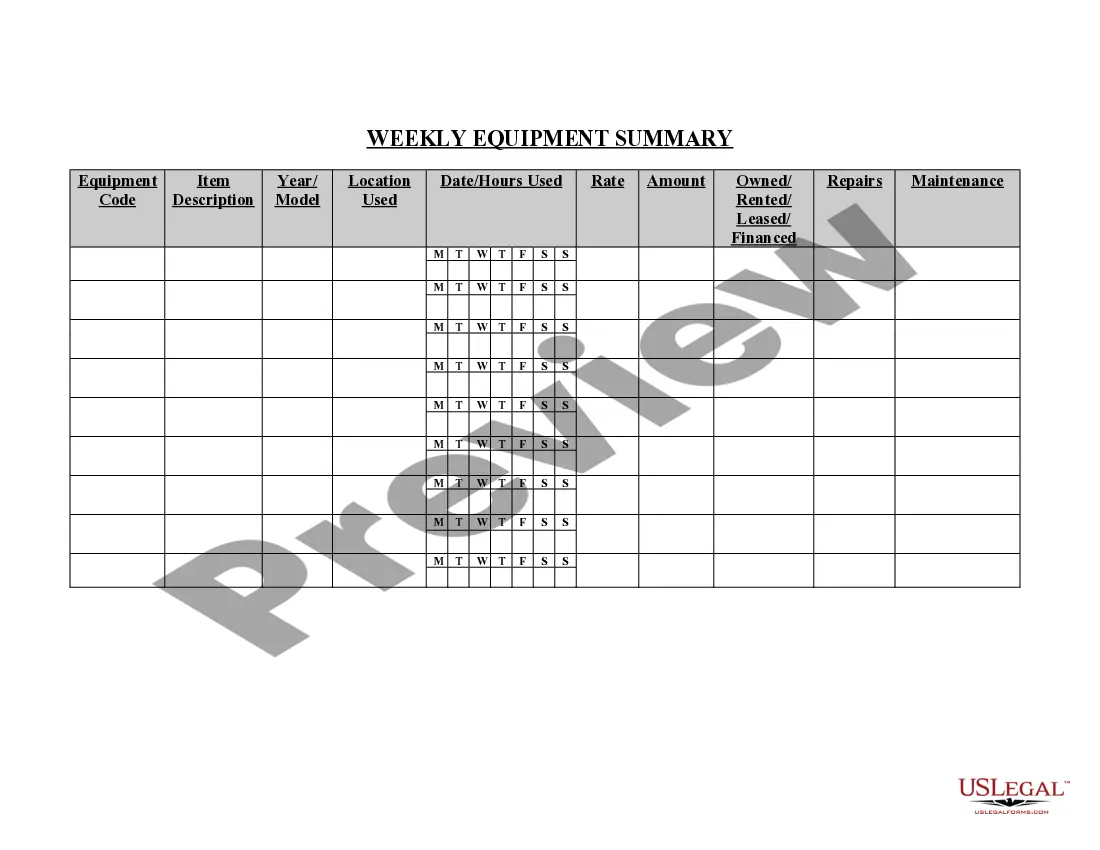
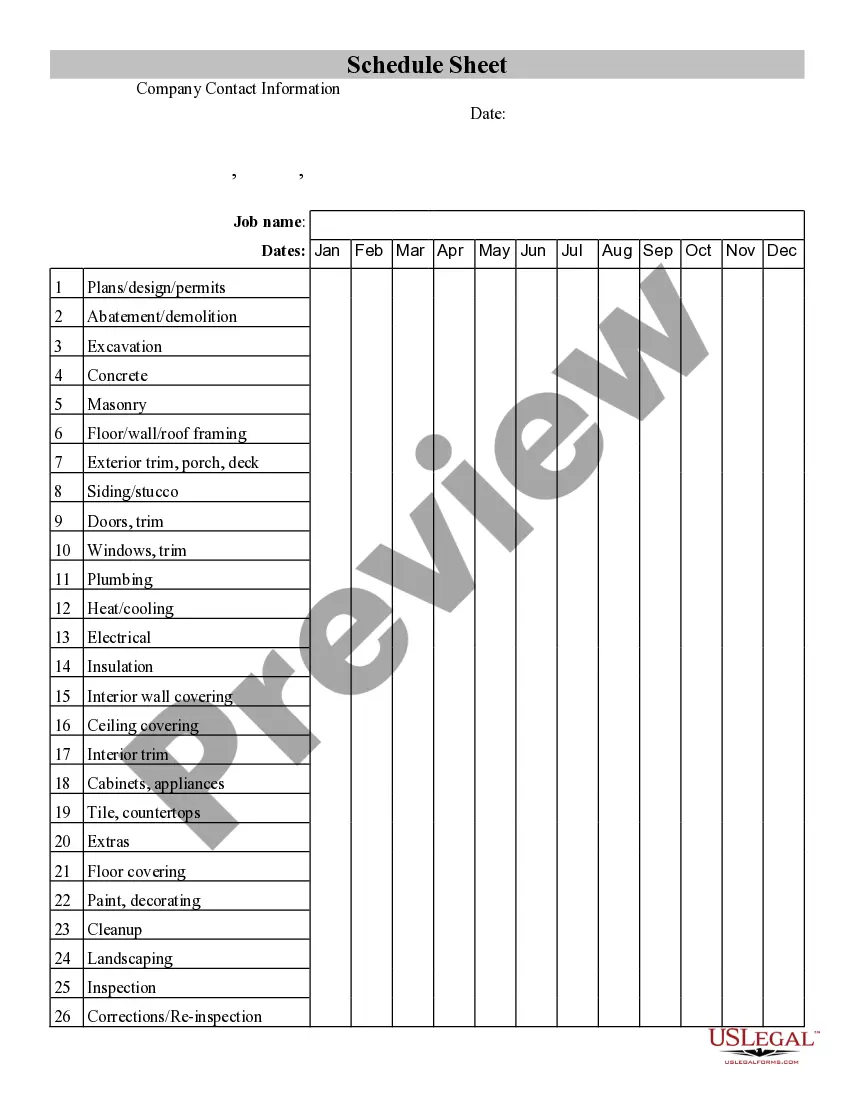
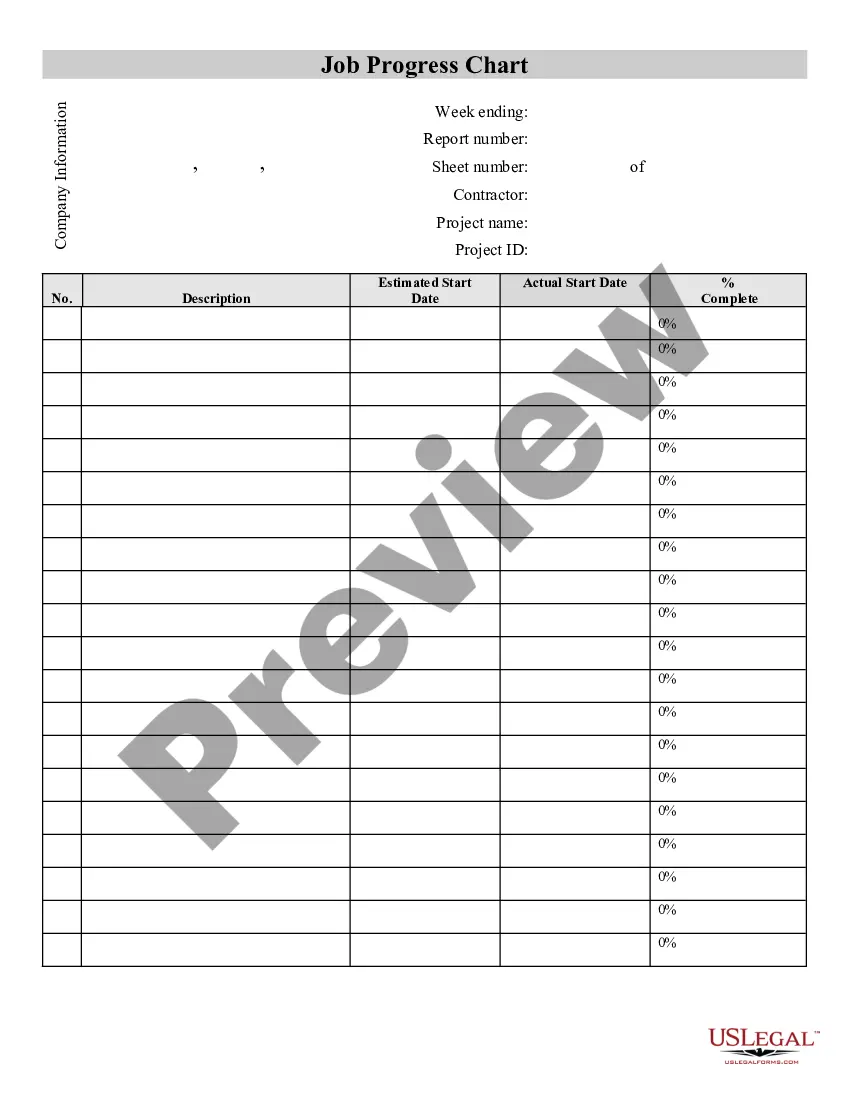
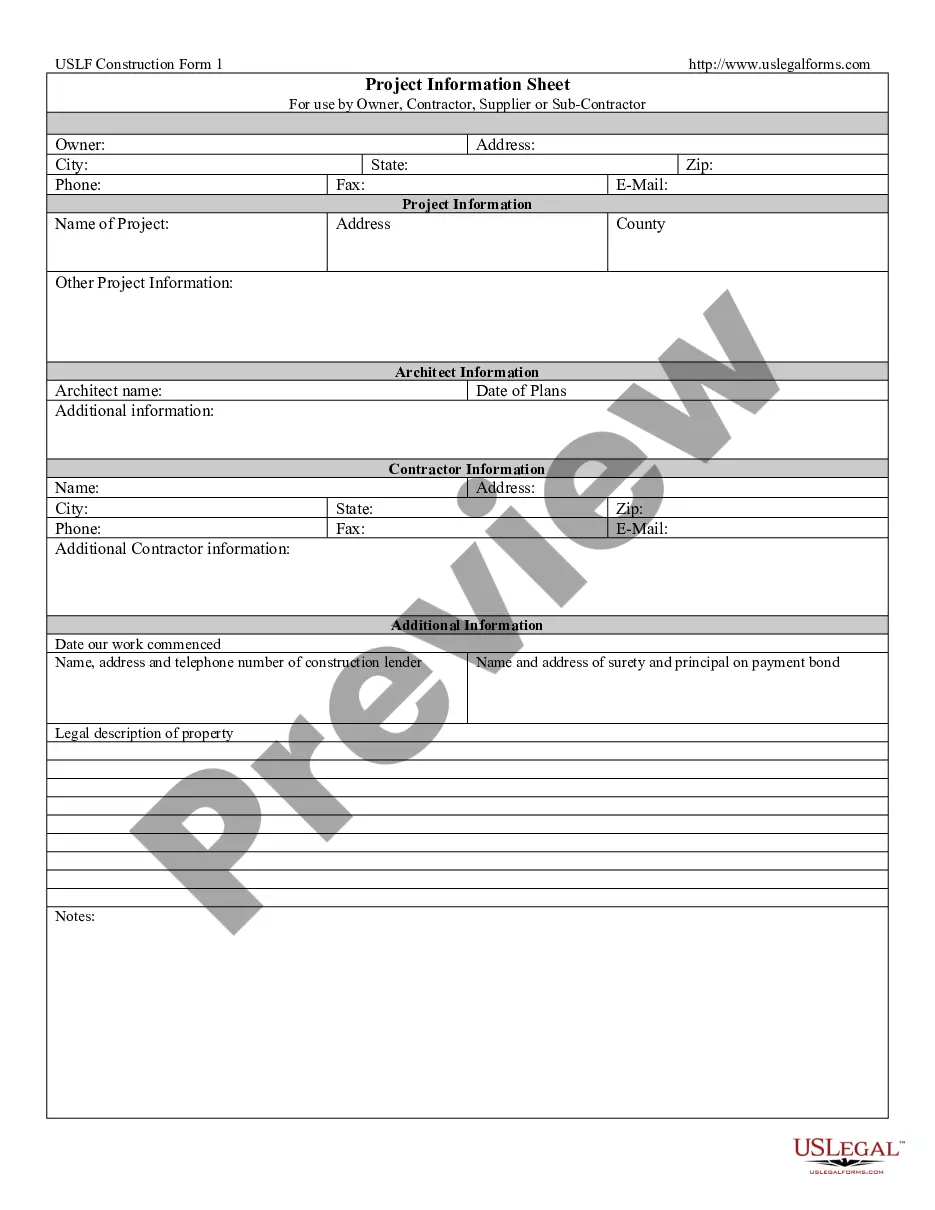
The Contractor's Weekly Equipment Summary is a fillable form that allows contractors to document essential details about the equipment utilized on a specific project. This form helps contractors maintain records about equipment usage, make and model information, maintenance or repairs performed, and ownership status. Unlike other equipment logs, this summary focuses on weekly tracking, making it easier to manage project resources effectively.
Key components of this form
- Date of report
- Equipment identification (make and model)
- Hours of operation
- Details on maintenance or repairs performed
- Ownership status (rented, owned, etc.)
- Notes for additional comments or observations
When to use this form
This form is necessary when contractors need to keep an accurate record of equipment usage on projects. It is particularly useful during project management meetings, reporting on resource efficiency, and assessing maintenance needs. Using this form weekly ensures that all equipment-related information is up-to-date and readily available for review or audits.
Who needs this form
- General contractors overseeing multiple construction sites
- Subcontractors responsible for specific equipment usage
- Project managers tracking equipment efficiency
- Construction companies looking to document equipment for auditing purposes
Steps to complete this form
- Enter the date of the report at the top of the form.
- List each piece of equipment used, including its make and model.
- Record the number of hours the equipment was in operation.
- Document any maintenance or repairs completed during the week.
- Indicate the ownership status of each piece of equipment.
- Add any additional notes relevant to the equipment or project in the comments section.
Notarization guidance
In most cases, this form does not require notarization. However, some jurisdictions or signing circumstances might. US Legal Forms offers online notarization powered by Notarize, accessible 24/7 for a quick, remote process.
Get your form ready online
Our built-in tools help you complete, sign, share, and store your documents in one place.
Make edits, fill in missing information, and update formatting in US Legal Forms—just like you would in MS Word.
Download a copy, print it, send it by email, or mail it via USPS—whatever works best for your next step.
Sign and collect signatures with our SignNow integration. Send to multiple recipients, set reminders, and more. Go Premium to unlock E-Sign.
If this form requires notarization, complete it online through a secure video call—no need to meet a notary in person or wait for an appointment.
We protect your documents and personal data by following strict security and privacy standards.

Make edits, fill in missing information, and update formatting in US Legal Forms—just like you would in MS Word.

Download a copy, print it, send it by email, or mail it via USPS—whatever works best for your next step.

Sign and collect signatures with our SignNow integration. Send to multiple recipients, set reminders, and more. Go Premium to unlock E-Sign.

If this form requires notarization, complete it online through a secure video call—no need to meet a notary in person or wait for an appointment.

We protect your documents and personal data by following strict security and privacy standards.
Avoid these common issues
- Failing to update equipment hours regularly.
- Inaccurate documentation of maintenance performed.
- Not specifying the correct ownership status.
- Leaving comments blank that could provide valuable context.
Why use this form online
- Easy access and download options for immediate use.
- Fillable format allows for quick and convenient data entry.
- Reliable record-keeping that helps maintain project efficiency.
- Editable at any time to reflect changing project requirements.
What to keep in mind
- The Contractor's Weekly Equipment Summary is essential for tracking equipment details on projects.
- Accurate documentation of equipment usage, maintenance, and ownership is crucial for project success.
- Utilizing the form online offers convenience and ensures better data management.
Looking for another form?

Form popularity
FAQ
Standard construction contracts should have the following information and clauses: Name of contractor and contact information. Include the contractor's license number along with phone number, email address, and company address. Name of homeowner and contact information.
The five requirements for creating a valid contract are an offer, acceptance, consideration, competency and legal intent.
Identifying/Contact Information. Title and Description of the Project. Projected Timeline and Completion Date. Cost Estimate and Payment Schedule. Stop Work Clause and Stop Payment Clause. Act of God Clause. Change Order Agreement. Warranty.
Your general contractor should provide proof of licensing, bonding and insurance before a project starts, but it's better to have it in hand before you sign any contracts. It's important that contractors carry any licensing and/or certification required for the specific trade or skill they practice.
The Construction Documents contain contract forms, conditions of the contract, specifications, and drawings. Bidding requirements are also produced during this phase. Stringent contractor qualifications are delineated, ensuring that only contractors with a proven track record will be prequalified to bid.
The Agreement. The agreement is the most fundamental document in a construction contract bundle. General Conditions. Special Conditions. Scope of Work. Drawings. Specifications. Bill of Quantities. Construction Schedule.
The date. time. weather and site conditions. material and labor logs. potential risks. any incidents. other notes and commentary.
General Requirements are used as the clearinghouse for items that do not apply directly to construction, the cost of which are customarily spread out over the entire project. These costs are also referred to as project overhead. For estimating purposes, either term is acceptable.
Bidding Documents. Construction Contractor Agreement. Architectural Drawings. Specifications. Bill of Quantities. Schedule. Work Orders. Subcontractor Application.