Medicaid Analysis Form (married)
Overview of this form
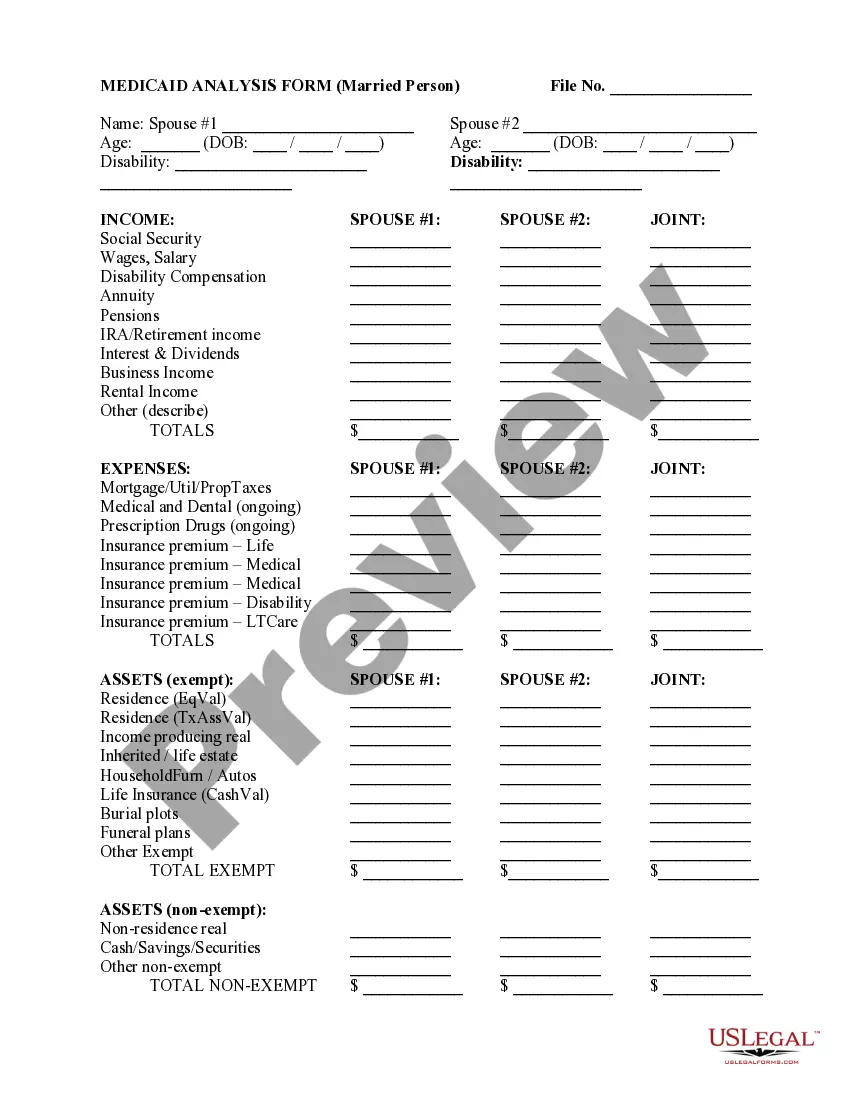
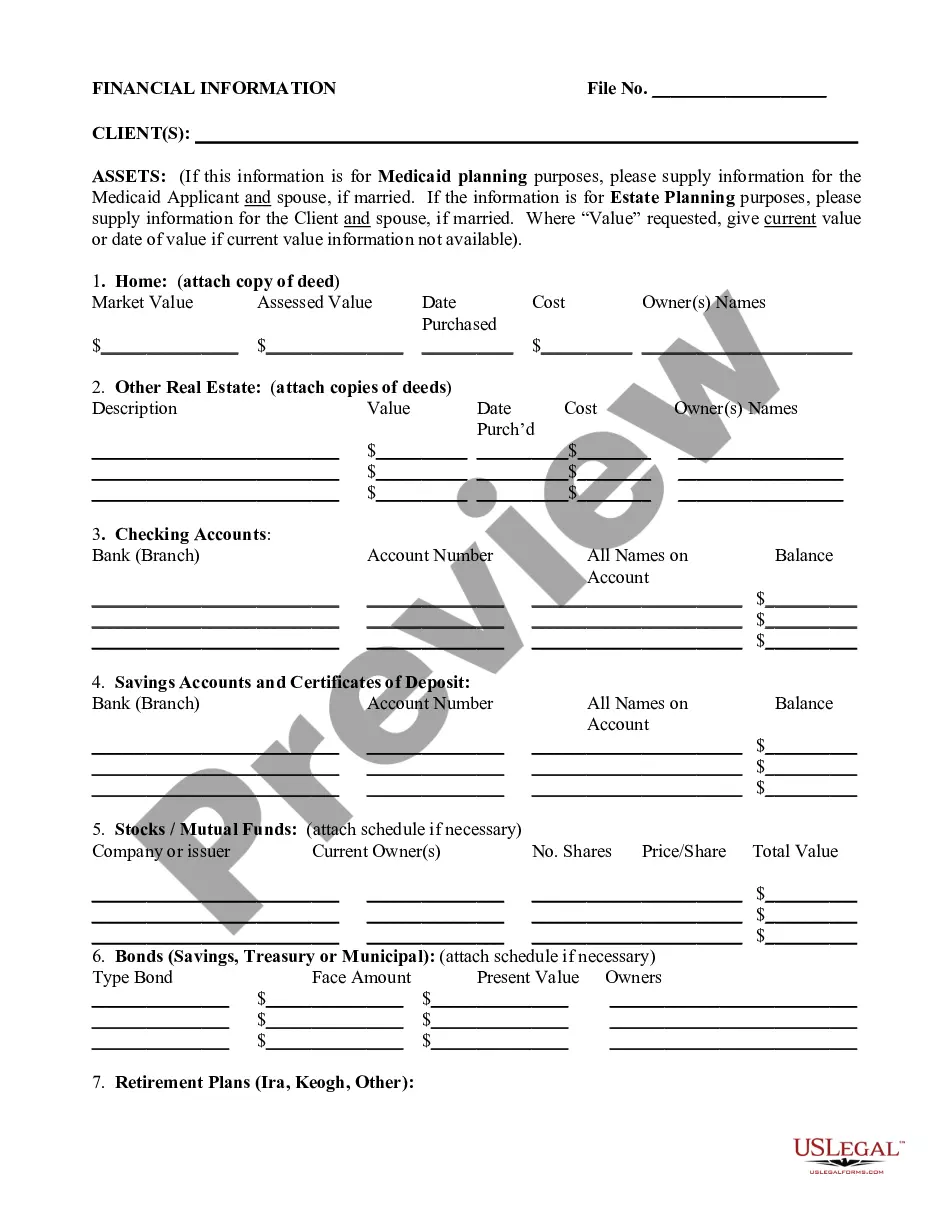
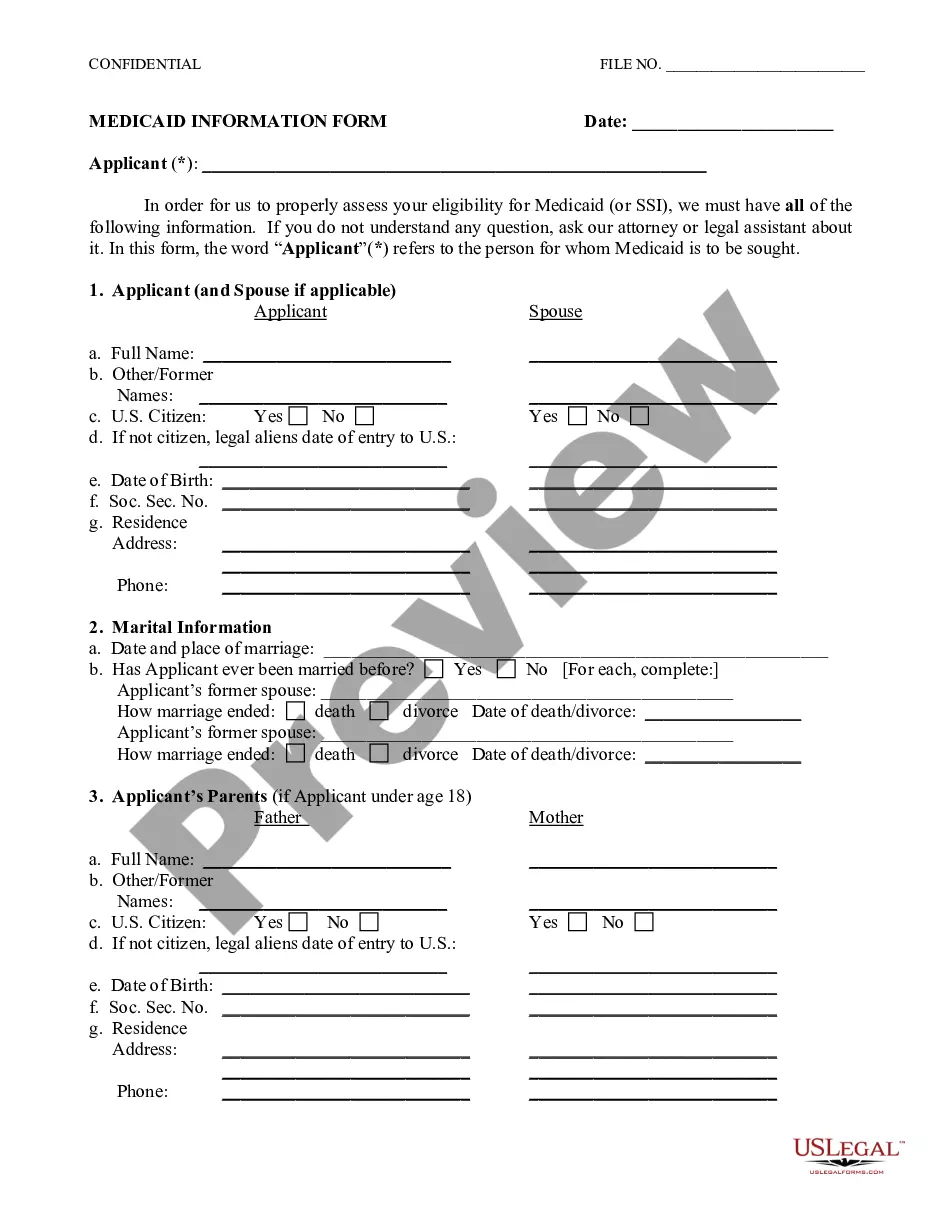
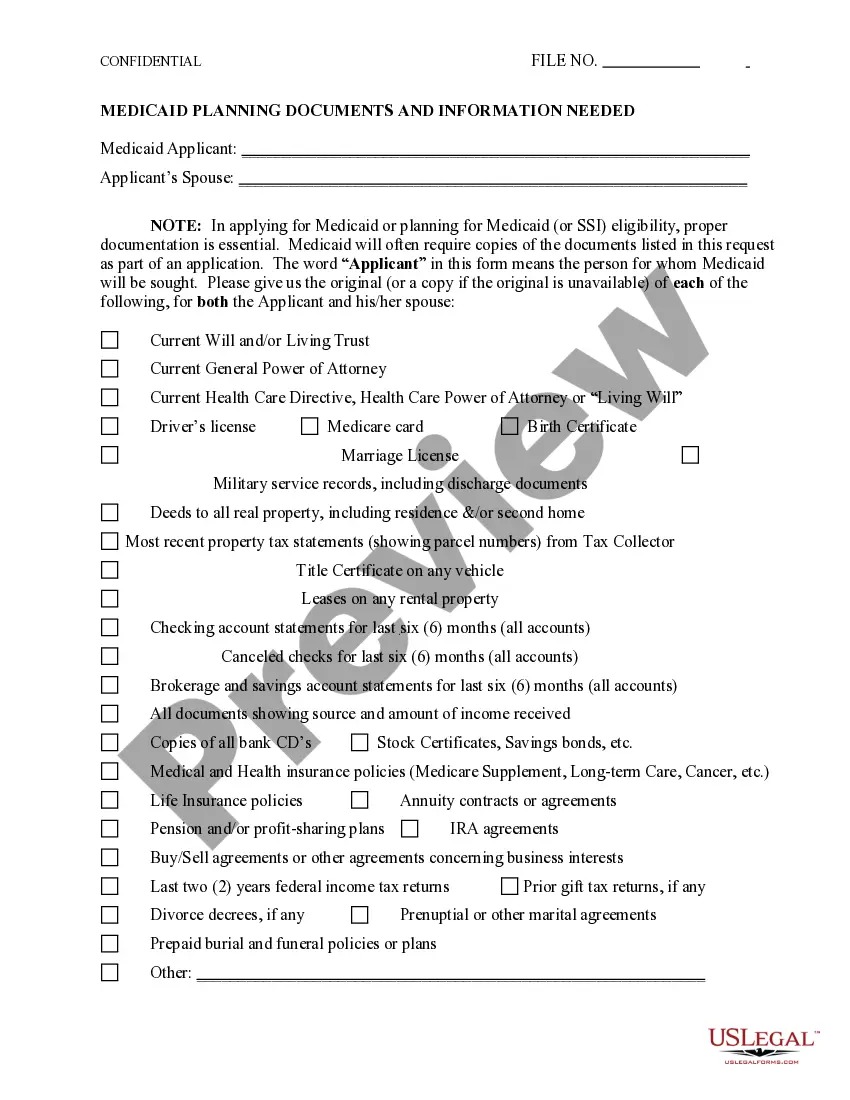
The Medicaid Analysis Form for married couples is a document designed to collect essential financial information from both spouses. This form plays a crucial role in evaluating financial plans concerning long-term care and eligibility for Medicaid benefits. Unlike other financial forms, it focuses specifically on married couples, ensuring a complete picture of shared resources and responsibilities.
Main sections of this form
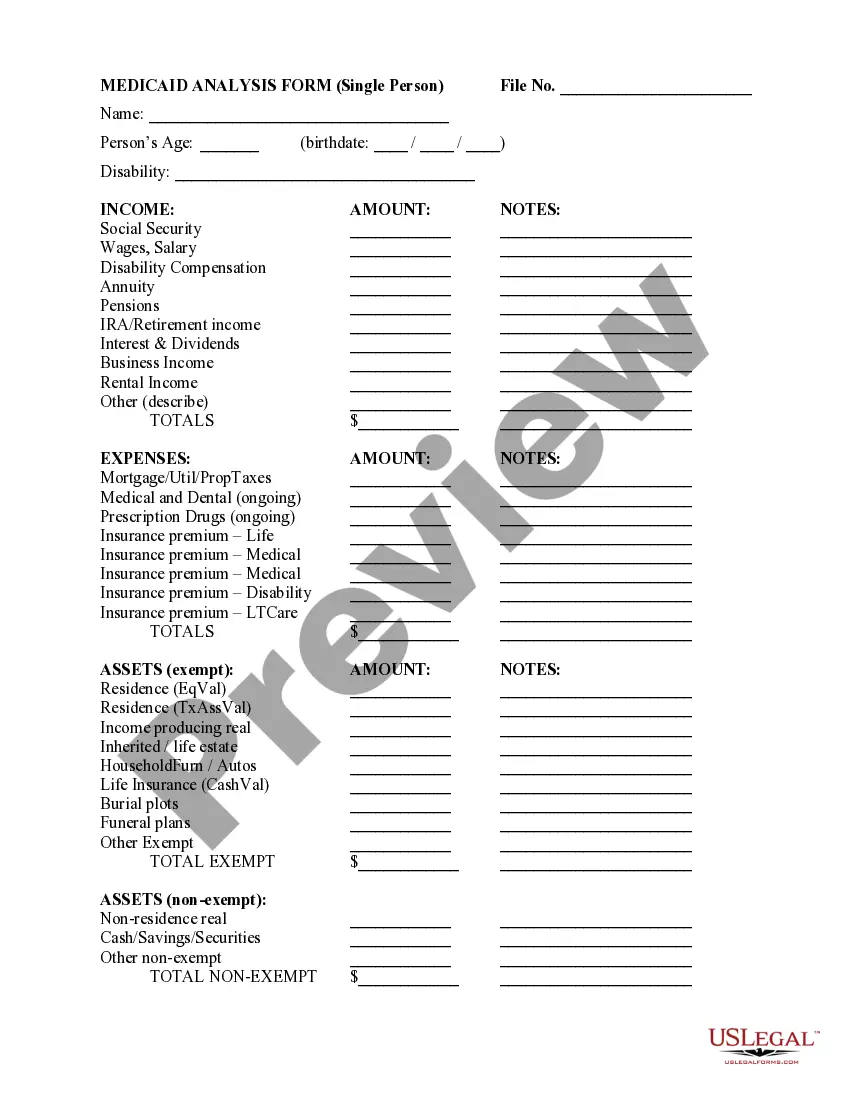
- Identification fields for both spouses, including name, age, and disability status.
- Section for detailing individual and joint income sources.
- Expense reporting for ongoing costs, such as medical, dental, and insurance premiums.
- Asset declarations distinguishing between exempt and non-exempt assets.
When this form is needed
This form is essential when a married couple is preparing to apply for Medicaid benefits, particularly when considering long-term care options. You should fill out this form if you need a comprehensive overview of your financial situation, especially if you anticipate needing care services that could be covered by Medicaid.
Who can use this document
- Married couples planning to apply for Medicaid benefits.
- Individuals seeking to evaluate their financial plan for long-term care.
- Families assisting elderly parents or partners in preparing for future healthcare needs.
Steps to complete this form
- Identify and enter the names and ages of both spouses at the top of the form.
- Document all sources of income for each spouse and any joint income sources in the designated sections.
- List all ongoing expenses, ensuring to include costs for medical care, insurance, and other relevant bills.
- Detail exempt and non-exempt assets, including real estate and financial assets.
- Ensure that all sections are accurately filled before submitting the form as part of your Medicaid application.
Does this document require notarization?
This form does not typically require notarization unless specified by local law. Always check your state regulations to determine if notarization is necessary for the Medicaid Analysis Form.
Get your form ready online
Our built-in tools help you complete, sign, share, and store your documents in one place.
Make edits, fill in missing information, and update formatting in US Legal Forms—just like you would in MS Word.
Download a copy, print it, send it by email, or mail it via USPS—whatever works best for your next step.
Sign and collect signatures with our SignNow integration. Send to multiple recipients, set reminders, and more. Go Premium to unlock E-Sign.
If this form requires notarization, complete it online through a secure video call—no need to meet a notary in person or wait for an appointment.
We protect your documents and personal data by following strict security and privacy standards.

Make edits, fill in missing information, and update formatting in US Legal Forms—just like you would in MS Word.

Download a copy, print it, send it by email, or mail it via USPS—whatever works best for your next step.

Sign and collect signatures with our SignNow integration. Send to multiple recipients, set reminders, and more. Go Premium to unlock E-Sign.

If this form requires notarization, complete it online through a secure video call—no need to meet a notary in person or wait for an appointment.

We protect your documents and personal data by following strict security and privacy standards.
Avoid these common issues
- Leaving fields blank or incomplete, especially in income and expense sections.
- Failing to differentiate between exempt and non-exempt assets.
- Overstating or understating income figures, which can affect Medicaid eligibility.
Benefits of completing this form online
- Convenient access to important financial forms without the need for physical paperwork.
- Editability allows you to easily update information as circumstances change.
- Secure storage of completed forms to ensure your information is protected.
Quick recap
- The Medicaid Analysis Form helps married couples assess their financial readiness for long-term care and Medicaid eligibility.
- Accurate and complete information is critical for successful Medicaid applications.
- Avoid common mistakes by carefully reviewing all fields before submission.
Looking for another form?
Form popularity
FAQ
Who is eligible for Colorado Medicaid? Household SizeMaximum Income Level (Per Year)1$19,3922$26,2283$33,0644$39,9004 more rows
Federal Poverty Level thresholds to qualify for Medicaid In 2023 these limits are: $14,580 for a single adult person, $30,000 for a family of four and $50,560 for a family of eight. To calculate for larger households, you need to add $5,140 for each additional person in families with nine or more members.
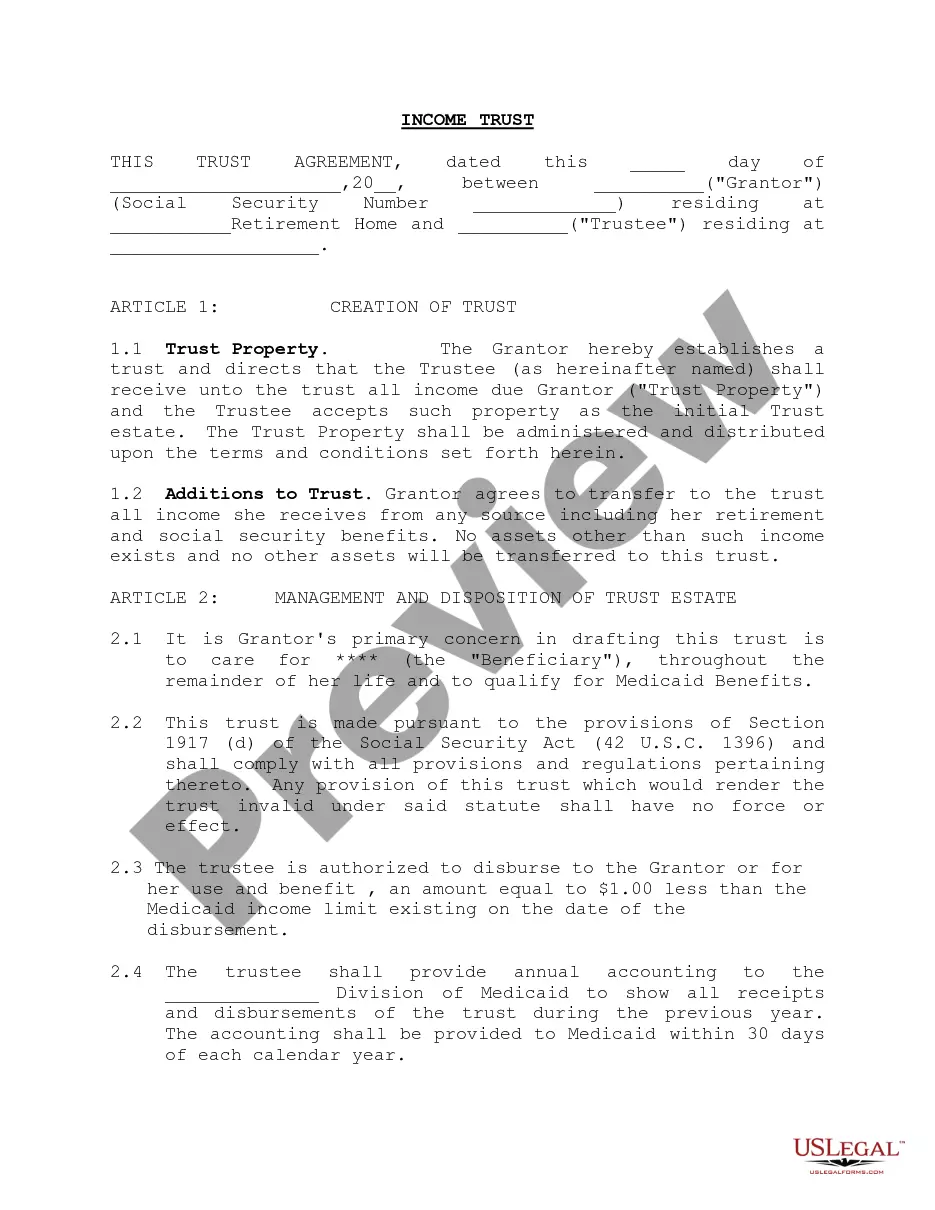
To remain eligible for either of the above Medicaid long-term care programs, all gross income that exceeds the program's income cap of $2,742.00/month (as of January 2023), must be deposited into a Qualified Income Trust (QIT) each and every calendar month.
In 1988, Congress enacted provisions to prevent what has come to be called "spousal impoverishment," leaving the spouse who is still living at home in the community with little or no income or resources.
Medicaid's Look-Back Rule Wisconsin has a 5-year Medicaid Look-Back Period that immediately precedes one's date of Nursing Home Medicaid or Waiver application. During this period, Medicaid checks to ensure no assets were gifted or sold under fair market value.
Required documentation might include any of the following: Current pay stubs, award letters (benefit verification letters) for Social Security, SSI, Railroad Retirement, or Veterans Affairs (VA), pension statements, alimony checks, dividend checks, written statements from one's employer or from a family member who is
Generally, in order to receive Medicaid Long-Term Care, the applicant must not have ?given away? assets within five years of applying for Medicaid benefits. This five year window is known as the ?look back? period.
Medicaid eligibility verification process should ideally start before offering the clinical services and be undertaken with utmost care. The following steps can ensure the reduction of eligibility-based denials for any healthcare provider billing team.