Rhode Island Contractors Forms Package

Understanding this form package
The Rhode Island Contractors Forms Package consists of vital legal documents specifically designed for contractors, owners, suppliers, and subcontractors. This package aims to assert legal rights, manage claims, and address significant legal issues related to construction projects, differing from generic forms by offering state-specific solutions tailored to Rhode Island's legal landscape. It includes essential forms for various project stages and scenarios, ensuring comprehensive coverage for users.
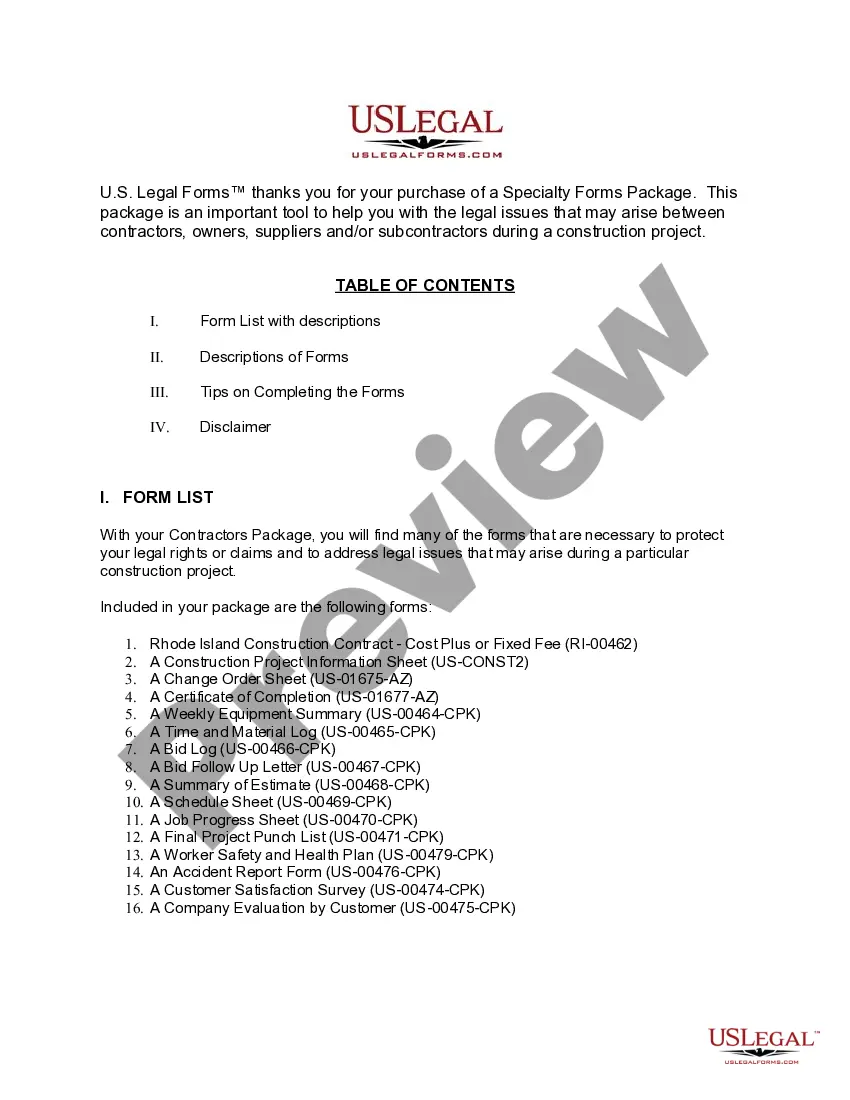
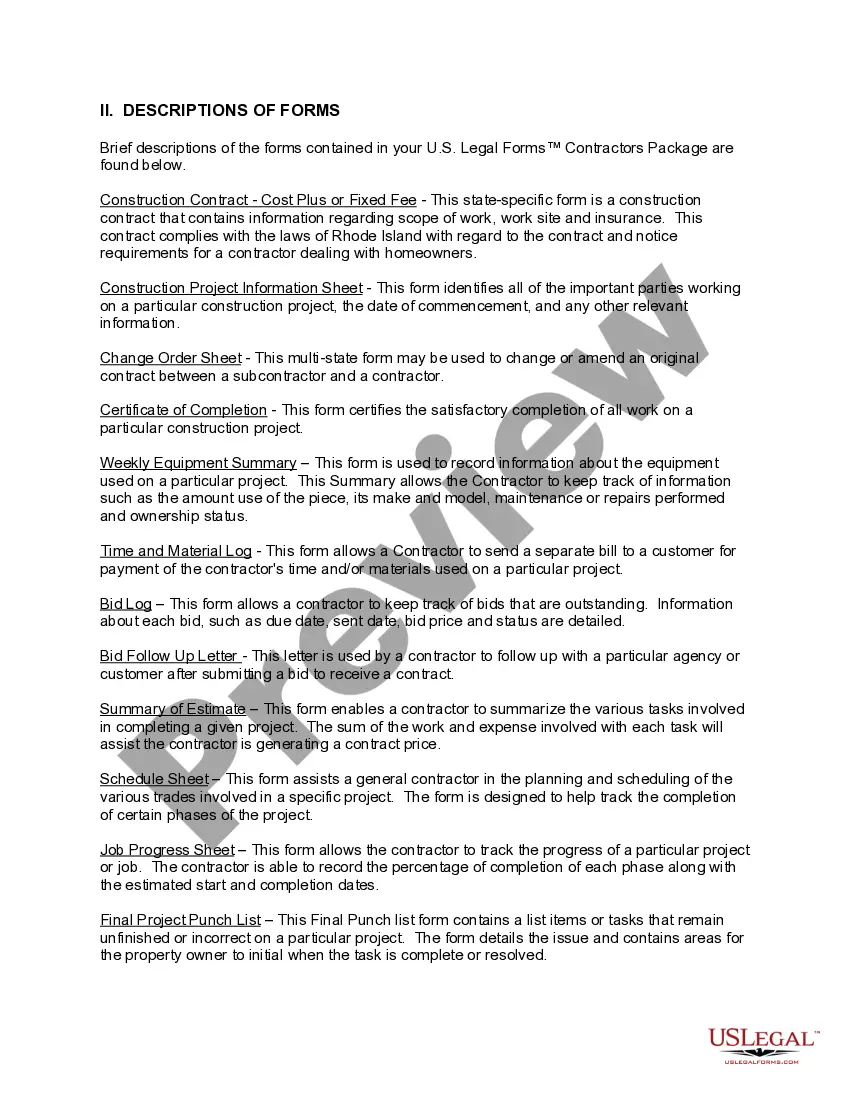
Forms provided in this package
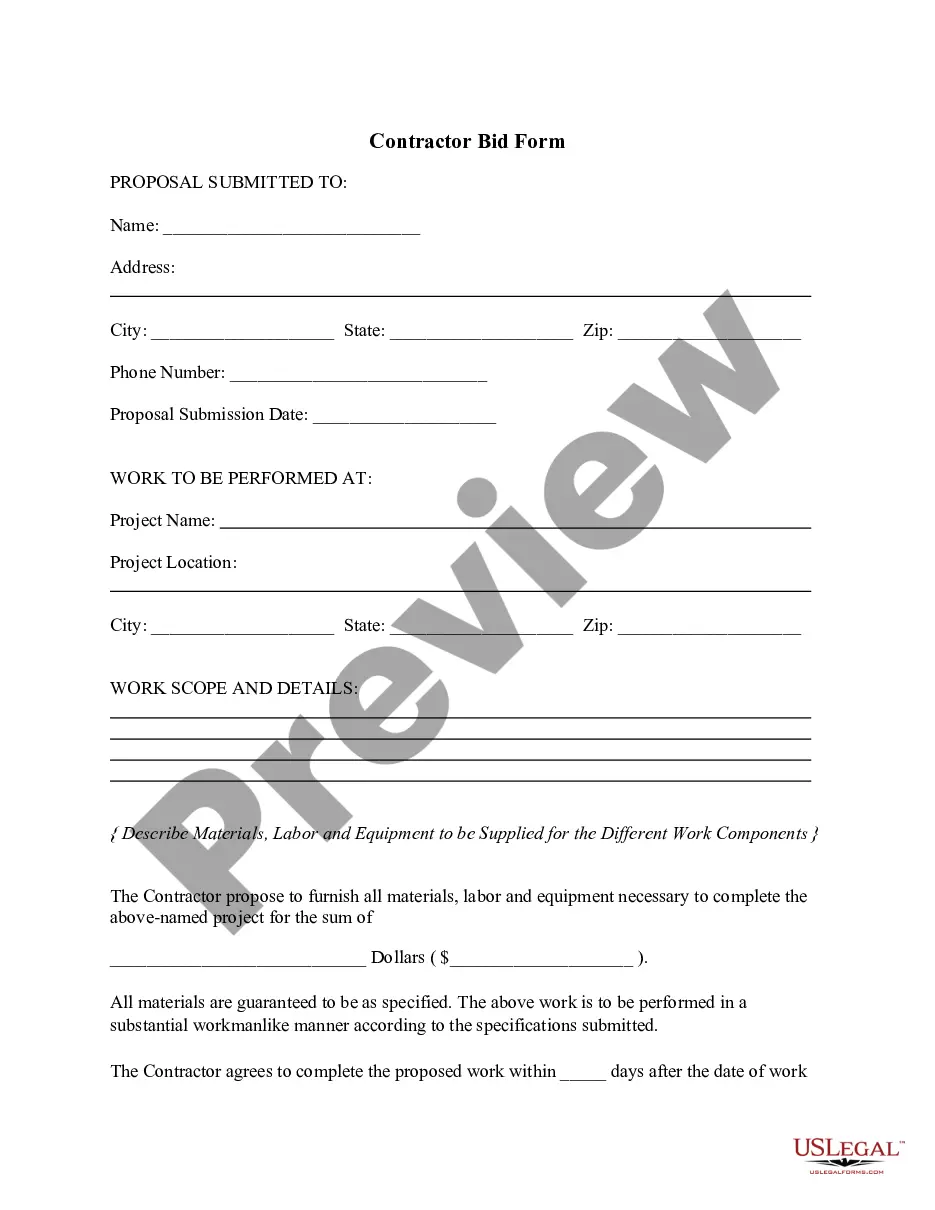
- Construction Contract Cost Plus or Fixed Fee
- Contractor's Weekly Equipment Summary
- Contractor's Time and Materials Log
- Contractor's Bid Log
- Contractor's Bid Follow Up Letter
- Contractor's Summary of an Estimate
- Contractor's Schedule Sheet
- Contractor's Job Progress Sheet
- Contractor's Final Punch List
- Customer Satisfaction Survey
- Construction Company Evaluation by a Customer
- Construction Accident Report
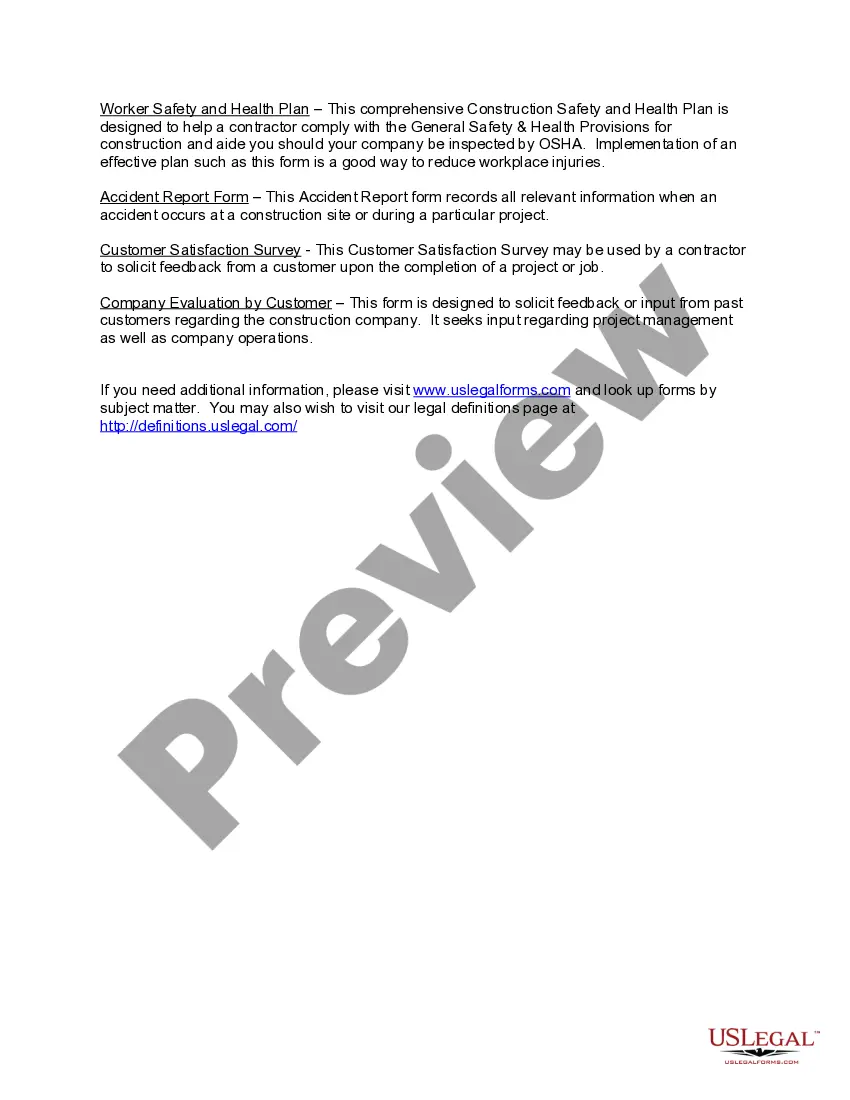
- Construction Safety and Health Plan
- Change Order for Construction or Repairs by Contractor
- Certification of Completion by Contractor
- Construction Project Information Sheet
Common use cases
This form package is particularly useful in a range of scenarios, including:
- Drafting construction contracts for new projects.
- Documenting changes to existing contracts through change orders.
- Ensuring project completion is formally recognized with a Certificate of Completion.
- Tracking project progress and safety through logs and plans.
- Gathering customer feedback after project completion.
Who should use this form package
- Contractors working on construction projects in Rhode Island.
- Subcontractors who need to manage legal documentation in a construction context.
- Suppliers providing materials for construction projects.
- Project owners requiring legal documentation to protect their investments.
- Any party seeking to ensure legal compliance and proper documentation in construction ventures.
Instructions for completing these forms
- Review all included forms to understand their purposes and uses.
- Identify the relevant parties involved in your project and fill in the Construction Project Information Sheet.
- Enter necessary dates, project details, and completion criteria in the respective forms.
- Document any changes to contracts using the Change Order Sheet as situations arise.
- Ensure all logs and reports are completed regularly for accurate tracking of the project.
Do forms in this package need to be notarized?
Forms in this package typically do not require notarization unless specified by your local law. However, it is essential to verify specific requirements for your project location and ensure compliance with Rhode Island regulations.
Get your form ready online
Our built-in tools help you complete, sign, share, and store your documents in one place.
Make edits, fill in missing information, and update formatting in US Legal Forms—just like you would in MS Word.
Download a copy, print it, send it by email, or mail it via USPS—whatever works best for your next step.
Sign and collect signatures with our SignNow integration. Send to multiple recipients, set reminders, and more. Go Premium to unlock E-Sign.
If this form requires notarization, complete it online through a secure video call—no need to meet a notary in person or wait for an appointment.
We protect your documents and personal data by following strict security and privacy standards.

Make edits, fill in missing information, and update formatting in US Legal Forms—just like you would in MS Word.

Download a copy, print it, send it by email, or mail it via USPS—whatever works best for your next step.

Sign and collect signatures with our SignNow integration. Send to multiple recipients, set reminders, and more. Go Premium to unlock E-Sign.

If this form requires notarization, complete it online through a secure video call—no need to meet a notary in person or wait for an appointment.

We protect your documents and personal data by following strict security and privacy standards.
Typical mistakes to avoid
- Failing to fill out required fields, which can lead to disputes later on.
- Not keeping copies of completed forms for documentation and reference.
- Ignoring state-specific clauses or requirements when drafting contracts.
- Delaying the submission of vital forms, such as Change Order Sheets, which can affect project timelines.
- Underestimating the importance of collecting customer feedback for future improvements.
Advantages of online completion
- Convenient access to all forms from any location at any time.
- Edit and customize forms according to your specific needs, ensuring relevance to your project.
- Reliable legal documents drafted by licensed attorneys to minimize errors and ensure compliance.
- Cost-effective option, saving you money compared to purchasing forms individually.
- Simplifies the process of obtaining essential paperwork, reducing delays in project execution.
Legal use & context
- All forms are designed to enhance legal protection and clarity in construction projects.
- Legal effectiveness is contingent upon proper completion and adherence to state laws.
- Users are encouraged to consult with a licensed attorney for complex legal situations or clarification of terms.
What to keep in mind
- The Rhode Island Contractors Forms Package provides necessary documentation for various construction-related activities.
- Understanding when and how to use these forms can significantly impact the success of your projects.
- Staying compliant with state-specific requirements is crucial for legal validity.
- Using these forms can help prevent misunderstandings and disputes between parties involved in construction projects.
Looking for another form?
Form popularity
FAQ
Landscaping (mowing, trimming, planting, etc.) Construction Demolition. Quick Loading & Unloading. Multitasking Skills. Hand Tools & Power Tools. Farm & Field Work. Ability to Lift Heavy Loads. Physical Stamina and Strength.
As an independent contractor, you'll usually make more money than if you were an employee. Companies are willing to pay more for independent contractors because they don't have the enter into expensive, long-term commitments or pay health benefits, unemployment compensation, Social Security taxes, and Medicare taxes.
A building contractor is an individual who engages in construction management. These consist of planning, developing and coordinating of activities of a successful building construction project.
General Contractors (including construction managers) earn an average of $43.93 per hour, or $91,370 per year.
Physical Strength and Endurance. Dexterity and Hand-Eye Coordination. Building and Engineering Knowledge. Strong Reading and Math Skills. Memory. Communication. Experience with Technology.
Herigstad says the tax responsibilities are a main reason for a contractor to get more pay than an employee typically 25% to 30% more.
Physical Strength and Endurance. Dexterity and Hand-Eye Coordination. Building and Engineering Knowledge. Strong Reading and Math Skills. Memory. Communication. Experience with Technology.
Project Planning Responsibilities. Plan important project development and implementation in advance. Project Management. Manage the budget for the completion of construction activities. Project Monitoring. Legal and Regulatory Responsibilities. Health and Safety Responsibilities.
According to the Construction Financial Management Association (www.cfma.org), the average pre-tax net profit for general contractors is between 1.4 and 2.4 percent and for subcontractors between 2.2 to 3.5 percent. This is not enough profit to compensate the risk contractors take.
Generally speaking, a general contractor is someone who manages a team of subcontractors to help do various types of construction projects in your home. A custom home builder, however, is specialized in building custom homes and is able to complete this specific type of project start to finish on their own.