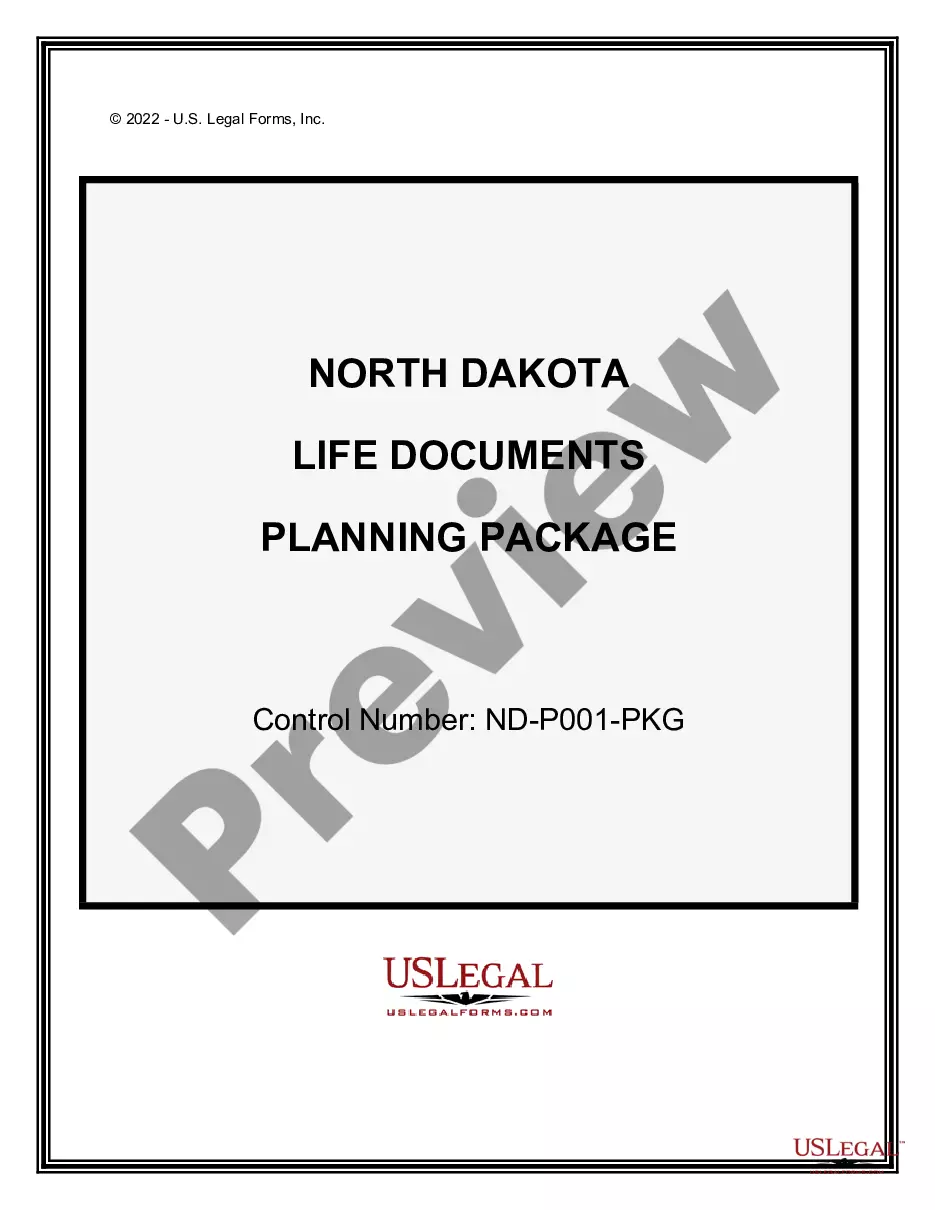
North Dakota Life Documents Planning Package, including Will, Power of Attorney and Living Will
Overview of this form package
The North Dakota Life Documents Planning Package is a comprehensive set of essential legal forms designed to assist individuals in organizing their estate and healthcare preferences. This package includes a Last Will, a General Durable Power of Attorney for Property and Finances, and a Statutory Health Care Directive, among others. It helps safeguard your wishes during late-life and emergency situations, ensuring your legal affairs are in order and reflect your specific needs within North Dakota law.
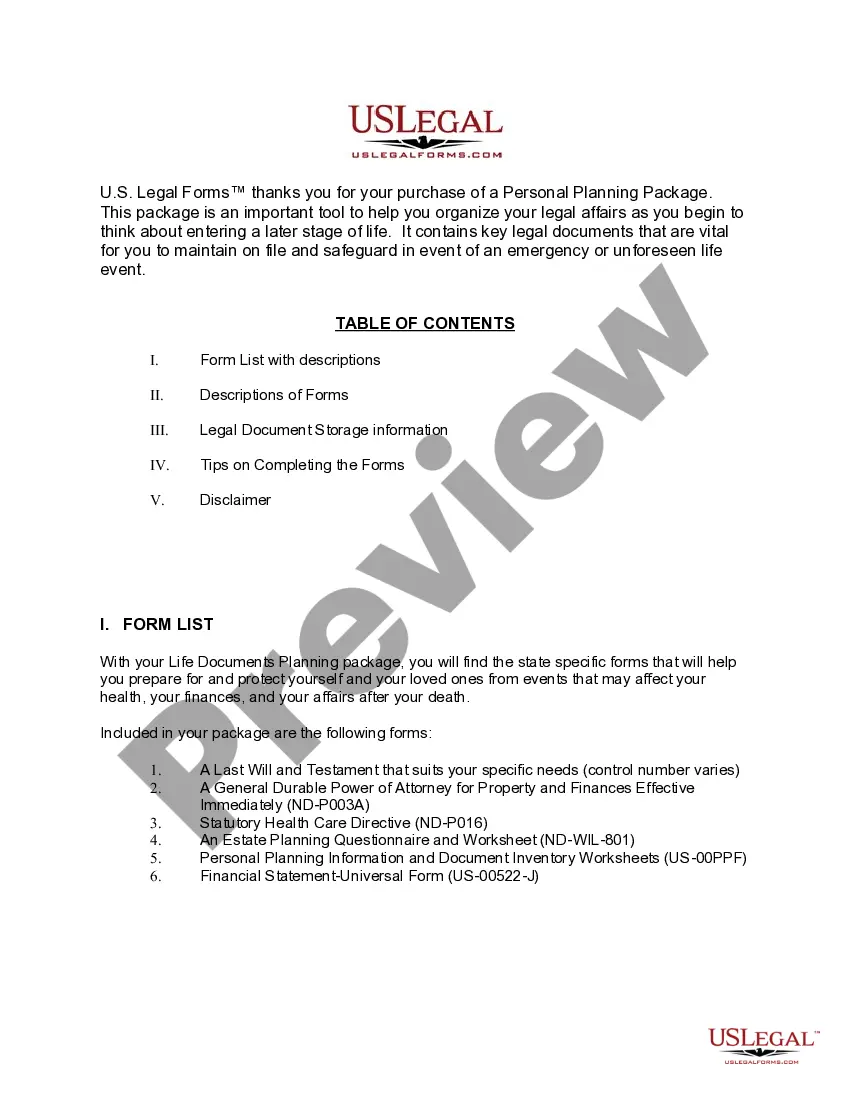
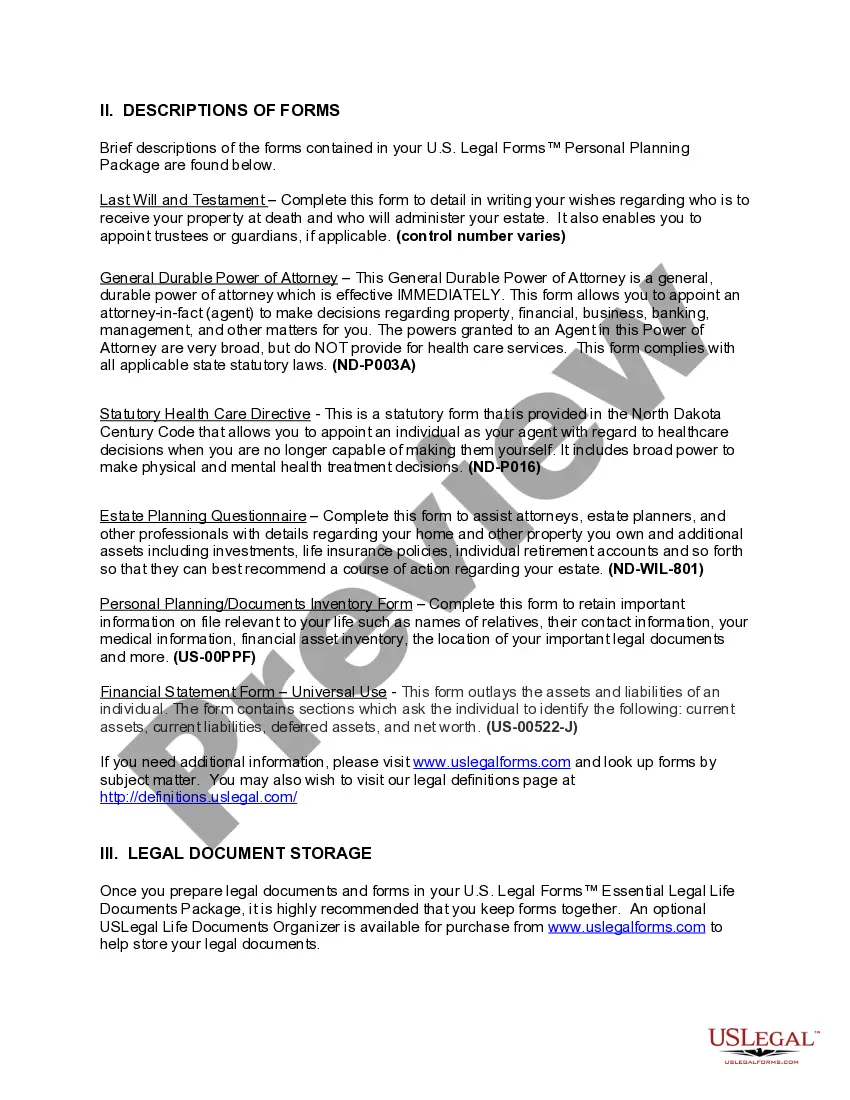
Forms provided in this package
- Last Will and Testament
- General Durable Power of Attorney for Property and Finances or Financial Effective Immediately
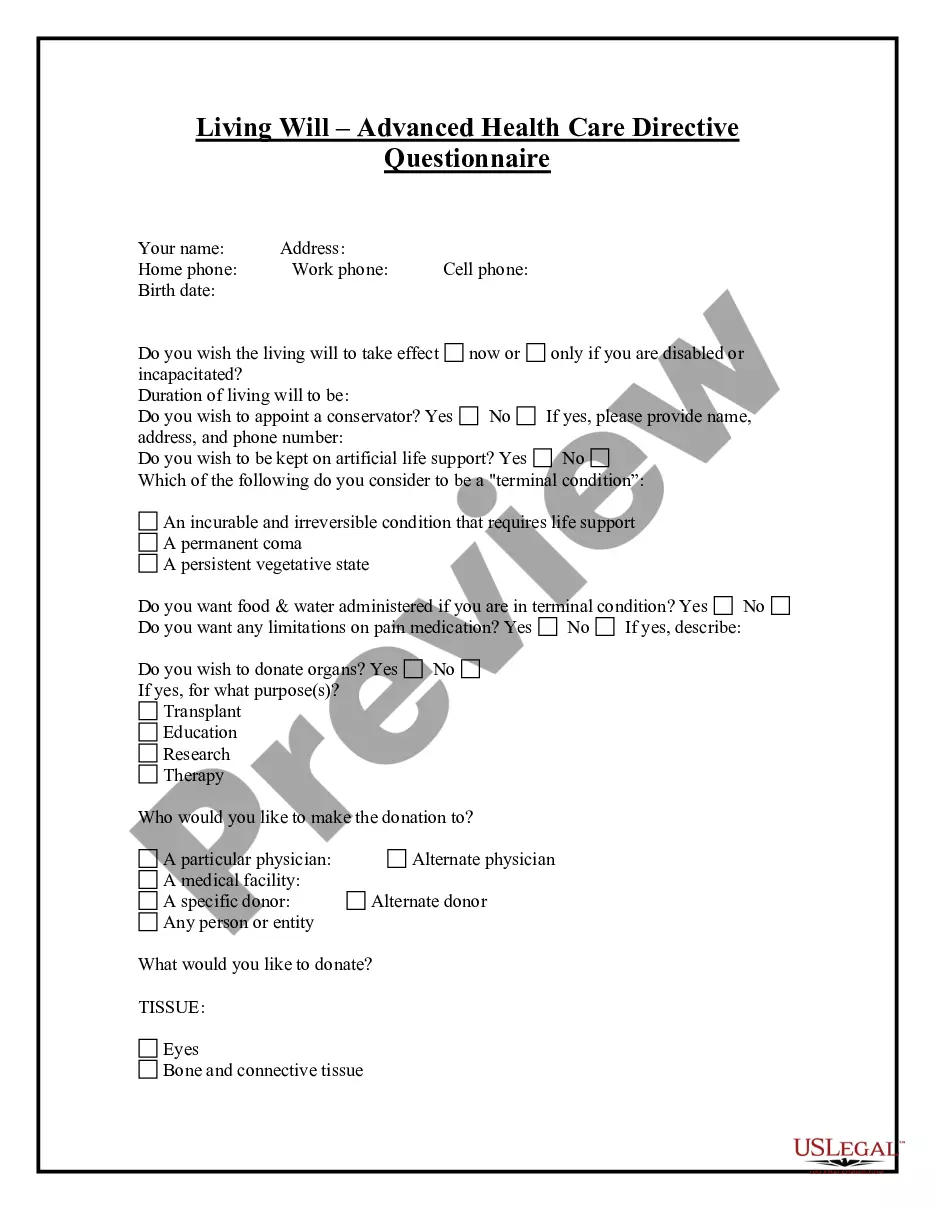
- Statutory Health Care Directive
- Estate Planning Questionnaire and Worksheets
- Sample Letter for Request for Free Credit Report Allowed by Federal Law
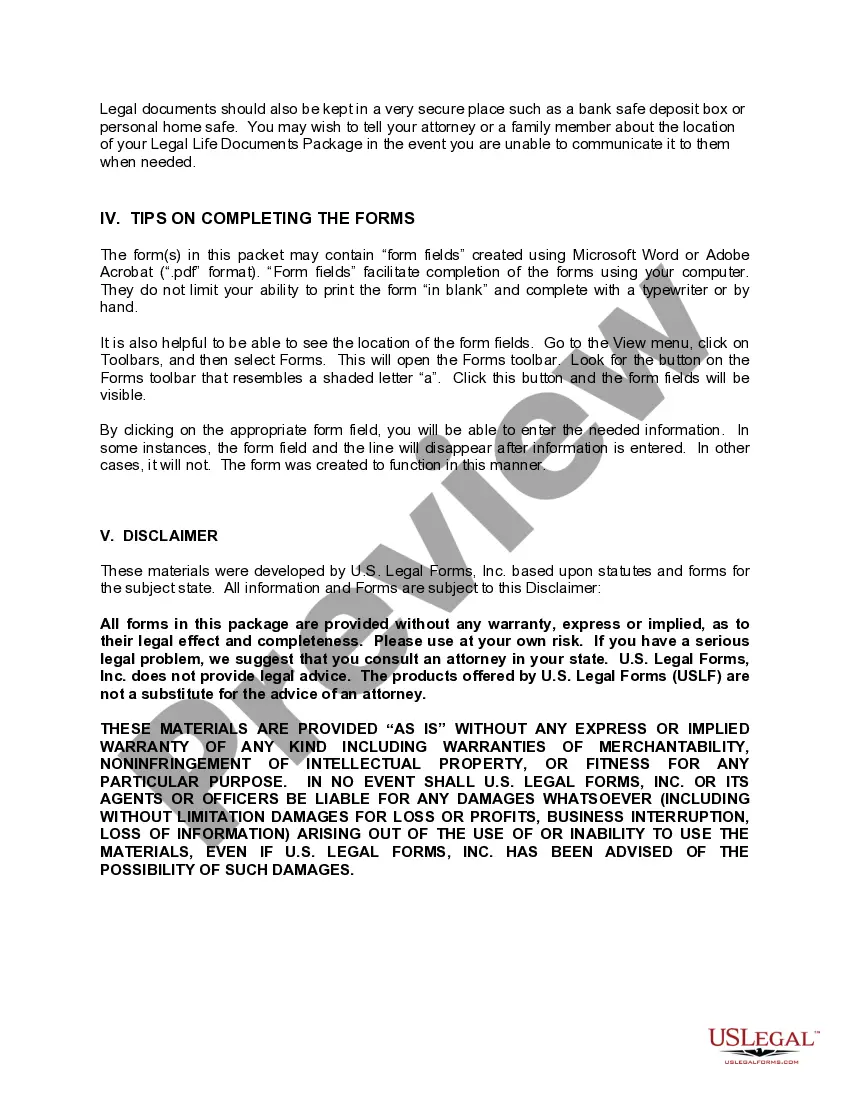
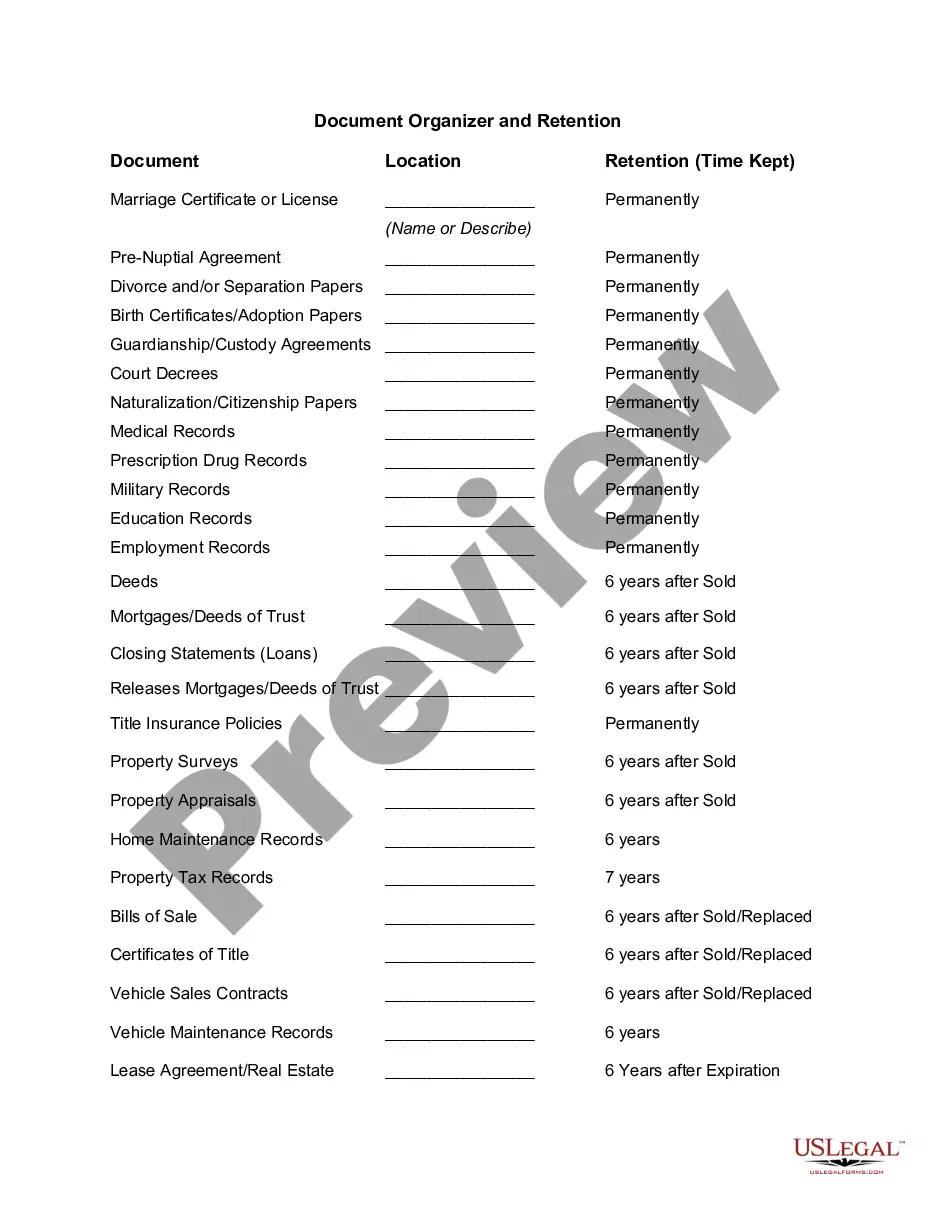
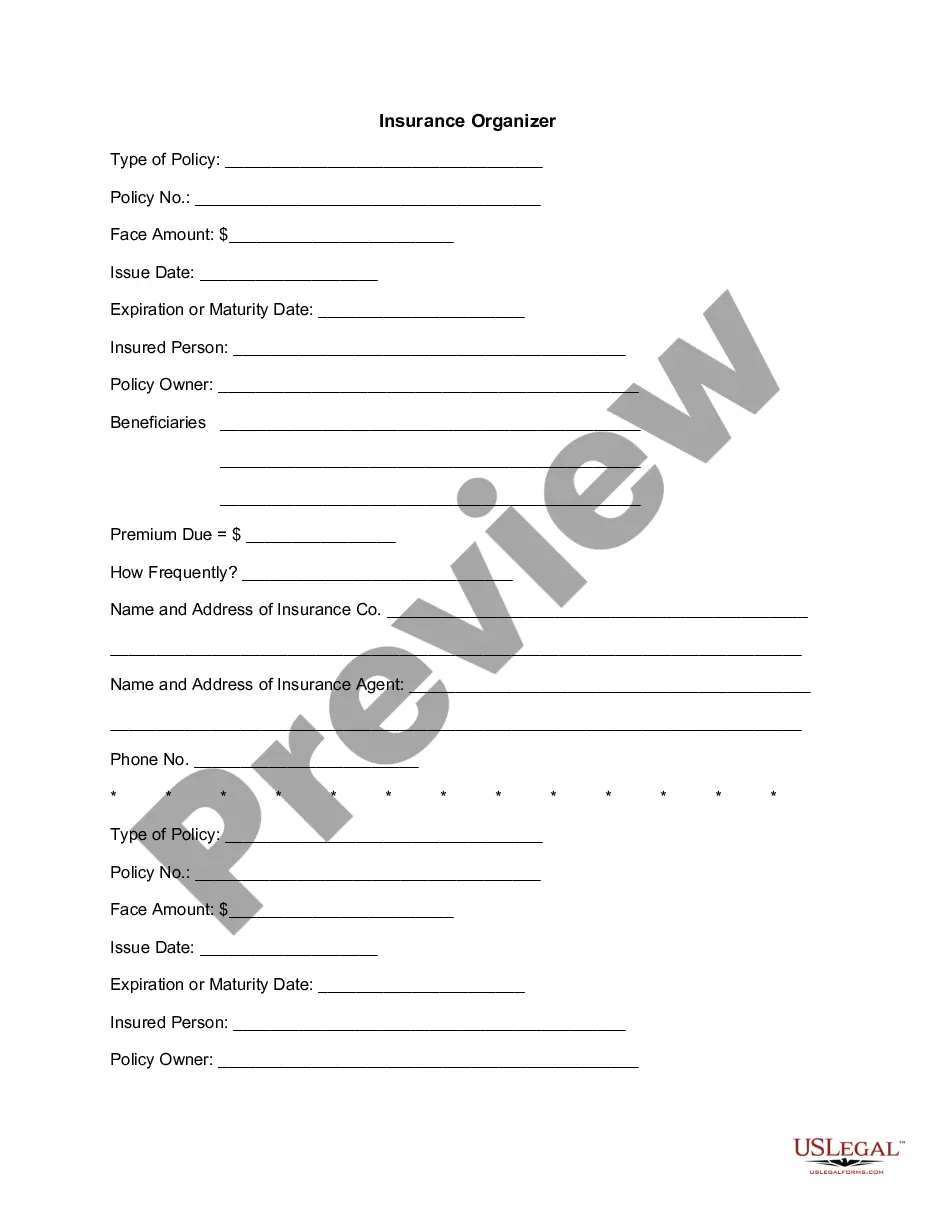
- Personal Planning Information and Document Inventory Worksheets - A Legal Life Document
- Estate Planning Questionnaire
When this form package is needed
This form package is particularly useful in several scenarios, such as:
- When you want to outline your final wishes regarding the distribution of your assets after death.
- If you need to delegate decision-making authority regarding your financial and property matters.
- When you want to ensure your healthcare preferences are known if you are unable to communicate them.
- When planning your estate to avoid potential conflicts among heirs and assure your intentions are documented.
- If you are preparing for significant life changes, such as retirement or a health crisis.
Who needs this form package
- Individuals who are 18 years or older and want to establish their Last Will.
- Anyone looking to appoint a trusted agent for their finances through a General Durable Power of Attorney.
- People who want to express their healthcare wishes through a Statutory Health Care Directive.
- Those planning their estate, regardless of the size of their assets.
How to prepare this document
- Review the included forms to understand each document's purpose and requirements.
- Identify the parties involved and gather necessary information, such as contact details and asset information.
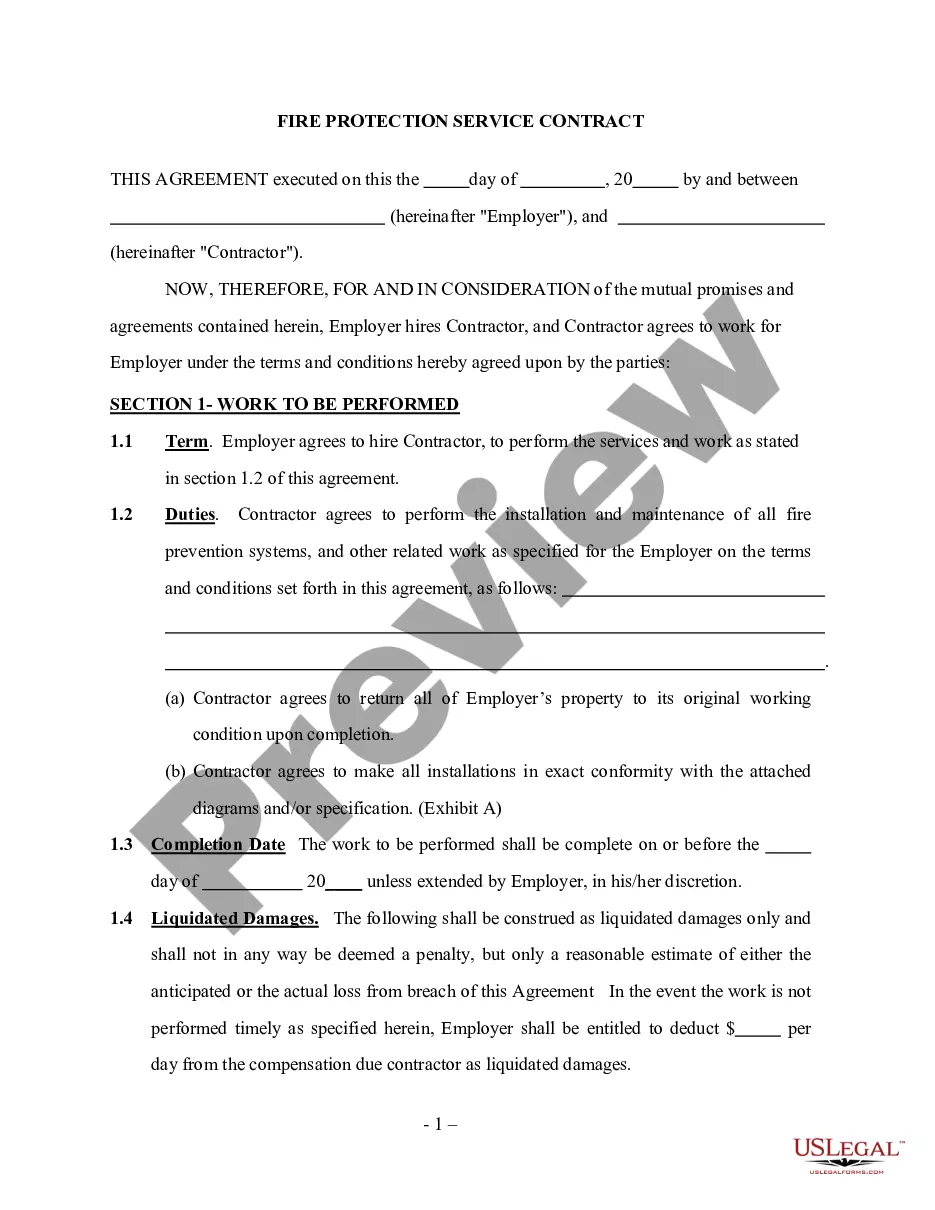
- Complete the Last Will, Durable Power of Attorney, and Statutory Health Care Directive with specific details pertinent to your wishes.
- Use the Estate Planning Questionnaire and Worksheets to help assemble your financial and personal information.
- Store the completed documents in a secure location, making sure trusted individuals know how to access them.
Notarization requirements for forms in this package
Forms in this package typically do not require notarization unless required by local law. However, it is advisable to check specific requirements based on your situation to ensure these documents are legally binding and enforceable.
Get your form ready online
Our built-in tools help you complete, sign, share, and store your documents in one place.
Make edits, fill in missing information, and update formatting in US Legal Forms—just like you would in MS Word.
Download a copy, print it, send it by email, or mail it via USPS—whatever works best for your next step.
Sign and collect signatures with our SignNow integration. Send to multiple recipients, set reminders, and more. Go Premium to unlock E-Sign.
If this form requires notarization, complete it online through a secure video call—no need to meet a notary in person or wait for an appointment.
We protect your documents and personal data by following strict security and privacy standards.

Make edits, fill in missing information, and update formatting in US Legal Forms—just like you would in MS Word.

Download a copy, print it, send it by email, or mail it via USPS—whatever works best for your next step.

Sign and collect signatures with our SignNow integration. Send to multiple recipients, set reminders, and more. Go Premium to unlock E-Sign.

If this form requires notarization, complete it online through a secure video call—no need to meet a notary in person or wait for an appointment.

We protect your documents and personal data by following strict security and privacy standards.
Typical mistakes to avoid
- Not signing the documents according to state requirements, which may invalidate them.
- Failing to review the documents thoroughly for accuracy and completeness.
- Not discussing your decisions with your appointed agents or family members.
- Neglecting to keep the documents updated after major life events (e.g., marriage, divorce, birth of children).
Why complete this package online
- Convenience of accessing and downloading essential legal documents from home.
- Customizable forms that can be easily edited to fit your personal situation.
- Peace of mind knowing the forms are drafted based on current state laws by licensed attorneys.
- Affordability compared to traditional legal services.
Quick recap
- The package includes essential documents for estate planning, financial management, and healthcare decisions.
- It is tailored specifically for North Dakota residents, ensuring compliance with state laws.
- Proper completion and organization of these forms can help safeguard your wishes and facilitate easier management of affairs by your loved ones.
Looking for another form?

Form popularity
FAQ
A living will is a vital part of the estate plan. You can alter it as your preferences and needs change over time.But your family cannot override your living will. They cannot take away your authority to make your own treatment and care plans.
Advance directives are oral and written instructions about future medical care should your parent become unable to make decisions (for example, unconscious or too ill to communicate).A living will is one type of advance directive. It takes effect when the patient is terminally ill.
You can give a person complete authority to make all decisions, or limit them significantly to make only specific decisions.If you want specificity, it is better to do that in your living will, which the person with a durable power of attorney cannot override.
A living will is only valid if you are unable to communicate your wishes. A health care power of attorney gives someone else (the proxy) the ability to make decisions for you regarding your health care. Unlike a living will, it applies to both end-of-life treatment as well as other areas of medical care.
The living will. Durable power of attorney for health care/Medical power of attorney. POLST (Physician Orders for Life-Sustaining Treatment) Do not resuscitate (DNR) orders. Organ and tissue donation.
An advance directive is a set of instructions someone prepares in advance of ill health that determines his healthcare wishes. A living will is one type of advance directive that becomes effective when a person is terminally ill.
The cost of setting up a living will varies from state to state, depending on whether it must be witnessed by a notary. Costs typically fall between $250-$500 to hire a lawyer to draft the living will, while forms can be self-completed for between $45 and $75.
Living will. A living will is a written, legal document that spells out medical treatments you would and would not want to be used to keep you alive, as well as your preferences for other medical decisions, such as pain management or organ donation. In determining your wishes, think about your values.
A living will is a document that explains whether or not you want to be kept on life support if you become terminally ill and will die shortly without life support, or fall into a persistent vegetative state.A living will becomes effective only when you cannot communicate your desires on your own.