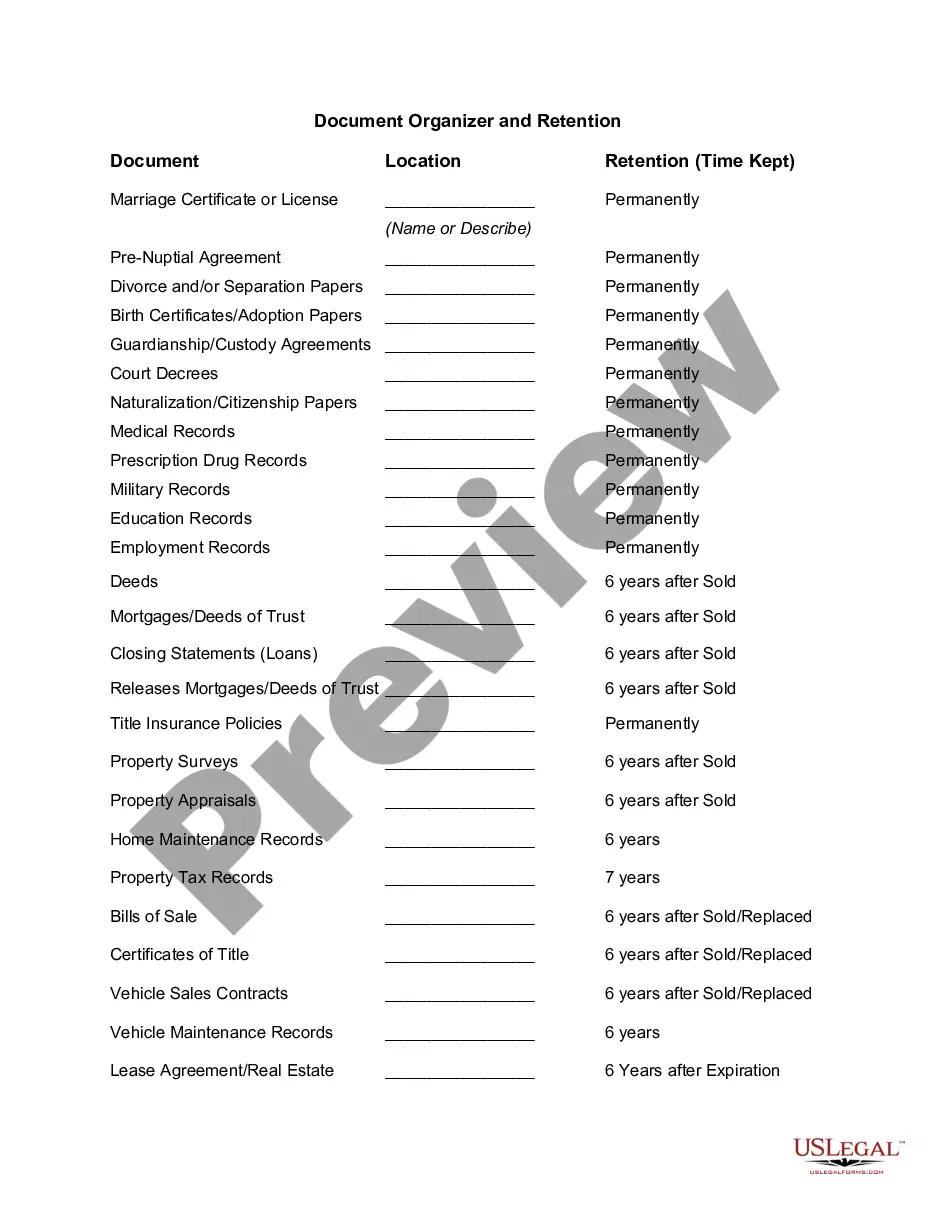
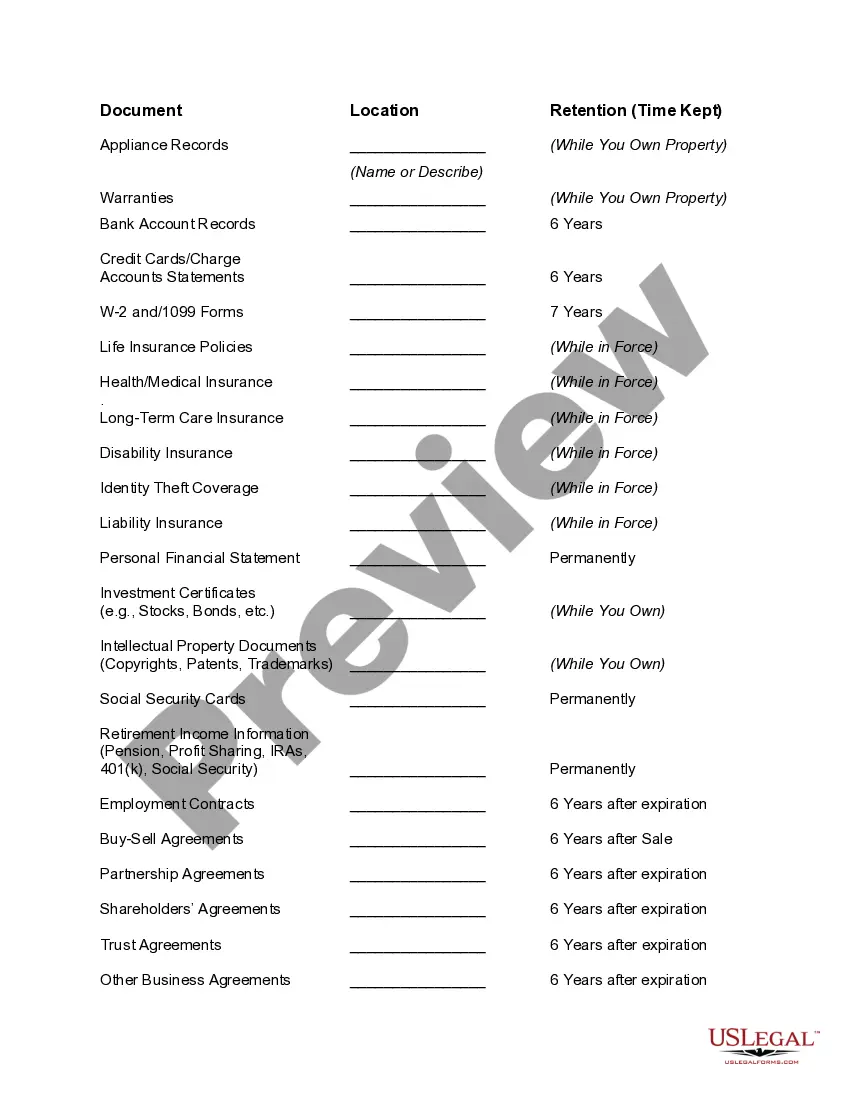
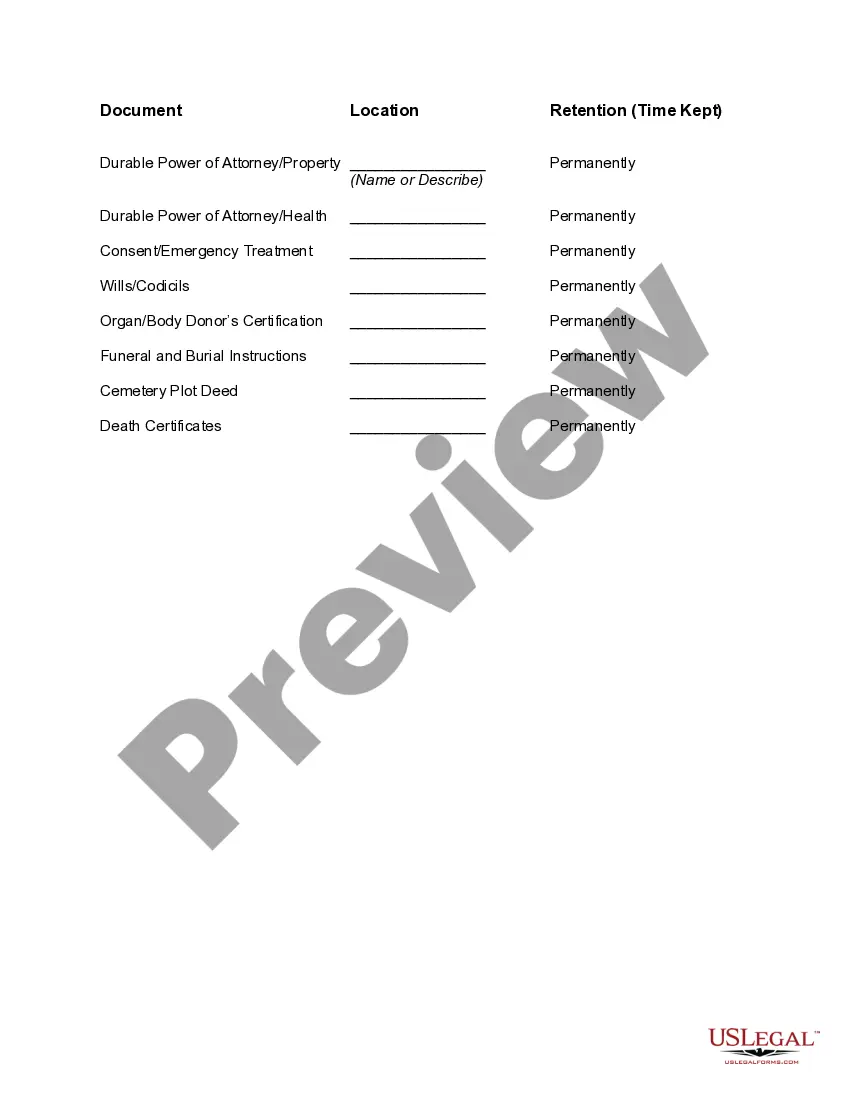
Document Organizer and Retention
What this document covers
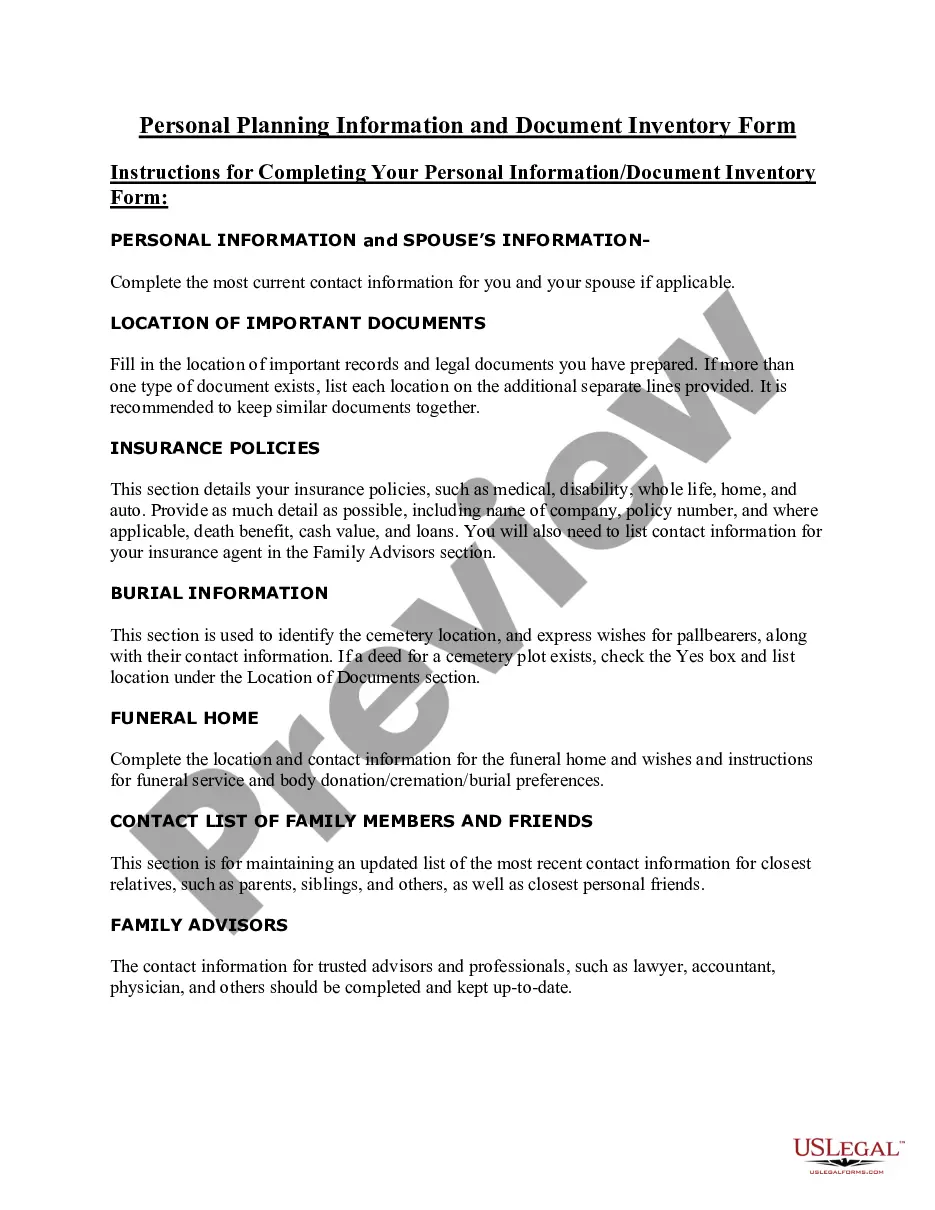
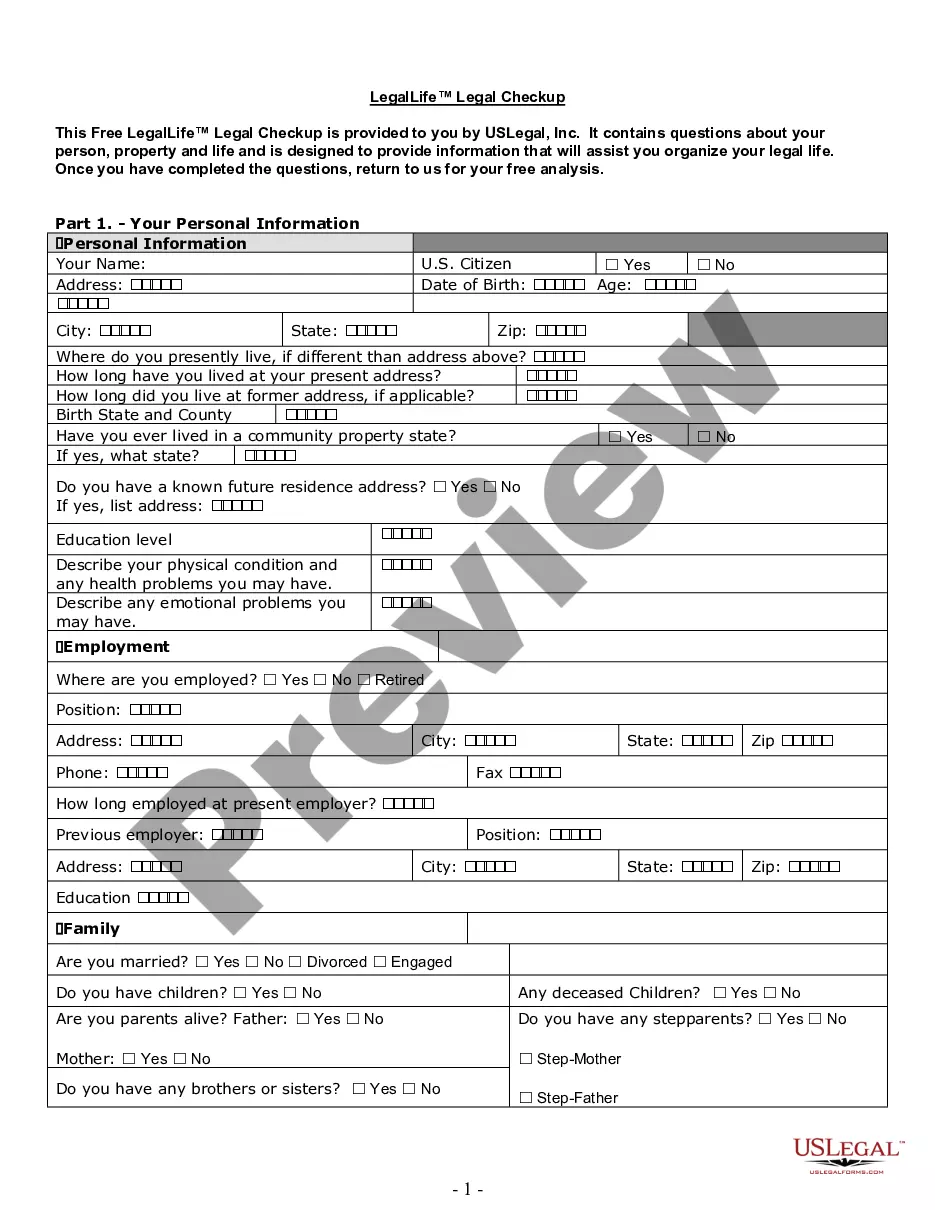
The Document Organizer and Retention form helps individuals maintain a comprehensive record of important personal documents and their retention periods. This form serves as a guide for organizing vital paperwork, ensuring that users understand when and how long to keep each document. Unlike general organizational templates, this form specifically focuses on legal and financial documents, providing clear retention guidelines drawn from expert recommendations.
Key components of this form
- Marriage and divorce documents: Includes marriage certificates, pre-nuptial agreements, and divorce papers.
- Personal identification records: Maintains birth and citizenship certificates, as well as Social Security cards.
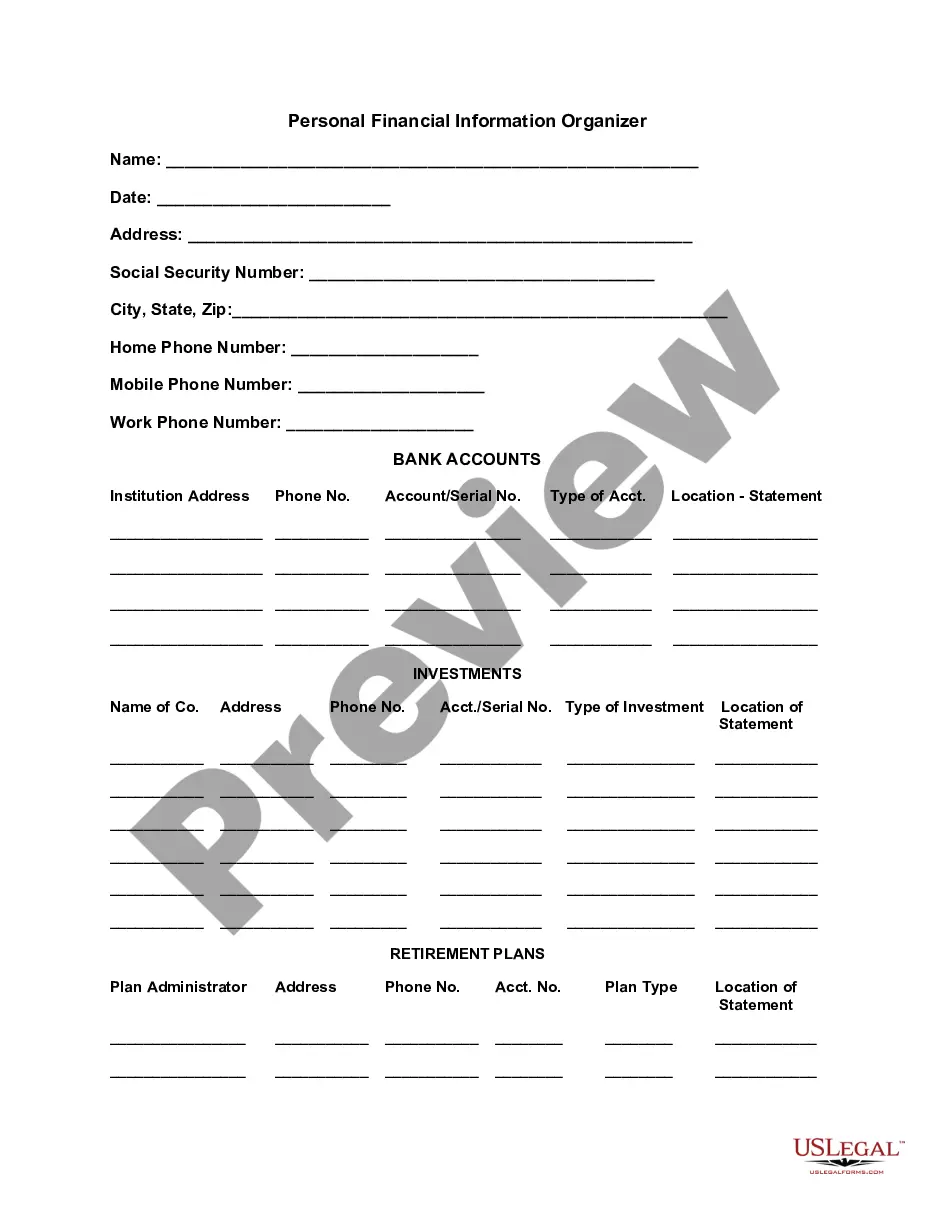
- Financial and property documents: Tracks deeds, mortgages, and financial agreements, including retention periods.
- Health-related documents: Organizes medical and insurance records along with critical healthcare powers of attorney.
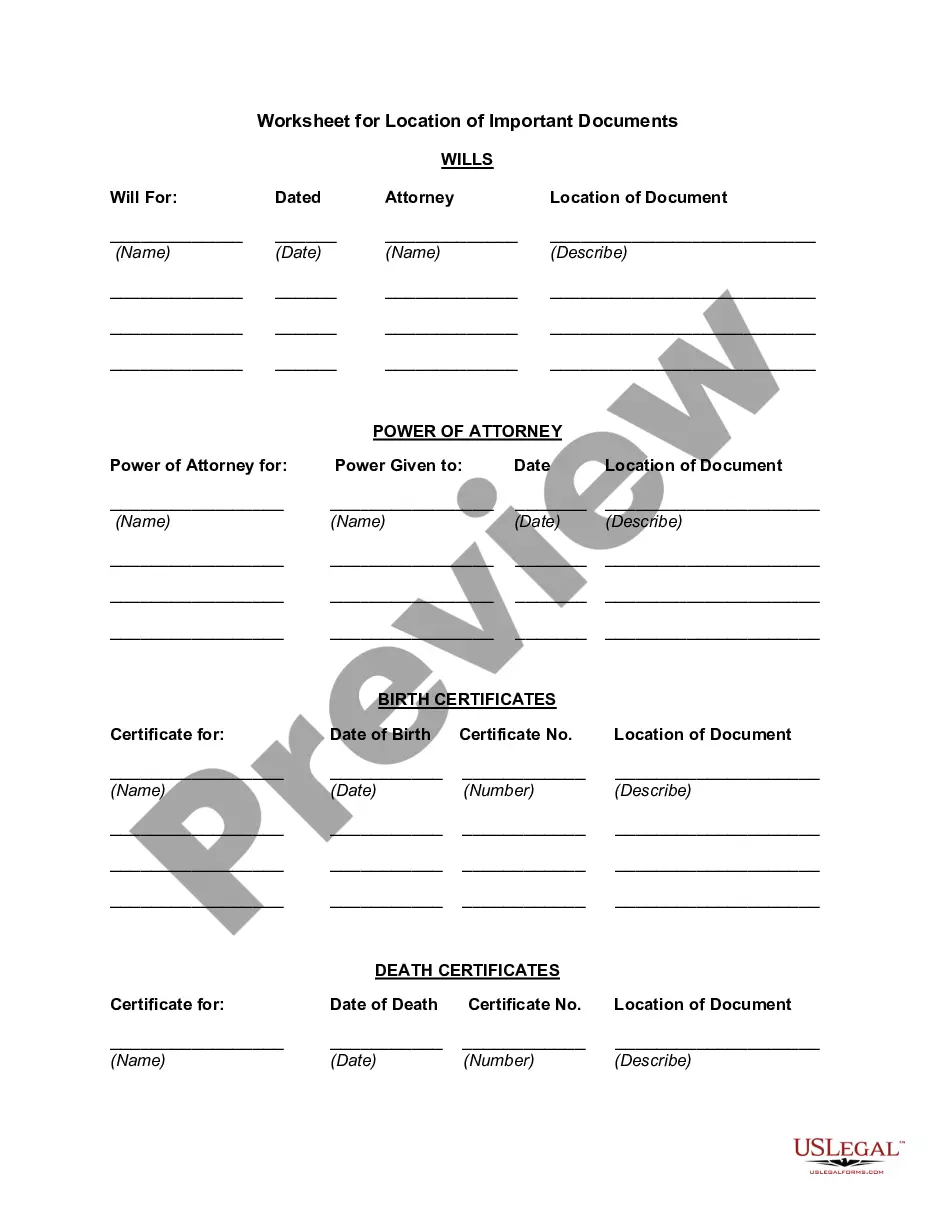
- Last wishes: Covers wills, burial instructions, and related documents that need permanent retention.
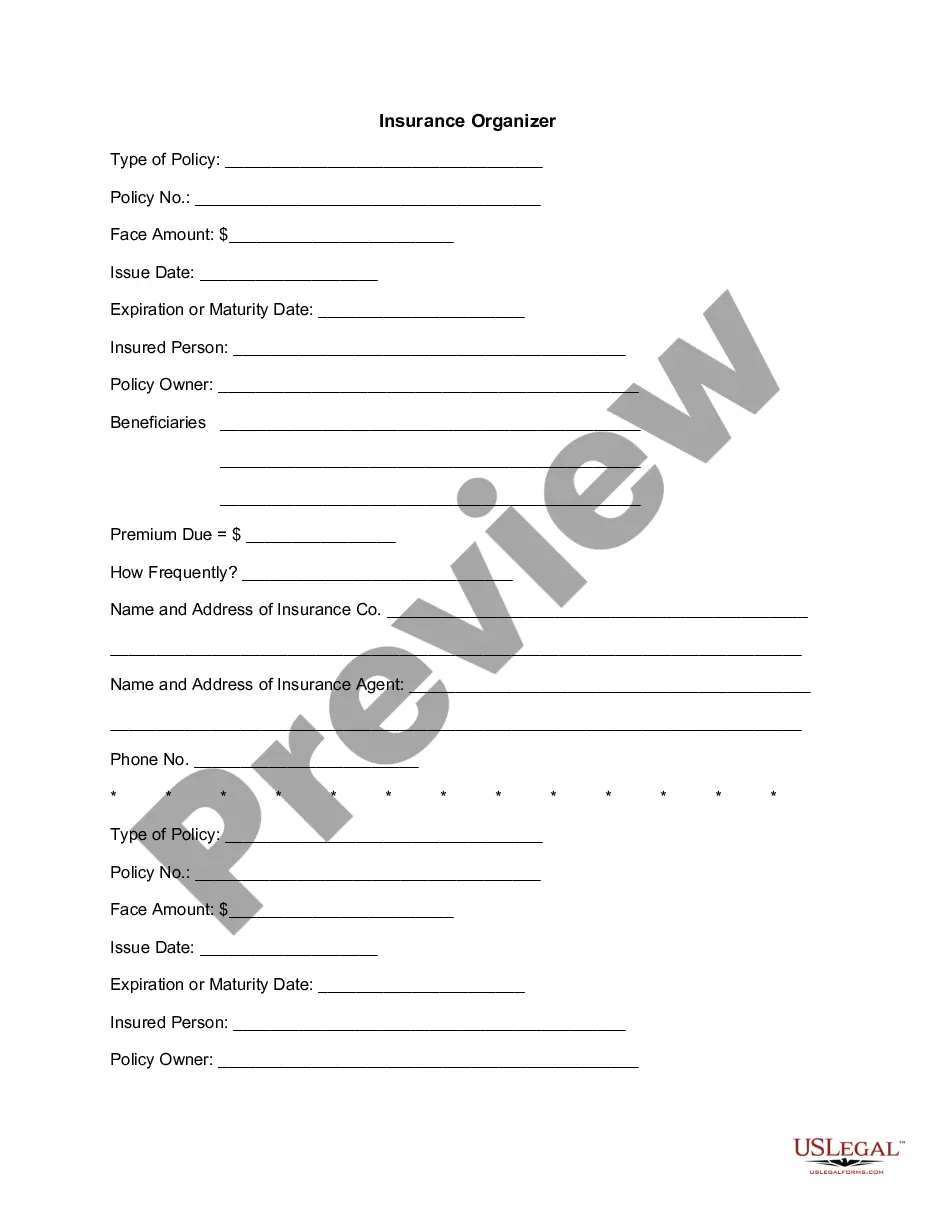
When to use this document
This form is essential for anyone looking to systematically organize their important documents. It is particularly useful in situations such as preparing for estate planning, managing personal finances or relocation, or ensuring compliance with legal requirements for document retention. By using this form, individuals can easily track which documents need to be retained for specific periods, protecting themselves and their heirs from potential legal complications.
Who needs this form
- Individuals preparing for marriage or divorce.
- Parents seeking to establish legal rights regarding custody and guardianship.
- Property owners needing to manage deeds, mortgages, and home maintenance records.
- Anyone wanting to secure their personal and financial records for future reference.
- Individuals involved in estate planning who want to ensure their final wishes are documented.
Instructions for completing this form
- Gather all relevant documents that need organization, such as marriage licenses, birth certificates, and financial papers.
- Identify the location where each document will be stored, whether in a safe deposit box or a home file.
- Specify the retention time for each document according to the guidance provided in the form.
- Write down any additional comments or specific instructions regarding access and management of these documents.
- Review the completed form to ensure all necessary documents are accounted for.
Is notarization required?
This form does not typically require notarization unless specified by local law. Users should consult state regulations regarding specific document types or signatures required to ensure the validity of their document organization efforts.
Get your form ready online
Our built-in tools help you complete, sign, share, and store your documents in one place.
Make edits, fill in missing information, and update formatting in US Legal Forms—just like you would in MS Word.
Download a copy, print it, send it by email, or mail it via USPS—whatever works best for your next step.
Sign and collect signatures with our SignNow integration. Send to multiple recipients, set reminders, and more. Go Premium to unlock E-Sign.
If this form requires notarization, complete it online through a secure video call—no need to meet a notary in person or wait for an appointment.
We protect your documents and personal data by following strict security and privacy standards.

Make edits, fill in missing information, and update formatting in US Legal Forms—just like you would in MS Word.

Download a copy, print it, send it by email, or mail it via USPS—whatever works best for your next step.

Sign and collect signatures with our SignNow integration. Send to multiple recipients, set reminders, and more. Go Premium to unlock E-Sign.

If this form requires notarization, complete it online through a secure video call—no need to meet a notary in person or wait for an appointment.

We protect your documents and personal data by following strict security and privacy standards.
Common mistakes
- Failing to include all important documents in the organizer.
- Not updating the document retention schedule when circumstances change.
- Overlooking specific retention periods for certain financial documents.
- Neglecting to review secure storage options for sensitive documents.
- Forgetting to communicate access details to heirs or trusted individuals.
Why use this form online
- Convenient access to download and update your document organizer anytime, anywhere.
- Easy ability to edit and personalize the form to meet specific needs.
- Reliable source of information, created by licensed attorneys, ensuring legal accuracy.
- Saves time by providing a structured way to organize complex legal and financial documents.
Looking for another form?
Form popularity
FAQ
A document retention policy (also known as a records and information management policy, recordkeeping policy, or a records maintenance policy) establishes and describes how a company expects its employees to manage company data from creation through destruction.
Document retention is a system that allows you and your employees to automatically create policies and determine what should be done with particular documents or records at a certain point of time.Have files automatically moved to a new folder, system, directory, or site.
Good examples. Length of time in a data retention policy ranges from minutes to years. As a result, it's important to use a policy engine that involves many different fields, such as user, department, folder and file type. A data retention policy should include email messages.
A document retention policy is only as good as its implementation.In addition, the policy must be flexible enough to be suspended if a litigation hold is necessary. The policy should address the litigation hold and how it is to be implemented, including any policy on email backup tapes.
The retention period begins at a specific time depending on the type of record. For example, the retention period for a financial record starts on July 1 of the following year. For another example, the retention period for the records of an employment search begins on the date that the hiring decision is made.
A good record retention policy can also reduce legal risks and discovery costs, as well as recovery effort time, associated with legitimate lawsuits. Destroying documents in accordance with a reasonable record retention policy can help protect your organization from legal risks.
A retention period (associated with a retention schedule or retention program) is an aspect of records and information management (RIM) and the records life cycle that identifies the duration of time for which the information should be maintained or "retained," irrespective of format (paper, electronic, or other).
Use the Default Installation Folders for Program Files. One Place for All Documents. Create Folders in a Logical Hierarchy. Nest Folders Within Folders. Follow the File Naming Conventions. Be Specific. File as You Go. Order Your Files for Your Convenience.