Illinois Co-Agent's Certification And Acceptance Of Authority
Understanding this form
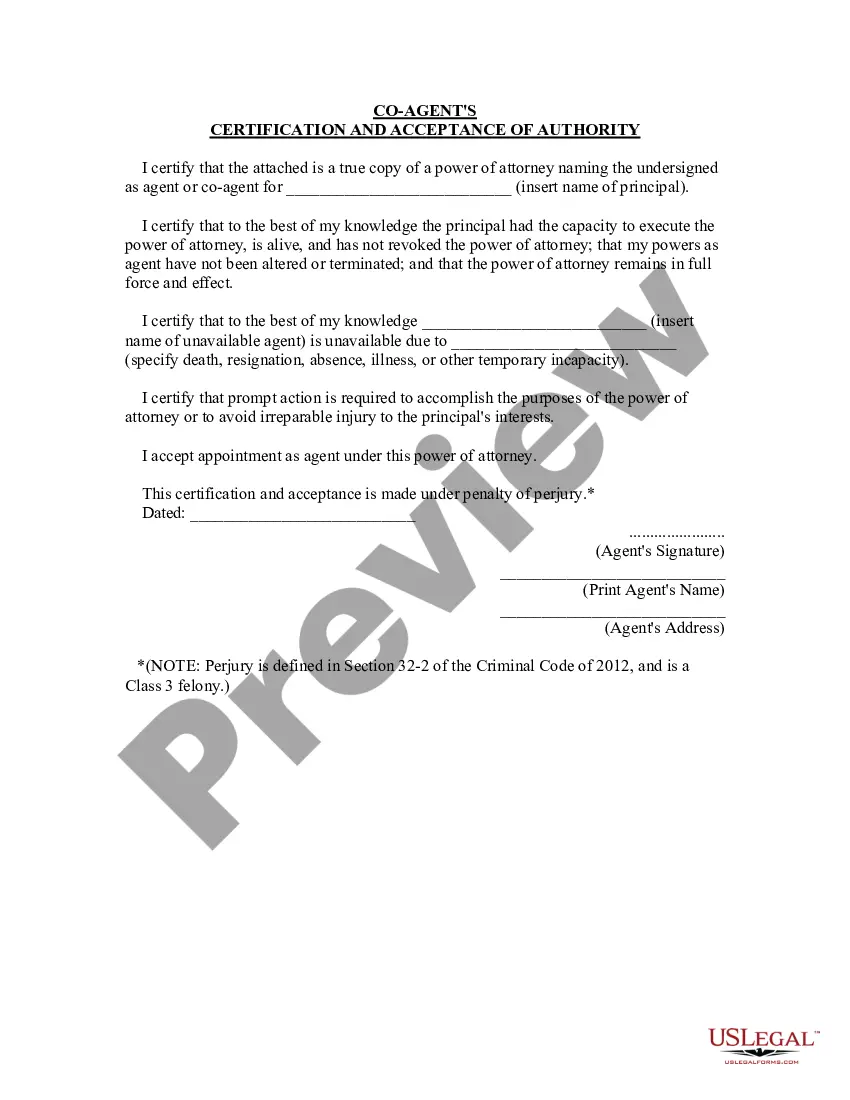
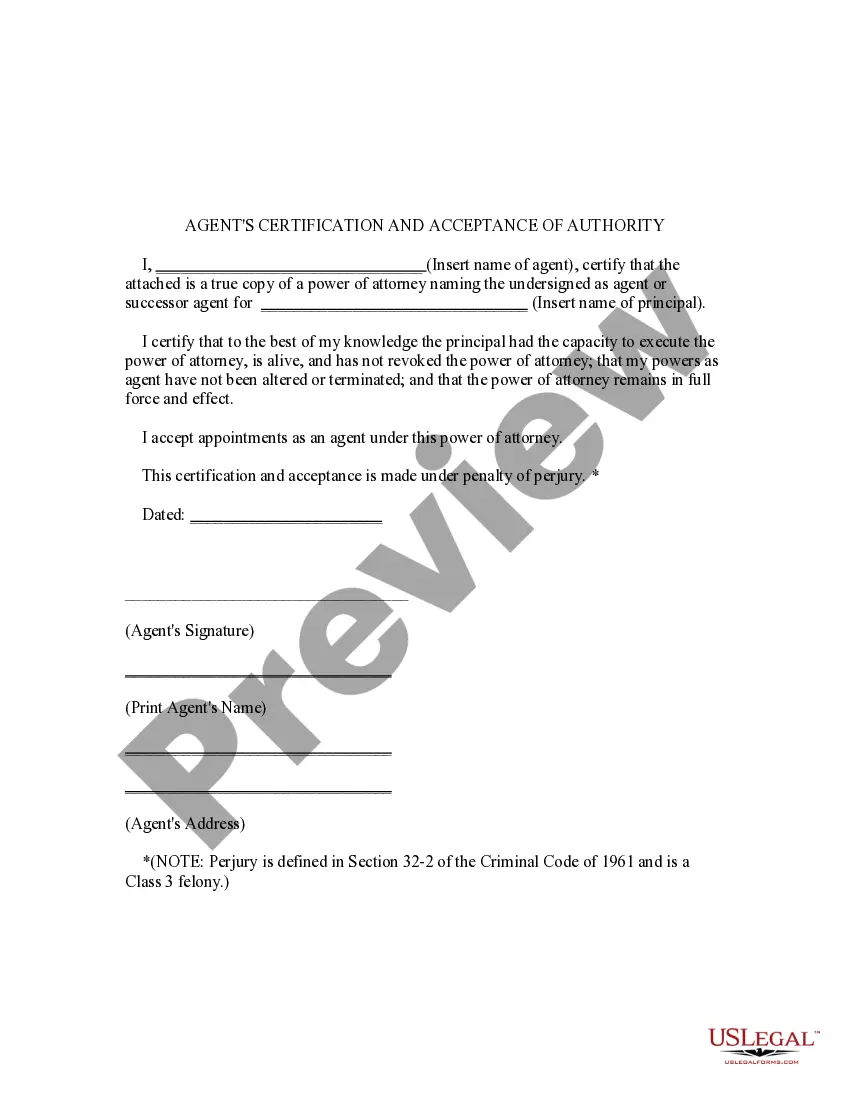
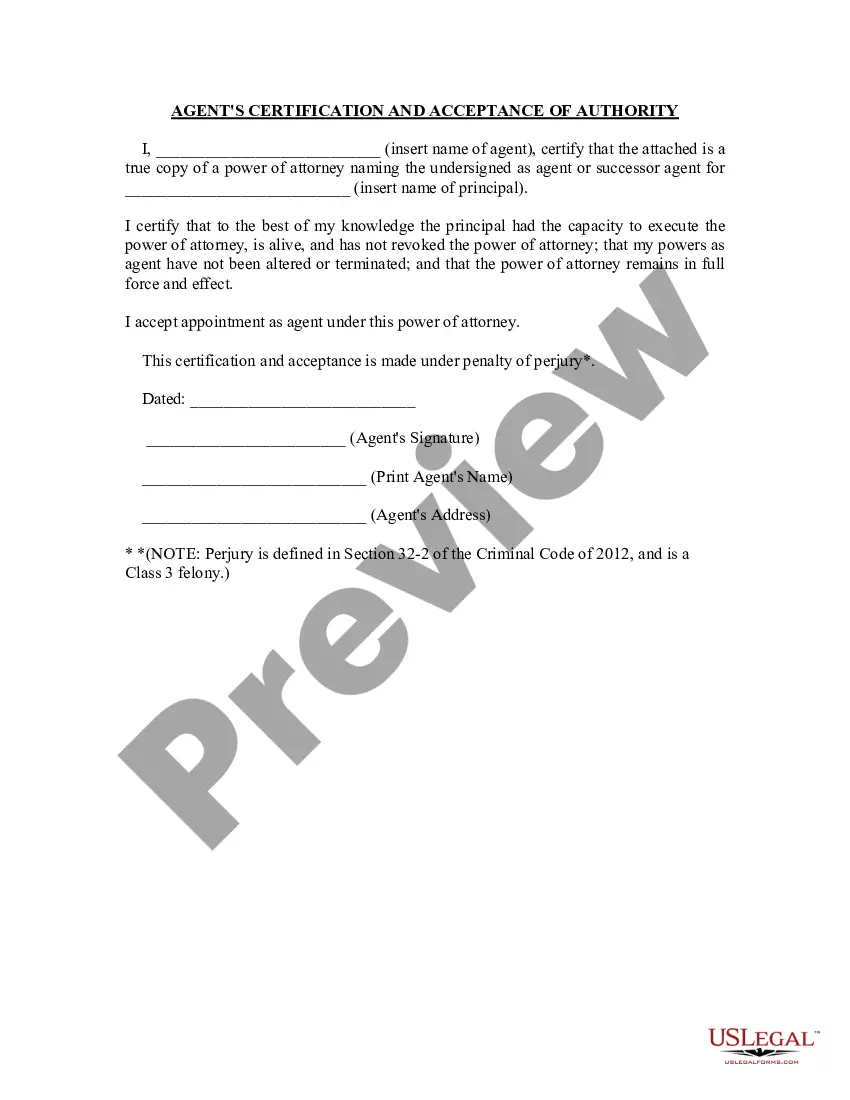
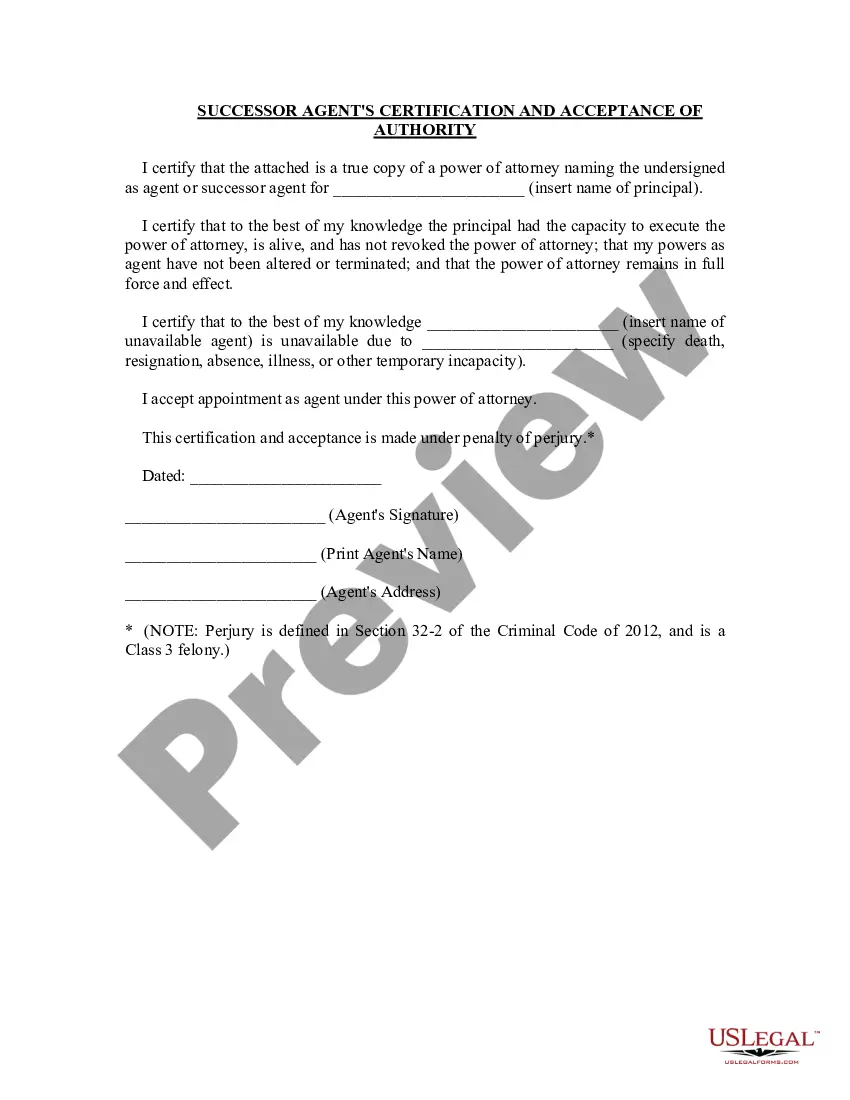
The Co-Agent's Certification and Acceptance of Authority is a legal document that enables a successor agent, named in a power of attorney, to formally accept their role and confirm the absence of the previous agent. This form is essential for ensuring that the transition of authority is clear and legally binding, differentiating it from other forms of power of attorney, which do not include a certification or acceptance process.
Key parts of this document
- Certification of the attached power of attorney as a true copy.
- Confirmation of the principal's capacity to execute the power of attorney.
- Declaration of the unavailability of the previous agent.
- Statement of the necessity for prompt action to protect the principal's interests.
- Acceptance of appointment as agent under the power of attorney.
- Agent's signature and printed name along with the agent's address.
Common use cases
This form is necessary when a successor agent needs to take over the responsibilities of a prior agent who is unavailable. Scenarios for use include situations where the previous agent has passed away, resigned, is temporarily incapacitated, or otherwise unable to fulfill their duties. It ensures the continuity of authority in representing the principal's interests.
Who can use this document
- Individuals designated as successor agents in a power of attorney.
- Co-agents who need to certify their appointment following the unavailability of another agent.
- Attorneys or legal representatives handling transition of authority matters.
Completing this form step by step
- Begin by obtaining a true copy of the original power of attorney document.
- Fill in the name of the principal in the specified field.
- Indicate the name of the previous agent and their reason for unavailability.
- State the urgency of the action required on behalf of the principal.
- Sign the form, print your name, and provide your address as the new agent.
Is notarization required?
This document requires notarization to meet legal standards. US Legal Forms provides secure online notarization powered by Notarize, allowing you to complete the process through a verified video call, available 24/7.
Get your form ready online
Our built-in tools help you complete, sign, share, and store your documents in one place.
Make edits, fill in missing information, and update formatting in US Legal Forms—just like you would in MS Word.
Download a copy, print it, send it by email, or mail it via USPS—whatever works best for your next step.
Sign and collect signatures with our SignNow integration. Send to multiple recipients, set reminders, and more. Go Premium to unlock E-Sign.
If this form requires notarization, complete it online through a secure video call—no need to meet a notary in person or wait for an appointment.
We protect your documents and personal data by following strict security and privacy standards.

Make edits, fill in missing information, and update formatting in US Legal Forms—just like you would in MS Word.

Download a copy, print it, send it by email, or mail it via USPS—whatever works best for your next step.

Sign and collect signatures with our SignNow integration. Send to multiple recipients, set reminders, and more. Go Premium to unlock E-Sign.

If this form requires notarization, complete it online through a secure video call—no need to meet a notary in person or wait for an appointment.

We protect your documents and personal data by following strict security and privacy standards.
Typical mistakes to avoid
- Failing to provide accurate information about the principal or previous agent.
- Omitting the reason for the previous agent's unavailability.
- Not signing the form, which can result in the document being deemed invalid.
Benefits of completing this form online
- Convenient and easy access to legal documents without the need for in-person meetings.
- Editable templates allow you to fill in specific details quickly and accurately.
- Reliability of documents created by licensed attorneys ensures compliance with legal standards.
Looking for another form?


Form popularity
FAQ
After the principal's name, write by and then sign your own name. Under or after the signature line, indicate your status as POA by including any of the following identifiers: as POA, as Agent, as Attorney in Fact or as Power of Attorney.
After the principal's name, write by and then sign your own name. Under or after the signature line, indicate your status as POA by including any of the following identifiers: as POA, as Agent, as Attorney in Fact or as Power of Attorney.
Signature Requirements In all states, the principal must sign the document and have it notarized. Some states also mandate two witnesses to the signature. As of 2018, some 23 states have adopted the Uniform Power of Attorney Act, which requires neither witnesses nor the agent's signature.
The person you give the power of attorney to is the agent and you are the principal. The agent is usually a spouse, a close friend, or a trusted relative. The document does not have to be notarized.
It is governed by the Illinois Power of Attorney Act.He or she must also act in accordance with the law and with the directions in this form. Your agent must keep a record of all receipts, disbursements, and significant actions taken as your agent.
1A designation of an agent and a written description of their powers.2A properly signed power of attorney document (signed by the principal)3A properly witnessed and signed power of attorney document (by an individual at least 18 years old)All About the Illinois Power of Attorney Act - M&A Law Firm\nmalawillinois.com > lawyer > 2019/07/30 > Estate-Planning > All-About-th...
The person you give the power of attorney to is the agent and you are the principal. The agent is usually a spouse, a close friend, or a trusted relative. The document does not have to be notarized.
Most states do not require a POA to be in writing in order to be effective, except in specific cases established by statute.As a result, most POAs can be executed electronically with or without authorization under the eCommerce laws, since there is no writing or signature requirement to begin with.
The Illinois POA document must list the: full contact information and signature of the principal. name of the agent(s) The power of attorney document must be signed by a notary public. Two witnesses must be present when notarizing and signing a power of attorney form.