North Carolina Excavation Contractor Package
What this form package covers
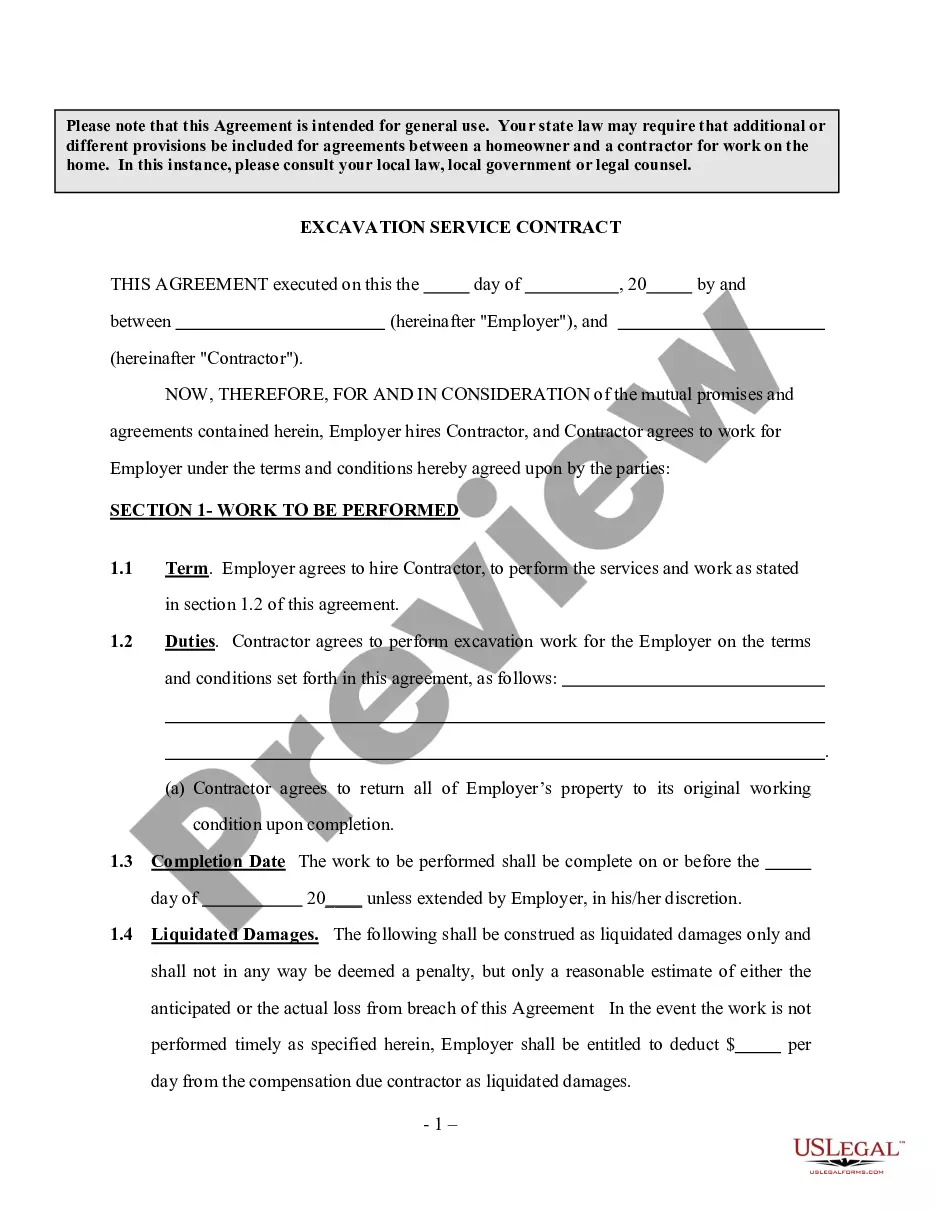
The North Carolina Excavation Contractor Package provides essential legal documents that excavation contractors need to protect their rights and manage legal issues within residential excavation, grading, backfill, or hauling projects. This package includes a state-compliant excavation contract, along with other important forms to facilitate seamless project execution and compliance with regulations. By using this package, contractors can ensure that all necessary documentation is accurately prepared and aligned with North Carolina law.
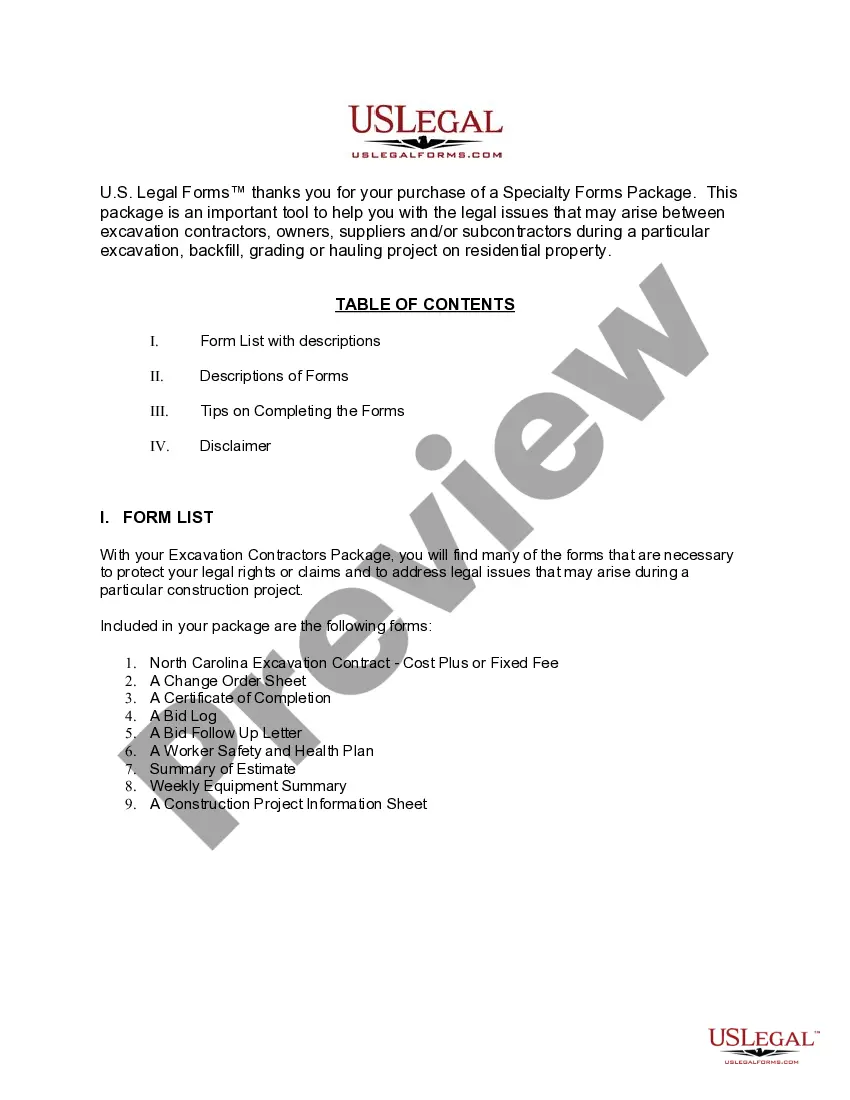
Forms provided in this package
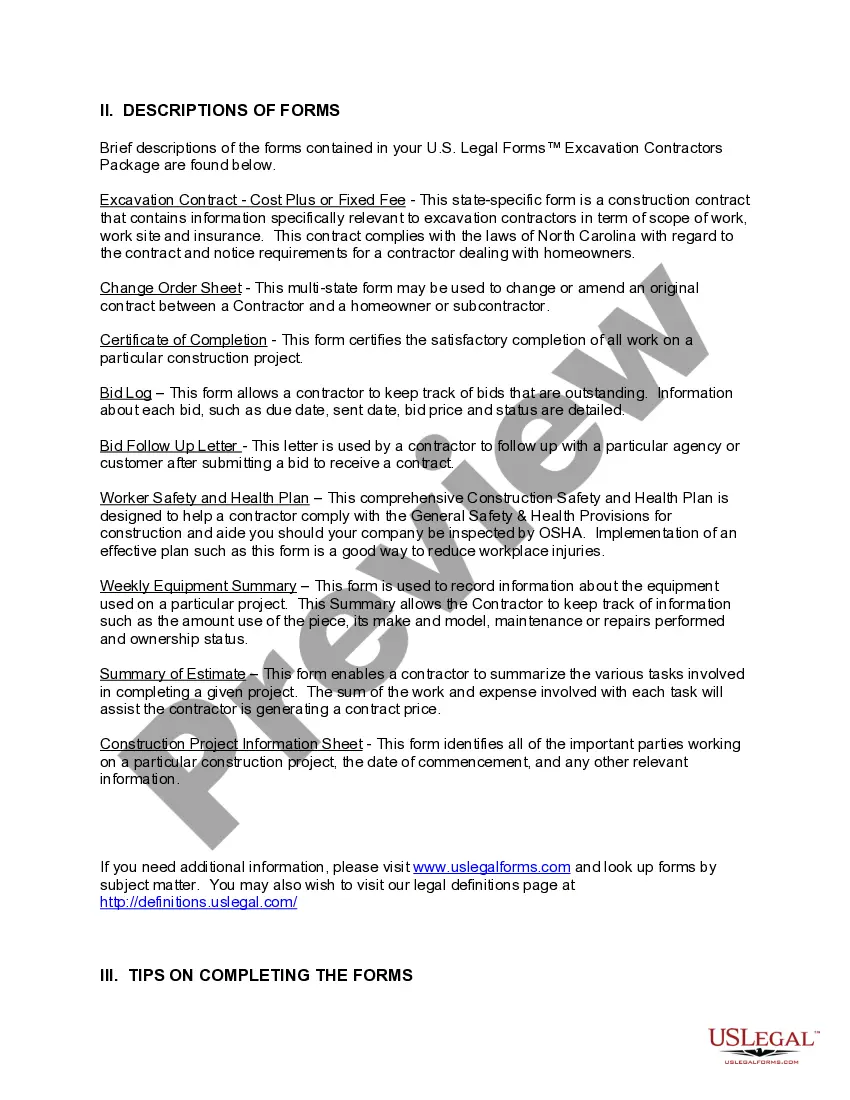
- Excavator Contract for Contractor
- Contractor's Weekly Equipment Summary
- Contractor's Bid Log
- Contractor's Bid Follow Up Letter
- Contractor's Summary of an Estimate
- Construction Safety and Health Plan
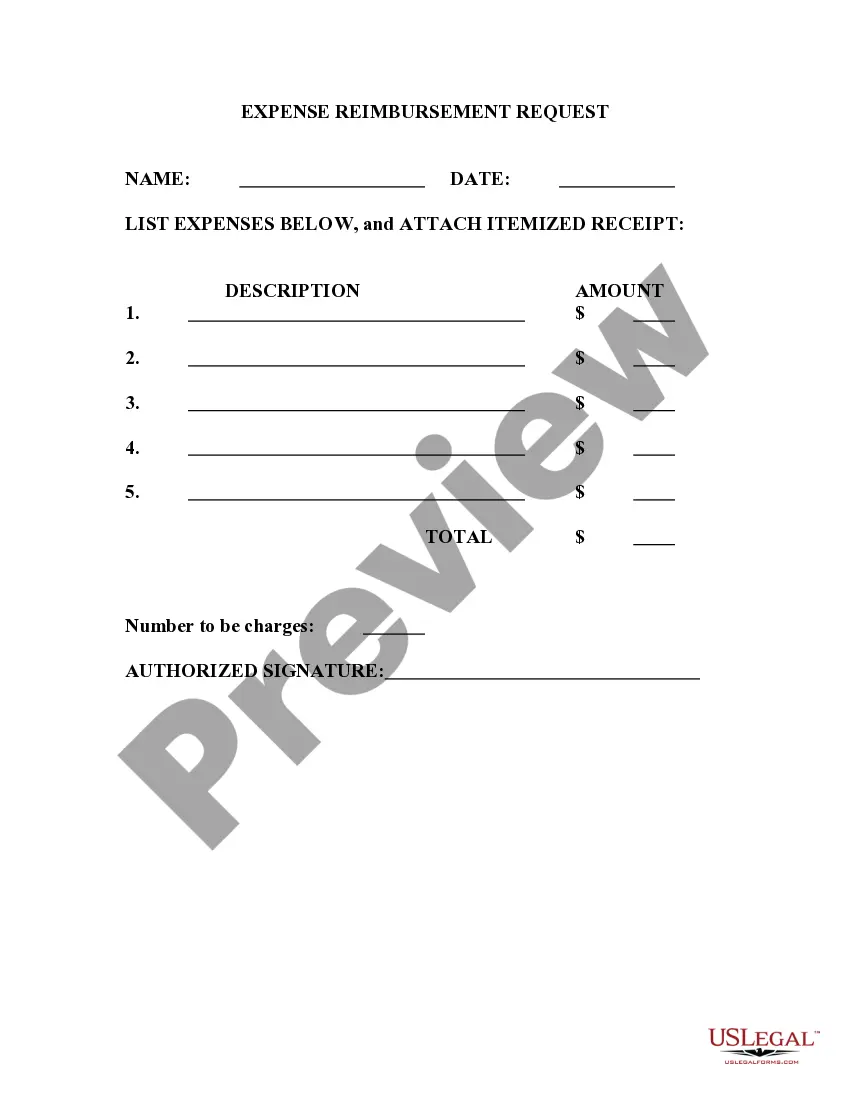
- Change Order for Construction or Repairs by Contractor
- Certification of Completion by Contractor
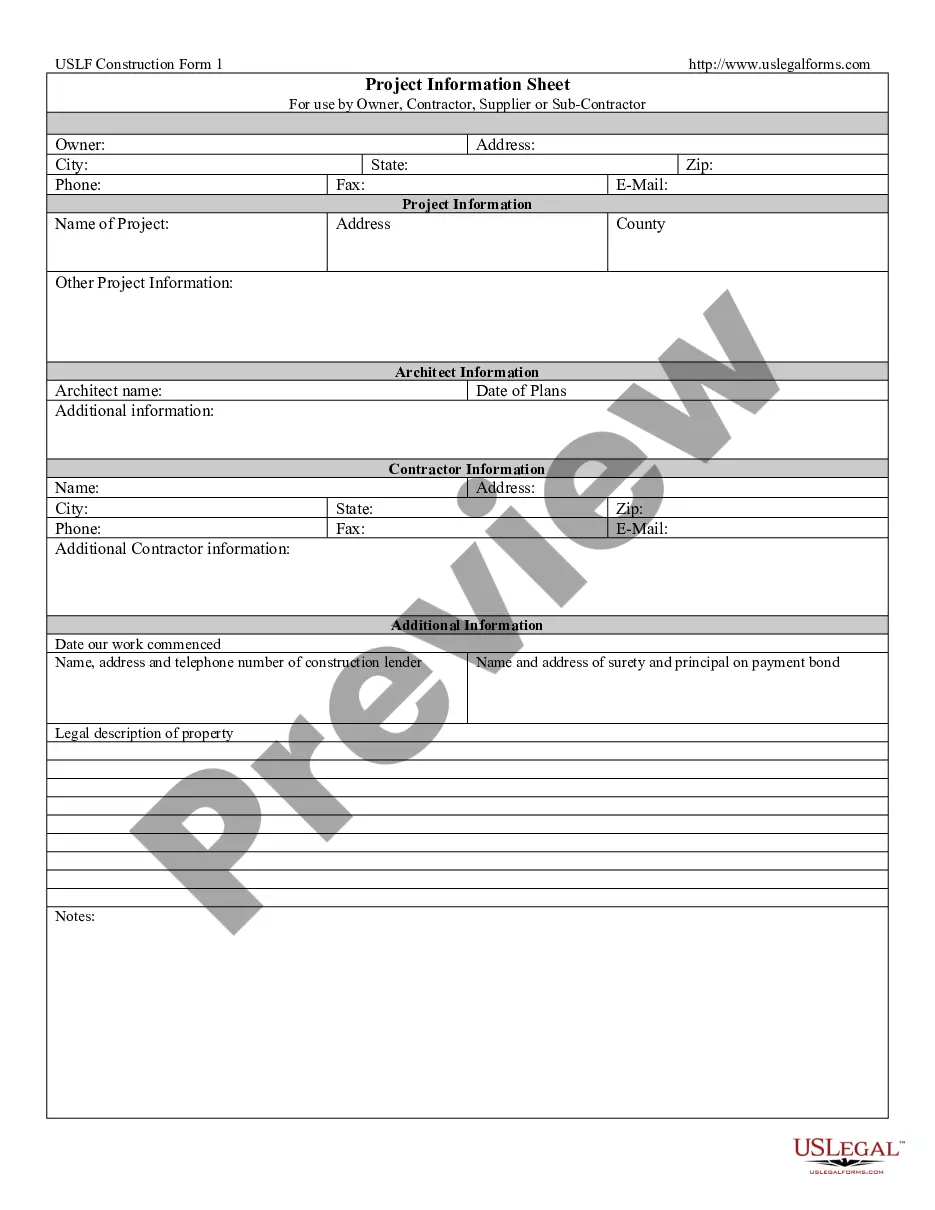
- Construction Project Information Sheet
When to use this document
This package is ideal for excavation contractors in North Carolina during the following scenarios:
- Entering a new excavation project.
- Modifying existing contracts with change orders.
- Documenting project completion with certificates.
- Tracking bids and follow-ups with clients or agencies.
- Ensuring compliance with safety regulations and health plans.
Who this form package is for
- Excavation contractors operating in North Carolina.
- Subcontractors involved in excavation-related projects.
- Homeowners seeking professional excavation services.
- Real estate developers managing excavation contracts.
How to complete these forms
- Review all included forms thoroughly.
- Identify the parties involved in the excavation project.
- Fill in the required fields including dates, descriptions, and contract details.
- Ensure signatures are obtained where necessary.
- Keep copies of completed documents for your records.
Notarization requirements for forms in this package
Most forms in this package do not require notarization. However, local laws or specific situations may demand it. Our online notarization service, powered by Notarize, lets you complete the process through a verified video call, available anytime.
Get your form ready online
Our built-in tools help you complete, sign, share, and store your documents in one place.
Make edits, fill in missing information, and update formatting in US Legal Forms—just like you would in MS Word.
Download a copy, print it, send it by email, or mail it via USPS—whatever works best for your next step.
Sign and collect signatures with our SignNow integration. Send to multiple recipients, set reminders, and more. Go Premium to unlock E-Sign.
If this form requires notarization, complete it online through a secure video call—no need to meet a notary in person or wait for an appointment.
We protect your documents and personal data by following strict security and privacy standards.

Make edits, fill in missing information, and update formatting in US Legal Forms—just like you would in MS Word.

Download a copy, print it, send it by email, or mail it via USPS—whatever works best for your next step.

Sign and collect signatures with our SignNow integration. Send to multiple recipients, set reminders, and more. Go Premium to unlock E-Sign.

If this form requires notarization, complete it online through a secure video call—no need to meet a notary in person or wait for an appointment.

We protect your documents and personal data by following strict security and privacy standards.
Common mistakes
- Failing to complete all necessary forms for a project.
- Not including all parties' signatures on contracts.
- Overlooking the need for change orders during project modifications.
- Neglecting to document completion with a Certificate of Completion.
Why complete this package online
- Convenient access to all necessary forms at any time.
- Editability allows customization of documents to suit specific project needs.
- Reliability in using attorney-drafted forms compliant with state law.
Legal use & context
- Documents provided in this package are legally binding when completed correctly.
- Proper use reduces the risk of disputes between contractors and clients.
- Forms should align with North Carolina law to ensure enforceability.
Key takeaways
- The North Carolina Excavation Contractor Package includes essential legal forms for excavation projects.
- Use this package to streamline project documentation and compliance.
- Always review forms for accuracy and ensure signatures are obtained.
Looking for another form?
Form popularity
FAQ
Pay the application and licensing fees: Limited License: $75. Intermediate License: $100. Unlimited License: $125.
Payment Schedule In Your Contract Before any work begins, a contractor will ask a homeowner to secure the job with a down payment. It shouldn't be more than 10-20 percent of the total cost of the job. Homeowners should never pay a contractor more than 10-20% before they've even stepped foot in their home.
Since the licensure statute requires a license only for projects that cost $30,000 or more, there is arguably a fourth tier which is sometimes known as the "handyman exception"for construction projects that cost under $30,000, no license is required.
A: It's not uncommon for contractors to ask for a down payment up front to secure your spot on their schedule or purchase some of the job materials in advance. Asking for more than half of the project cost up front, though, is a big red flag.I recommend tying payments to progress made during the job.
You shouldn't pay more than 10 percent of the estimated contract price upfront, according to the Contractors State License Board.
If an application is submitted with a completed exam, the licensing process takes about 30 days. If an exam is required, it will depend on when exams are successfully completed. It takes about 2 to 3 weeks after exams are completed before a license to be granted.
It is a common misconception that since the builder exam is open book, it is not difficult to pass. In actuality the North Carolina construction license exam is more difficult to pass than similar closed book exams due to the fact that you have books available as a resource during the contractor exam.
If the contractor requests a large sum of money before work has begun, Mozen says you should ask specifically what types of work or materials those payments are covering.Contractors sometimes have other motives, other than purchasing materials, when they ask for large amounts of money in advance, Fowler says.
The maximum allowed is $10,000. Also, contractors that have provided materials and labor to property may have lien rights against the real property.