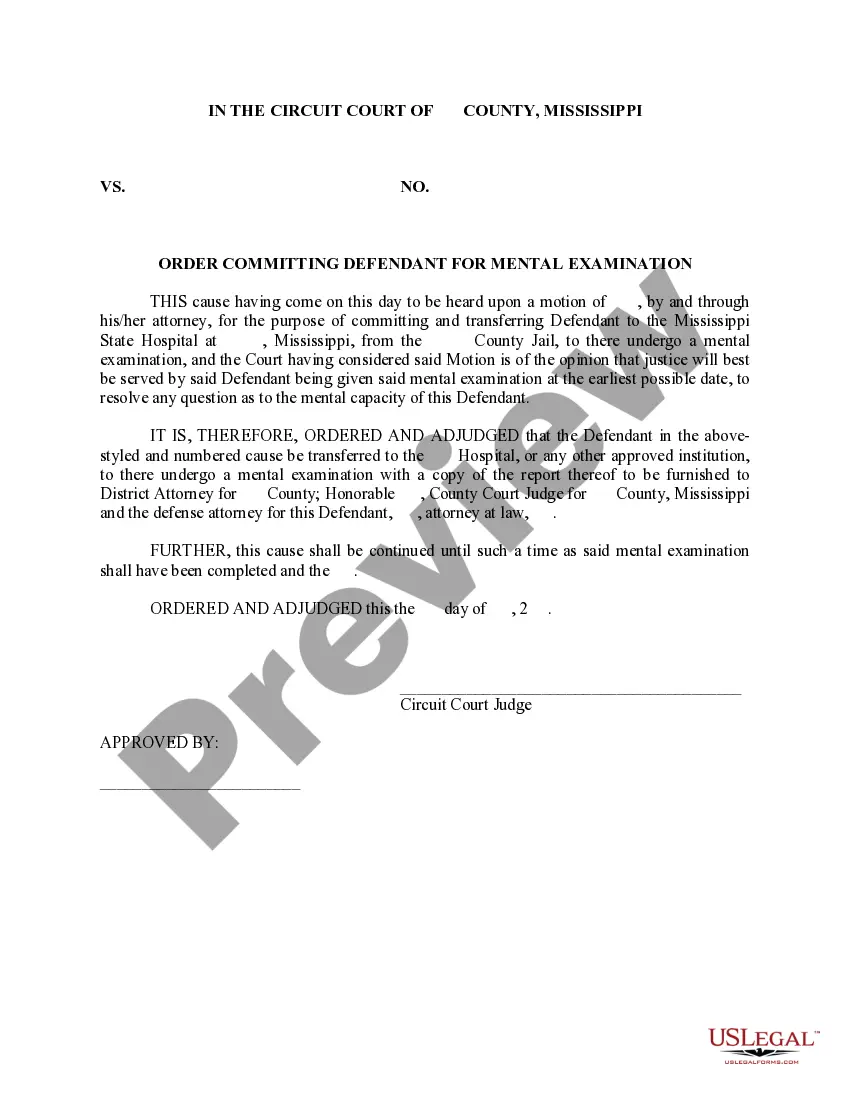
Louisiana Motion to Fix for Trial
What this document covers
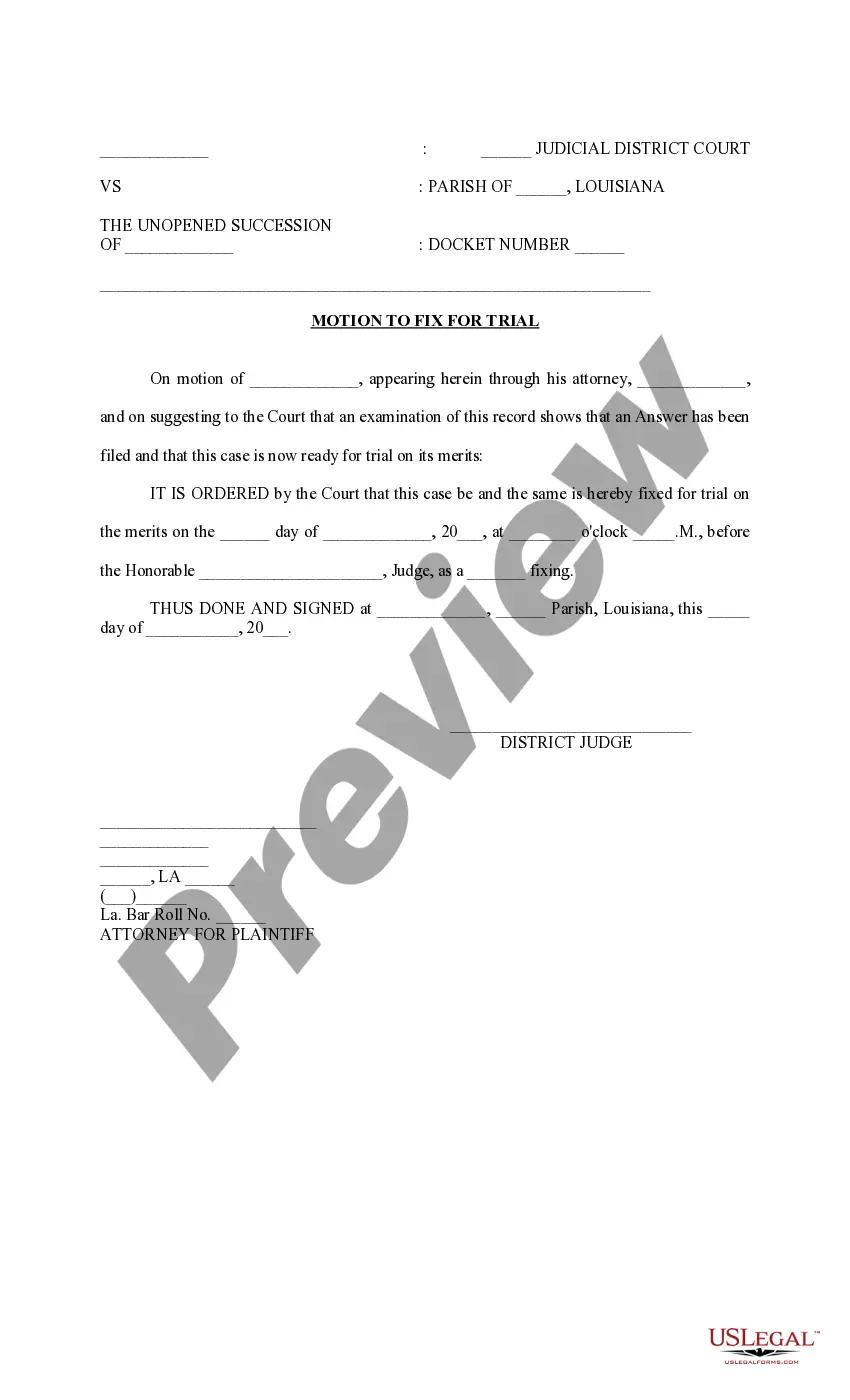
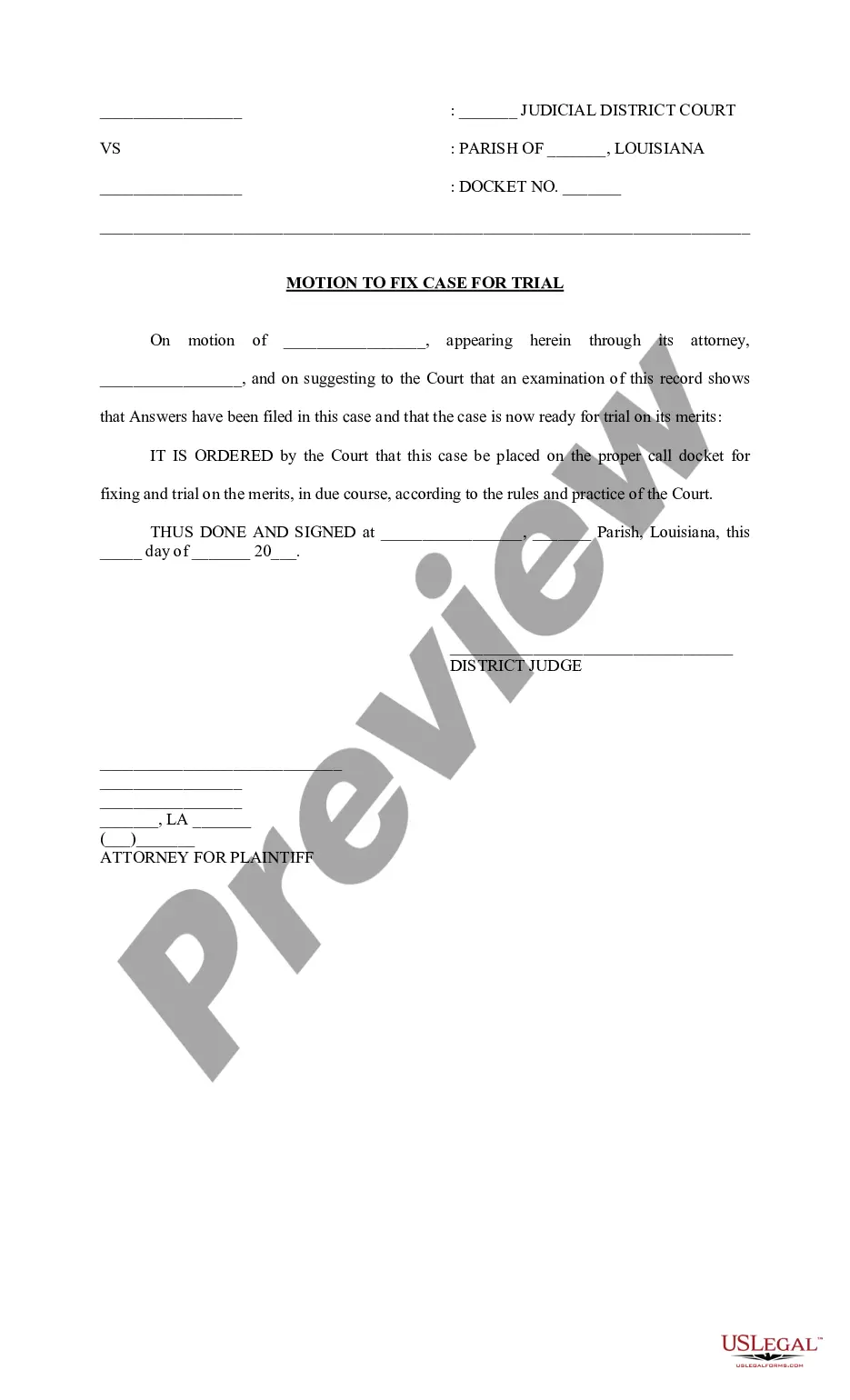
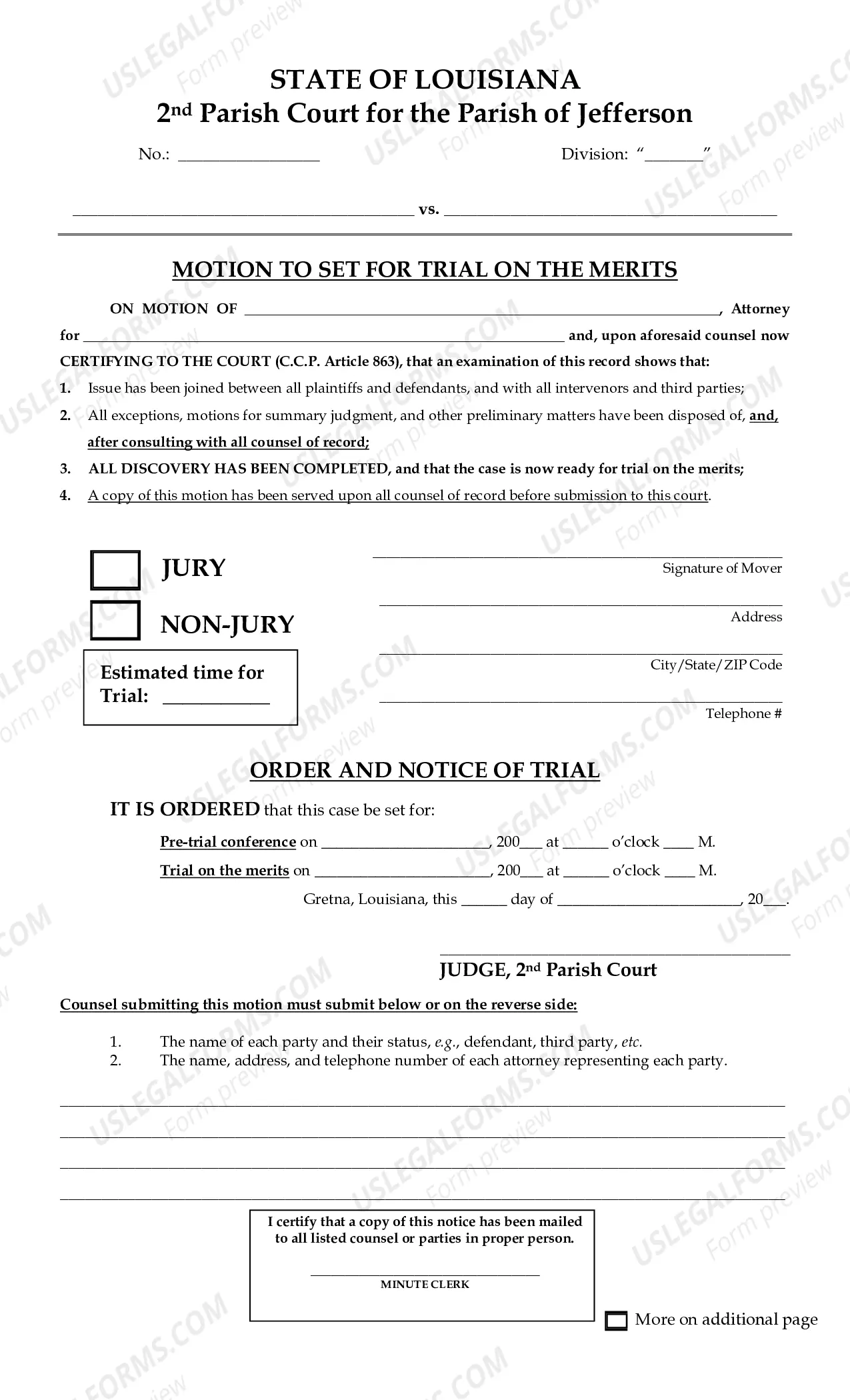
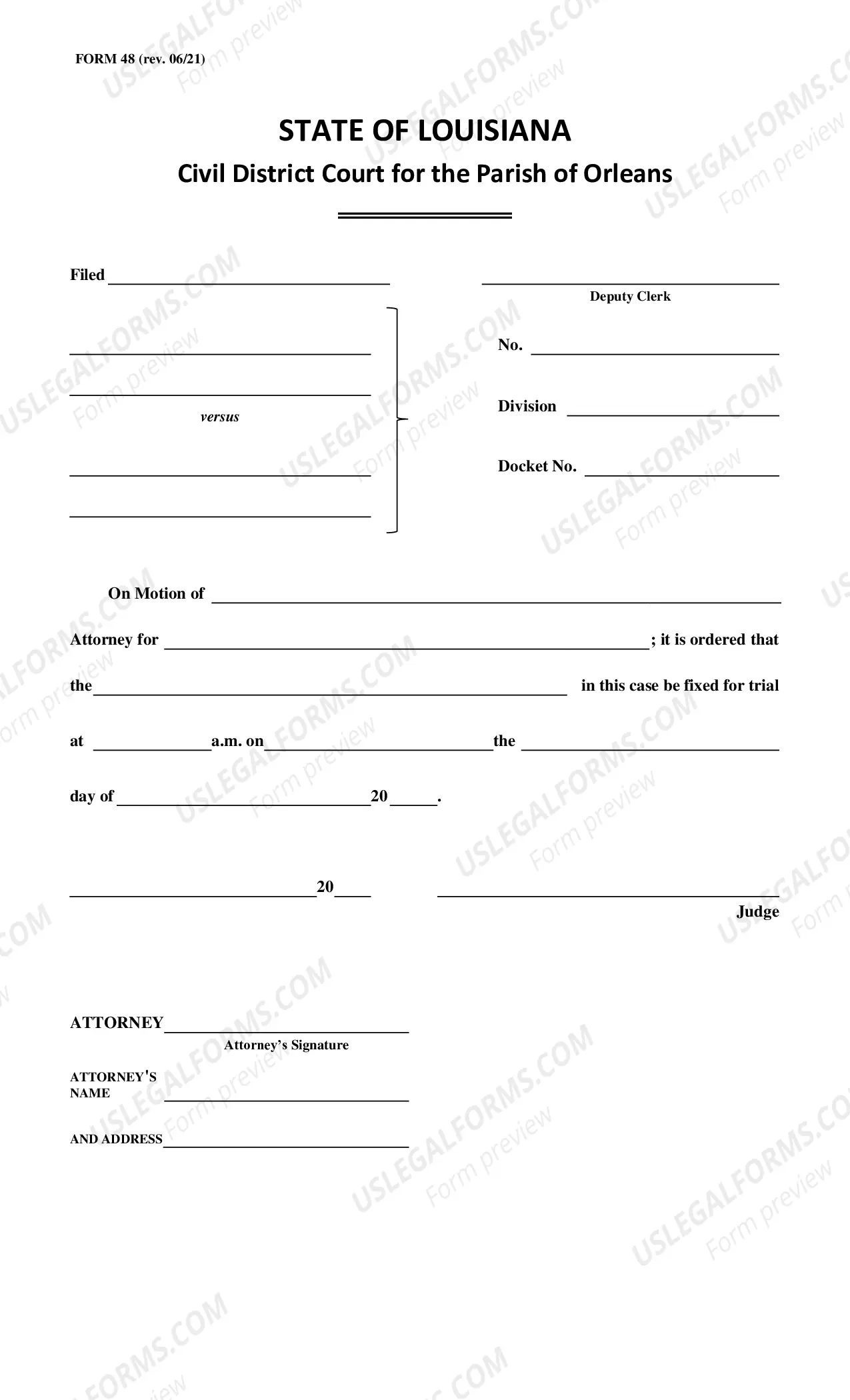
The Motion to Fix for Trial is a legal document filed by the attorney for the plaintiff in a civil matter. This motion asserts that the case is ready to proceed to trial, including a request for the court to set a specific date and time for the trial. Unlike other motions, this document signals that all preparatory steps have been completed, making it essential for moving forward in the judicial process.
Key components of this form
- Details of the plaintiff and attorney involved in the case.
- Statement indicating readiness for trial based on prior filings.
- Order from the court specifying the trial date and time.
- Signature of the district judge overseeing the case.
- Bar roll number and contact information of the attorney for the plaintiff.
When this form is needed
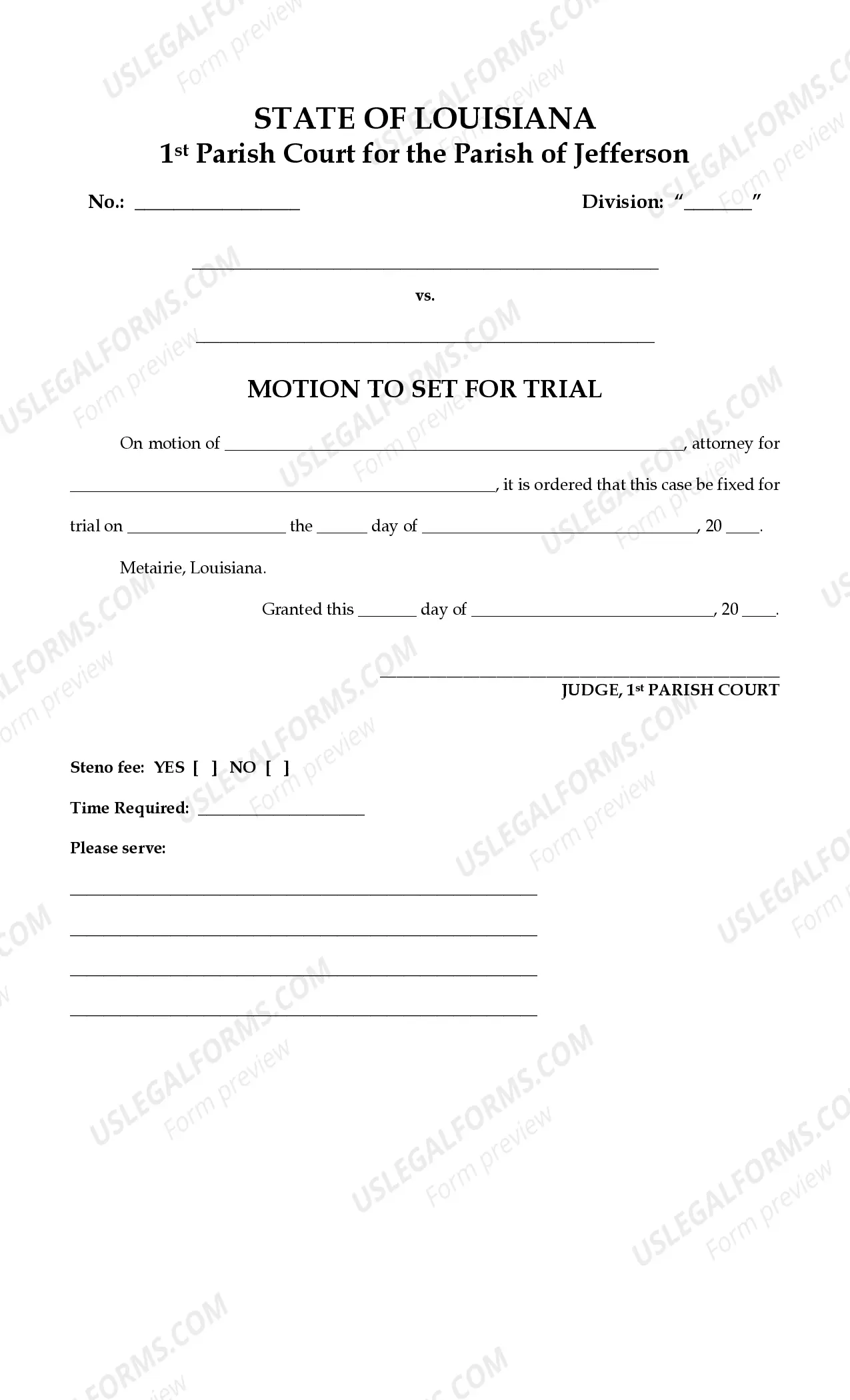
This form is used when a plaintiff has completed all necessary pre-trial procedures and is ready to bring their case before a judge. It formally requests that the court schedule a trial date, which is crucial for ensuring that the case proceeds in a timely manner. Situations that commonly require this motion include civil claims, disputes over contracts, and personal injury cases.
Who this form is for
- Attorneys representing plaintiffs in civil cases.
- Individuals or entities awaiting a trial on their case.
- Legal professionals managing court schedules and trial readiness.
Instructions for completing this form
- Identify the parties involved, including the plaintiff and their attorney.
- Provide the details of the case, including the judicial district and docket number.
- State that an answer has been filed and that the case is ready for trial.
- Specify the proposed trial date and time for the court's consideration.
- Have the attorney sign and fill in their bar roll number and contact information.
Is notarization required?
Notarization is generally not required for this form. However, certain states or situations might demand it. You can complete notarization online through US Legal Forms, powered by Notarize, using a verified video call available anytime.
Get your form ready online
Our built-in tools help you complete, sign, share, and store your documents in one place.
Make edits, fill in missing information, and update formatting in US Legal Forms—just like you would in MS Word.
Download a copy, print it, send it by email, or mail it via USPS—whatever works best for your next step.
Sign and collect signatures with our SignNow integration. Send to multiple recipients, set reminders, and more. Go Premium to unlock E-Sign.
If this form requires notarization, complete it online through a secure video call—no need to meet a notary in person or wait for an appointment.
We protect your documents and personal data by following strict security and privacy standards.

Make edits, fill in missing information, and update formatting in US Legal Forms—just like you would in MS Word.

Download a copy, print it, send it by email, or mail it via USPS—whatever works best for your next step.

Sign and collect signatures with our SignNow integration. Send to multiple recipients, set reminders, and more. Go Premium to unlock E-Sign.

If this form requires notarization, complete it online through a secure video call—no need to meet a notary in person or wait for an appointment.

We protect your documents and personal data by following strict security and privacy standards.
Common mistakes
- Failing to include all required case details, such as the docket number.
- Not confirming that all parties have been notified of the readiness for trial.
- Missing the deadline for filing the motion before the trial date.
- Neglecting to sign the form or provide the attorney's bar roll number.
Advantages of online completion
- Convenience of downloading and completing the form at any time.
- Editability allows for easy adjustments before final submission.
- Access to templates prepared by licensed attorneys ensures legal accuracy.
- Time-saving structure that helps streamline the trial scheduling process.
What to keep in mind
- The Motion to Fix for Trial sets a specific trial date for civil cases.
- Proper completion and timely submission are critical for case advancement.
- Use this form to ensure that all parties are prepared for the upcoming trial.
Looking for another form?



Form popularity
FAQ
A motion to amend a judgment in Louisiana is a legal request to modify a court's decision. This motion allows parties to correct errors or adjust outcomes based on new evidence or legal grounds. When navigating the process, understanding the specifics of the Louisiana Motion to Fix for Trial can be crucial. Utilizing platforms like USLegalForms can help ensure that your motion is properly prepared and filed.
After you complete your motion, you must file it with the court.You must then serve (mail) a copy of your filed motion (including all exhibits and the date, time, and place of hearing) to all other parties in the case. If a party is represented by an attorney, mail the motion directly to the attorney's office.
Fill out the forms. You have to fill out at least 2 forms, maybe more, to file your opposition. File the forms. Turn in your completed forms by mail or efiling. Serve the other party. Get ready for the hearing. Prepare an order.
You write your motion. You file your motion with the court clerk. The court clerk inserts the date and time your motion will be heard by the judge. You serve (mail) your motion to the other side.
A motion is a written request or proposal to the court to obtain an asked-for order, ruling, or direction.Courts usually have specific requirements for filing a motion, so either consult your attorney or look up the local court rules to understand what you will need as you move forward.
The motion must include a separate "Notice of Motion" which includes a brief summary of the nature of the motion, the deadline for filing a response, and if there is a hearing, the date, time, and location of the hearing.
Ask the court for a motion date. Identify and fill out your motion forms. Serve and file your motion forms. Confirm that you will attend the motion. Go to your motion hearing. Receive the judge's decision.
Create a legal heading for your motion. Capitalize your title head. Declare the facts. Write the memorandum using the law and legal precedent to plead your case. Conclude the motion with a brief summary of your request.
A motion is an application to the court made by the prosecutor or defense attorney, requesting that the court make a decision on a certain issue before the trial begins. The motion can affect the trial, courtroom, defendants, evidence, or testimony.