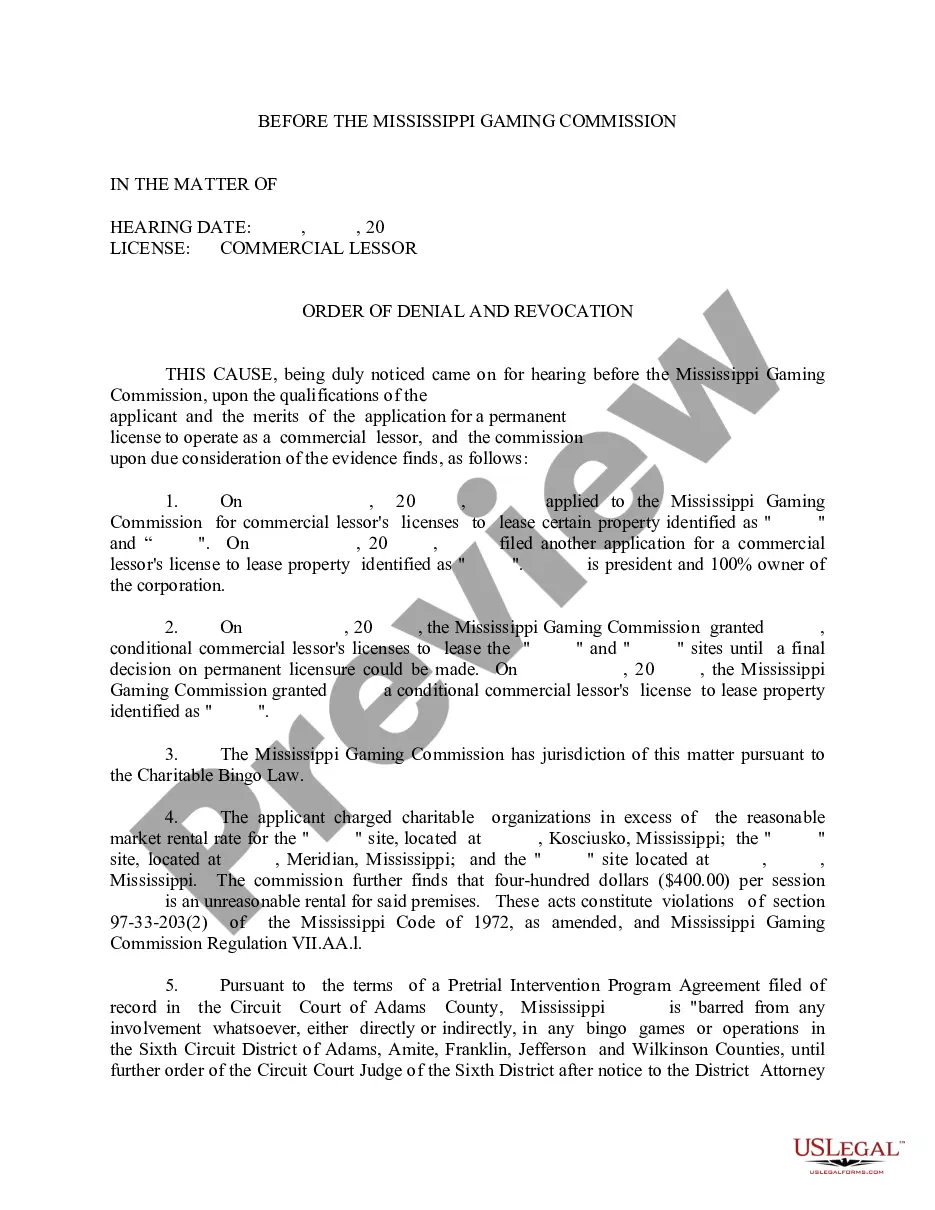
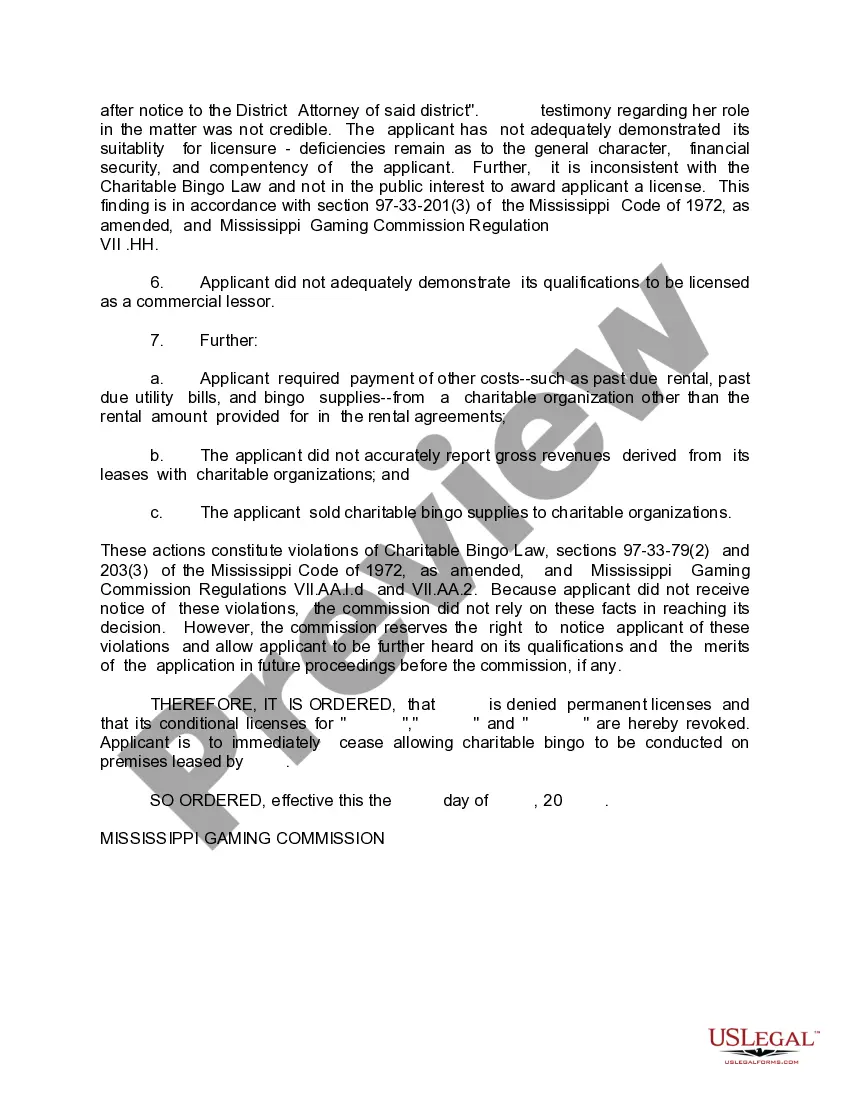
Mississippi Order of Denial and Revocation
About this form
The Order of Denial and Revocation is an official written directive from the court that informs a party of a denied request, typically related to licensing or permits. This document not only provides the details of the court's decision but also requires the recipient to take specific actions. It is essential to understand that this form is a critical legal instrument that helps ensure compliance with court orders, distinguishing it from other legal documents related to licensing or governmental approvals.
Key components of this form
- Identification of the applicant and context of the application.
- Preliminary findings from the court regarding the applicant's qualifications.
- Details on non-compliance issues related to financial reporting and obligations.
- Conclusions reached by the court regarding the denial and revocation.
- Signature and official designation of the judge.
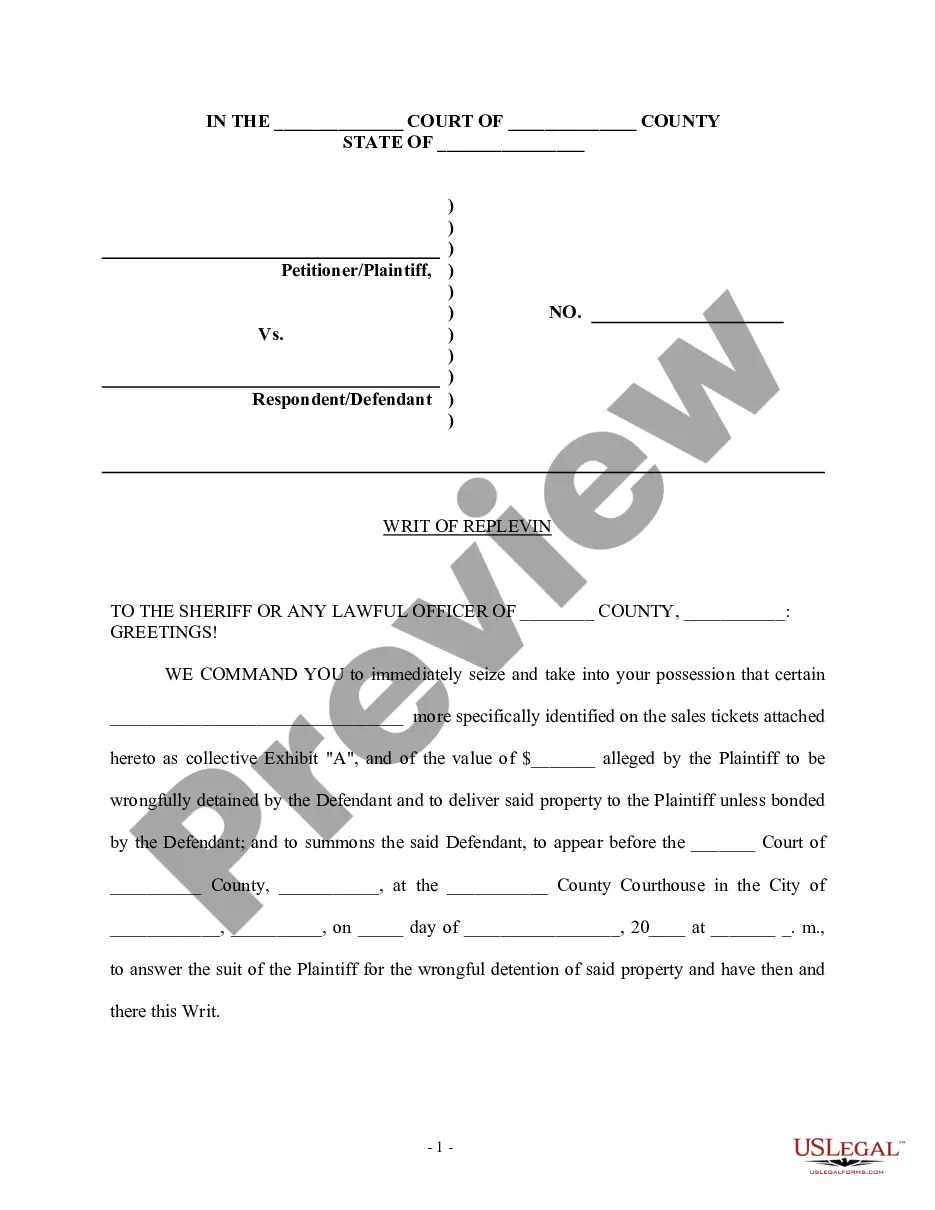
Situations where this form applies
This form should be used when the court has determined that an applicant does not meet the necessary qualifications for a specific license, such as a commercial lessor license. It is particularly useful for documenting the reasons for denial and revocation, helping to clarify any compliance issues related to financial transactions or reporting. If you are involved in a licensing process and your application has been denied, this form is essential for official communication from the court.
Who can use this document
- Individuals or organizations applying for a commercial lessor license.
- Legal professionals drafting documents for court submission.
- Parties seeking to understand or respond to a court's order of denial.
How to complete this form
- Identify the applicant's name and the context of the requested license.
- Clearly outline the merits of the application as examined by the court.
- Specify the reasons for denial, including any compliance failures.
- Ensure accuracy in financial reporting as it pertains to the applicant.
- Complete the required signature line for the presiding judge.
Is notarization required?
This form does not typically require notarization unless specified by local law. However, always check with your jurisdiction to confirm if notarization is needed for legal validity.
Get your form ready online
Our built-in tools help you complete, sign, share, and store your documents in one place.
Make edits, fill in missing information, and update formatting in US Legal Forms—just like you would in MS Word.
Download a copy, print it, send it by email, or mail it via USPS—whatever works best for your next step.
Sign and collect signatures with our SignNow integration. Send to multiple recipients, set reminders, and more. Go Premium to unlock E-Sign.
If this form requires notarization, complete it online through a secure video call—no need to meet a notary in person or wait for an appointment.
We protect your documents and personal data by following strict security and privacy standards.

Make edits, fill in missing information, and update formatting in US Legal Forms—just like you would in MS Word.

Download a copy, print it, send it by email, or mail it via USPS—whatever works best for your next step.

Sign and collect signatures with our SignNow integration. Send to multiple recipients, set reminders, and more. Go Premium to unlock E-Sign.

If this form requires notarization, complete it online through a secure video call—no need to meet a notary in person or wait for an appointment.

We protect your documents and personal data by following strict security and privacy standards.
Common mistakes to avoid
- Failing to provide comprehensive evidence to support the application.
- Omitting details of financial obligations and compliance issues.
- Not adhering to specific state formatting or language requirements.
- Misidentifying the applicant or the relevant license in the document.
Benefits of completing this form online
- Convenient access to essential legal documents for immediate use.
- Easy customization to meet your specific case details.
- Reliable templates drafted by licensed attorneys, ensuring compliance with legal standards.
Legal use & context
- The form serves as an official record of the court's decision regarding a license application.
- It is legally binding, and failure to comply with its directives may result in contempt of court.
- This document can be used as evidence in case of further appeals or legal proceedings related to the license denial.
Key takeaways
- The Order of Denial and Revocation is essential for upholding licensing regulations.
- Completing the form accurately is crucial to avoid unnecessary delays or legal challenges.
- Understand the grounds for denial to ensure compliance with court directives.
Looking for another form?


Form popularity
FAQ
Revocation is a noun form of the verb revoke, which means to take back, withdraw, or cancel. Revoke and revocation are typically used in the context of officially taking back or cancelling some kind of right, status, or privilege that has already been given or approved.
Failing to comply with a condition of probation can land you in jail. By Sara J. Berman. Defendants caught (either by police or probation officers) violating a condition of probation are subject to having their probation revoked (taken away) and all or part of the original suspended jail or prison sentence imposed.
Every probation has specific terms and conditions that must be followed. In a motion to revoke probation, the courts will likely try to send you back to jail or prison. This is the opposite of a motion to dismiss, which would mean the case goes away entirely.
§ 2.103 Revocation hearing procedure. (a) The purpose of the revocation hearing shall be to determine whether the parolee has violated the conditions of his release and, if so, whether his parole or mandatory release should be revoked or reinstated.
No paperwork is required. You are now off probation.
Revocation stayed, Probation:Revocation Stayed, Suspension, Probation: The Board revokes a license. However, the revocation is "stayed" or temporarily set aside, pending successful completion of probation. If the licensee violates probation, the Board may lift the "stay" and revoke the license.
A revocation hearing can refer to one of two things: a probation revocation hearing or a parole revocation hearing. A revocation hearing is a court hearing before a judge in which the judge decides whether to revoke your probation or your parole. If you are revoked, you face serious jail time.
After you have completed at least one year of supervision, your attorney can petition the Court, or. After you have completed two thirds of your term of supervision, you can request early termination through your U.S. Probation Officer.