Virginia Renovation Contractor Package
What is this form package?
The Virginia Renovation Contractor Package is a comprehensive set of legal documents tailored for renovation contractors and related parties. This package includes essential forms to help protect legal rights, address claims, and manage various aspects of renovation projects on residential properties. Central to this package is the renovation contract, which is specifically designed to comply with Virginia state law, ensuring that all projects meet local legal requirements.
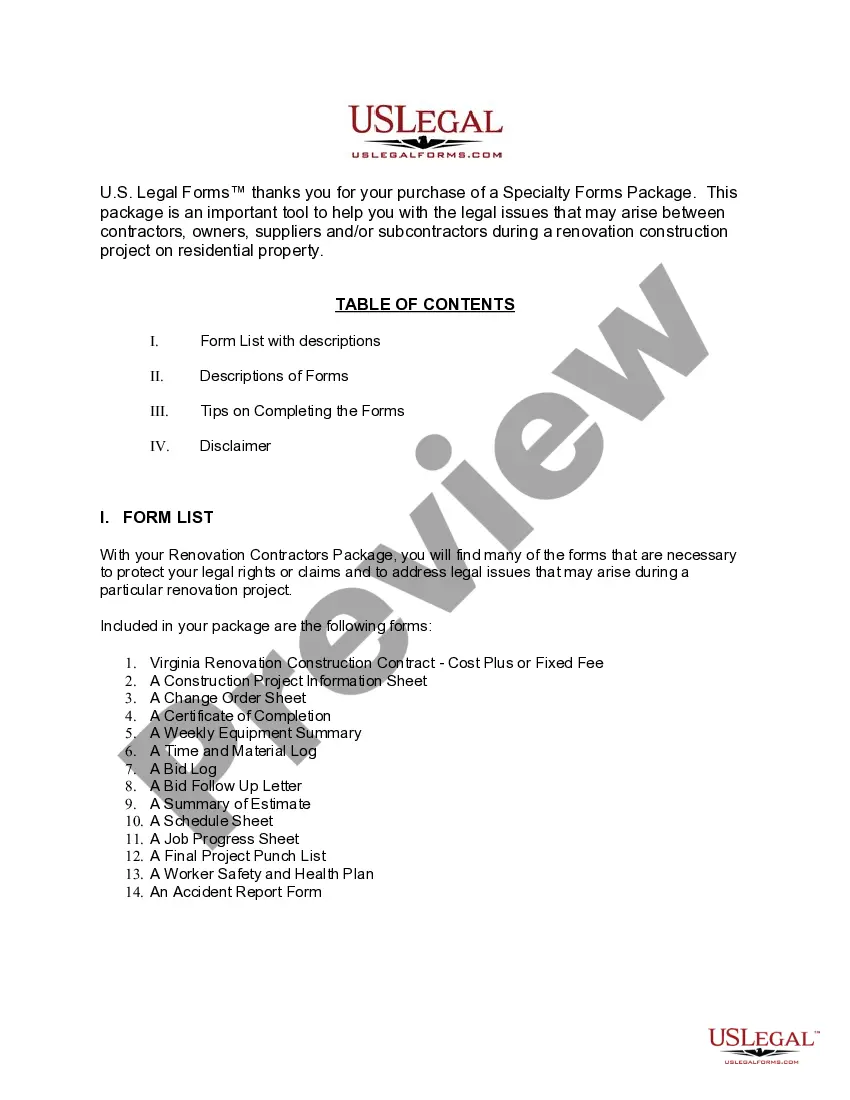
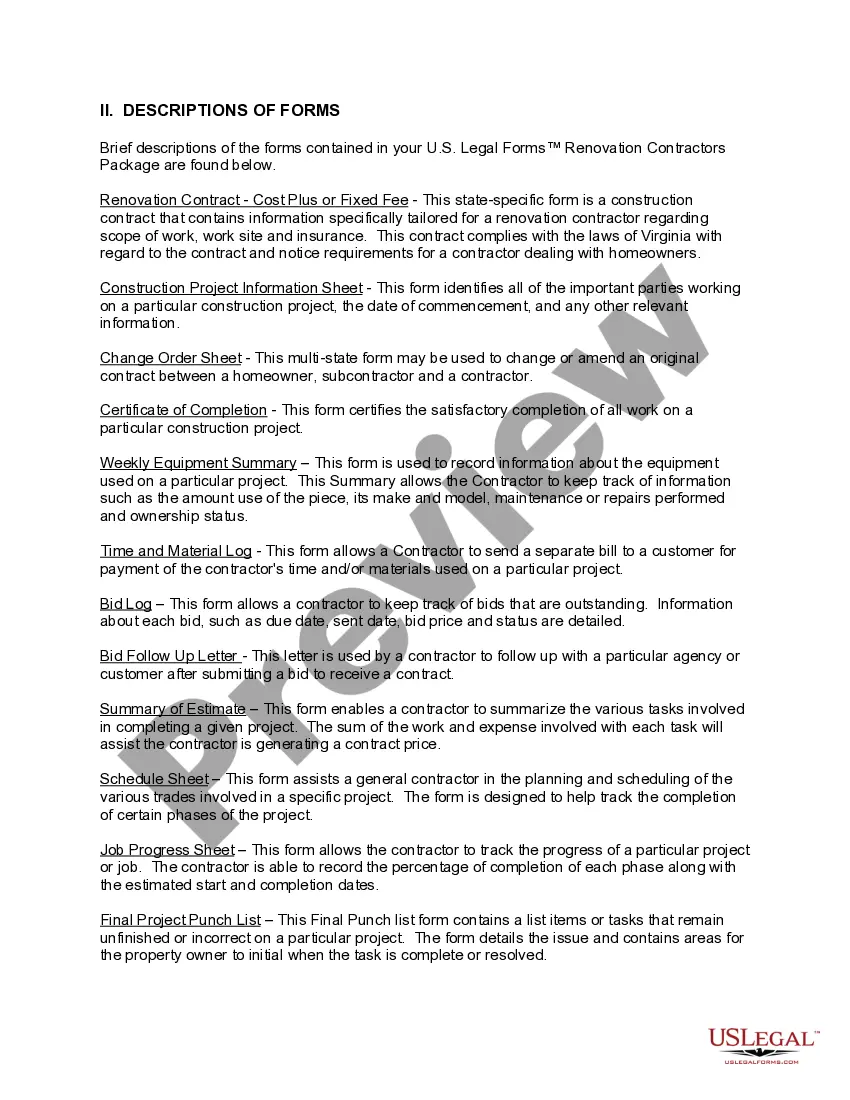
Documents contained in this package
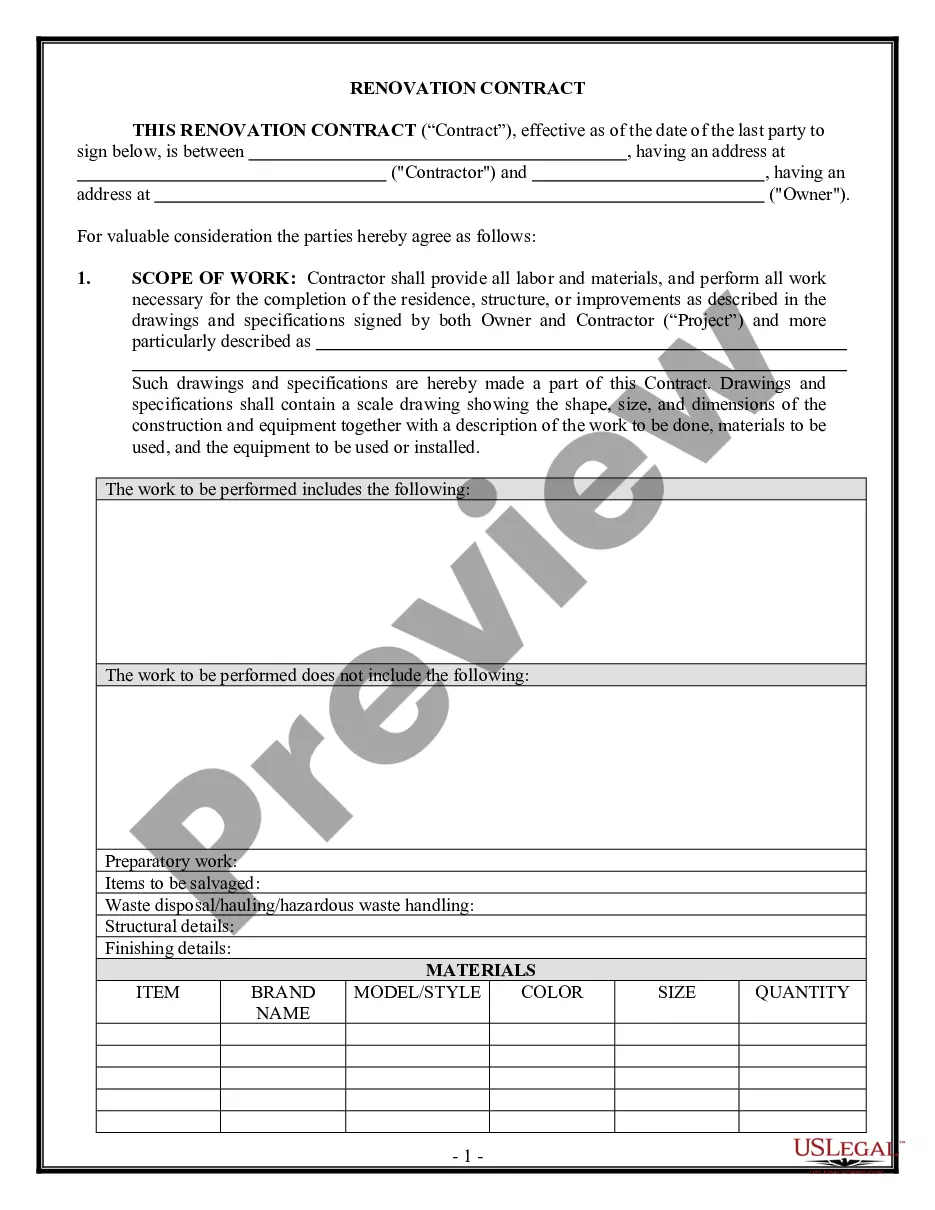
- Renovation Contract for Contractor
- Contractor's Weekly Equipment Summary
- Contractor's Time and Materials Log
- Contractor's Bid Log
- Contractor's Bid Follow Up Letter
- Contractor's Summary of an Estimate
- Contractor's Schedule Sheet
- Contractor's Job Progress Sheet
- Contractor's Final Punch List
- Construction Accident Report
- Construction Safety and Health Plan
- Change Order for Construction or Repairs by Contractor
- Certification of Completion by Contractor
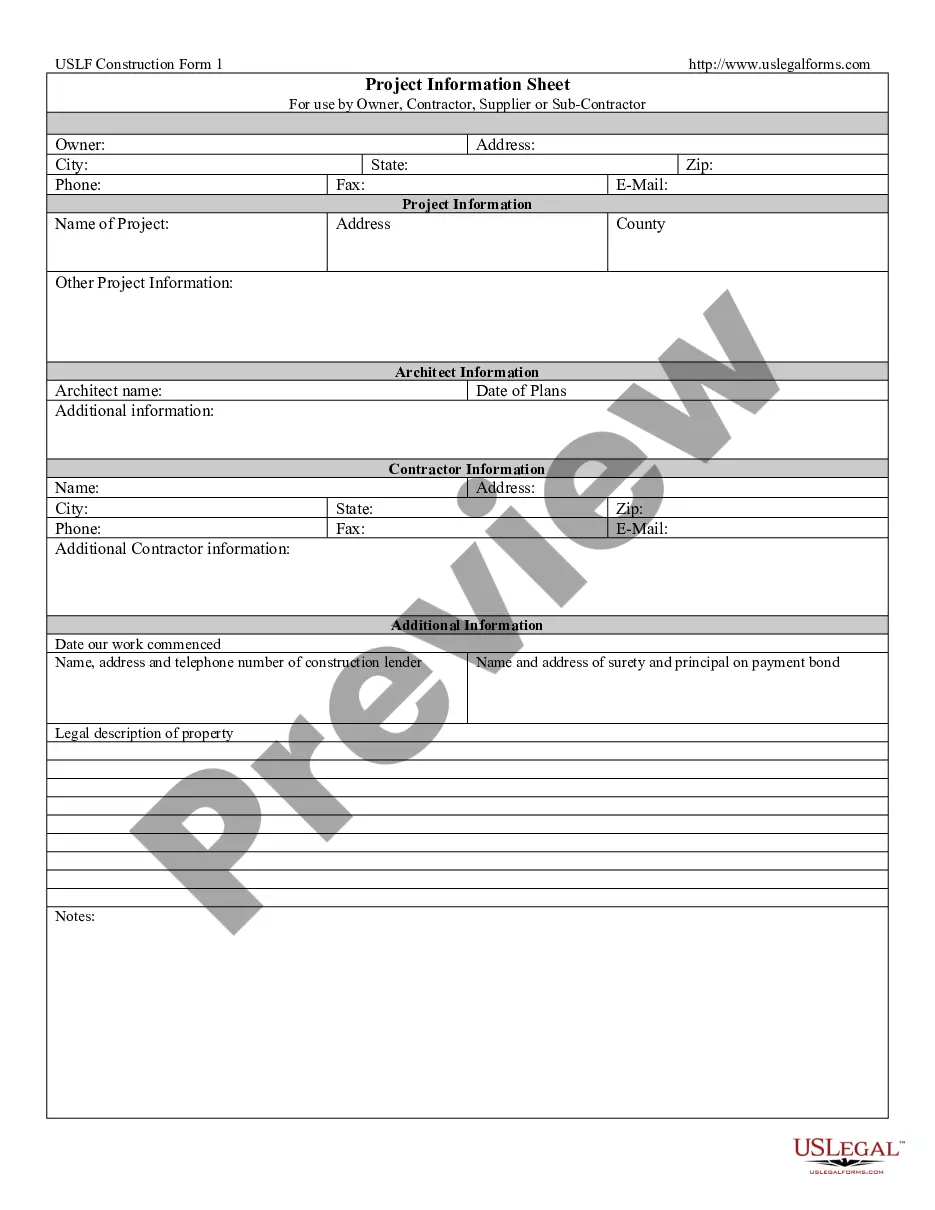
- Construction Project Information Sheet

When to use this document
This form package is ideal for use in the following scenarios:
- When starting a renovation project that requires a clear contract between contractors and property owners.
- If you need to document changes to an existing contract during a project.
- When managing project logistics including bids, schedules, and safety plans.
- To ensure compliance with safety regulations and to address any accidents that may occur on the project site.
Who should use this form package
- Renovation contractors operating in Virginia.
- Property owners engaging contractors for residential renovations.
- Suppliers involved in providing materials for renovation projects.
- Subcontractors working on residential renovation projects.
How to prepare this document
- Review the included forms to understand their purpose and relevance to your project.
- Gather necessary information, including dates, parties involved, and project details.
- Fill in the required fields on each form, ensuring accuracy.
- Sign and date the relevant documents as needed.
- Store completed forms securely for future reference and compliance.
Notarization details for included forms
Notarization is generally not required for forms in this package. However, specific circumstances or local laws may require it. You can complete notarization remotely through US Legal Forms, powered by Notarize, with 24/7 availability.
Get your form ready online
Our built-in tools help you complete, sign, share, and store your documents in one place.
Make edits, fill in missing information, and update formatting in US Legal Forms—just like you would in MS Word.
Download a copy, print it, send it by email, or mail it via USPS—whatever works best for your next step.
Sign and collect signatures with our SignNow integration. Send to multiple recipients, set reminders, and more. Go Premium to unlock E-Sign.
If this form requires notarization, complete it online through a secure video call—no need to meet a notary in person or wait for an appointment.
We protect your documents and personal data by following strict security and privacy standards.

Make edits, fill in missing information, and update formatting in US Legal Forms—just like you would in MS Word.

Download a copy, print it, send it by email, or mail it via USPS—whatever works best for your next step.

Sign and collect signatures with our SignNow integration. Send to multiple recipients, set reminders, and more. Go Premium to unlock E-Sign.

If this form requires notarization, complete it online through a secure video call—no need to meet a notary in person or wait for an appointment.

We protect your documents and personal data by following strict security and privacy standards.
Common mistakes
- Failing to include all necessary parties in the renovation contract.
- Not clearly defining the scope of work and payment terms in the contract.
- Overlooking safety and health regulations in the Worker Safety and Health Plan.
- Submitting bid documents without proper follow-up or documentation in the Bid Log.
Benefits of completing this package online
- Convenient access to essential legal forms that can be downloaded instantly.
- Editability allows for customization of contracts to fit specific project needs.
- Reliability of forms drafted by licensed attorneys, ensuring legal validity.
- Cost-effective solution, saving over 50 percent compared to purchasing the forms separately.
Legal use & context
- All forms in this package can be used to assert legal rights or claims in Virginia.
- Utilizing these forms helps ensure compliance with state laws governing renovation projects.
- Completing the forms correctly is essential for enforceability and protection against disputes.
Looking for another form?
Form popularity
FAQ
Class C Specialty Contractor There are 42 separate C license classifications for contractors whose construction work requires special skill and whose principal contracting business involves the use of specialized building trades or crafts.
Check Contract Basics. The basic job of a contractor agreement is to spell out the scope of the project's work. Set a Payment Schedule. Schedule Start and End Dates. Specify Change Orders. Research Your Arbitration Options. Turn Down the Contractor's Warranty.
A general contractor provides a strong background in framing and carpentry along with many other skills. Because remodeling jobs typically involve several specialty areas, the general contractor serves as a project manager who coordinates the entire job.
Detailed Description of the Job. How Payments Will Be Made. Start and End Dates of the Project. How Changes to the Project Will Be Dealt With. Lien Waivers. Written Notice of Your Right to Cancel Without Penalty. Warranty. Signatures.
There are three license classes: Class A, Class B, and Class C: Class A Contractors License: required when the total value of a single contract or project is $120,000 or more, or is $750,000 or more over a 12-month period. The Qualified Individual identified for this license must have at least 5 years of experience.
Class C contractors perform or manage construction, removal, repair, or improvements when (i) the total value referred to in a single contract or project is over $1,000 but no more than $10,000, or (ii) the total value of all such construction, removal, repair, or improvements undertaken by such person within any
Never Tell a Contractor They are the Only One Bidding on the Job. Don't Tell a Contractor Your Budget. Never Ask a Contractor for a Discount if You Pay Upfront. Don't Tell a Contractor That You Aren't in A Hurry. Do Not Let a Contractor Choose the Materials.
A Class C Contractor is any contractor that has single contracts from $1,000 or more but less than $10,000 or contracts totaling less than $150,000 over a one-year period. Virginia does not require Continuing Education for the Class C Contractor classification.
Create a business entity. Decide which license you need (A,B, or C as listed previously). Take a mandatory 8-Hour pre-license course (required for all license types) Pass the required exams. Complete your application and submit to the Board with the appropriate fee.