Virginia Painting Contractor Package
What is this form package?
The Virginia Painting Contractor Package is designed to provide essential legal documents specifically for painting contractors and subcontractors in Virginia. This form package includes a compliant painting contract and various forms to help confirm legal rights, facilitate project management, and ensure safety. Unlike generic form packages, this set is tailored to meet Virginia's legal standards, making it a reliable resource for professionals in the painting industry.
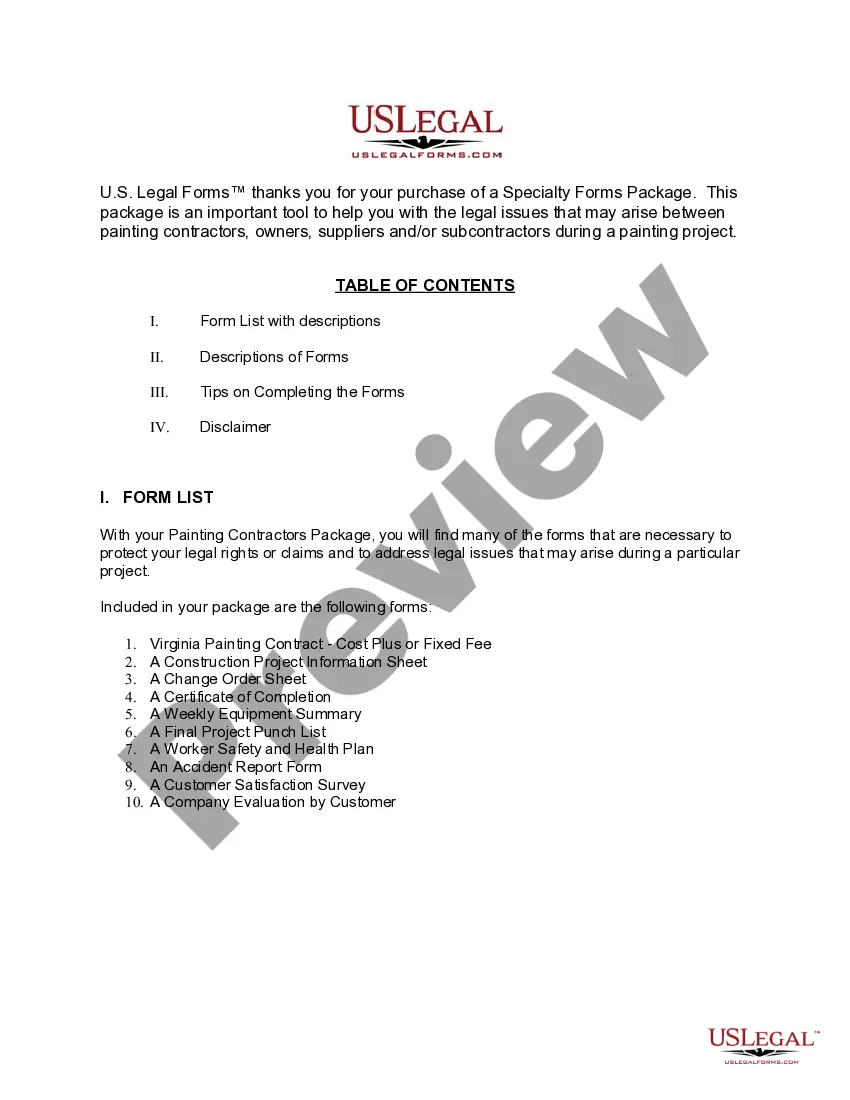
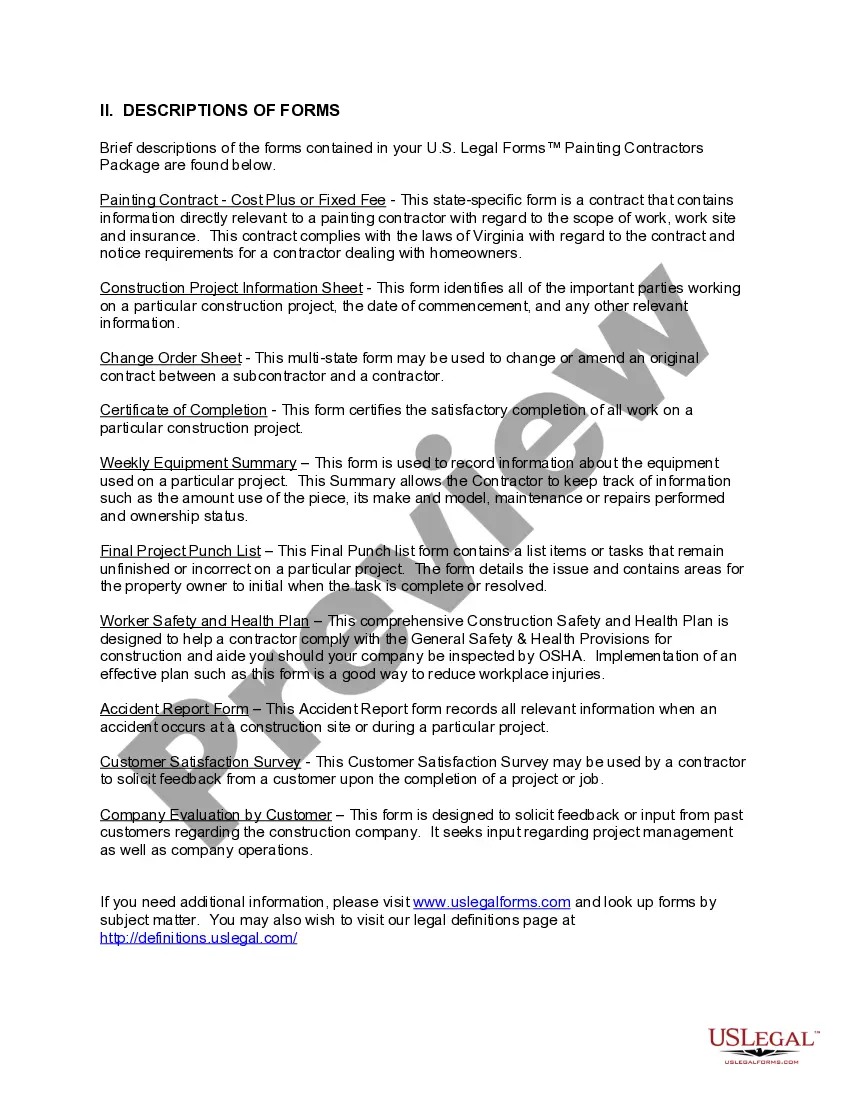
Forms provided in this package
- Painting Contract for Contractor
- Contractor's Weekly Equipment Summary
- Contractor's Final Punch List
- Customer Satisfaction Survey
- Construction Company Evaluation by a Customer
- Construction Accident Report
- Construction Safety and Health Plan
- Change Order for Construction or Repairs by Contractor
- Certification of Completion by Contractor
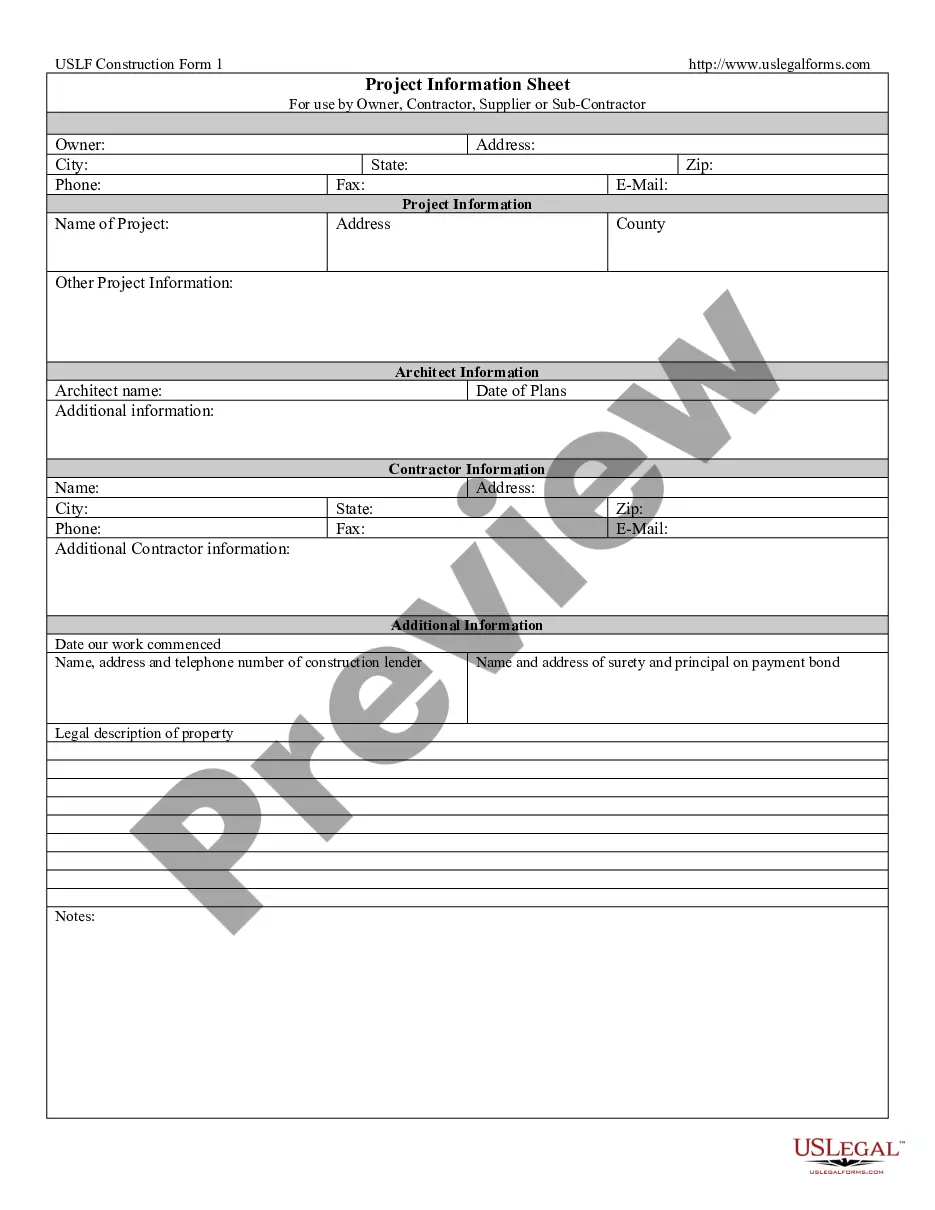
- Construction Project Information Sheet
When to use this form package
This form package is useful in a variety of situations, including:
- Starting a new painting project where a clear contract is needed.
- Making adjustments to an existing contract through change orders.
- Documenting completed work and ensuring customer satisfaction.
- Maintaining safety and health protocols on the job site.
- Tracking equipment usage and project completion status.
Who needs this form package
- Licensed painting contractors in Virginia.
- Painting subcontractors seeking standardized legal protection.
- Project owners looking to ensure that their interests are legally protected.
- Construction managers needing to streamline project documentation.
Steps to complete these forms
- Review all included forms to understand your legal obligations and options.
- Identify the parties involved in the painting project and fill in their details.
- Enter project dates and specific details about the work to be performed.
- Complete any necessary change orders as the project progresses.
- Gather signatures from all parties to ensure forms are legally binding.
- Maintain copies of all completed forms for future reference.
Notarization requirements for forms in this package
Forms in this package usually don’t need notarization, but certain jurisdictions or signing circumstances may require it. US Legal Forms provides a secure online notarization option powered by Notarize, accessible 24/7 from anywhere.
Get your form ready online
Our built-in tools help you complete, sign, share, and store your documents in one place.
Make edits, fill in missing information, and update formatting in US Legal Forms—just like you would in MS Word.
Download a copy, print it, send it by email, or mail it via USPS—whatever works best for your next step.
Sign and collect signatures with our SignNow integration. Send to multiple recipients, set reminders, and more. Go Premium to unlock E-Sign.
If this form requires notarization, complete it online through a secure video call—no need to meet a notary in person or wait for an appointment.
We protect your documents and personal data by following strict security and privacy standards.

Make edits, fill in missing information, and update formatting in US Legal Forms—just like you would in MS Word.

Download a copy, print it, send it by email, or mail it via USPS—whatever works best for your next step.

Sign and collect signatures with our SignNow integration. Send to multiple recipients, set reminders, and more. Go Premium to unlock E-Sign.

If this form requires notarization, complete it online through a secure video call—no need to meet a notary in person or wait for an appointment.

We protect your documents and personal data by following strict security and privacy standards.
Typical mistakes to avoid
- Failing to enter accurate details about the project or parties involved.
- Not securing proper signatures, which can invalidate the contract.
- Neglecting to complete the Change Order Sheet when project modifications occur.
- Overlooking safety protocols within the Worker Safety and Health Plan.
- Not retaining copies of completed forms for record-keeping.
Advantages of online completion
- Convenient access to essential legal documents anytime, anywhere.
- Editable forms allow customization to fit specific project needs.
- Reliable templates that comply with Virginia law, reducing legal risks.
- Instant downloads save time compared to hiring legal assistance.
- User-friendly format simplifies the completion process.
Legal use & context
- The painting contract is designed to protect both the contractor's and client's interests in Virginia.
- Completion certificates and project documentation help establish legal groundwork if disputes arise.
- Health and safety documentation can mitigate liability and comply with OSHA regulations.
Key takeaways
- The Virginia Painting Contractor Package provides crucial legal forms for contractors in Virginia.
- Use this package to facilitate clear agreements, track project changes, and ensure safety compliance.
- Follow the provided steps to accurately complete and store your forms.
Looking for another form?
Form popularity
FAQ
Do I really need to get a business license in Virginia? Yes! It's true that a lot of self-employed individuals, particularly those who work from home, never get a state or local Virginia business license.
There are three license classes: Class A, Class B, and Class C: Class A Contractors License: required when the total value of a single contract or project is $120,000 or more, or is $750,000 or more over a 12-month period. The Qualified Individual identified for this license must have at least 5 years of experience.
Class C contractors perform or manage construction, removal, repair, or improvements when (i) the total value referred to in a single contract or project is over $1,000 but no more than $10,000, or (ii) the total value of all such construction, removal, repair, or improvements undertaken by such person within any
A Class C Contractor is any contractor that has single contracts from $1,000 or more but less than $10,000 or contracts totaling less than $150,000 over a one-year period. Virginia does not require Continuing Education for the Class C Contractor classification.
Operating without a required contractor's license is a criminal class one misdemeanor. There can be DPOR civil penalties. Operating without a required contractor license would be a violation of the Virginia Consumer Protection Act. This is a very legitimate police power by the state.
All contractors of any kind must complete an 8-hour Contractor Basic Business course. Courses may be taken online or in a classroom as long as they are approved by the Commonwealth of Virginia.
Virginia. Painting and wall covering contractors in Virginia require a state license from the Department of Professional and Occupational Regulation. There are Class A and Class B contractors depending on years of experience and worth.
PSA: Performing Construction Work in Virginia Requires a Contractor's License.However, the risk is great for the unlicensed subcontractor or contractor even where they hold a license from another state. These risks run from non-payment due to a lack of license to the inability to record a mechanic's lien.
Create a business entity. Decide which license you need (A,B, or C as listed previously). Take a mandatory 8-Hour pre-license course (required for all license types) Pass the required exams. Complete your application and submit to the Board with the appropriate fee.