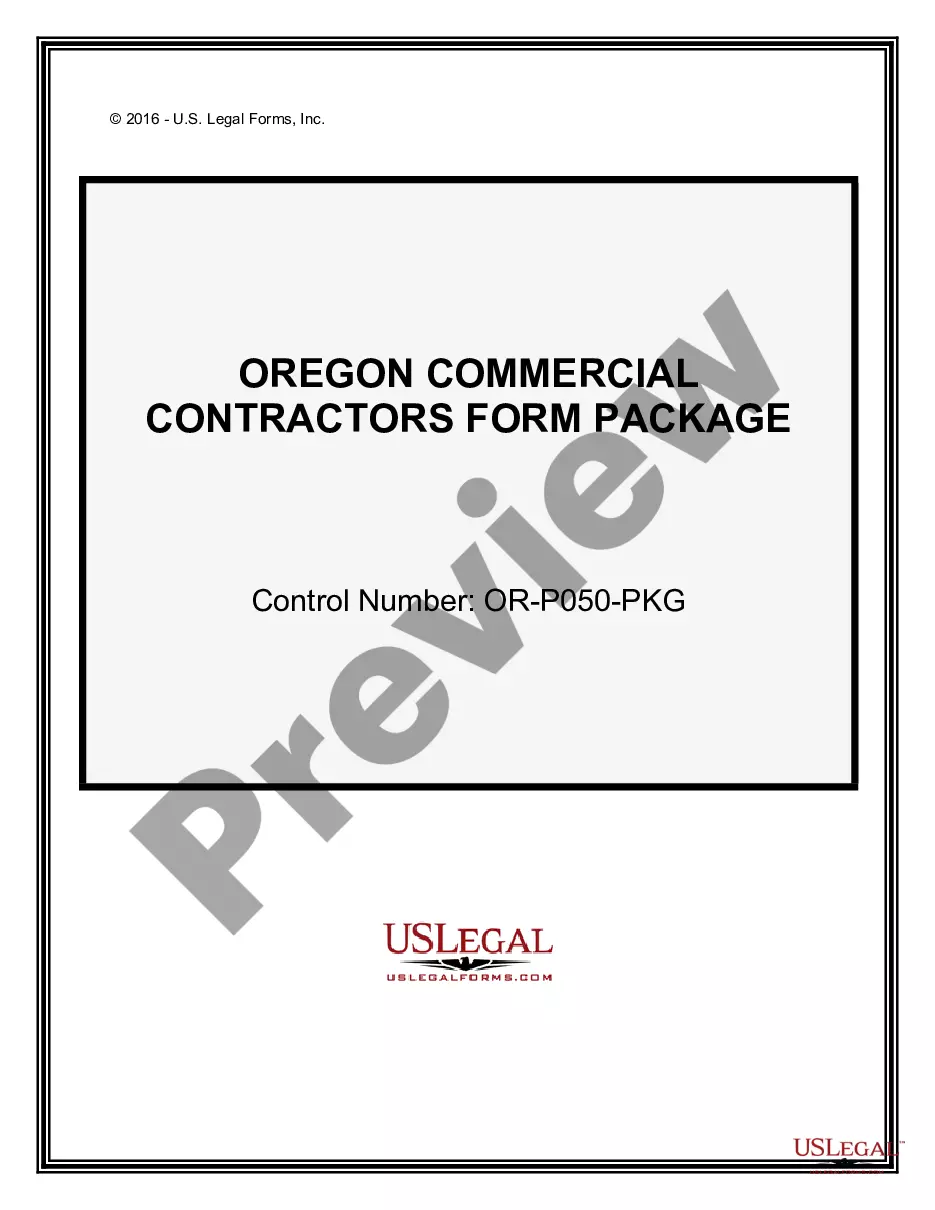
Oregon Commercial Contractor Package
Understanding this form package
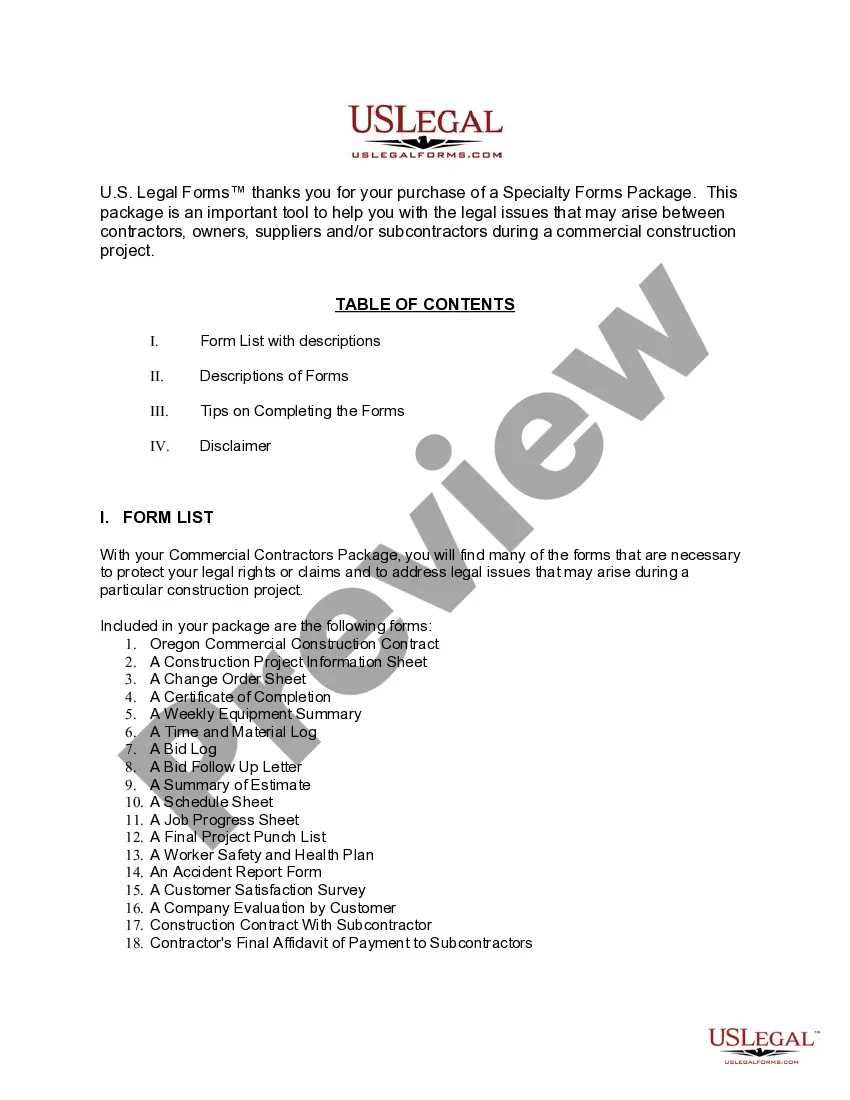
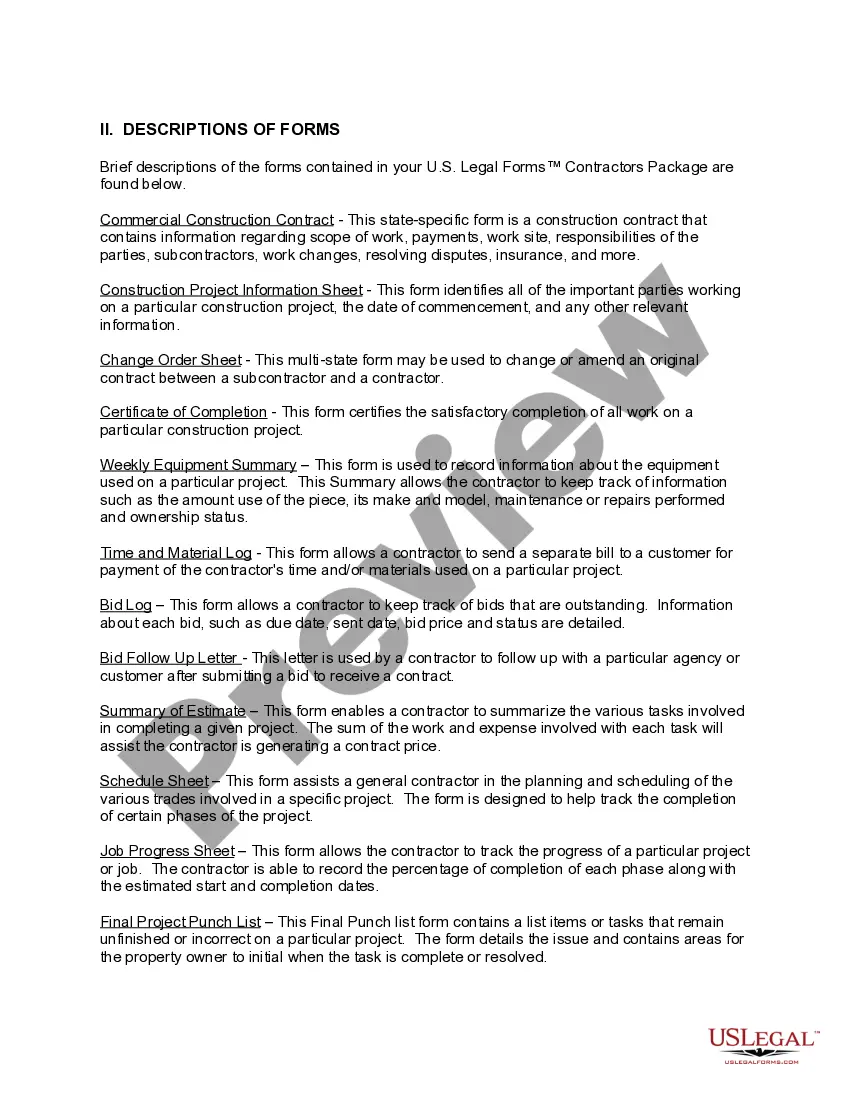
The Oregon Commercial Contractor Package is a comprehensive set of legal documents designed specifically for commercial contractors, owners, suppliers, and subcontractors. It aims to protect your legal rights and address essential legal issues that may arise during construction projects. This package stands out because it focuses on the unique needs of commercial construction, excluding requirements for new home construction, with the primary document being the Oregon Commercial Construction Contract.
Forms provided in this package
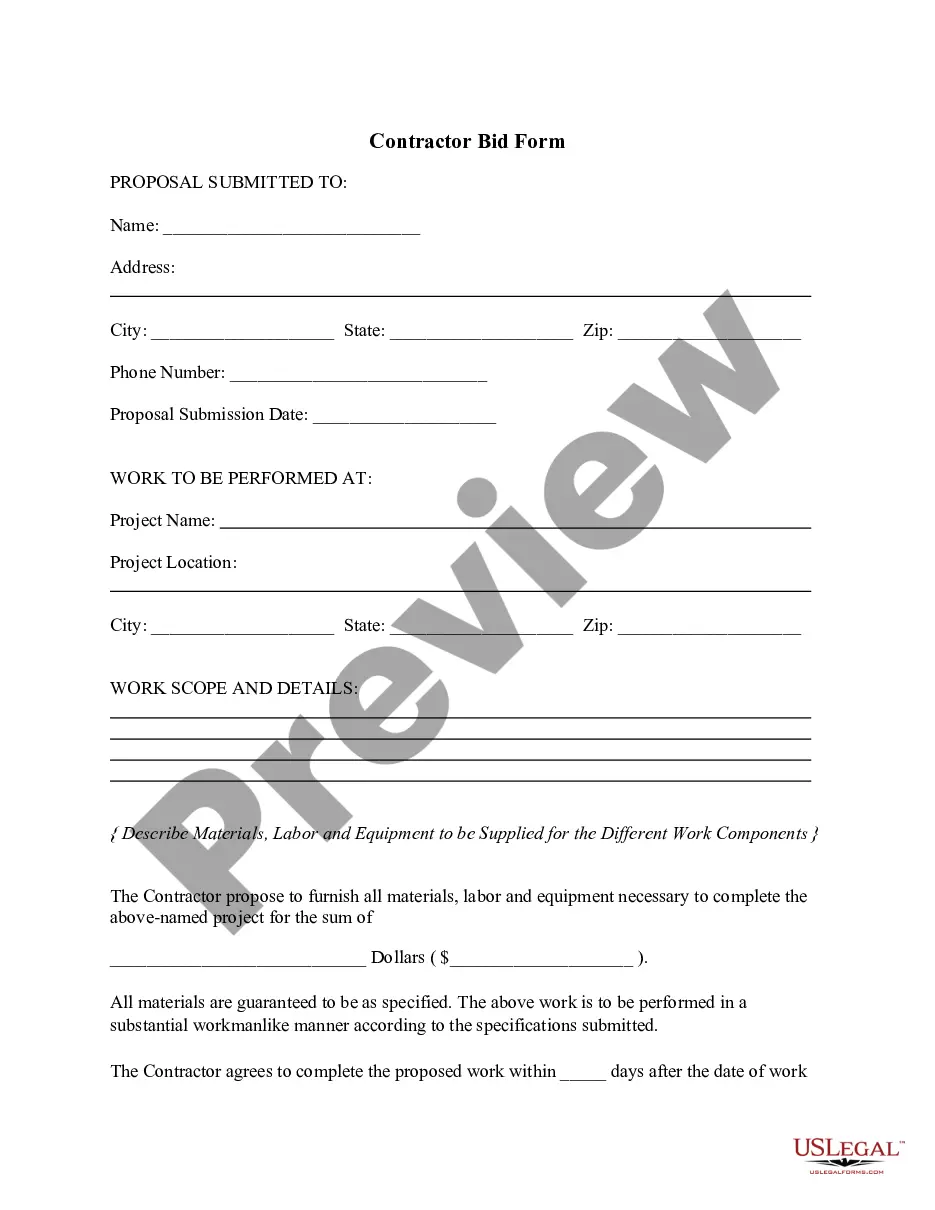
- Commercial Contract for Contractor
- Contractor's Weekly Equipment Summary
- Contractor's Time and Materials Log
- Contractor's Bid Log
- Contractor's Bid Follow Up Letter
- Contractor's Final Affidavit of Payment to Subcontractors
- Contractor's Summary of an Estimate
- Contractor's Schedule Sheet
- Contractor's Job Progress Sheet
- Contractor's Final Punch List
- Customer Satisfaction Survey
- Construction Company Evaluation by a Customer
- Construction Accident Report
- Construction Safety and Health Plan
- Construction Contract with Subcontractor
- Change Order for Construction or Repairs by Contractor
- Certification of Completion by Contractor
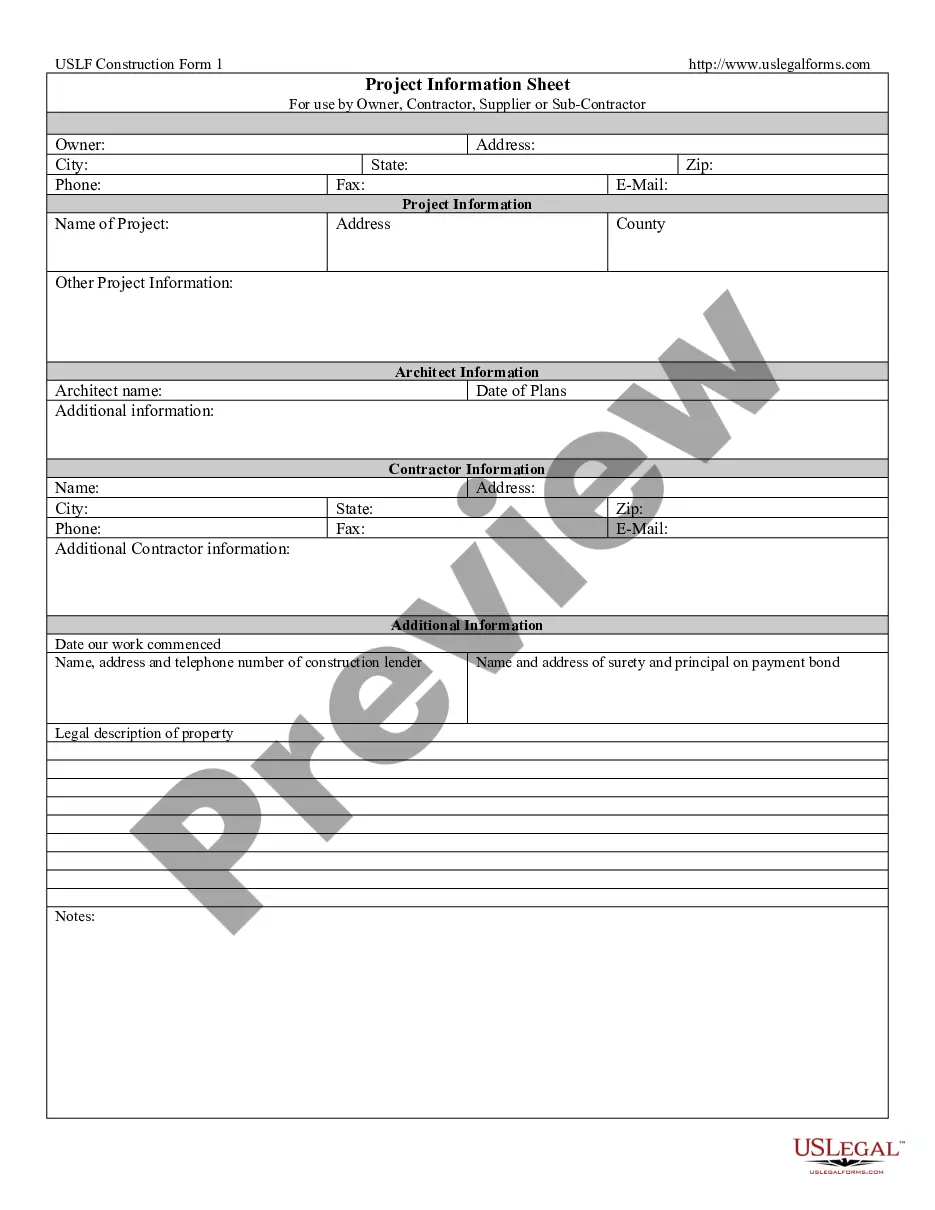
- Construction Project Information Sheet

When to use this form package
This package should be used when you are involved in a commercial construction project. It is particularly useful in scenarios such as:
- Entering into contracts with clients or subcontractors.
- Managing project changes with change orders.
- Establishing project completions with certificates.
- Tracking equipment use and costs throughout the project.
- Ensuring customer satisfaction upon project completion.
Who should use this form package
- Commercial contractors undertaking significant construction projects.
- Business owners seeking to formalize agreements with contractors or subcontractors.
- Suppliers and subcontractors wanting to safeguard their rights and obligations.
- Anyone needing to document project details effectively and legally.
Instructions for completing these forms
- Review all included forms to understand their purpose and content.
- Identify the parties involved in the construction project and fill in their details accurately.
- Enter relevant dates and specific contract terms in the Oregon Commercial Construction Contract.
- Document any changes to the project using the Change Order Sheet as necessary.
- Finalize and sign the forms, keeping copies for your records.
Do forms in this package need to be notarized?
Notarization is required for one or more forms in this package. US Legal Forms provides secure online notarization powered by Notarize, allowing you to complete the process through a verified video call.
Get your form ready online
Our built-in tools help you complete, sign, share, and store your documents in one place.
Make edits, fill in missing information, and update formatting in US Legal Forms—just like you would in MS Word.
Download a copy, print it, send it by email, or mail it via USPS—whatever works best for your next step.
Sign and collect signatures with our SignNow integration. Send to multiple recipients, set reminders, and more. Go Premium to unlock E-Sign.
If this form requires notarization, complete it online through a secure video call—no need to meet a notary in person or wait for an appointment.
We protect your documents and personal data by following strict security and privacy standards.

Make edits, fill in missing information, and update formatting in US Legal Forms—just like you would in MS Word.

Download a copy, print it, send it by email, or mail it via USPS—whatever works best for your next step.

Sign and collect signatures with our SignNow integration. Send to multiple recipients, set reminders, and more. Go Premium to unlock E-Sign.

If this form requires notarization, complete it online through a secure video call—no need to meet a notary in person or wait for an appointment.

We protect your documents and personal data by following strict security and privacy standards.
Avoid these common issues
- Failing to include all relevant parties' information in contracts.
- Not completing forms in their entirety before submission.
- Overlooking necessary signatures, particularly for documents requiring notarization.
- Neglecting to track project progress accurately, leading to disputes.
Why complete this package online
- Convenient access to legally compliant forms tailored for Oregon.
- Editability allows customization of forms to fit specific project needs.
- Reliable documents created by licensed attorneys increase your legal security.
Looking for another form?


Form popularity
FAQ
The threshold for performing certain work without a contractor license increased from $500 to $1,000. To qualify for the exemption, a contractor must perform work that is casual, minor or inconsequential. This means that the work cannot: Be structural in nature.
Can someone become a contractor if they have a prison record? A prison record does not necessarily mean you cannot get a license. However, there are certain felony convictions that may prevent you from getting a license. Each case is reviewed on an individual basis.
The Oregon Construction Contractors Board requires all applicants to pay an Oregon Contractor License registration fee of $250. This Oregon Contractors License fee covers you for two years. This fee is usually $325, but from July 1, 2017 - June 30, 2019, the fee will only be $250.
(18) Working without a construction permit in violation of ORS 701.098, $1,000 for the first offense; $2,000 and suspension of CCB license for three (3) months for the second offense; $5,000 and permanent revocation of CCB license for the third and subsequent offenses.
Since you start prepping with the required pre-license education hours, only need to score a 70%, and the test is open book, the Oregon CCB contractors exam isn't nearly as stressful as other tests you've probably taken in your life.
Florida, Louisiana, Colorado, Connecticut, Kansas, Indiana, Kansas, Missouri, New Hampshire, New York, Ohio, Pennsylvania and Wyoming don't require a specific state license for contractors. Before starting a project, though, check local ordinances to see what licenses you need from your city or county.
To obtain your Oregon CCB License, you will need to complete 16 hours of training on law and business practices and pass a state test. Information on required pre-licensing training can be found on the Oregon CCB website.
In the state of Oregon, anyone performing construction work for compensation is required to have a contractor license. The exceptions to this rule are gutter cleaning, power and pressure washing, and handyman work on projects with a contract value of $1,000 or less.