Oregon Electrical Contractor Package
Overview of this form package
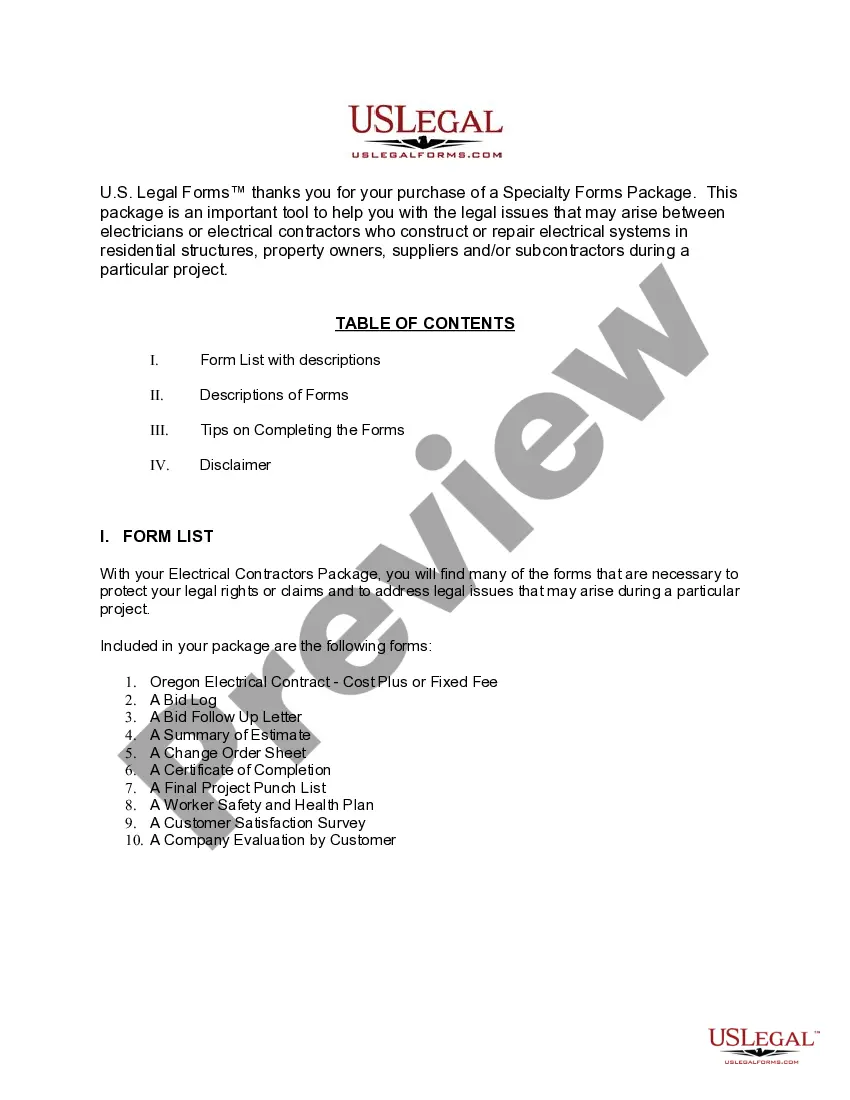
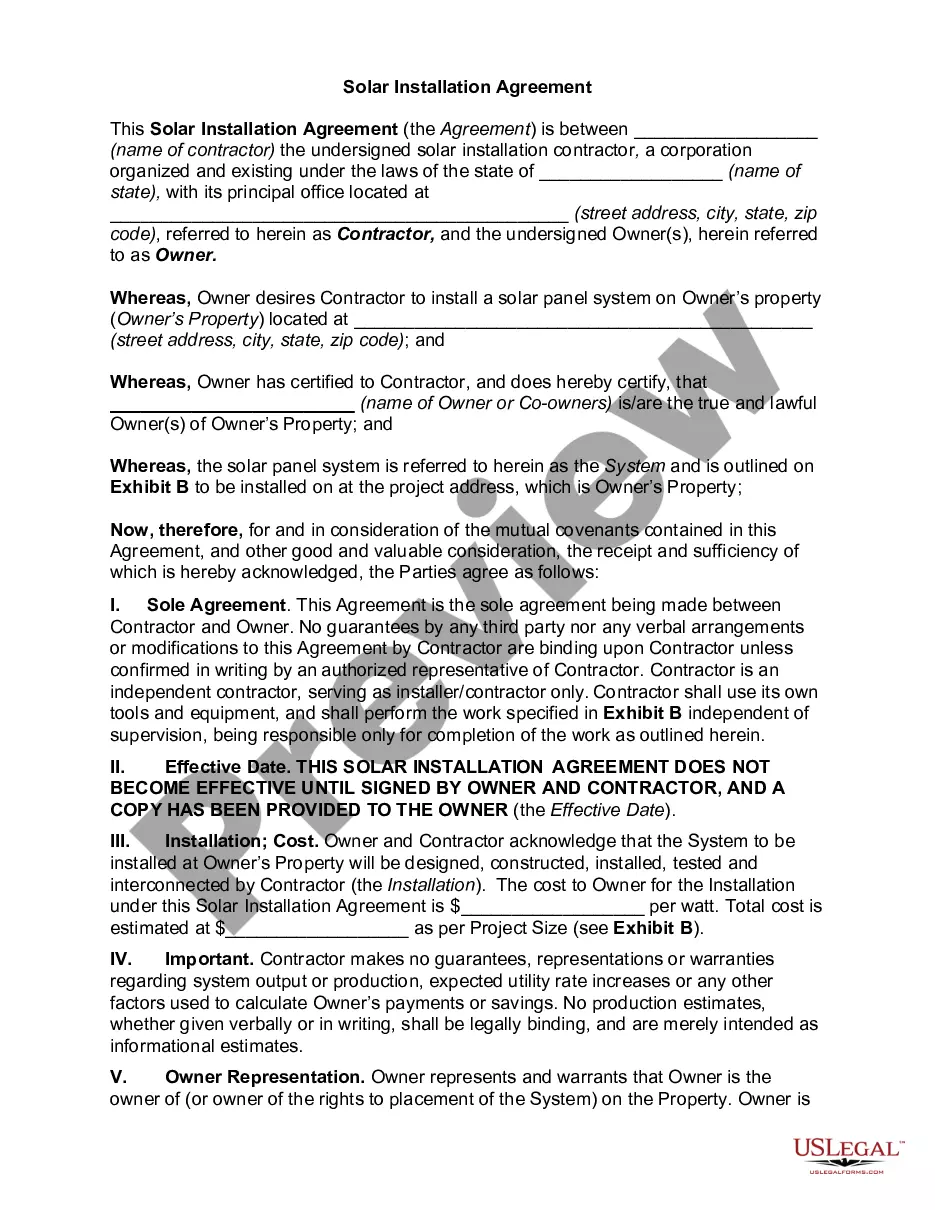
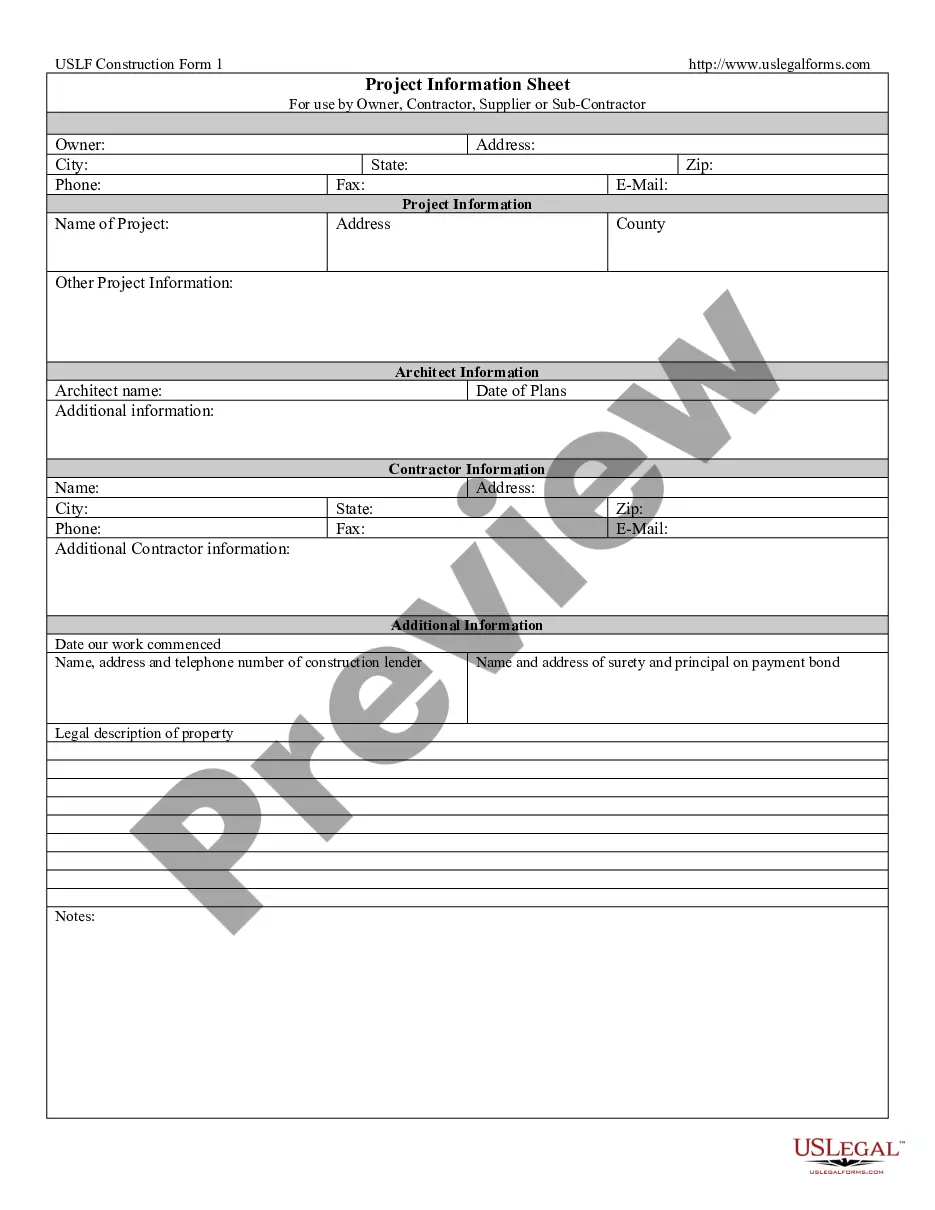
The Oregon Electrical Contractor Package is a comprehensive set of legal forms designed for electricians and electrical contractors operating in Oregon. This package equips users with essential documentation to navigate legal issues that may arise during electrical projects, whether for new construction or renovations. It includes a primary electrical contract that complies with state law, setting it apart from other similar forms packages that may lack jurisdictional specificity.
Documents contained in this package
- Electrical Contract for Contractor
- Contractor's Bid Log
- Contractor's Bid Follow Up Letter
- Contractor's Summary of an Estimate
- Contractor's Final Punch List
- Customer Satisfaction Survey
- Construction Company Evaluation by a Customer
- Construction Safety and Health Plan
- Change Order for Construction or Repairs by Contractor
- Certification of Completion by Contractor






When to use this document
This package is ideal for situations including:
- Starting a new electrical project with clear terms outlined in a contract.
- Tracking and following up on bids sent to clients or agencies.
- Documenting changes to the original contract through change orders.
- Certifying the completion of a project.
- Ensuring safety and compliance with health regulations during construction.
- Gathering feedback from customers to improve service and satisfaction.
Who can use this document
- Licensed electrical contractors in Oregon.
- Electricians involved in residential or commercial projects.
- Property owners hiring electrical contractors.
- Suppliers and subcontractors working on electrical projects.
- Anyone managing legal aspects of electrical work specifically in Oregon.
Steps to complete these forms
- Review the included forms and understand their purpose and requirements.
- Identify the parties involved, such as contractors, property owners, and suppliers.
- Complete the required fields with accurate information, including dates and signatures.
- Save and organize all forms for easy access during the project lifecycle.
- Distribute necessary forms to relevant parties for review and acknowledgment.
Do documents in this package require notarization?
Notarization is not commonly needed for forms in this package. However, if your state’s laws require it, our notarization service, powered by Notarize, allows you to finalize documents online 24/7 without in-person visits.
Get your form ready online
Our built-in tools help you complete, sign, share, and store your documents in one place.
Make edits, fill in missing information, and update formatting in US Legal Forms—just like you would in MS Word.
Download a copy, print it, send it by email, or mail it via USPS—whatever works best for your next step.
Sign and collect signatures with our SignNow integration. Send to multiple recipients, set reminders, and more. Go Premium to unlock E-Sign.
If this form requires notarization, complete it online through a secure video call—no need to meet a notary in person or wait for an appointment.
We protect your documents and personal data by following strict security and privacy standards.

Make edits, fill in missing information, and update formatting in US Legal Forms—just like you would in MS Word.

Download a copy, print it, send it by email, or mail it via USPS—whatever works best for your next step.

Sign and collect signatures with our SignNow integration. Send to multiple recipients, set reminders, and more. Go Premium to unlock E-Sign.

If this form requires notarization, complete it online through a secure video call—no need to meet a notary in person or wait for an appointment.

We protect your documents and personal data by following strict security and privacy standards.
Avoid these common issues
- Failing to include all necessary parties in the contracts.
- Not updating the forms with accurate project details.
- Overlooking required signatures before submitting forms.
- Neglecting to follow up on bids or change orders.
- Not keeping a copy of all completed forms for future reference.
Why complete this package online
- Convenient access to all necessary forms in one package, reducing the hassle of searching for individual documents.
- Edit and customize forms easily to meet specific project requirements.
- Reliability ensured through forms drafted by licensed attorneys, offering peace of mind regarding legal validity.
- Ability to download and print forms for use both digitally and in hard copy.
Quick recap
- The Oregon Electrical Contractor Package provides essential legal forms for electrical projects in Oregon.
- Ideal for contractors, property owners, and subcontractors managing electrical work.
- Adheres to state laws, ensuring all forms are legally compliant.
- Online access allows flexibility and ease of use for completing necessary documentation.
Looking for another form?


Form popularity
FAQ
The LME program consists of 4,000 on-the-job training hours and two years of core classes. The SE program consists of 8,000 on-the-job training hours and four years of core classes. After either program, the apprentice would be eligible to test for their LME license.
The threshold for performing certain work without a contractor license increased from $500 to $1,000. To qualify for the exemption, a contractor must perform work that is casual, minor or inconsequential. This means that the work cannot: Be structural in nature.
(18) Working without a construction permit in violation of ORS 701.098, $1,000 for the first offense; $2,000 and suspension of CCB license for three (3) months for the second offense; $5,000 and permanent revocation of CCB license for the third and subsequent offenses.
The general contractor may hire an electrician, a plumber, a cabinet maker-installer, a tile layer and a granite installer. New Construction: Probably the most complex construction project is building a new house.
(1) Except as otherwise provided in this subsection, a person is not required to obtain a license to make an electrical installation on residential or farm property that is owned by the person or a member of the person's immediate family if the property is not intended for sale, exchange, lease or rent.
Complete an Oregon apprenticeship. Have at least 288 hours of classroom training. Have at least 4,000 hours of work experience. Pass an examination.
As of Apr 14, 2021, the average annual pay for a Journeyman Electrician in Oregon is $52,868 an year. Just in case you need a simple salary calculator, that works out to be approximately $25.42 an hour.
Provide proof that they have at least four years (8,000 hours) of experience as a Journeyman. Fill out the application. Wait for information about the testing location. Schedule the exam. Pass the exam with at least 75 %.