Ohio Default Judgment Entry
About this form
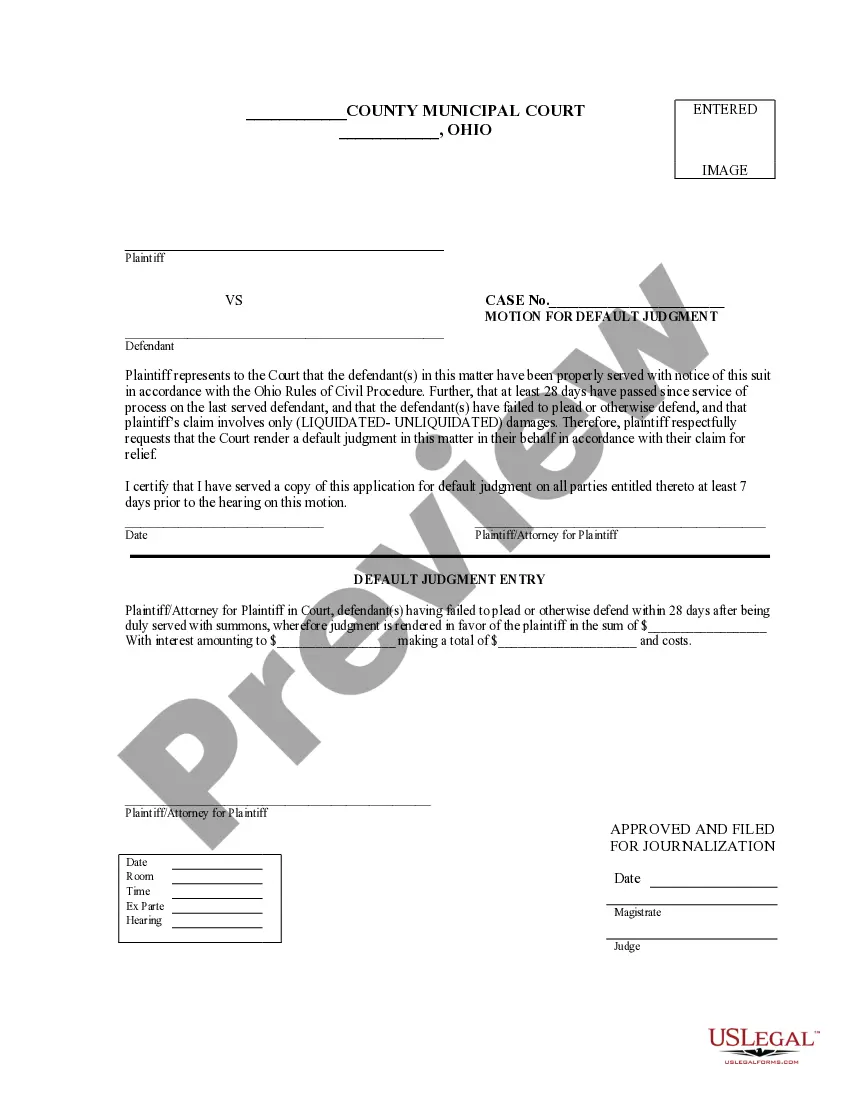
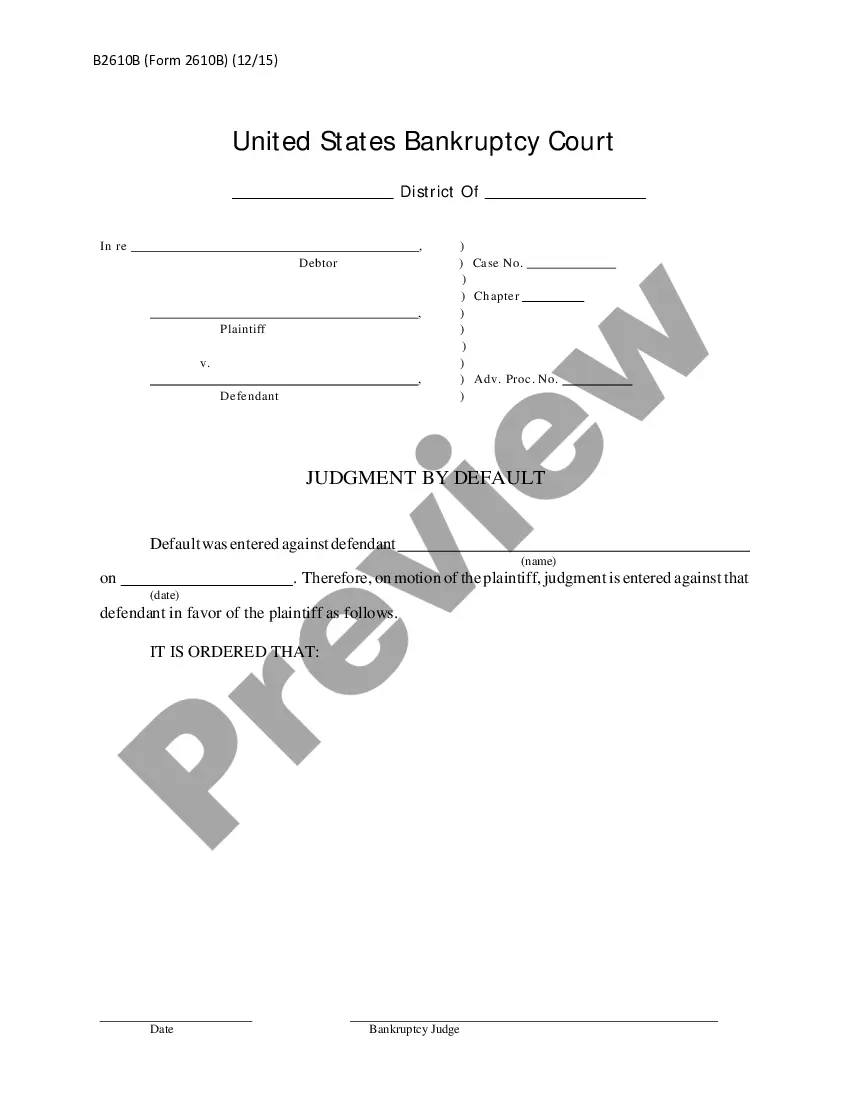
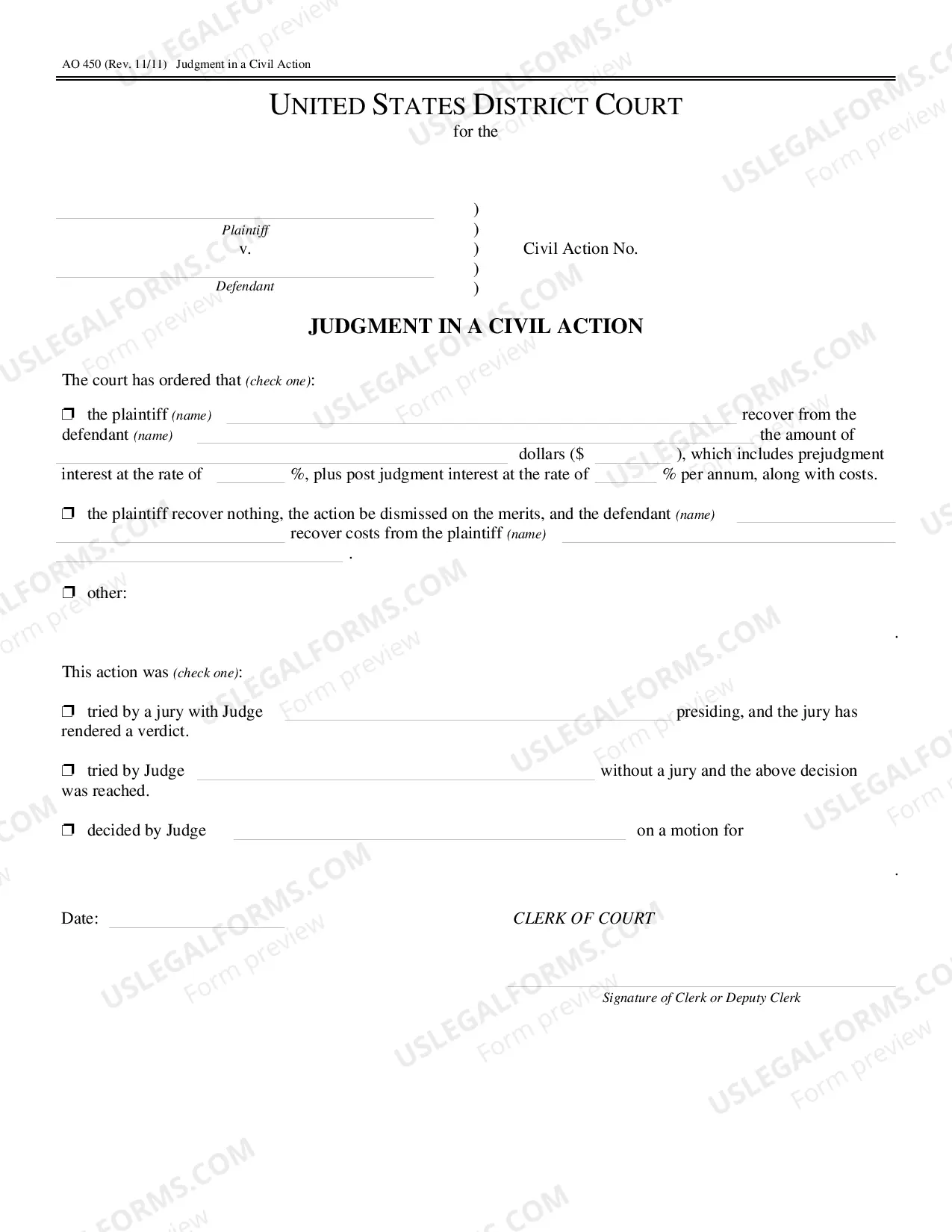
A Default Judgment Entry is a legal document used in Ohio garnishment cases when a plaintiff seeks a judgment against a defendant who has not responded to a lawsuit. This form is particularly important as it allows the plaintiff to obtain a judgment without a trial, provided that certain conditions, such as proper service and the lack of a response from the defendant, are met. Unlike other court forms, this document specifically focuses on granting a judgment when the defendant fails to defend against the claim.
Key components of this form
- Identification of the court and case number.
- Details regarding service of process on the defendant.
- Request for default judgment with specific outcomes including liquidated or unliquidated damages.
- Certification of service to all parties involved.
- Final judgment details including amounts and interest.
- Signatures of the plaintiff or the plaintiff's attorney and a magistrate or judge.
Situations where this form applies
This form should be used when the defendant in a legal case has been properly served but fails to respond within the required timeframe. For example, if a plaintiff sues a defendant for unpaid debts and the defendant does not file an answer or appear in court within 28 days, the plaintiff can then file for a default judgment using this form. It is a crucial step to ensure that the plaintiff can move forward with collecting the judgment awarded by the court.
Who should use this form
- Plaintiffs in Ohio garnishment cases seeking a default judgment.
- Attorneys representing clients in cases where defendants have failed to respond.
- Individuals with limited legal knowledge needing a straightforward method to navigate a default judgment process.
How to prepare this document
- Identify the court and fill in the case number.
- Confirm that the defendant has been served and record the date of service.
- Specify whether the damages are liquidated or unliquidated.
- Enter the total amount the plaintiff is claiming, including any interest and costs.
- Sign and date the document, along with the attorney's signature if applicable.
Does this document require notarization?
This form does not typically require notarization to be legally valid. However, some jurisdictions or document types may still require it. US Legal Forms provides secure online notarization powered by Notarize, available 24/7 for added convenience.
Get your form ready online
Our built-in tools help you complete, sign, share, and store your documents in one place.
Make edits, fill in missing information, and update formatting in US Legal Forms—just like you would in MS Word.
Download a copy, print it, send it by email, or mail it via USPS—whatever works best for your next step.
Sign and collect signatures with our SignNow integration. Send to multiple recipients, set reminders, and more. Go Premium to unlock E-Sign.
If this form requires notarization, complete it online through a secure video call—no need to meet a notary in person or wait for an appointment.
We protect your documents and personal data by following strict security and privacy standards.

Make edits, fill in missing information, and update formatting in US Legal Forms—just like you would in MS Word.

Download a copy, print it, send it by email, or mail it via USPS—whatever works best for your next step.

Sign and collect signatures with our SignNow integration. Send to multiple recipients, set reminders, and more. Go Premium to unlock E-Sign.

If this form requires notarization, complete it online through a secure video call—no need to meet a notary in person or wait for an appointment.

We protect your documents and personal data by following strict security and privacy standards.
Common mistakes
- Failing to provide proof of proper service of process.
- Not waiting the required time after service before filing for default judgment.
- Inaccurately filling out the damages section, leading to potential disputes.
- Neglecting to certify that all parties received notice of the application for default judgment.
Advantages of online completion
- Convenience of downloading and completing the form from home at any time.
- Editability allows users to customize the form to fit their specific case needs.
- Access to forms drafted by licensed attorneys ensures legal accuracy.
Looking for another form?
Form popularity
FAQ
Entry of default refers to the process where the person making a claim in a case makes a request before a court of law stating that the party against whom they have made a claim have failed to furnish any meaningful response to the claimant's pleadings within the time allowed for that.
Default judgments happen when you don't respond to a lawsuit often from a debt collector and a judge resolves the case without hearing your side.Next up could be wage garnishment or a bank account levy, which allows a creditor to remove money from your bank accounts to repay the debt.
Typically, a court's rules governing enforcement of default judgments include procedures for wage garnishments, attachment of bank accounts and seizure of assets. The plaintiff can usually pursue more than one of these enforcement mechanisms simultaneously.
In California, money judgments are enforceable by a writ of execution. In order to enforce the judgment lien, the judgment creditor must obtain a writ of execution, levy and then sell the real property at an execution sale.
In effect, you're found guilty because you never entered a defense. Default judgments are sometimes called automatic judgments because of how fast they can happen. Next up could be wage garnishment or a bank account levy, which allows a creditor to remove money from your bank accounts to repay the debt.
First, you can ask the court to set aside the default judgment and give you an opportunity to contest it. Next, you can settle the debt with the debt buyer for an amount less than what the default judgment is for. And finally you can eliminate the default judgment completely by filing for bankruptcy.
In order to vacate a judgment in California, You must file a motion with the court asking the judge to vacate or set aside the judgment. Among other things, you must tell the judge why you did not respond to the lawsuit (this can be done by written declaration).
A default judgment means that the court has decided that you owe money. This a result of the person suing you in small claims court and you failed to appear at the hearing.
The danger of allowing a default judgment against you is once this occurs the debt buyer can garnish your wages and your bank accounts.If you don't submit a written answer to the lawsuit the court can enter a default judgment giving the debt buyer everything they are asking for.