Virginia Performance Horse Lease Agreement
What this document covers
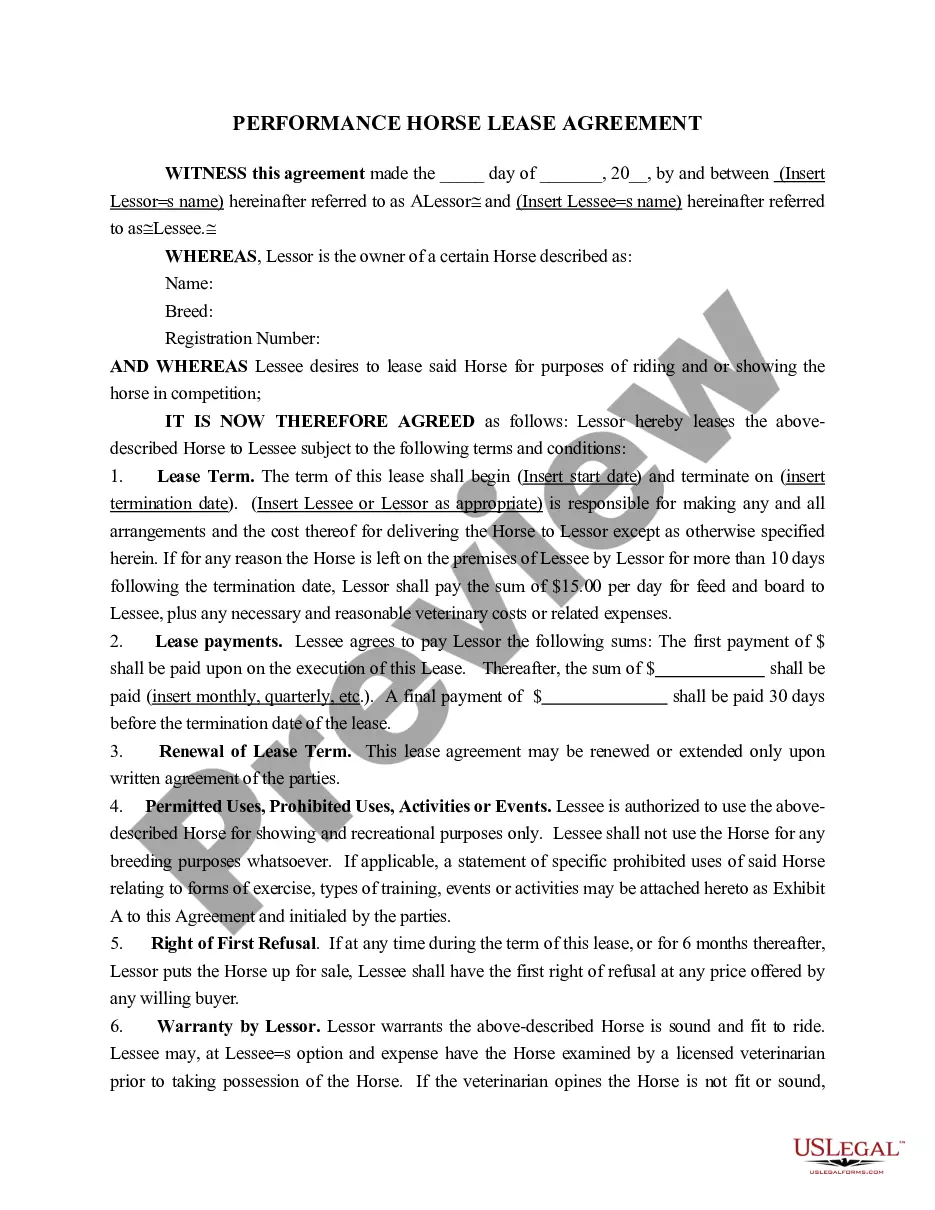
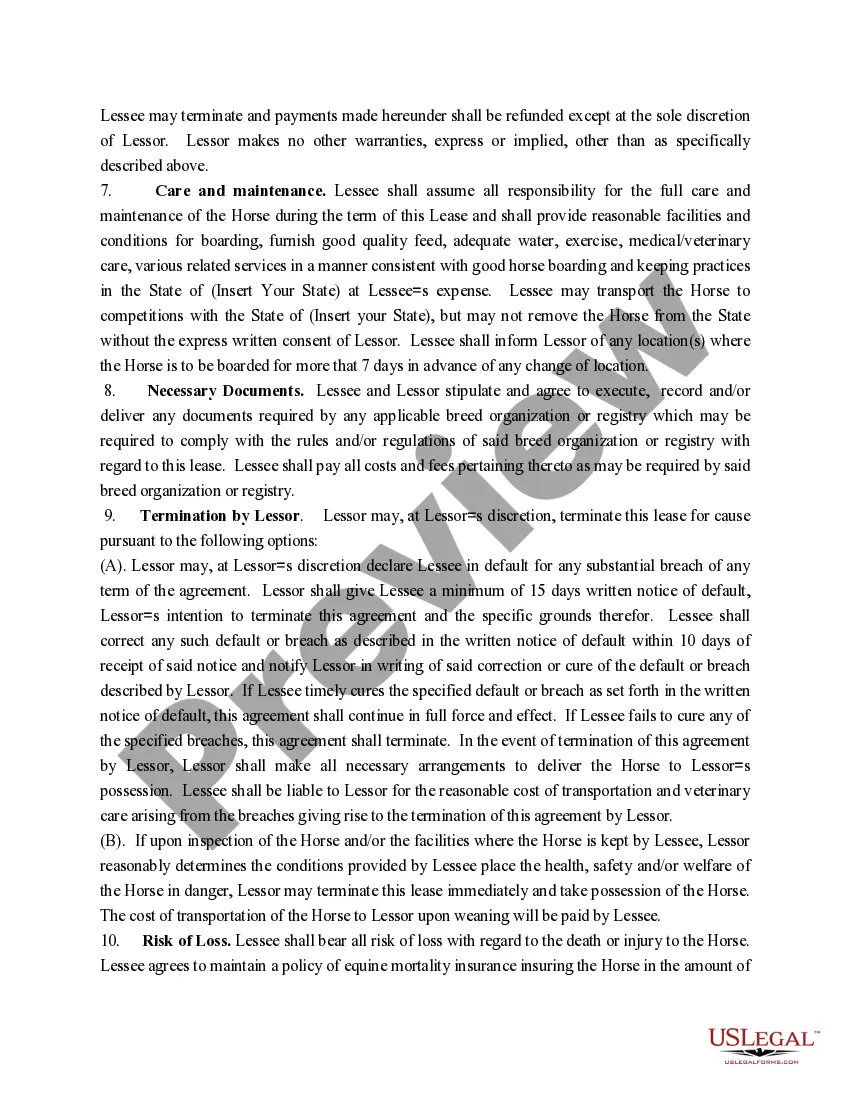
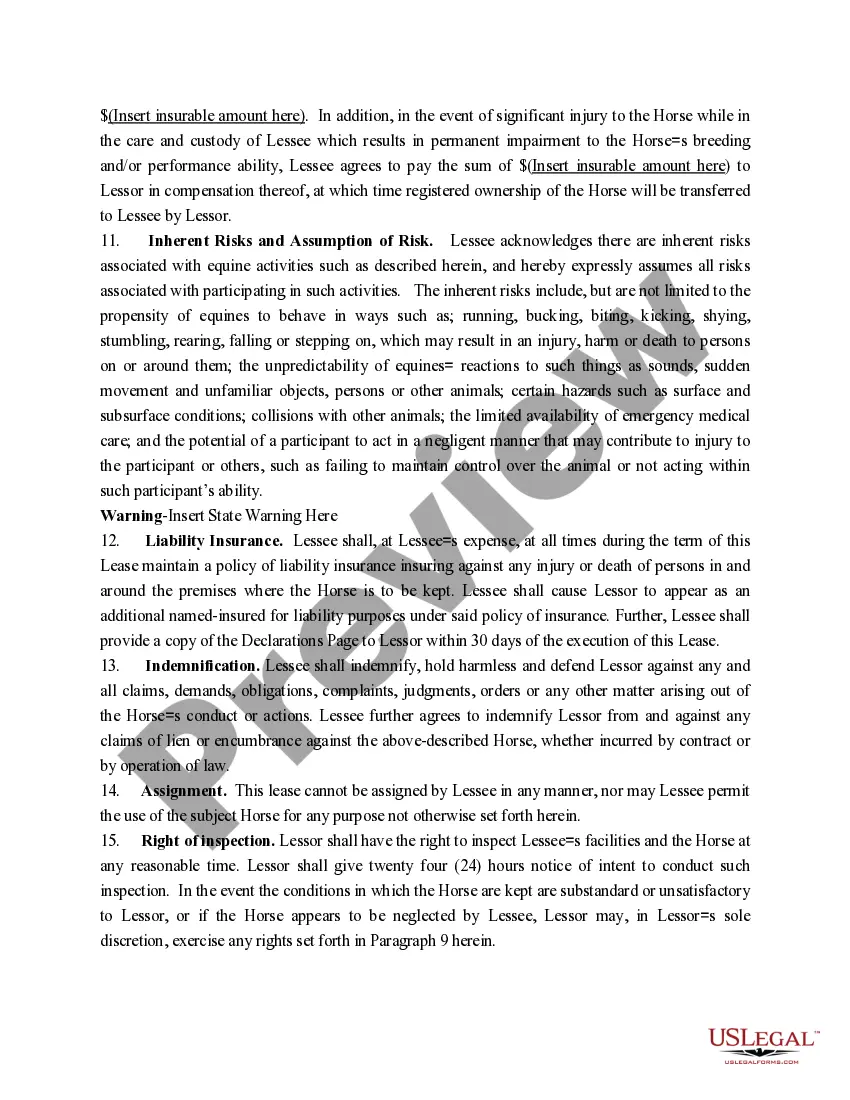
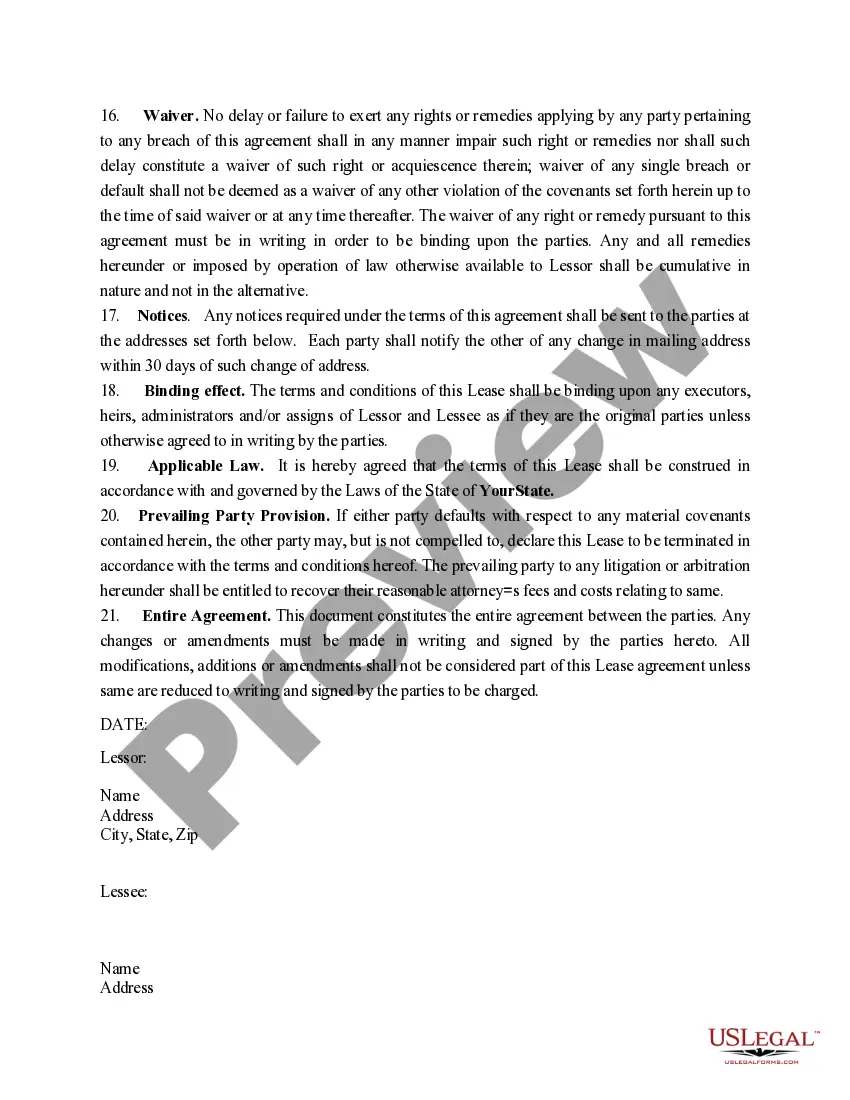
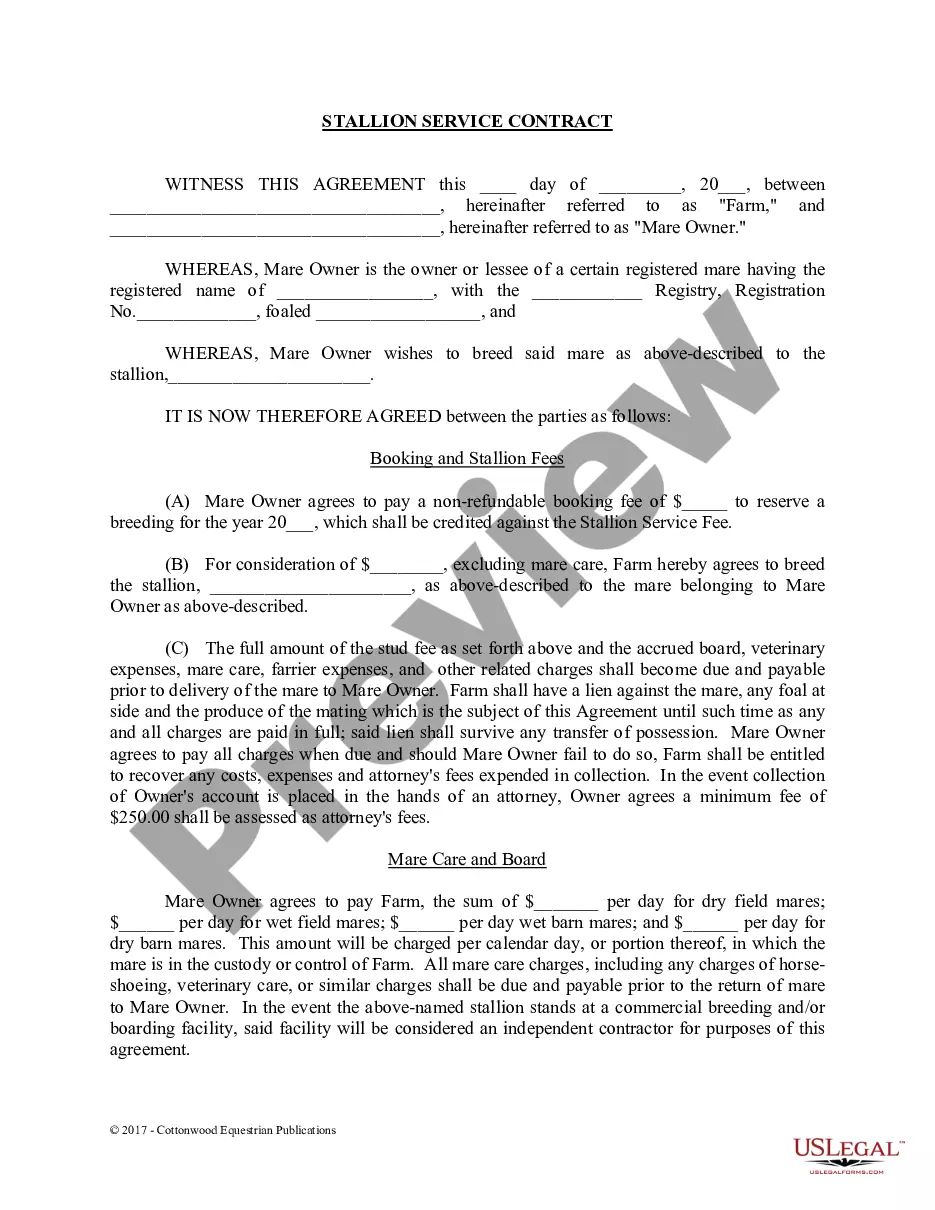
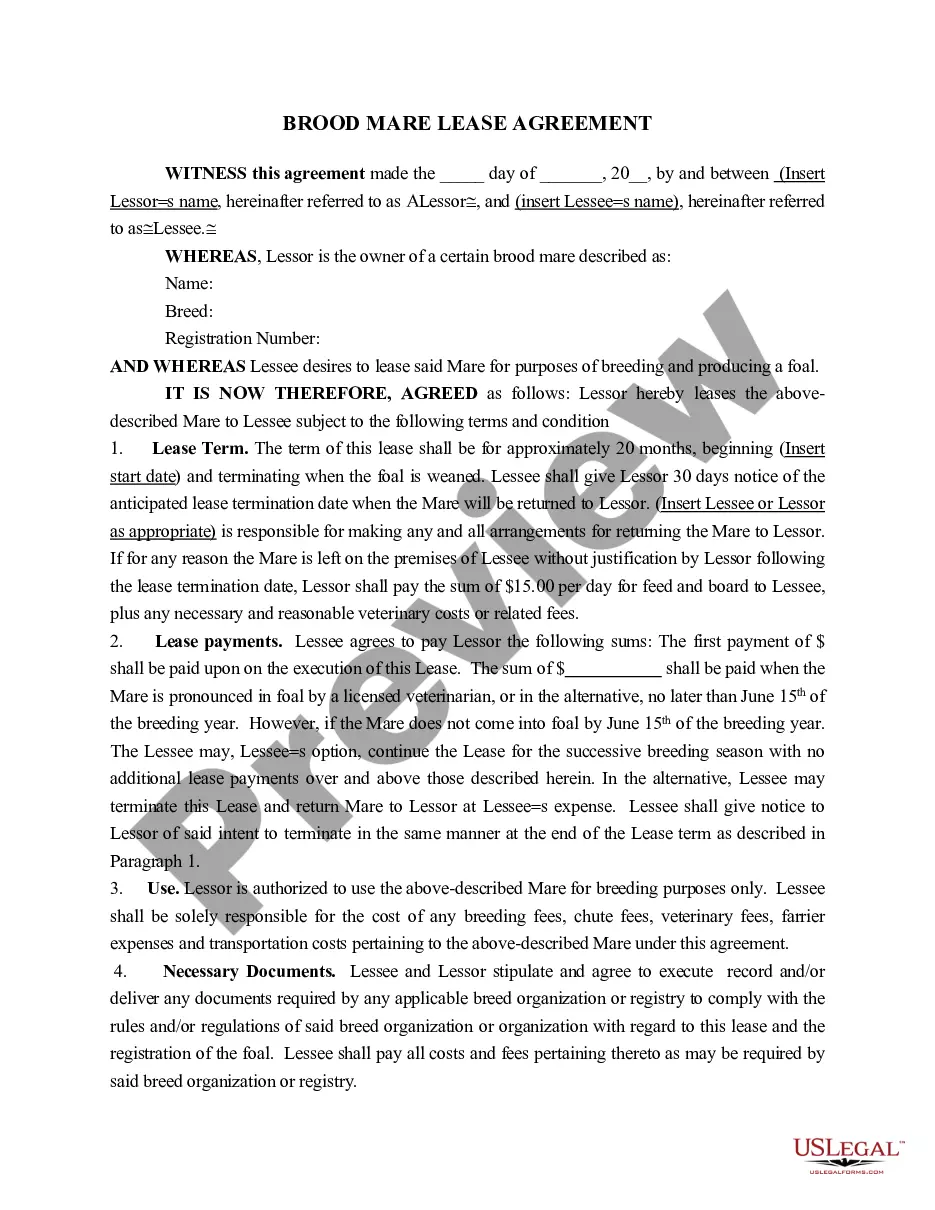
The Performance Horse Lease Agreement is a legal document that outlines the terms under which one party (the lessor) agrees to lease a horse to another party (the lessee) for riding or competition purposes. This form is specifically tailored for performance and brood mares, distinguishing it from standard horse lease agreements. It provides detailed clauses on lease payment, permitted uses, care requirements, and risk management to protect both parties during the lease period.
Main sections of this form
- Lease term: Specifies the duration of the lease, including start and end dates.
- Lease payments: Details the payment structure, including initial and periodic payments.
- Permitted uses: Outlines the approved activities for the horse and prohibits breeding.
- Right of first refusal: Grants the lessee the option to purchase the horse if the lessor decides to sell.
- Risk of loss: Clarifies liability for the horse's care and any related costs.
Situations where this form applies
This agreement is useful when an individual or organization wishes to lease a performance horse for equestrian activities, such as riding or showing in competitions. It is ideal for those who do not own a horse but wish to participate in equestrian events or require a temporary lease for training purposes. Additionally, it can be beneficial when the horse owner seeks to provide a horse for lease while ensuring that their interests and the horse's welfare are protected.
Who needs this form
- Horse owners looking to lease their horse for performance activities.
- Individuals or organizations looking to lease a horse for non-breeding uses.
- Equestrian trainers or competitors needing a temporary horse for events.
- Anyone involved in the equestrian community seeking legal clarity on rental agreements.
How to complete this form
- Identify the parties: Fill in the names and contact information of both the lessor and lessee.
- Specify the horse: Provide details such as the horse's name, breed, and registration number.
- Enter the lease term: Clearly state the lease start and end dates.
- Detail the lease payments: Specify the amounts and due dates for all payments.
- Review permitted uses: Ensure that the lessee understands and agrees to the allowed activities for the horse.
Does this document require notarization?
This form does not typically require notarization unless specified by local law. However, having a witness or notarization could strengthen the enforceability of the agreement, ensuring both parties have clarity and commitment to the terms outlined.
Get your form ready online
Our built-in tools help you complete, sign, share, and store your documents in one place.
Make edits, fill in missing information, and update formatting in US Legal Forms—just like you would in MS Word.
Download a copy, print it, send it by email, or mail it via USPS—whatever works best for your next step.
Sign and collect signatures with our SignNow integration. Send to multiple recipients, set reminders, and more. Go Premium to unlock E-Sign.
If this form requires notarization, complete it online through a secure video call—no need to meet a notary in person or wait for an appointment.
We protect your documents and personal data by following strict security and privacy standards.

Make edits, fill in missing information, and update formatting in US Legal Forms—just like you would in MS Word.

Download a copy, print it, send it by email, or mail it via USPS—whatever works best for your next step.

Sign and collect signatures with our SignNow integration. Send to multiple recipients, set reminders, and more. Go Premium to unlock E-Sign.

If this form requires notarization, complete it online through a secure video call—no need to meet a notary in person or wait for an appointment.

We protect your documents and personal data by following strict security and privacy standards.
Common mistakes
- Failing to specify the lease term or payment schedule.
- Not detailing the permitted and prohibited uses of the horse.
- Omitting important contact information of either party.
- Neglecting to include a right of first refusal clause.
- Not understanding local state laws that may affect the lease agreement.
Advantages of online completion
- Convenient access to customizable templates that can be downloaded anytime.
- Editable fields allow for easy adjustments to suit specific needs and scenarios.
- Drafted by licensed attorneys, ensuring legal reliability and adherence to best practices.
- Quick turnaround, allowing users to complete leasing arrangements faster.
- Availability across devices for ease of use whether at home or on the go.
- The lease agreement establishes the legal relationship between the horse owner and the lessee.
- It provides enforceability of terms, protecting both parties in case of disputes.
- Limitations are in place regarding the horse's use to maintain its welfare.
Summary of main points
- The Performance Horse Lease Agreement outlines essential terms of leasing a horse for riding and competition.
- Both parties must understand their responsibilities to maintain the horse's welfare.
- This agreement can help prevent misunderstandings and legal disputes in the future.
Looking for another form?
Form popularity
FAQ
Full Leasing a Horse When you full lease a horse you pay an agreed upon fee for exclusive access to the horse. This means you are the only one riding the horse.
The Half-Lease Contract.In this type of agreement, the owner of the horse or lessor splits the horse's care expenses and riding time with a lessee. It can be a beneficial way to save money on board, feed, vet bills, etc., and it can be great for your horse if your own saddle time is limited.
Leasing a horse is nearly always less expensive than buying one.Leasing often allows riders of all levels to get a better quality horse than they might buy. Horse owners don't usually sell their best or most promising horses, but do lease them out when they don't have time for them or need some extra income.
Option #1: The person leasing the horse is responsible for all of the horse's expenses (board, feed, veterinary, farrier, etc). The person leasing the horse may ride or use the horse any time they'd like. Full leases rarely restrict riding days, times, or horse-related events, like attending a horse show.
FULL LEASE: For $400 per month, you will have full, exclusive use of the horse. Full-leases require that you also pay to the costs of routine farrier and health care, which will vary according to the horse's needs.
A free lease means that the horse is leased to someone without any payment to the owner. When you have a free lease you retain ownership and control of your horse but your horse, in best case scenarios, is still cared for and loved. Everyone wins. The owner has good care for the horse they love.
Lease-to-Buy Equine Contract To purchase the horse, the buyer will pay the full purchase price during the lease term. During this time, the buyer will continue making lease payments per the parties' agreement, which will potentially go toward the total purchase price of the horse.