Indiana Drainage Contractor Package
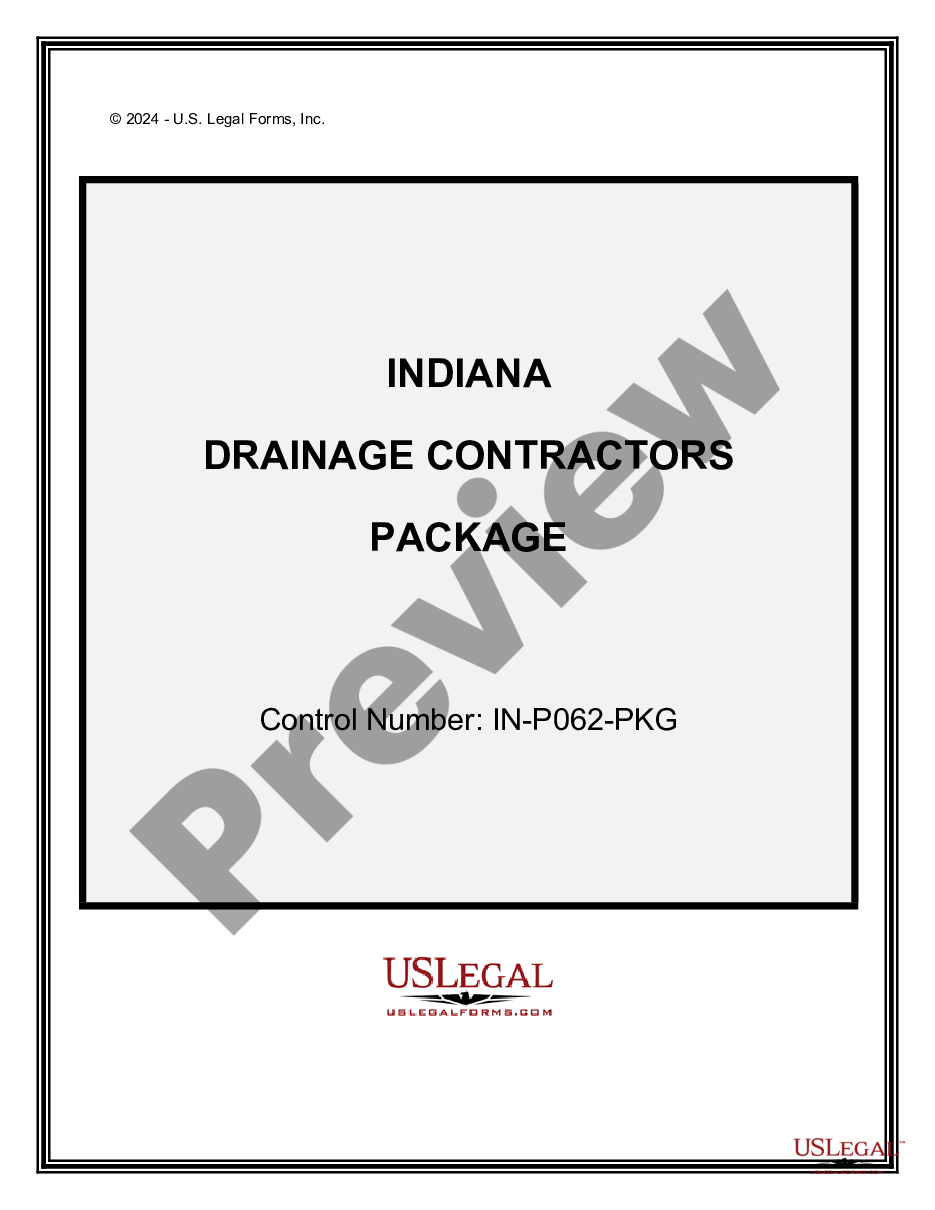
Understanding this form package
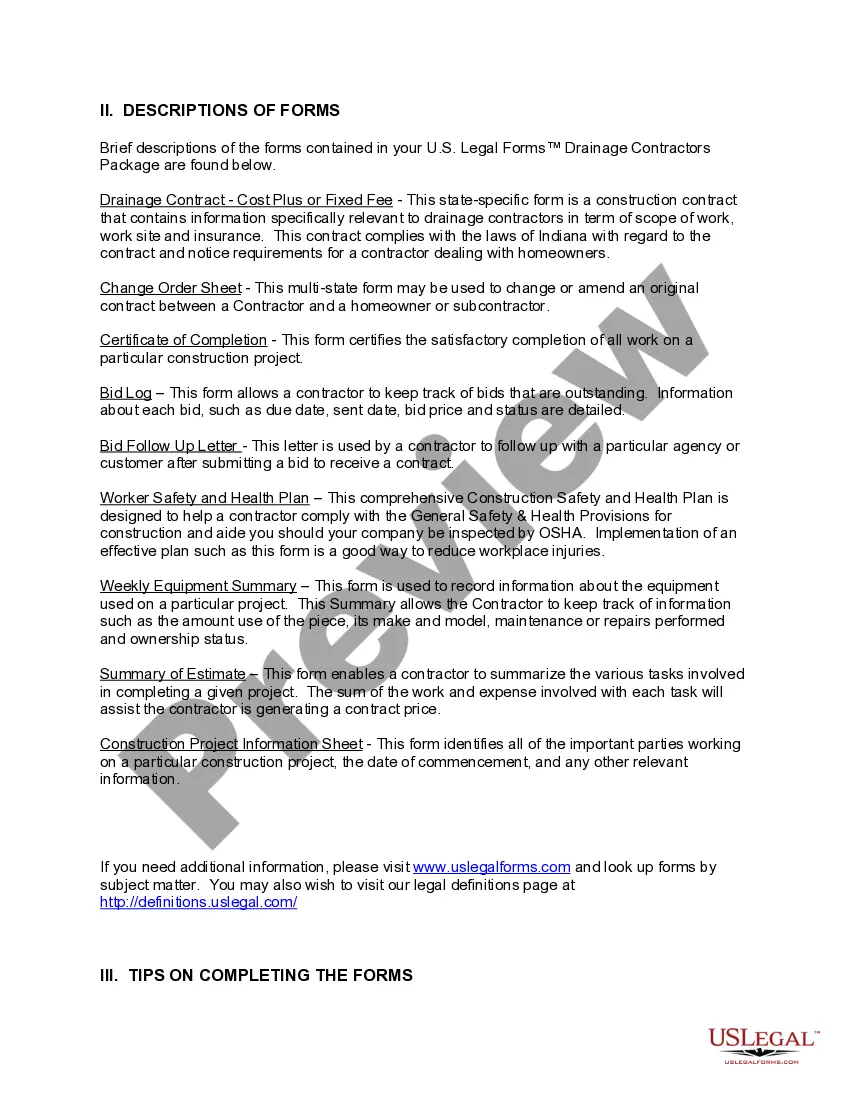
The Indiana Drainage Contractor Package provides essential legal documents specifically designed for drainage contractors, owners, suppliers, and subcontractors involved in construction projects. This package helps you assert your legal rights, manage claims, and address significant legal issues during the installation of cesspools, septic tanks, storm drains, and other sewage disposal systems. Notably, the package includes a compliant drainage contract that adheres to Indiana state law, ensuring that you have reliable resources at your disposal.
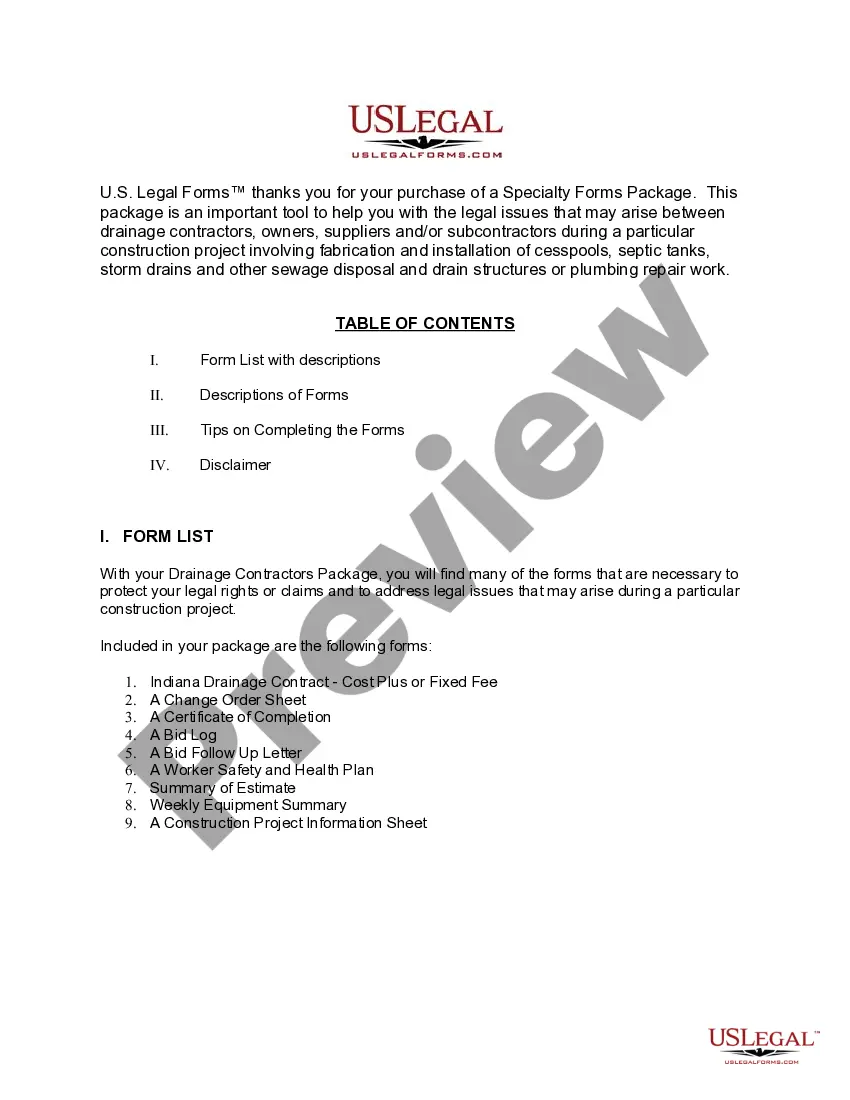
Documents contained in this package
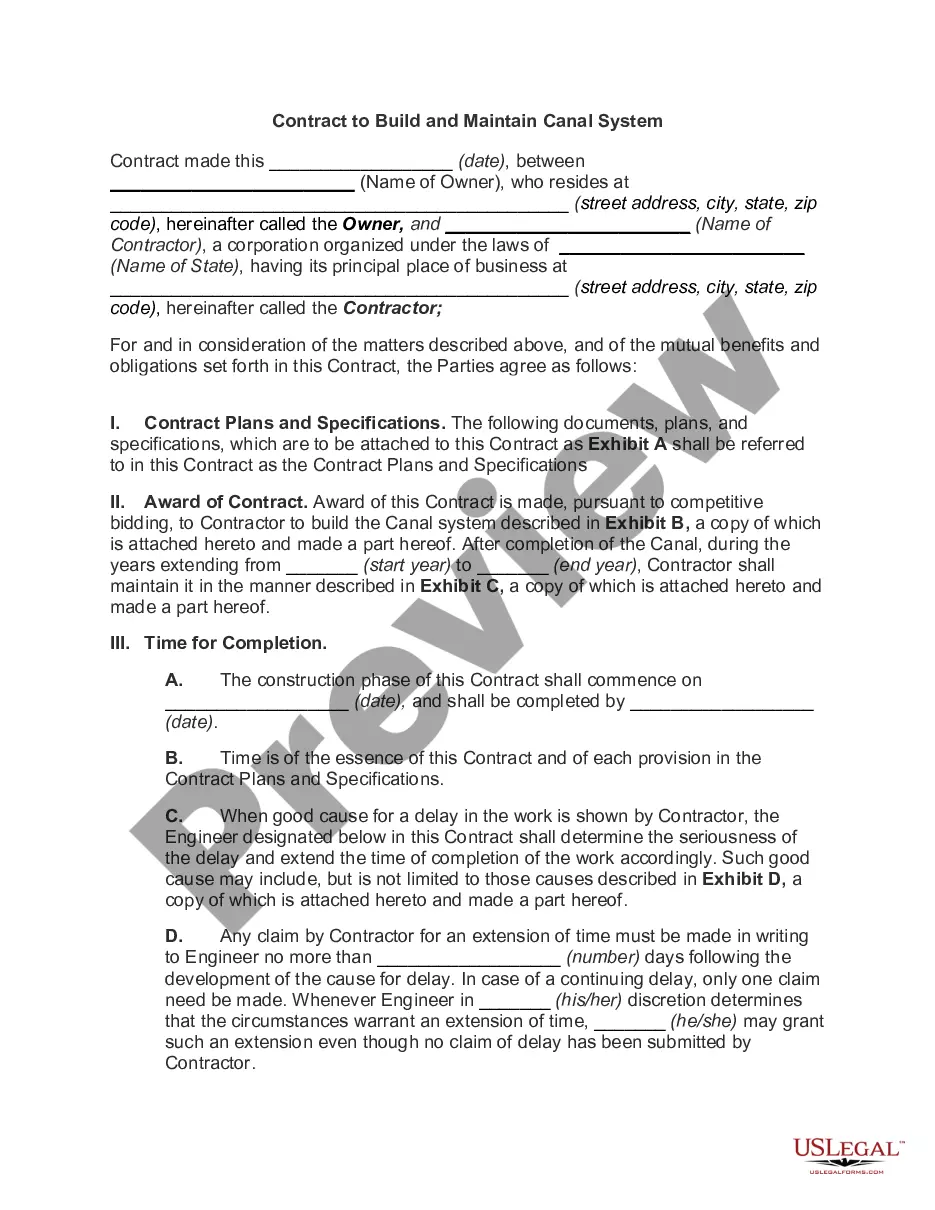
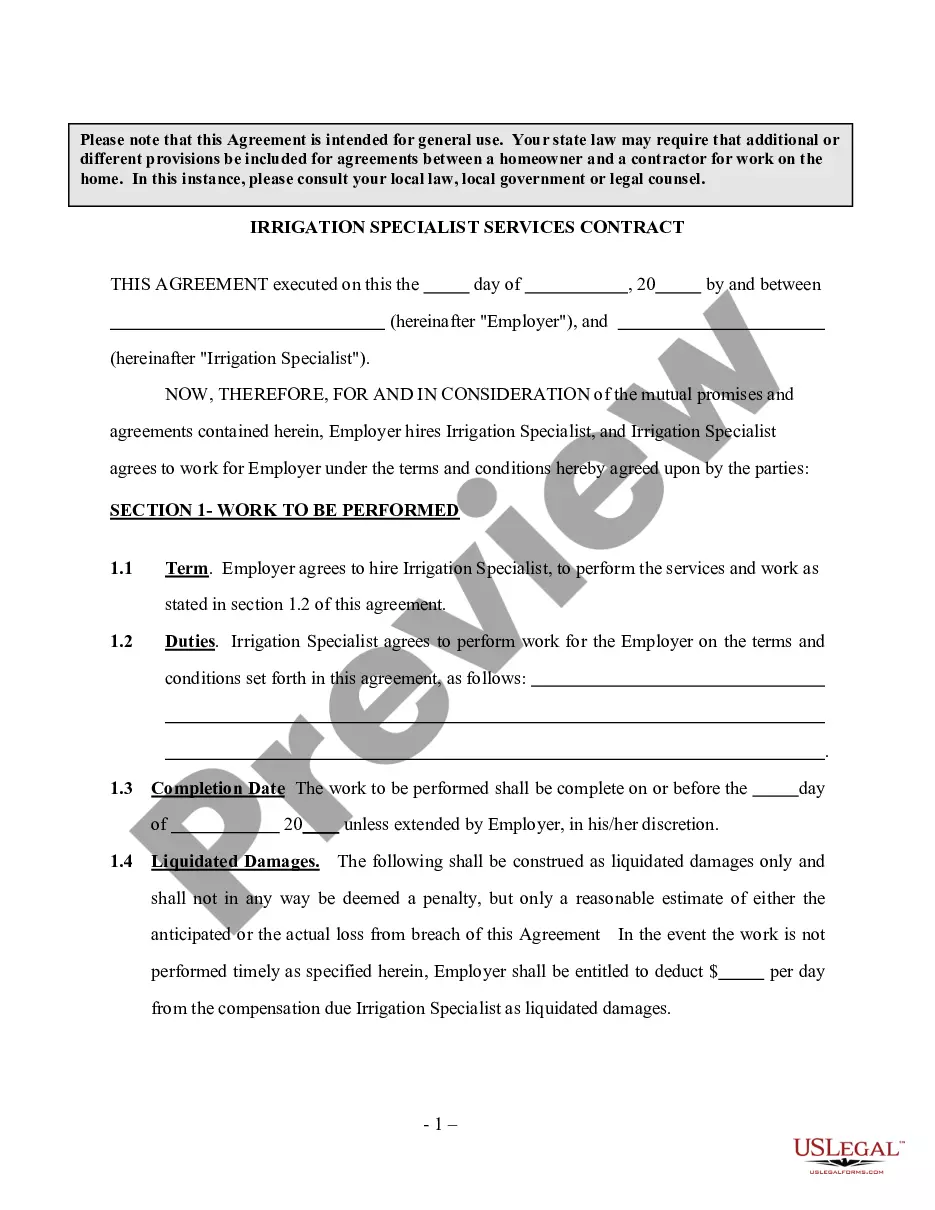
- Drainage Contract for Contractor
- Contractor's Weekly Equipment Summary
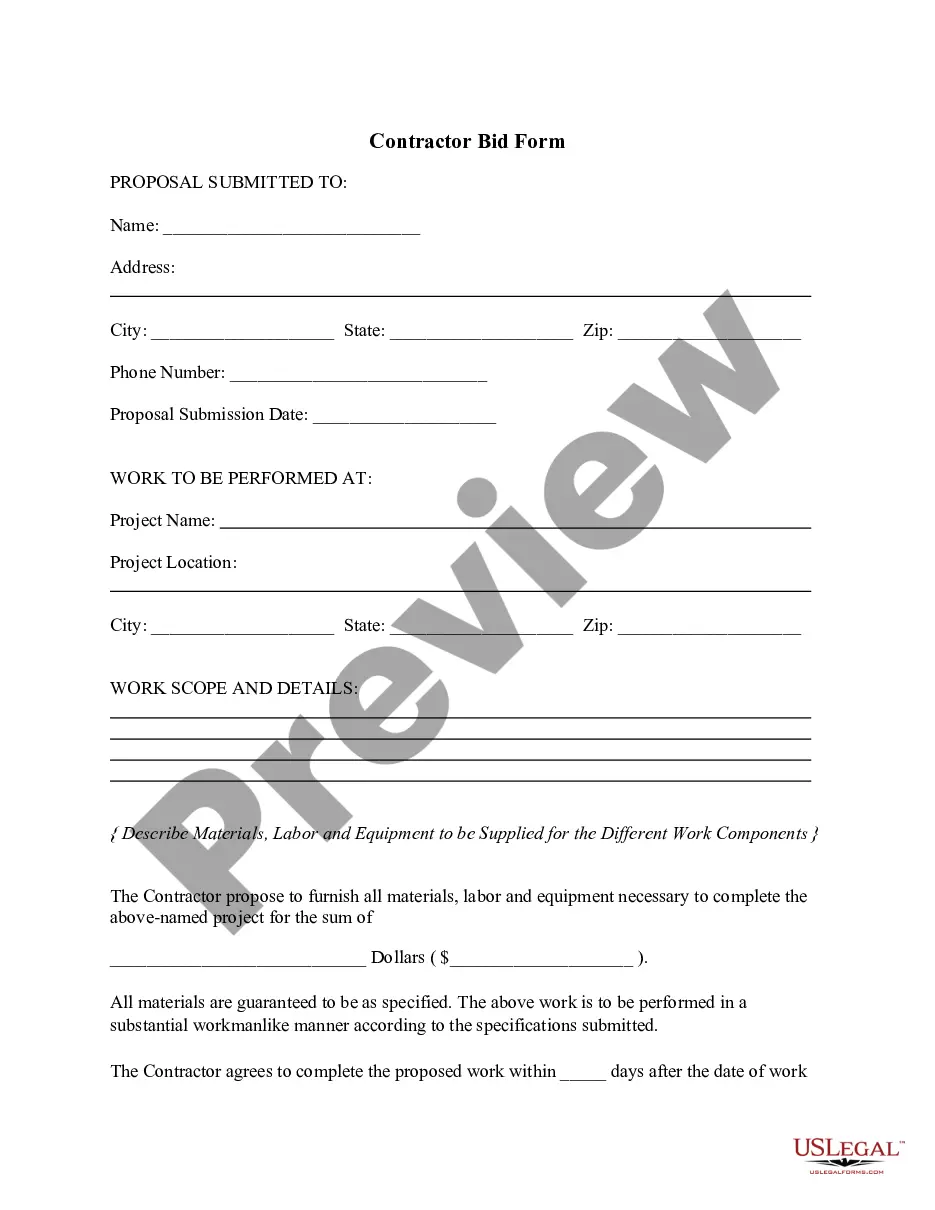
- Contractor's Bid Log
- Contractor's Bid Follow Up Letter
- Contractor's Summary of an Estimate
- Construction Safety and Health Plan
- Change Order for Construction or Repairs by Contractor
- Certification of Completion by Contractor
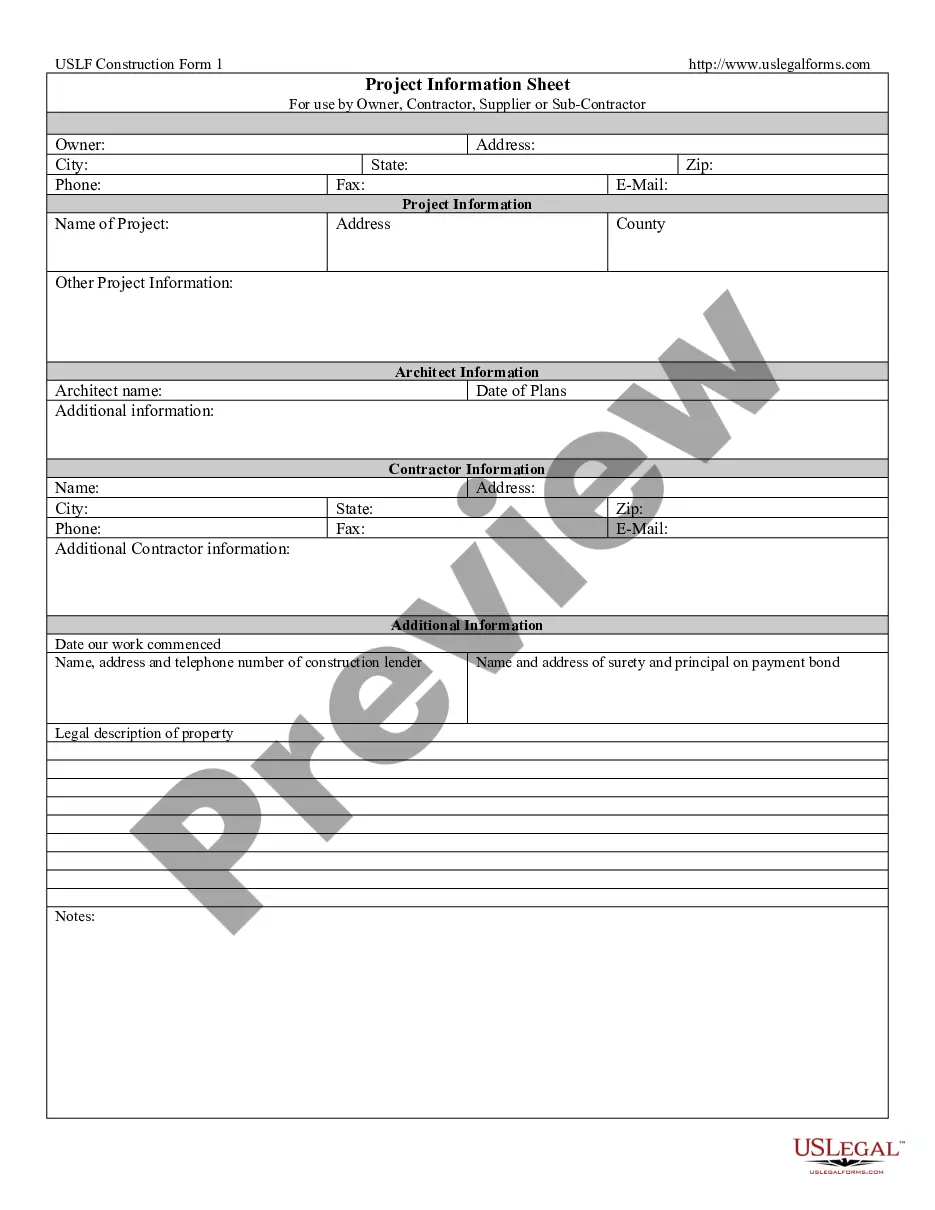
- Construction Project Information Sheet

Common use cases
This form package is ideal for use in scenarios such as:
- Entering into agreements for drainage installation and plumbing repair work.
- Making modifications to existing contracts through change orders.
- Tracking project progress and equipment usage during construction projects.
- Certifying the completion of drainage work to comply with local regulations.
- Documenting estimates and bids for transparency and accountability.
Who this form package is for
- Drainage contractors seeking formal agreements for projects.
- Property owners contracting drainage services.
- Suppliers providing materials for drainage systems.
- Subcontractors involved in plumbing or drainage work.
- Anyone managing a construction project that includes sewage disposal systems.
How to prepare this document
- Review the entire package to understand each form's purpose and use.
- Identify the parties involved in the contract and enter their information clearly.
- Fill in all required fields, including dates and specific details related to your project.
- Consult the construction project information sheet to gather necessary project details.
- Sign and date forms where required, ensuring all parties involved do the same.
Notarization guidance for this package
Forms in this package typically do not require notarization unless required by local law. It's essential to review specific state requirements for any notarization necessities for your projects.
Get your form ready online
Our built-in tools help you complete, sign, share, and store your documents in one place.
Make edits, fill in missing information, and update formatting in US Legal Forms—just like you would in MS Word.
Download a copy, print it, send it by email, or mail it via USPS—whatever works best for your next step.
Sign and collect signatures with our SignNow integration. Send to multiple recipients, set reminders, and more. Go Premium to unlock E-Sign.
If this form requires notarization, complete it online through a secure video call—no need to meet a notary in person or wait for an appointment.
We protect your documents and personal data by following strict security and privacy standards.

Make edits, fill in missing information, and update formatting in US Legal Forms—just like you would in MS Word.

Download a copy, print it, send it by email, or mail it via USPS—whatever works best for your next step.

Sign and collect signatures with our SignNow integration. Send to multiple recipients, set reminders, and more. Go Premium to unlock E-Sign.

If this form requires notarization, complete it online through a secure video call—no need to meet a notary in person or wait for an appointment.

We protect your documents and personal data by following strict security and privacy standards.
Mistakes to watch out for
- Failing to include all parties' details in the drainage contract.
- Not updating change orders to reflect agreement modifications.
- Overlooking signature requirements on completion certificates.
- Neglecting to track bids accurately in the bid log.
- Inadequately documenting safety plans which may lead to compliance issues.
Benefits of using this package online
- Convenient access to all essential forms in one package, saving time and effort.
- Editability allows you to customize forms to fit your specific project needs.
- Reliable content drafted by licensed attorneys, ensuring compliance with legal standards.
- Instant download options enable immediate use without unnecessary delays.
Legal use & context
- This package assists in documenting agreements and processes in drainage contracting.
- Proper use of these forms helps protect legal rights and obligations during and after construction projects.
- Utilizing complete and accurate forms minimizes the risk of disputes with clients or subcontractors.
What to keep in mind
- The Indiana Drainage Contractor Package provides vital legal documents tailored for drainage projects.
- Included forms ensure compliance with Indianaâs legal standards.
- Using these forms helps protect legal rights and assures proper project management.
- Convenient access and editability enhance the user experience.
Looking for another form?
Form popularity
FAQ
Look for landscapers who specialize in new lawn creation, ground leveling, and drainage management as they are best suited for such a project.
First, the plumber sends a camera on a wire or line into the pipe or drain system. He may start from a point inside your home or from a better access point outside. By noting which direction the wire travels, the plumber can get a general idea of the underground location of the pipes.
Improper Grading - Grading is the leveling or sloping of the land around your home. The way your soil is graded by builders, homeowners & landscapers can have a big impact on drainage. Common fixes: Regrading portions of your yard to improve water flow may be the solution.
It can typically be found in the basement, crawl space or garage. You will want to search for a pipe that is approximately four inches in diameter with a screw cap on the top that has a notch or square knob at the top. Note that some homes have an indoor sewer cleanout point, while others may be located outdoors.
Municipal drainage plans provide details of legal points of discharge for stormwater drainage. They may also provide surface levels. Water authority documentation such as a sewer plan provides details of plumbing fixtures, drainage lines and points of attachment to existing building(s) on a site.
The Council may hold your drainage plans. Ask for drainage plans from the previous owner. Ask your neighbours for drainage plans. You have no obligation to submit your drainage plan to authorities.
The average cost to install a drainage system in yard is $8 to $15 per linear foot or between $1,200 and $8,000, depending on the lawn size. A sub-surface system of yard drainage pipes are connected to drop inlets or catch basins where water runoff is distributed by emitters.
Contact Your Local CouncilYour local council will likely have some sort of copy of the drainage plans for your property that can be obtained for a small fee.