Polygraph Consent Form
About this form
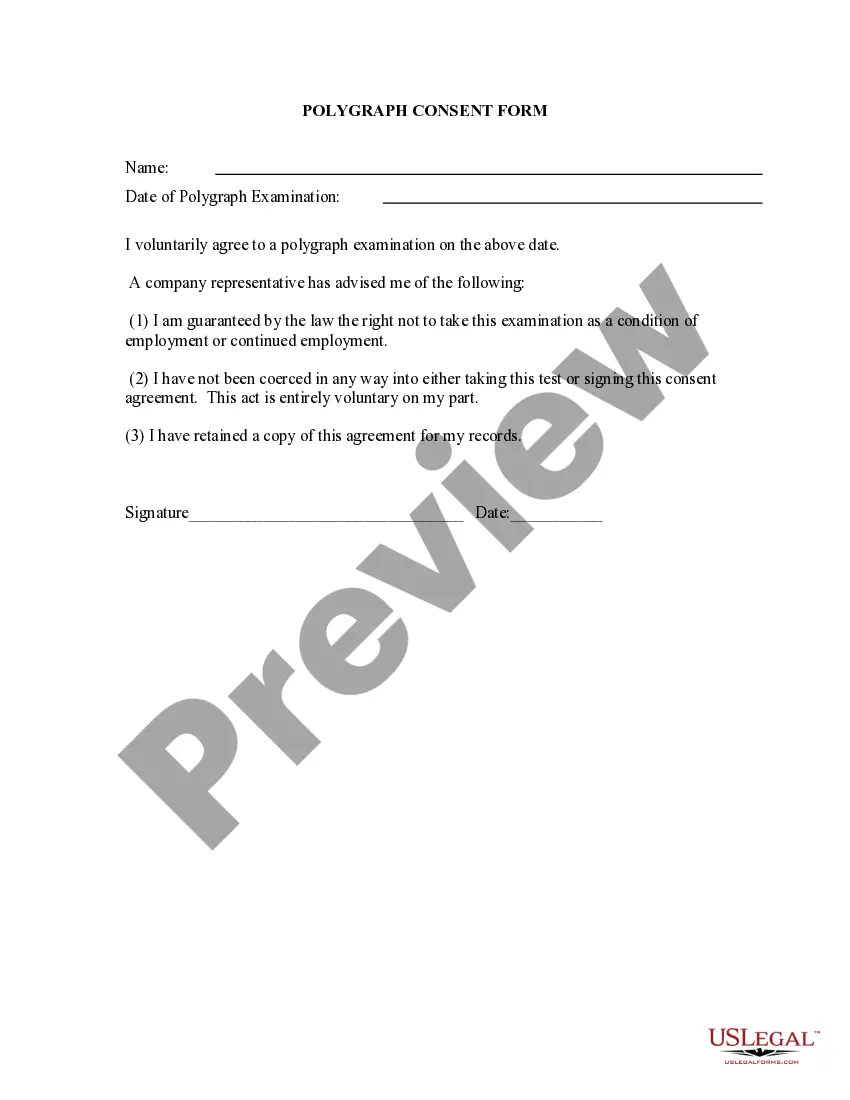
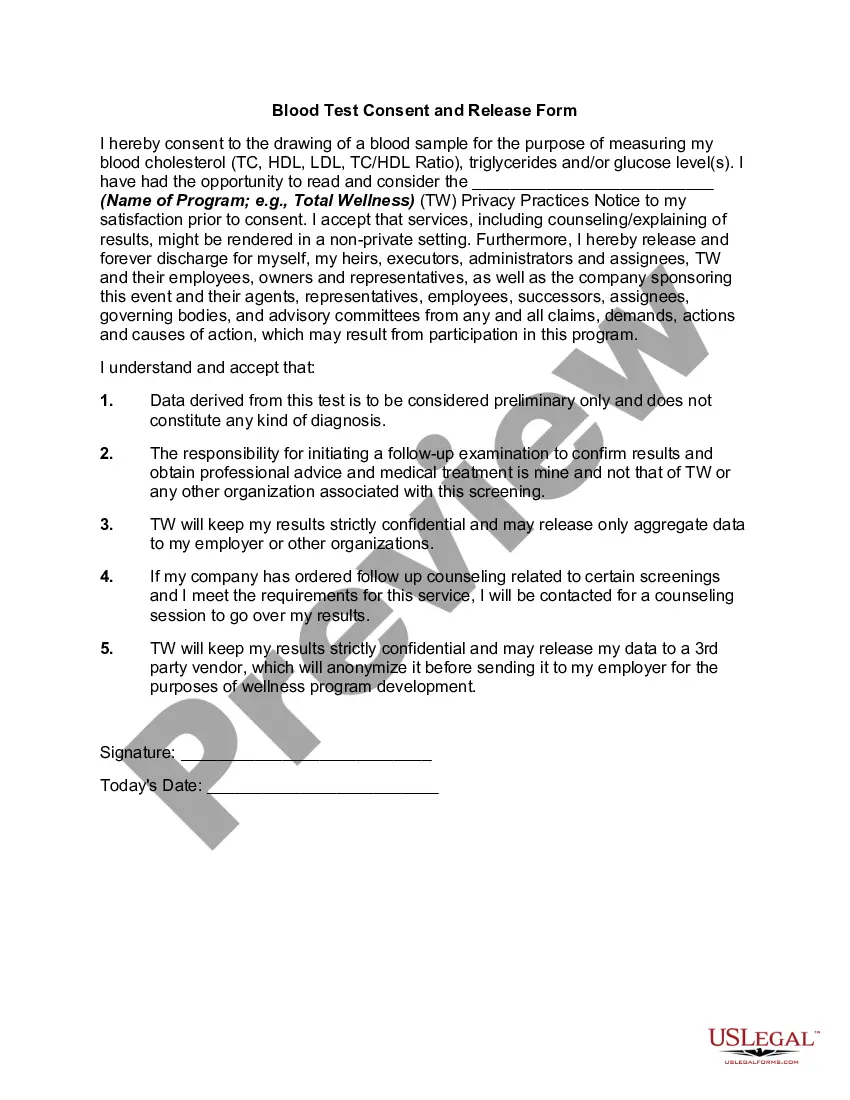
The Polygraph Consent Form is a legal document used by employees to give their permission for a polygraph test, often known as a lie detector test. This form ensures that the consent is voluntary and acknowledges that the employee has not been coerced into taking the test. By utilizing this form, individuals can clearly outline the terms of their consent, differing it from other agreements related to employment testing.
Key parts of this document
- Voluntary consent declaration: A statement affirming that signing the form and taking the test is entirely voluntary.
- Retention of agreement: The employee acknowledges keeping a copy of the consent agreement for their records.
- Signature block: A space for the employee's signature to formalize consent.
- Date section: A field for the date when the consent is signed.
Common use cases
This form is typically used when an employer requires an employee to undergo a polygraph test as part of a background check, fraud investigation, or specific job requirements. It is essential in situations where the test relates to workplace safety, security, or compliance with certain regulatory standards.
Who should use this form
- Employees who are asked to take a polygraph test by their employer.
- Employers who require documented consent from employees before conducting polygraph tests.
- Human resources professionals managing employee testing protocols.
How to prepare this document
- Read the entire consent form carefully to understand its terms.
- Indicate your consent by signing in the designated area.
- Fill in the date on which you are signing the form.
- Keep a copy of the completed form for your personal records.
Is notarization required?
This form does not typically require notarization unless specified by local law. However, it's always advised to check local regulations to ensure compliance.
Get your form ready online
Our built-in tools help you complete, sign, share, and store your documents in one place.
Make edits, fill in missing information, and update formatting in US Legal Forms—just like you would in MS Word.
Download a copy, print it, send it by email, or mail it via USPS—whatever works best for your next step.
Sign and collect signatures with our SignNow integration. Send to multiple recipients, set reminders, and more. Go Premium to unlock E-Sign.
If this form requires notarization, complete it online through a secure video call—no need to meet a notary in person or wait for an appointment.
We protect your documents and personal data by following strict security and privacy standards.

Make edits, fill in missing information, and update formatting in US Legal Forms—just like you would in MS Word.

Download a copy, print it, send it by email, or mail it via USPS—whatever works best for your next step.

Sign and collect signatures with our SignNow integration. Send to multiple recipients, set reminders, and more. Go Premium to unlock E-Sign.

If this form requires notarization, complete it online through a secure video call—no need to meet a notary in person or wait for an appointment.

We protect your documents and personal data by following strict security and privacy standards.
Typical mistakes to avoid
- Not reading the form thoroughly before signing.
- Failing to retain a copy of the signed form for personal record-keeping.
- Signing under pressure or without understanding the implications of the consent.
Advantages of online completion
- Convenient access: Download the form anytime and from anywhere.
- Editability: Customize the form as needed to meet your specific situation.
- Reliability: Use professionally drafted templates created by licensed attorneys.
Legal use & context
- The form establishes clear consent which protects both employee and employer rights.
- It is important for complying with laws regarding the use of polygraph tests in the workplace.
- Improper use or lack of consent documented in this form could lead to legal complications.
Looking for another form?


Form popularity
FAQ
Polygraphs measure physiological arousal factors, including heart rate, blood pressure, respiration, perspiration, and skin conductivity. The theory of the lie detector test is that these physiological responses will be different when the subject is truthful versus when the subject lies.
According to a report from the National Academy of Sciences, a variety of mental and physical factors, such as anxiety about being tested, can affect polygraph results making the technique susceptible to error. Unfortunately, once you have failed a government polygraph test, there may be little you can do to
The answer: sort of. Dr. Saxe explains: The fundamental problem is that there is no unique physiological response to lying. So, yes, anxiety plays a role, as do medications that affect heart rate and blood pressure.
Polygraphs are easy to beat." NSA spokeswoman Vanee Vines says that the polygraph "is one of the vetting tools" used by the NSA and other federal agencies "to assess an individual's eligibility for access, and continued eligibility access, to highly sensitive intelligence information."
When you answer a question on the polygraph, give only the answer that is required. That means yes or no only. A closed question, in the context of the polygraph test, can be challenging to answer, however especially when a binary yes or no feels too simplistic. That is the point.
How to cheat it. According to George Maschke and Gino Scalabrini, authors of The Lie Behind the Lie Detector, there are four ways to beat the test: Change your heart rate , breathing rate, blood pressure and sweat level while answering control questions.
You will be asked about the following topics during a typical police polygraph or CVSA: Shoplifting or theft of money or merchandise from employer. Illegal drug trafficking or dealing. Illegal drug or medication use, including steroids.