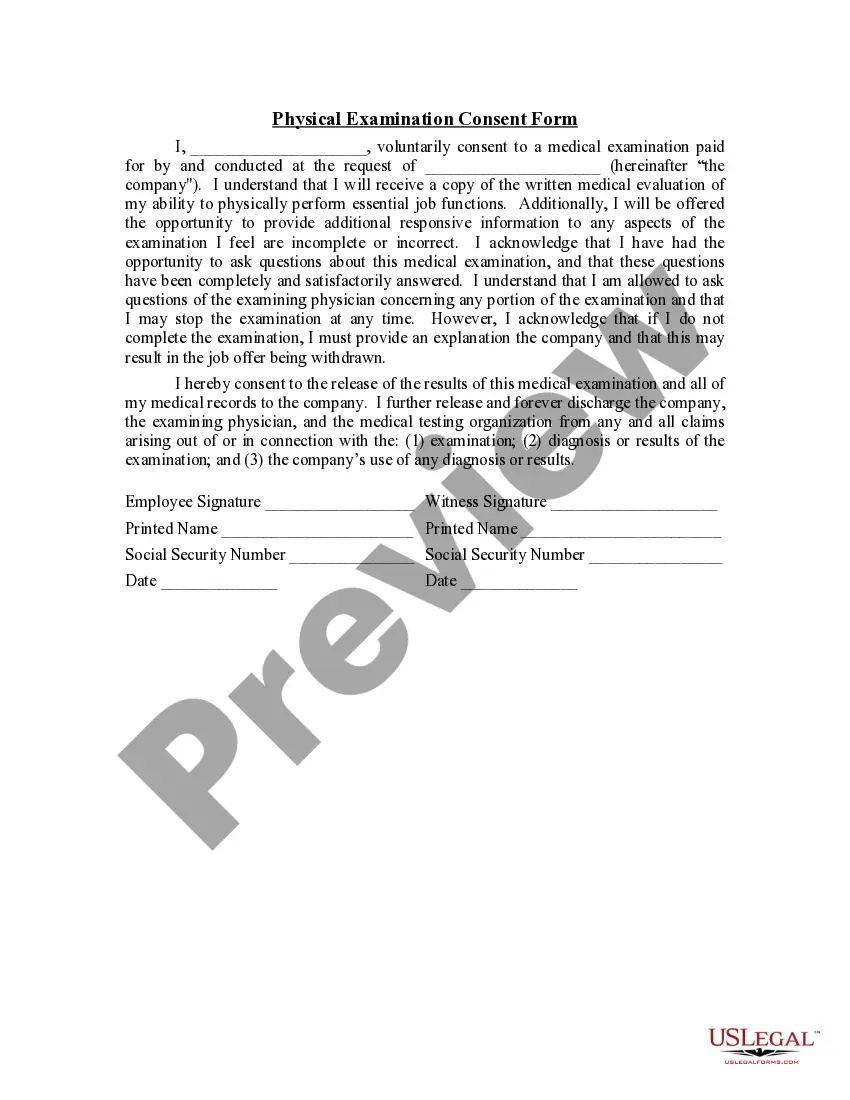
Physical Examination Consent Form
Understanding this form
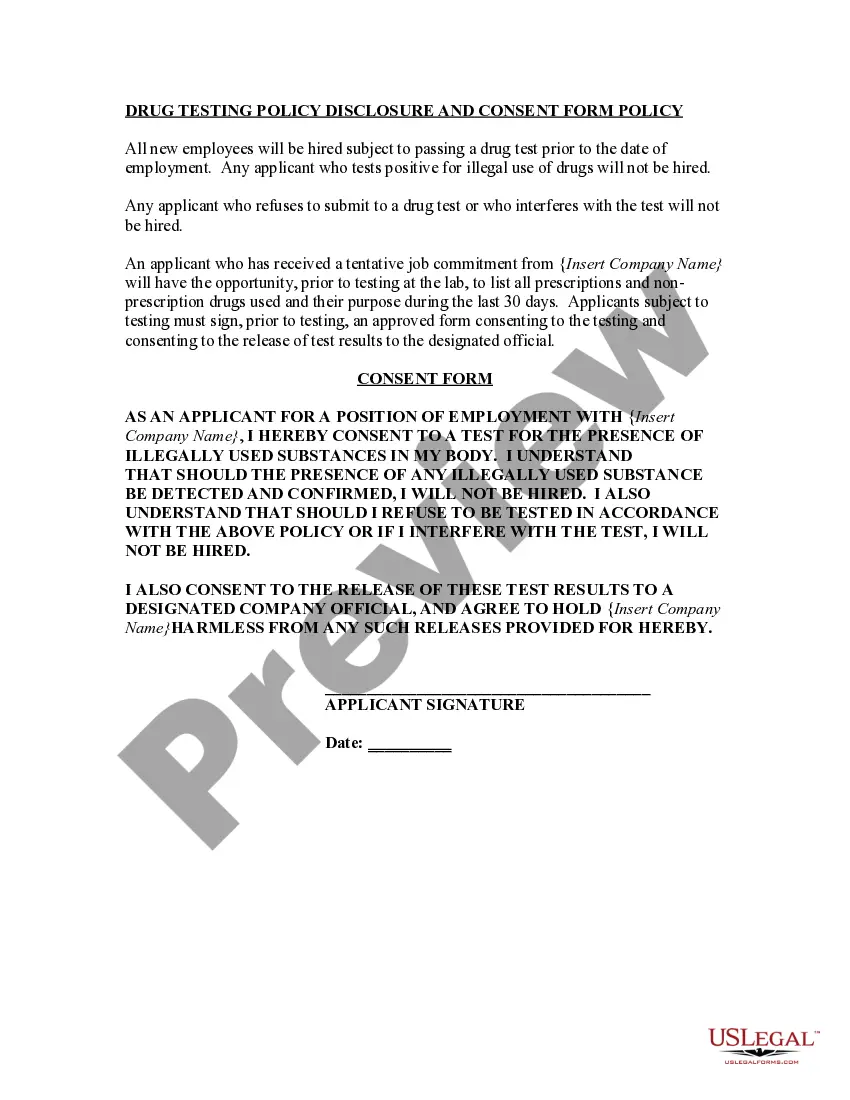
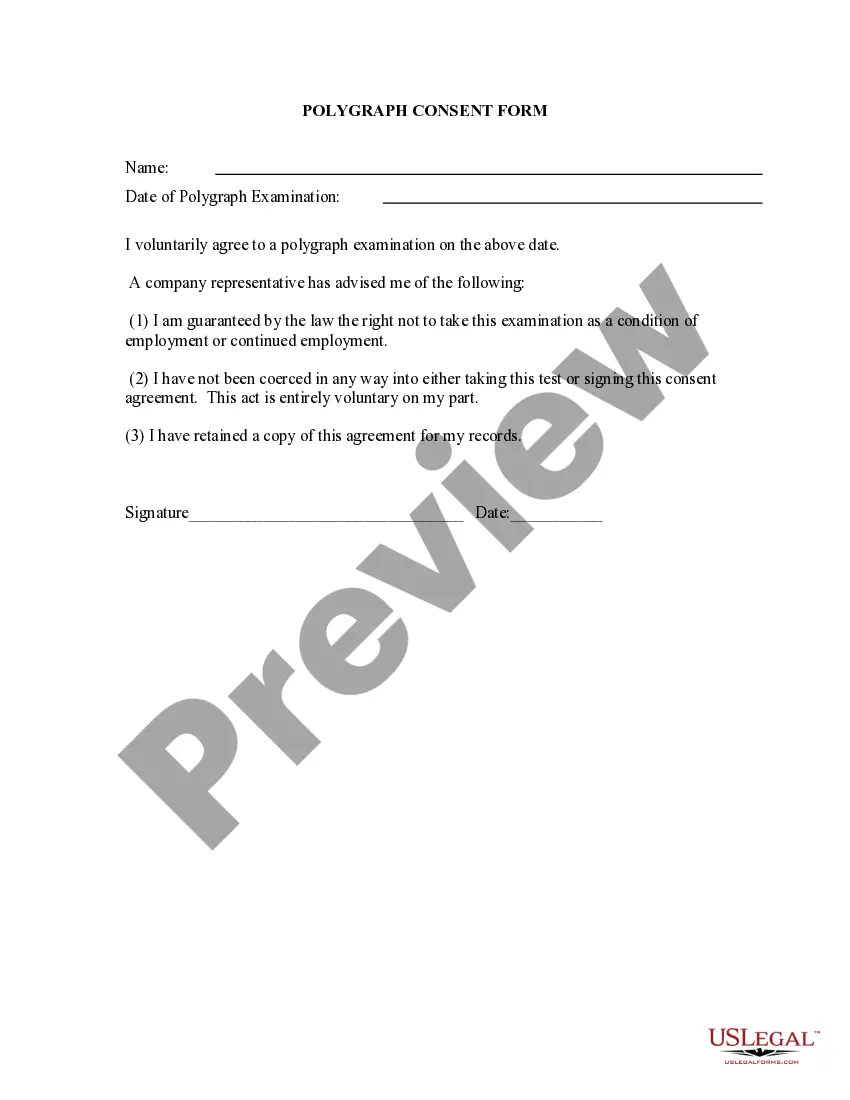
The Physical Examination Consent Form is a document used by employers to obtain consent from an employee for a medical examination aimed at assessing their fitness to perform specific job functions. This form ensures that the employee is aware of the examination process and their rights during the examination, distinguishing it from other consents that may not cover health assessments related to employment.
Form components explained
- Identification of the employee consenting to the examination.
- Acknowledgment that the examination is conducted at the company's request and is paid for by the company.
- Provision for the employee to receive a copy of the medical evaluation.
- Opportunities for the employee to address any concerns regarding the examination.
- Release of liability for the company and the medical personnel involved.
- Signatures of both the employee and a witness to validate the consent.
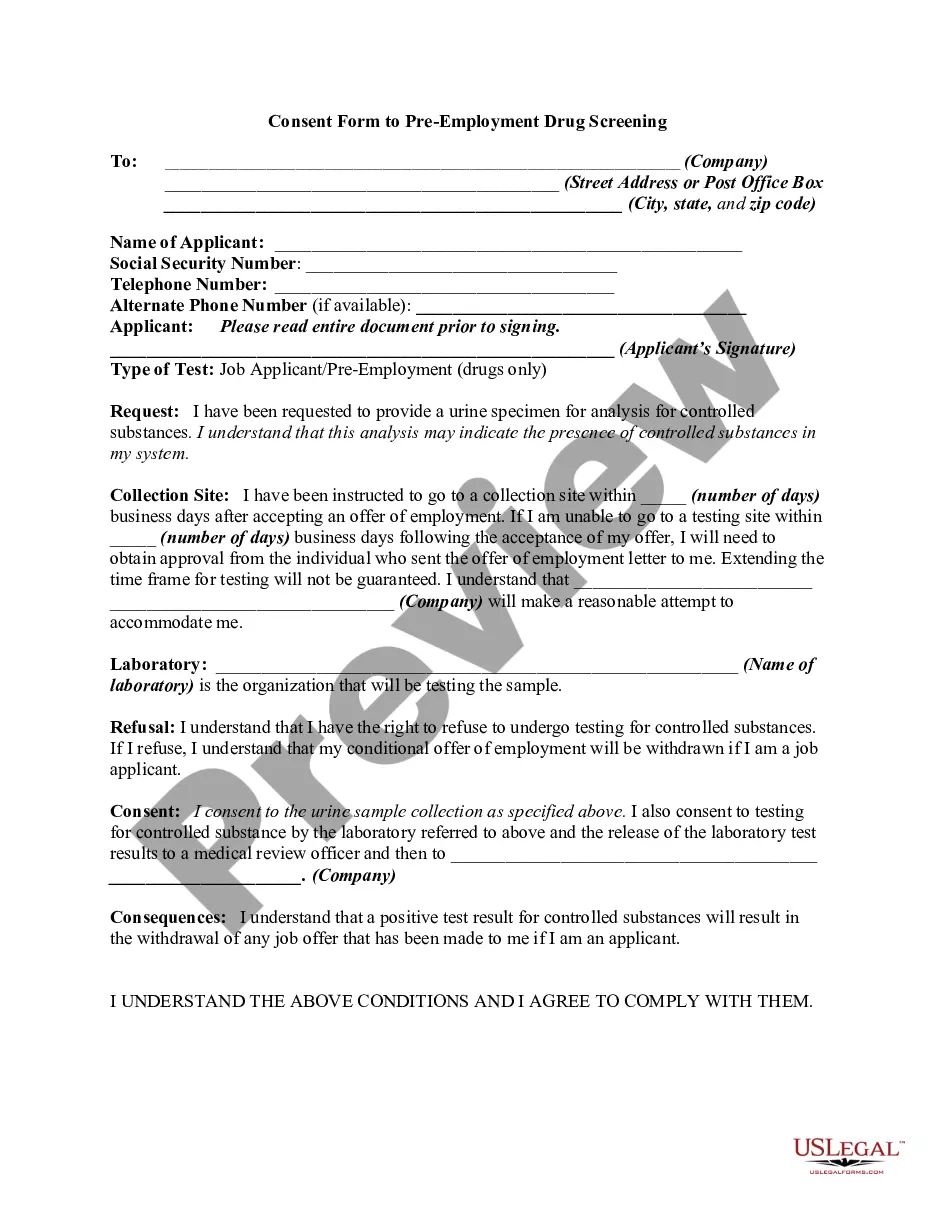
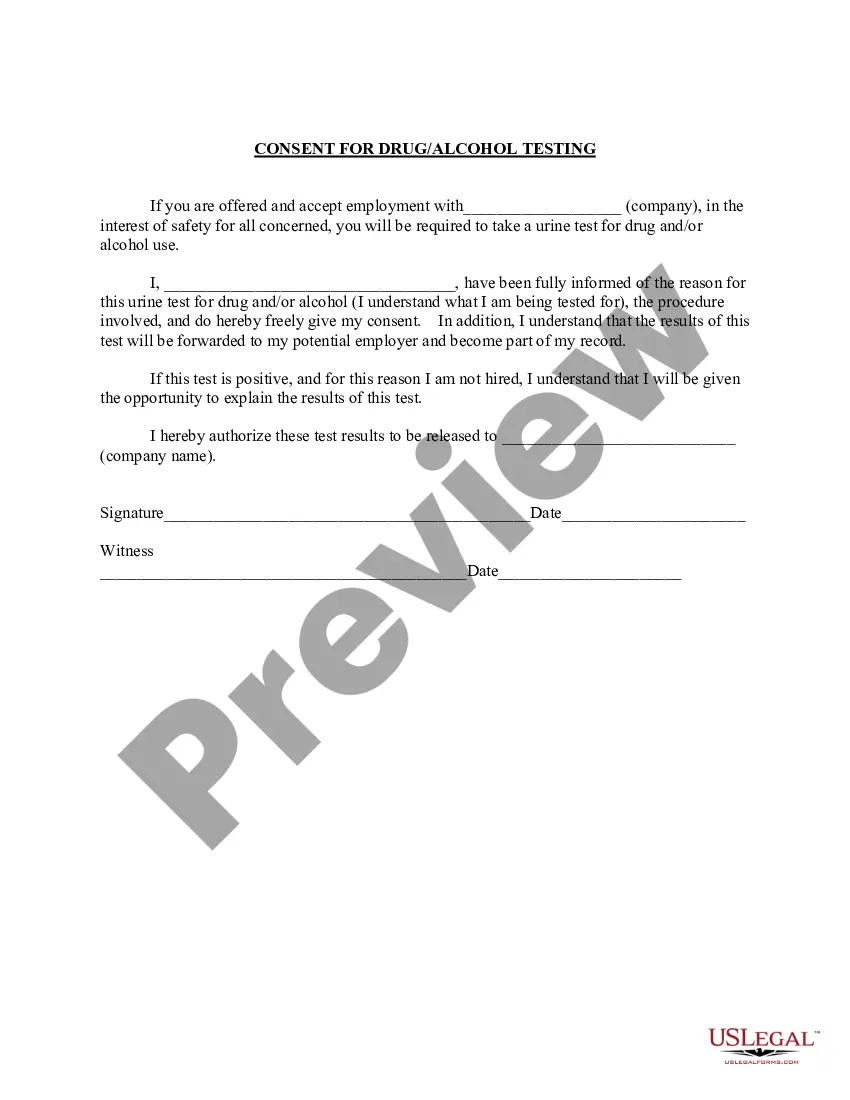
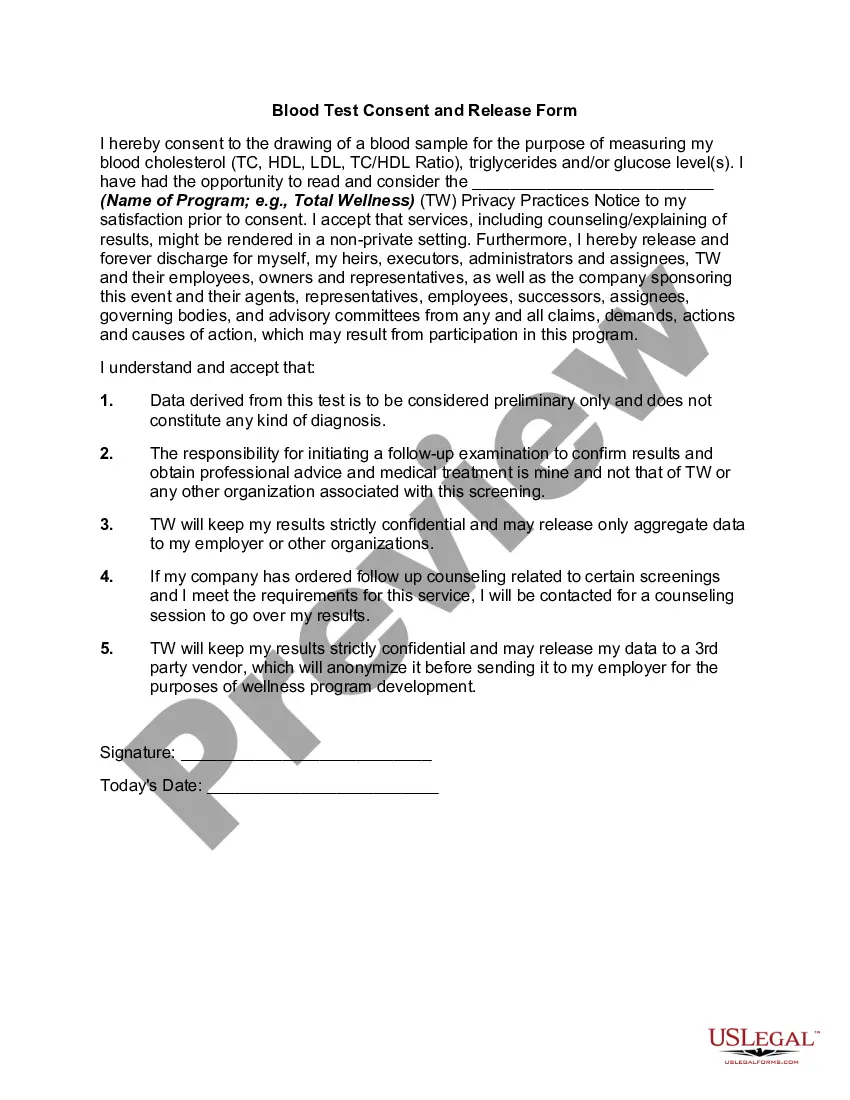
When to use this form
This form should be used when an employer requires an employee to undergo a medical examination as part of the hiring process or to assess ongoing fitness for a specific job role. It is particularly relevant in sectors where physical capabilities are crucial for job performance, such as in manufacturing, construction, or any role requiring strenuous physical activity.
Intended users of this form
- Employers who need to conduct medical examinations related to job fitness.
- Employees who are required to complete a physical examination as part of their employment.
- HR professionals and legal teams involved in the hiring process.
Instructions for completing this form
- Enter the employee's full name in the designated space.
- Fill in the name of the company requesting the examination.
- Provide the date when the consent is being signed.
- Have the employee sign the form to indicate consent.
- Ensure that a witness also signs and prints their name for validation.
- Collect the Social Security Numbers if required for identification purposes.
Does this document require notarization?
Notarization is generally not required for this form. However, certain states or situations might demand it. You can complete notarization online through US Legal Forms, powered by Notarize, using a verified video call available anytime.
Get your form ready online
Our built-in tools help you complete, sign, share, and store your documents in one place.
Make edits, fill in missing information, and update formatting in US Legal Forms—just like you would in MS Word.
Download a copy, print it, send it by email, or mail it via USPS—whatever works best for your next step.
Sign and collect signatures with our SignNow integration. Send to multiple recipients, set reminders, and more. Go Premium to unlock E-Sign.
If this form requires notarization, complete it online through a secure video call—no need to meet a notary in person or wait for an appointment.
We protect your documents and personal data by following strict security and privacy standards.

Make edits, fill in missing information, and update formatting in US Legal Forms—just like you would in MS Word.

Download a copy, print it, send it by email, or mail it via USPS—whatever works best for your next step.

Sign and collect signatures with our SignNow integration. Send to multiple recipients, set reminders, and more. Go Premium to unlock E-Sign.

If this form requires notarization, complete it online through a secure video call—no need to meet a notary in person or wait for an appointment.

We protect your documents and personal data by following strict security and privacy standards.
Avoid these common issues
- Failing to collect signatures from both the employee and a witness.
- Not providing a clear copy of the medical evaluation to the employee.
- Overlooking the need for the employee to ask questions before signing.
- Incorporating any medical terminology without clear explanations.
Why use this form online
- Convenience of downloading the form at any time.
- Editability allows employers to customize the document as needed.
- Access to forms drafted by licensed attorneys ensures legal validity.
Legal use & context
- This form is legally binding once signed by both parties, indicating that consent has been given for the medical examination.
- Employers must ensure that the examination is job-related and necessary for the role the employee is being hired for.
- Liability waivers included in the form protect the company and medical professionals from lawsuits stemming from the examination.
Key takeaways
- The Physical Examination Consent Form is essential for obtaining employee consent for medical evaluations relevant to job responsibilities.
- Completing the form properly ensures legal protection for both the employer and employee.
- Awareness of state-specific laws can enhance compliance and minimize risk.
Looking for another form?



Form popularity
FAQ
Please bring your physician's referral or prescription for physical therapy, your insurance card, and a government issued photo ID, like a driver's license. It is also advisable to bring any records from your previous doctor, a list of your medications, allergies and a list of prior doctors.
Physical Form means a document maintained in physical paper form or a document previously maintained in Electronic Form which has been transferred to Physical Form. Sample 2. Based on 3 documents. 3. ff0b New List.
Physical exams are typically performed by your primary care physician. A physical examination can be helpful because it can help determine the status of your health. This can give way to early intervention and prevention of any health issues that you are currently at risk for.
The physical assessment includes an audioscope, examination light, laryngeal mirror, nasal speculum, otoscope, ophthalmoscope, penlight, percussion hammer, sphygmomanometer, stethoscope, thermometer, and tuning fork. Audioscope tool used to screen patients for hearing loss.
Inspection. Your examiner will look at, or "inspect" specific areas of your body for normal color, shape and consistency. Palpation. Percussion. Auscultation. The Neurologic Examination:
Inspection. Palpation. Auscultation. Percussion.
Inspection. Your examiner will look at, or "inspect" specific areas of your body for normal color, shape and consistency. Palpation. Percussion. Auscultation. The Neurologic Examination:
Four actions are taught as the basis of physical examination: inspection, palpation (feel), percussion (tap to determine resonance characteristics), and auscultation (listen).
WHEN YOU PERFORM a physical assessment, you'll use four techniques: inspection, palpation, percussion, and auscultation. Use them in sequenceunless you're performing an abdominal assessment. Palpation and percussion can alter bowel sounds, so you'd inspect, auscultate, percuss, then palpate an abdomen.