Texas Foundation Contractor Package
Understanding this form package
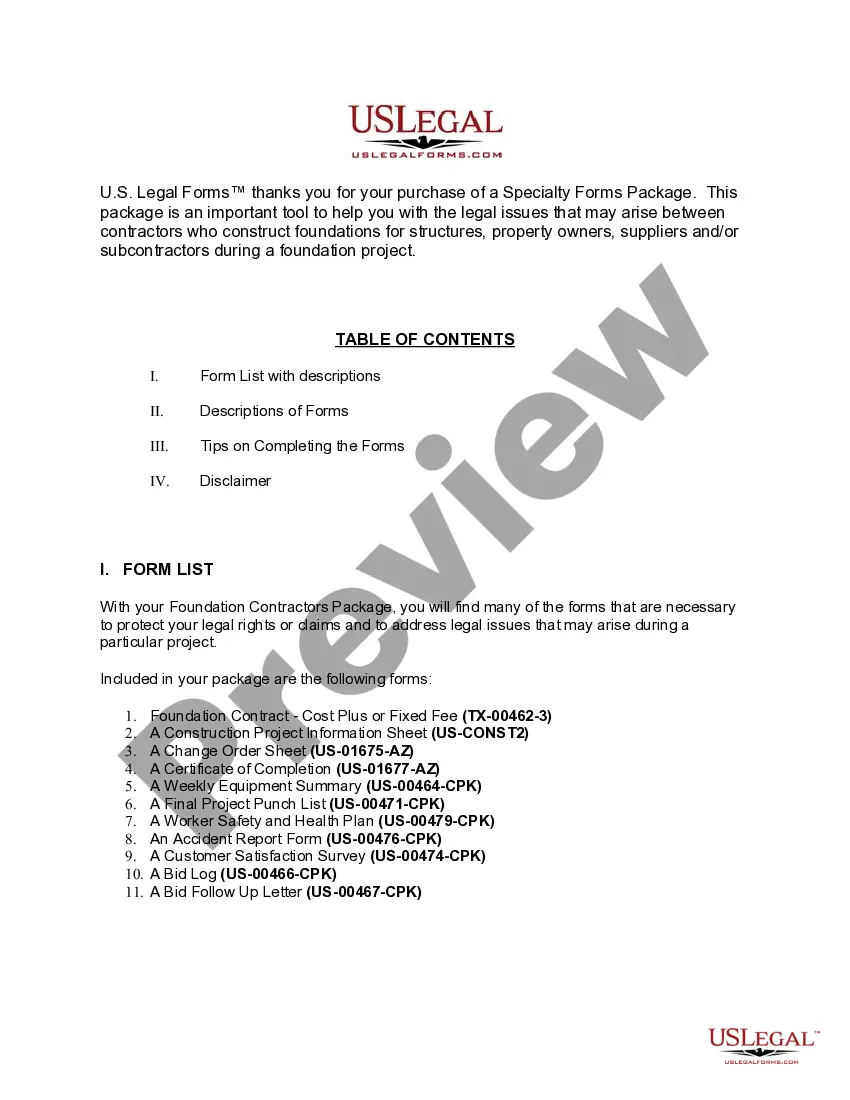
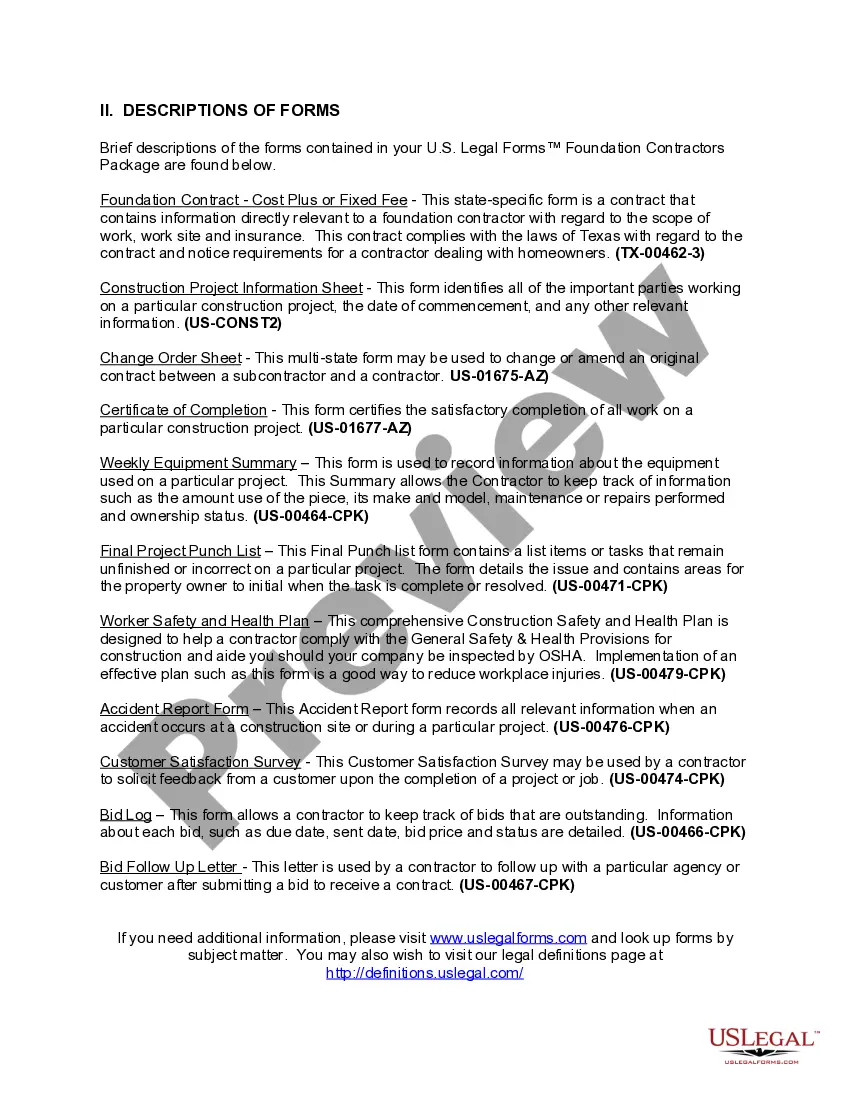
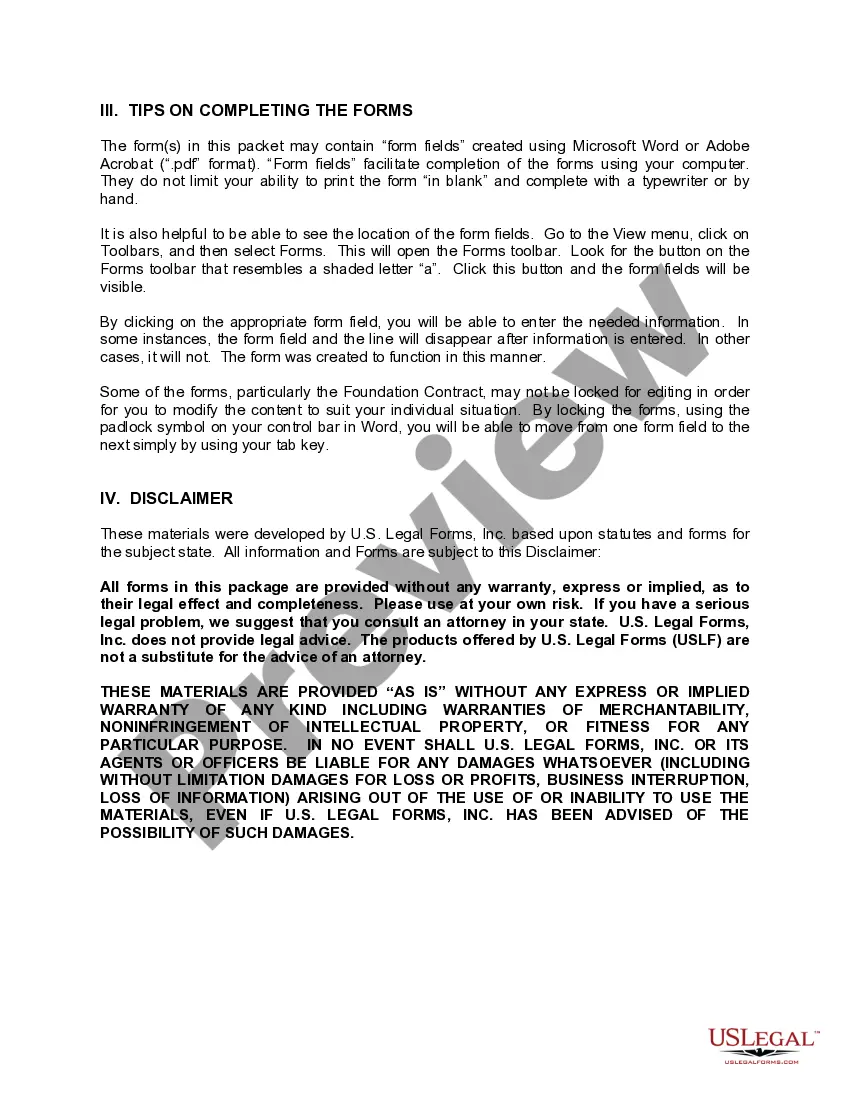
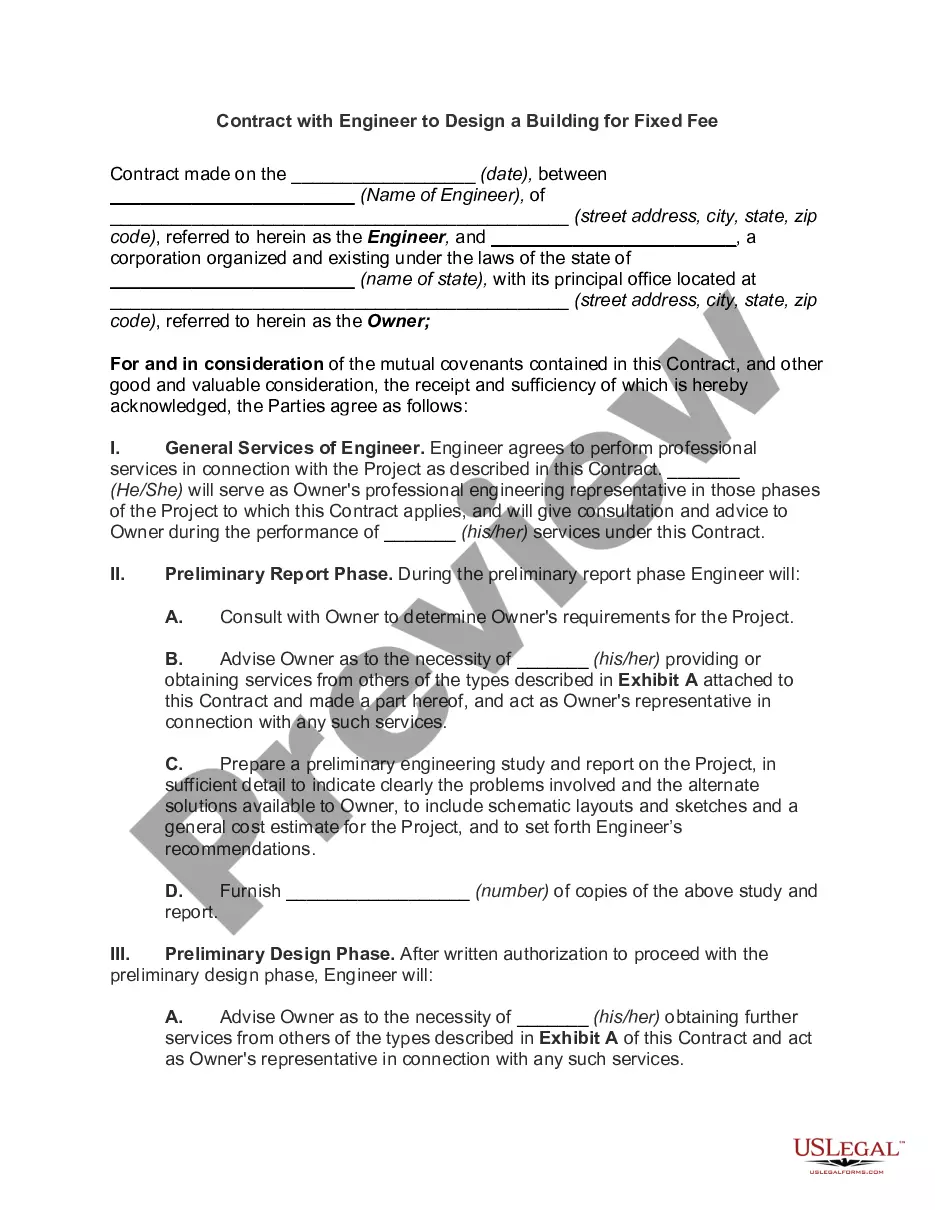
The Texas Foundation Contractor Package includes essential legal documents specifically designed for contractors, homeowners, and subcontractors involved in foundation construction for residential buildings. This package features a foundational contract that adheres to Texas state law, along with various supplementary forms necessary for managing construction projects efficiently. This package not only protects your legal rights but also addresses critical legal matters that may arise during construction projects, distinguishing it from generic form packages.
Forms provided in this package
- Foundation Contract for Contractor
- Contractor's Weekly Equipment Summary
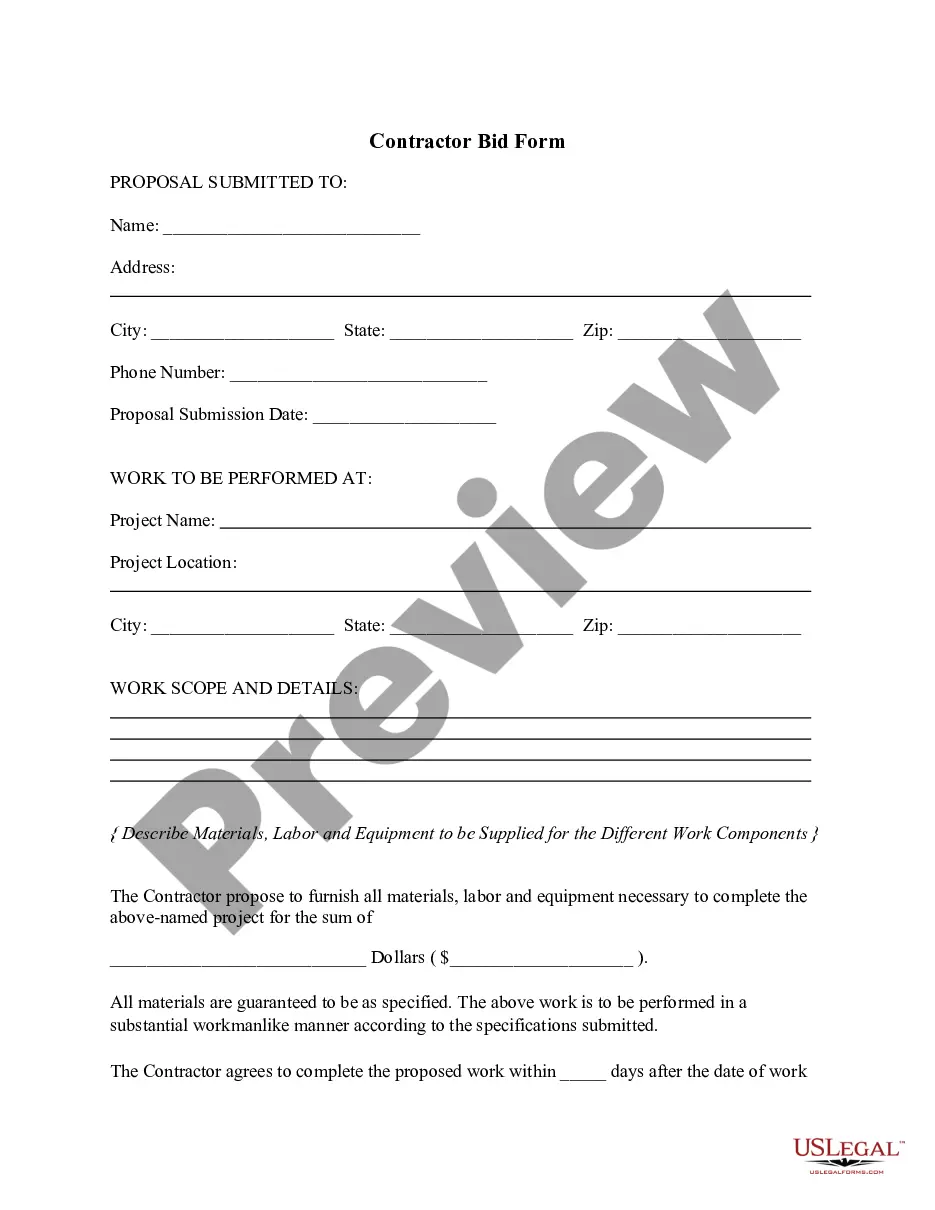
- Contractor's Bid Log
- Contractor's Bid Follow Up Letter
- Customer Satisfaction Survey
- Construction Accident Report
- Construction Safety and Health Plan
- Change Order for Construction or Repairs by Contractor
- Certification of Completion by Contractor
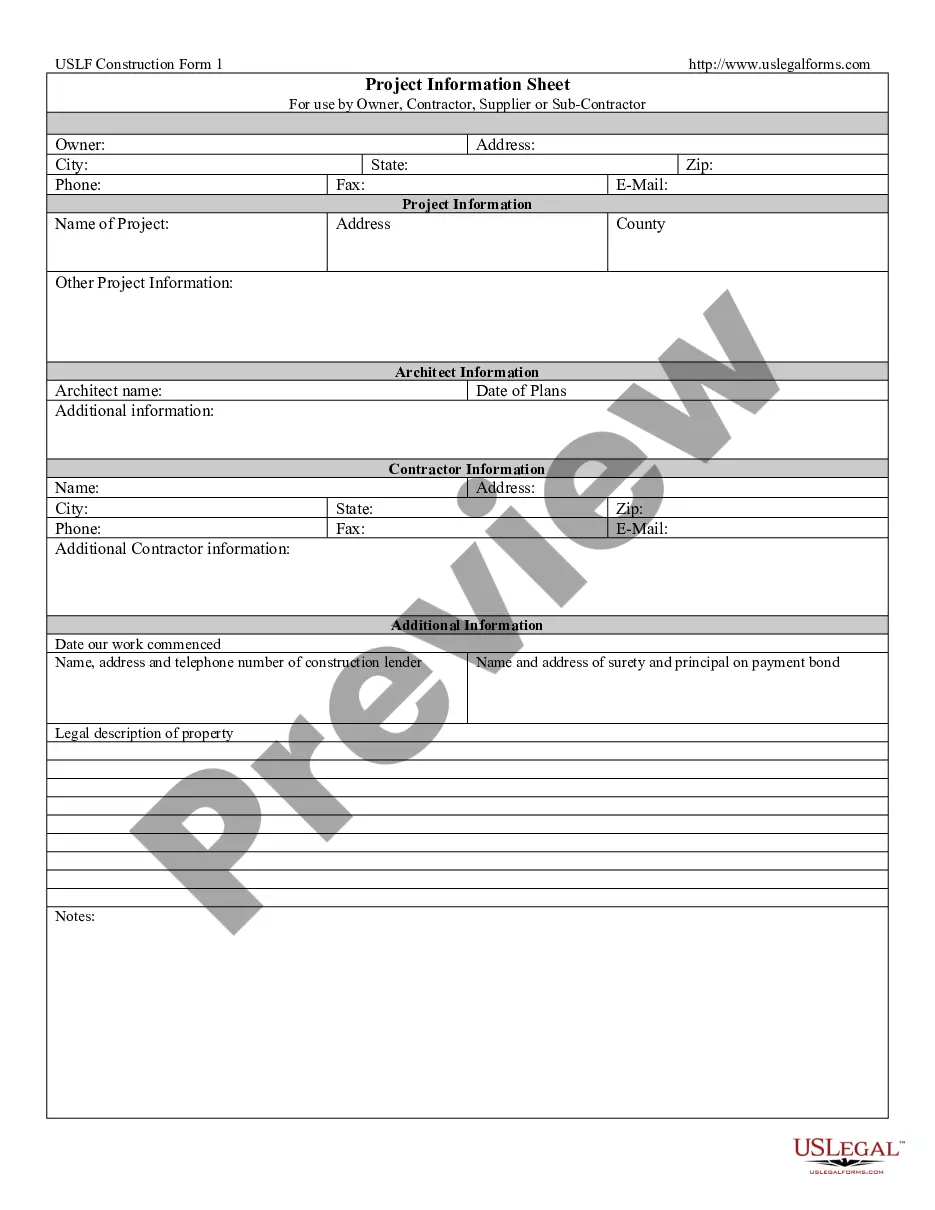
- Construction Project Information Sheet


Common use cases
This form package is useful in various scenarios, such as:
- Entering into contracts with homeowners for foundation construction.
- Communicating project changes through change orders.
- Documenting project completion and certifying safety protocols.
- Tracking equipment usage and worker safety during construction.
- Gathering customer feedback post-project completion.
Intended users of this form package
- Foundation contractors operating in Texas.
- Homeowners looking to hire contractors for foundation work.
- Subcontractors engaged in the foundation construction process.
- Construction project managers overseeing residential foundation projects.
How to complete these forms
- Review all included forms to determine which are relevant to your project.
- Identify all parties involved in the construction project and enter their details on the Construction Project Information Sheet.
- Fill out the Foundation Contract based on the agreement with the homeowner.
- Utilize the Change Order Sheet to document any amendments to the contract.
- Complete the Certificate of Completion once the project is finished to certify satisfactory work.
- Use the Worker Safety and Health Plan to ensure compliance with safety regulations throughout the project.
Notarization requirements for forms in this package
Most forms in this package do not require notarization. However, local laws or specific situations may demand it. Our online notarization service, powered by Notarize, lets you complete the process through a verified video call, available anytime.
Get your form ready online
Our built-in tools help you complete, sign, share, and store your documents in one place.
Make edits, fill in missing information, and update formatting in US Legal Forms—just like you would in MS Word.
Download a copy, print it, send it by email, or mail it via USPS—whatever works best for your next step.
Sign and collect signatures with our SignNow integration. Send to multiple recipients, set reminders, and more. Go Premium to unlock E-Sign.
If this form requires notarization, complete it online through a secure video call—no need to meet a notary in person or wait for an appointment.
We protect your documents and personal data by following strict security and privacy standards.

Make edits, fill in missing information, and update formatting in US Legal Forms—just like you would in MS Word.

Download a copy, print it, send it by email, or mail it via USPS—whatever works best for your next step.

Sign and collect signatures with our SignNow integration. Send to multiple recipients, set reminders, and more. Go Premium to unlock E-Sign.

If this form requires notarization, complete it online through a secure video call—no need to meet a notary in person or wait for an appointment.

We protect your documents and personal data by following strict security and privacy standards.
Common mistakes
- Failing to clearly identify parties involved in the project.
- Neglecting to document changes using the Change Order Sheet.
- Not completing the Certificate of Completion after project completion.
- Forgetting to implement safety protocols as outlined in the Worker Safety and Health Plan.
Advantages of online completion
- Convenient access to essential legal forms that can be downloaded and customized as needed.
- Editability allows for quick modifications based on specific project requirements.
- Reliability ensures that all forms are professionally drafted and compliant with Texas law.
Legal use & context
- The forms included are designed to ensure compliance with Texas construction law.
- Proper completion and execution of these documents can help prevent disputes between contractors and clients.
- These forms facilitate clear communication and understanding of project expectations among all parties.
Summary of main points
- The Texas Foundation Contractor Package is designed to protect your legal rights in foundation construction.
- It includes essential forms that streamline project management and documentation.
- Understanding local regulations is key for effective use of these forms.
Looking for another form?


Form popularity
FAQ
Estimates, generally, must be professionally reasonable. A 10-20% overage might be considered reasonable, especially if the contractor discovered issues along the way that he couldn't have been aware of initially (for example, mold or flooding).
Typically, pay no more than 1/3rd up front. completed 1/3rd of the job. to your satisfaction. Don't sign your insurance check over to a contractor.
Fixed price contracts. With a fixed price contract the buyer (that's you) doesn't take on much risk. Cost-reimbursable contracts. With a cost-reimbursable contract you pay the vendor for the actual cost of the work. Time and materials contracts.
If the contractor requests a large sum of money before work has begun, Mozen says you should ask specifically what types of work or materials those payments are covering.Contractors sometimes have other motives, other than purchasing materials, when they ask for large amounts of money in advance, Fowler says.
A: It's not uncommon for contractors to ask for a down payment up front to secure your spot on their schedule or purchase some of the job materials in advance. Asking for more than half of the project cost up front, though, is a big red flag.I recommend tying payments to progress made during the job.
In order to cancel the transaction, the consumer must send the notice of cancellation form, or some other written statement indicating the intent to cancel the contract, to the creditor at the address stated on the notice. This notice need only state the consumer's intention to cancel the transaction.
Terms. This is the first section of any agreement or contract and states the names and locations of the parties involved. Responsibilities & Deliverables. Payment-Related Details. Confidentiality Clause. Contract Termination. Choice of Law.
There are three main types of construction contract, identified according to the mechanism for calculating the sum due to be paid by the employer: lump sum contracts, re-measurement contracts and cost-reimbursable contracts.
You shouldn't pay more than 10 percent of the estimated contract price upfront, according to the Contractors State License Board.