Employee Stock Option Agreement
Understanding this form
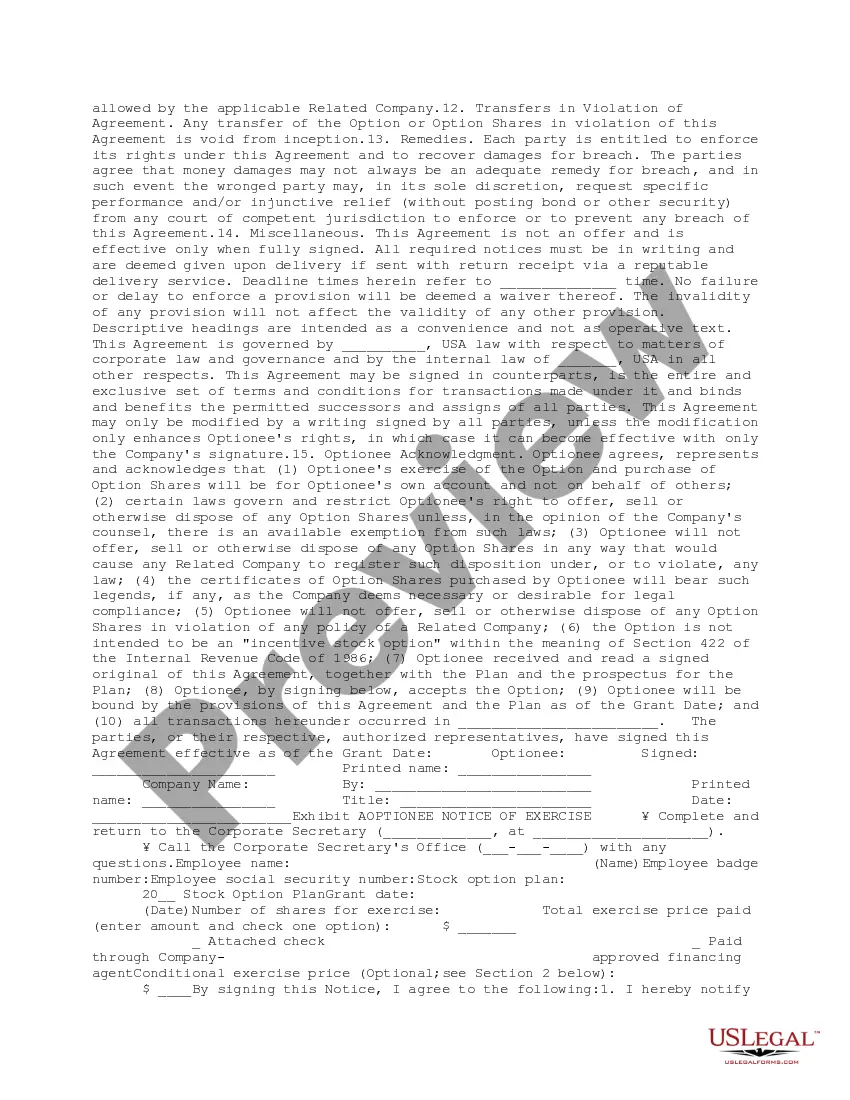
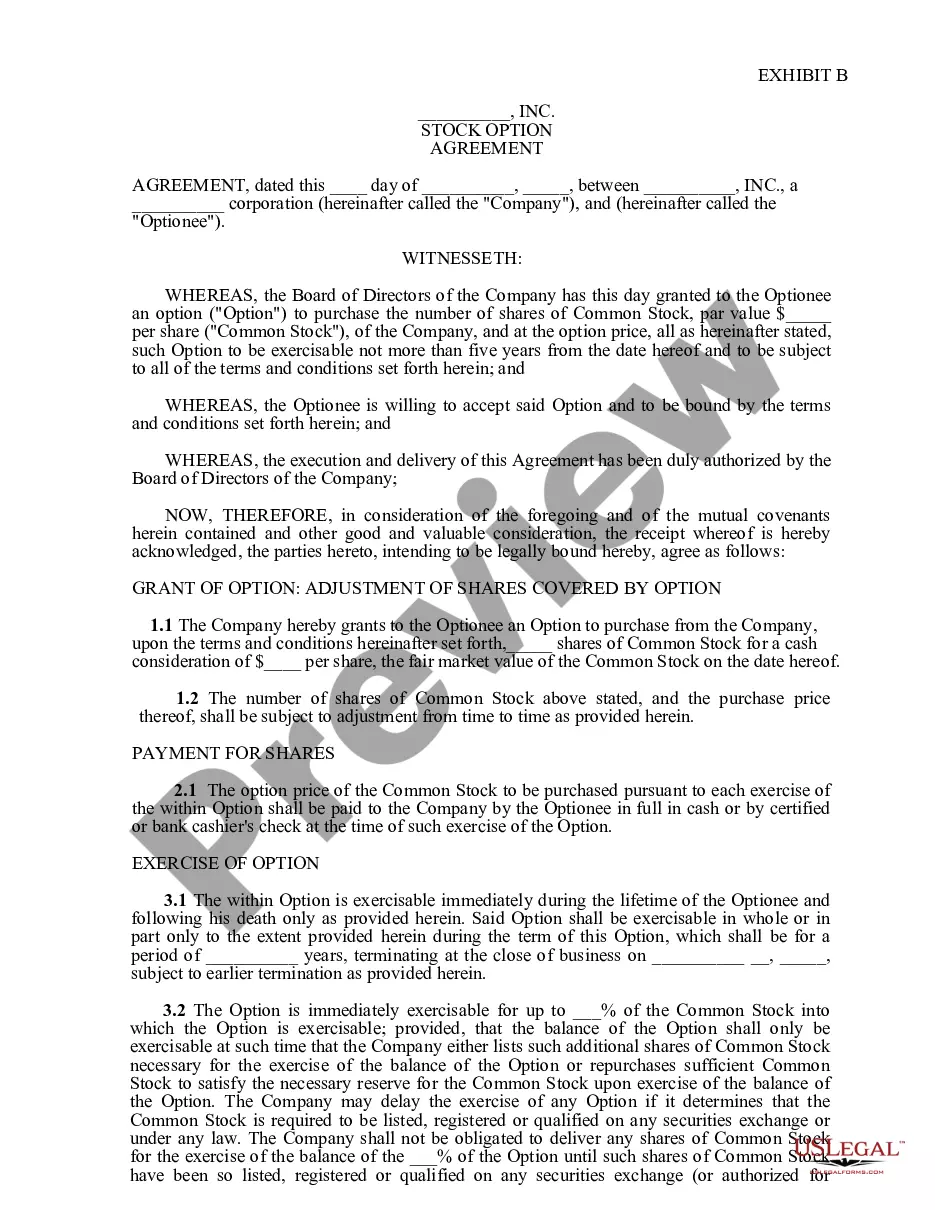
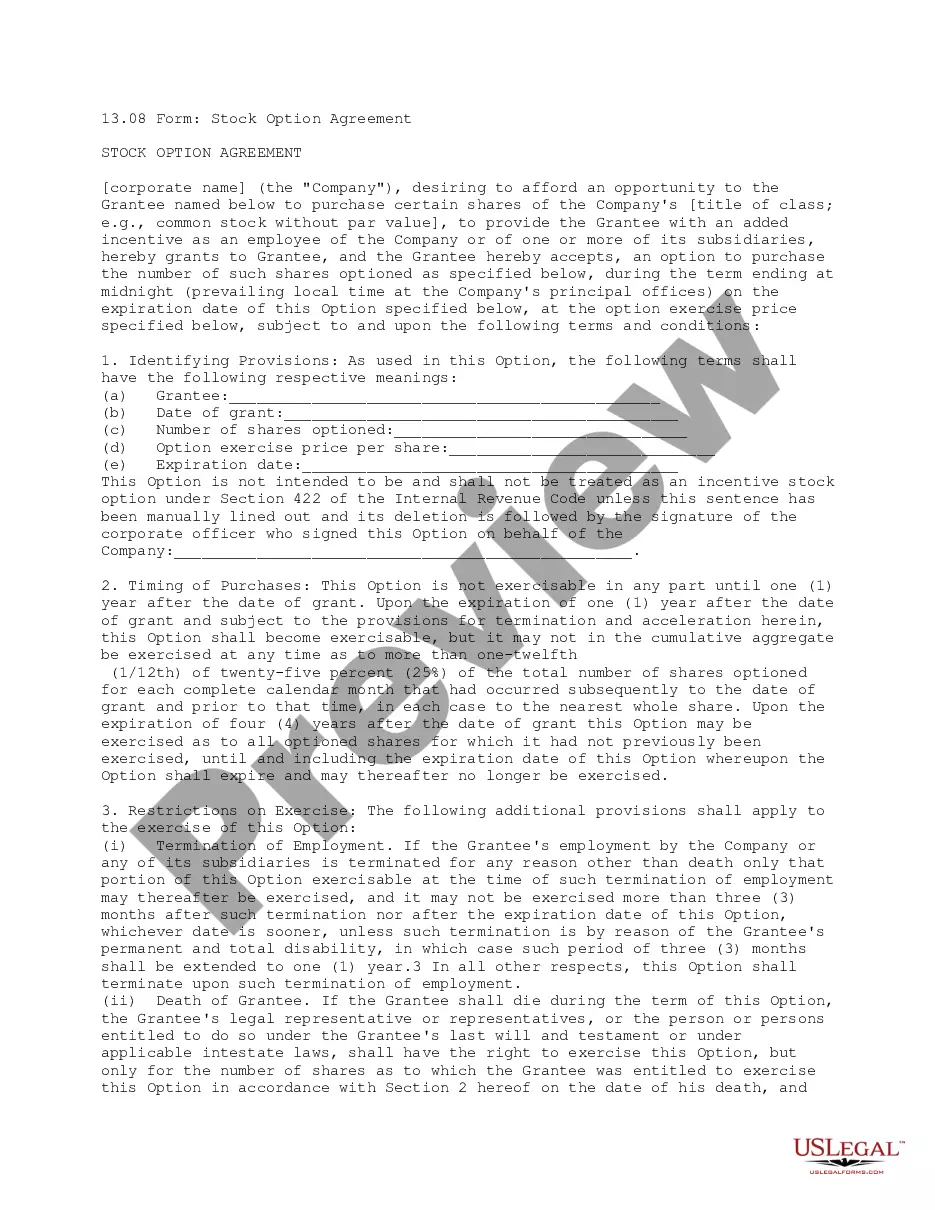
The Employee Stock Option Agreement is a legal document that grants an employee the right to purchase shares of the company's stock at a predetermined price. Unlike incentive stock options, this agreement typically outlines non-qualified stock options, meaning the options are subject to different tax treatment. This form serves as a valuable tool for both employees and employers to formalize the terms under which stock options are granted, ensuring mutual understanding and compliance with corporate policies and laws.
Form components explained
- Grant date: Start date for options eligibility.
- Exercise price: Price at which the employee can buy the shares.
- Option shares: Number of shares available for purchase.
- Vesting schedule: Timeline for when options become available to exercise.
- Termination clauses: Conditions under which the agreement becomes void.
- Tax withholding provisions: Requirements for tax payments upon exercising the options.





Situations where this form applies
This form is essential when a company wishes to offer stock options to employees as part of their compensation package. It should be used when setting up a stock option plan, especially for employees who will be contributing significantly to the company. It is also necessary when changes to existing stock options need to be documented, such as adjustments in the share structure or exercise conditions.
Who should use this form
- Employers offering stock options as part of employee compensation.
- Employees receiving stock options as an incentive for their service.
- Companies undergoing financial restructuring or stock plan alterations.
- Human resources professionals managing employee benefits.
Completing this form step by step
- Identify the parties: Enter the employee's name and the company's name and details.
- Specify the grant date: Fill in the date from which options are effective.
- Enter the exercise price: Clearly state the price per share under which options can be exercised.
- Detail the vesting schedule: Outline when employees will gain full access to their options.
- Include signature: Ensure the agreement is signed by both the employee and a company representative.
Notarization requirements for this form
This form does not typically require notarization to be legally valid. However, some jurisdictions or document types may still require it. US Legal Forms provides secure online notarization powered by Notarize, available 24/7 for added convenience.
Get your form ready online
Our built-in tools help you complete, sign, share, and store your documents in one place.
Make edits, fill in missing information, and update formatting in US Legal Forms—just like you would in MS Word.
Download a copy, print it, send it by email, or mail it via USPS—whatever works best for your next step.
Sign and collect signatures with our SignNow integration. Send to multiple recipients, set reminders, and more. Go Premium to unlock E-Sign.
If this form requires notarization, complete it online through a secure video call—no need to meet a notary in person or wait for an appointment.
We protect your documents and personal data by following strict security and privacy standards.

Make edits, fill in missing information, and update formatting in US Legal Forms—just like you would in MS Word.

Download a copy, print it, send it by email, or mail it via USPS—whatever works best for your next step.

Sign and collect signatures with our SignNow integration. Send to multiple recipients, set reminders, and more. Go Premium to unlock E-Sign.

If this form requires notarization, complete it online through a secure video call—no need to meet a notary in person or wait for an appointment.

We protect your documents and personal data by following strict security and privacy standards.
Mistakes to watch out for
- Failing to clearly define the vesting schedule.
- Omitting the exercise price or leaving it blank.
- Not obtaining necessary signatures from all parties.
- Ignoring state-specific regulations regarding stock options.
Why use this form online
- Convenient access: Download and complete the form from anywhere.
- Editability: Easily make changes or updates to fit specific needs.
- Reliability: Utilize legally sound templates drafted by licensed attorneys.
Legal use & context
- Establishes the legal framework for stock options in compliance with securities laws.
- Protects both the employee's and employer's rights and responsibilities regarding the options.
- Defines how options can be exercised, including any conditions that may affect their validity.
Main things to remember
- The Employee Stock Option Agreement grants employees the right to purchase company shares at a specified price.
- It establishes clear terms regarding vesting, exercise, and termination of options.
- Utilizing this form helps protect both the company's interests and employees' rights.
Legal terms and meanings
- Non-qualified stock option: A type of stock option that does not meet specific IRS requirements for tax benefits.
- Vesting: The process by which an employee earns the right to exercise stock options over time.
- Exercise price: The price at which stock options can be purchased by the employee.
Looking for another form?







Form popularity
FAQ
These options, which are contracts, give an employee the right to buy or exercise a set number of shares of the company stock at a pre-set price, also known as the grant price. This offer doesn't last forever, though. You have a set amount of time to exercise your options before they expire.
However, when you sell an optionor the stock you acquired by exercising the optionyou must report the profit or loss on Schedule D of your Form 1040. If you've held the stock or option for less than one year, your sale will result in a short-term gain or loss, which will either add to or reduce your ordinary income.
Employee stock options (ESOs) are a type of equity compensation granted by companies to their employees and executives.Typically, ESOs are issued by the company and cannot be sold, unlike standard listed or exchange-traded options.
The future value of your employee stock options will depend on two factors: the performance of the underlying stock and the strike price of your options. For example, if the stock is worth $30 and your option's strike price is $25, your options will be worth $5 per share.
The stock option compensation is an expense of the business and is represented by the debit to the expense account in the income statement. The other side of the entry is to the additional paid in capital account (APIC) which is part of the total equity of the business.
About Stock Option Agreements When a company offers employees stock options, they do so through a special contract called a stock option agreement.The option agreement dictates all the terms of the offer -- including vesting schedule, time limits for exercise once vested and any other special conditions.
Determine if you are vested in your company employee stock ownership program. Read the rules for selling your stock. Contact your company's plan administrator and indicate you'd like to cash out your stock. List your stock with a stockbroker if your company stock is publicly-traded.
Find out how big the discount would be, compared to preferred shares. Ask about the most recent appraisal. Don't be afraid to take the future into consideration. Negotiate salary first, stock options next. Oh, and you might also want to learn how long you have to buy those shares.
A stock option is the right to buy a specific number of shares of company stock at a pre-set price, known as the exercise or strike price, for a fixed period of time, usually following a predetermined waiting period, called the vesting period. Most vesting periods span follow three to five years, with a certain