Employee Stock Option Plan
Overview of this form
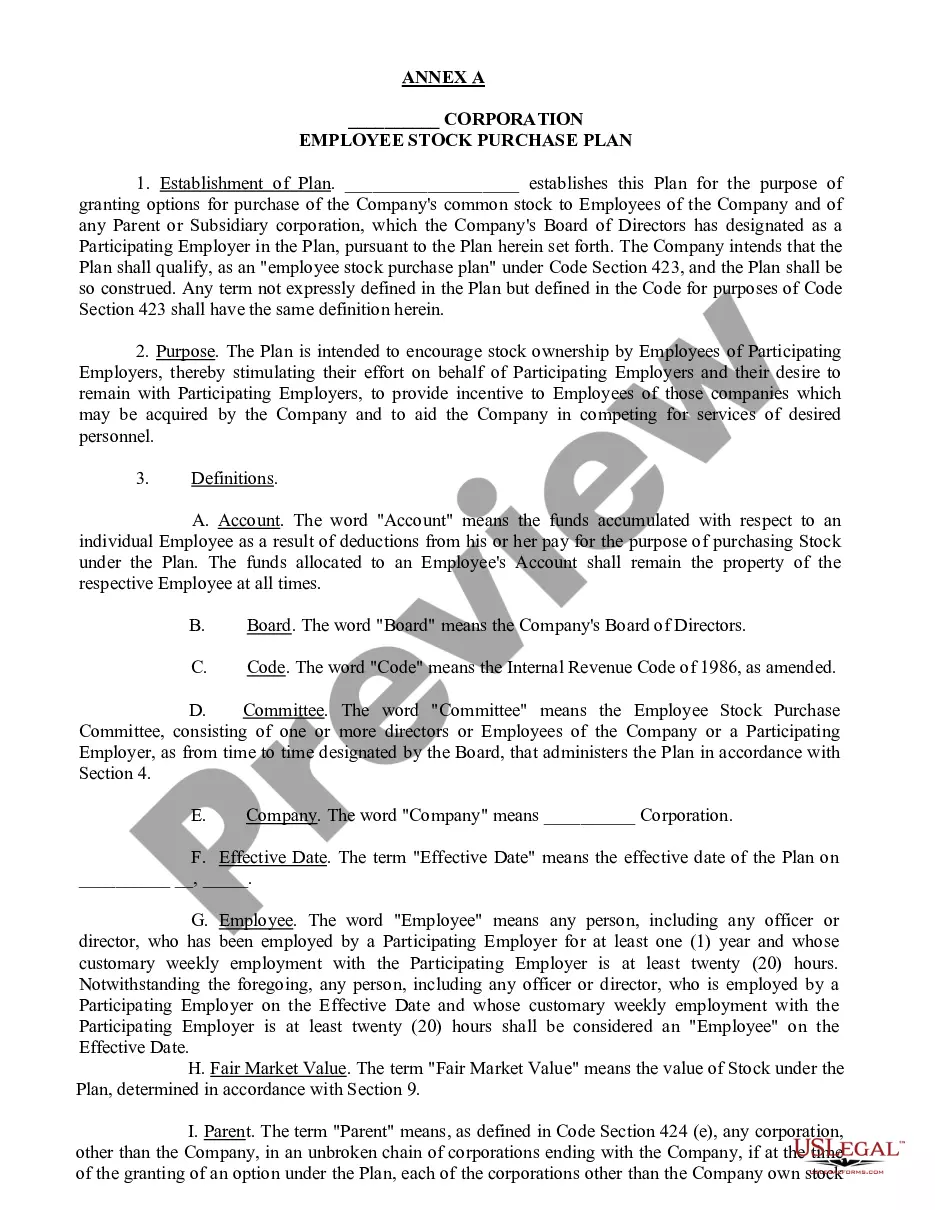
The Employee Stock Option Plan is a legal document that outlines a company's plan to grant stock options to its employees. This incentivizes employees to share in the company's success by acquiring ownership stakes. Unlike standard employment agreements, this plan specifically focuses on equity compensation, which can include stock appreciation rights (SARs) and other stock-based awards. It serves to attract and retain skilled employees while aligning their interests with those of the shareholders.
What’s included in this form
- Purpose - Outlines the plan's intention to enhance long-term company success.
- Eligibility - Specifies which employees qualify to receive stock options.
- Plan Administration - Details the responsibilities of the Compensation Committee in overseeing the plan.
- Awards - Describes the different types of awards, such as stock options and stock awards, that can be granted under the plan.
- Tax Withholding - Explains the company's rights to withhold taxes from awards granted under the plan.









Common use cases
This form should be used when a company wants to implement an Employee Stock Option Plan to offer stock options to its employees. It is applicable in scenarios where the company aims to motivate employees through participation in stock ownership, enhance employee retention, or comply with legal regulations surrounding employee incentives.
Who this form is for
- Businesses looking to attract and retain talent through equity compensation.
- Companies prepared to offer performance-based incentives to employees.
- Employers seeking to align employee interests with that of shareholders for long-term growth.
Steps to complete this form
- Identify the company and specify the effective date of the Stock Option Plan.
- Define the eligibility criteria for employees who will receive stock options.
- Articulate the roles and responsibilities of the Compensation Committee administering the plan.
- Detail the number of shares available for issuance and the conditions surrounding the awards.
- Include provisions for tax withholding and stock option adjustments as necessary.
Notarization requirements for this form
This form does not typically require notarization unless specified by local law. It is recommended to check your jurisdictionâs requirements to ensure compliance.
Get your form ready online
Our built-in tools help you complete, sign, share, and store your documents in one place.
Make edits, fill in missing information, and update formatting in US Legal Forms—just like you would in MS Word.
Download a copy, print it, send it by email, or mail it via USPS—whatever works best for your next step.
Sign and collect signatures with our SignNow integration. Send to multiple recipients, set reminders, and more. Go Premium to unlock E-Sign.
If this form requires notarization, complete it online through a secure video call—no need to meet a notary in person or wait for an appointment.
We protect your documents and personal data by following strict security and privacy standards.

Make edits, fill in missing information, and update formatting in US Legal Forms—just like you would in MS Word.

Download a copy, print it, send it by email, or mail it via USPS—whatever works best for your next step.

Sign and collect signatures with our SignNow integration. Send to multiple recipients, set reminders, and more. Go Premium to unlock E-Sign.

If this form requires notarization, complete it online through a secure video call—no need to meet a notary in person or wait for an appointment.

We protect your documents and personal data by following strict security and privacy standards.
Typical mistakes to avoid
- Failing to clearly define eligibility, leading to confusion among employees.
- Not including provisions for potential regulatory changes affecting the plan.
- Omitting important details regarding the types of awards offered and their conditions.
Why use this form online
- Convenience of completing the form at any time and from anywhere.
- Editable templates that allow customization based on specific company needs.
- Reliable legal language drafted by licensed attorneys, ensuring compliance.
Legal use & context
- Ensures compliance with federal regulations regarding stock options.
- Subject to approval by the company's Board of Directors and stockholders.
- Non-compliance with the plan's provisions may lead to unintended tax consequences.
What to keep in mind
- The Employee Stock Option Plan incentivizes employees through stock ownership, contributing to the company's success.
- It includes detailed sections on eligibility, share allocation, and administration responsibilities.
- Careful completion and compliance with legal requirements are vital for the plan's effectiveness.
Looking for another form?







Form popularity
FAQ
An ESOP will probably cost $80,000 to $250,000 to set up and run the first year and, for most companies with fewer than a few hundred employees, $20,000 to $30,000 annually.
To set up an ESOP, you'll have to establish a trust to buy your stock. Then, each year you'll make tax-deductible contributions of company shares, cash for the ESOP to buy company shares, or both. The ESOP trust will own the stock and allocate shares to individual employee's accounts.
IRS Form 3922 Transfer of Stock Acquired Through an Employee Stock Purchase Plan Under Section 423(c) is for informational purposes only and is not entered into your return. You will need this information when you sell the stock, so the form should be kept for your records.
The stock option compensation is an expense of the business and is represented by the debit to the expense account in the income statement. The other side of the entry is to the additional paid in capital account (APIC) which is part of the total equity of the business.
Since you'll have to exercise your option through your employer, your employer will usually report the amount of your income on line 1 of your Form W-2 as ordinary wages or salary and the income will be included when you file your tax return.
Employee stock options (ESOs) are a type of equity compensation granted by companies to their employees and executives.Typically, ESOs are issued by the company and cannot be sold, unlike standard listed or exchange-traded options.
The future value of your employee stock options will depend on two factors: the performance of the underlying stock and the strike price of your options. For example, if the stock is worth $30 and your option's strike price is $25, your options will be worth $5 per share.
These options, which are contracts, give an employee the right to buy or exercise a set number of shares of the company stock at a pre-set price, also known as the grant price. This offer doesn't last forever, though. You have a set amount of time to exercise your options before they expire.
Find out how big the discount would be, compared to preferred shares. Ask about the most recent appraisal. Don't be afraid to take the future into consideration. Negotiate salary first, stock options next. Oh, and you might also want to learn how long you have to buy those shares.