Employee Stock Option Prospectus
What is this form?
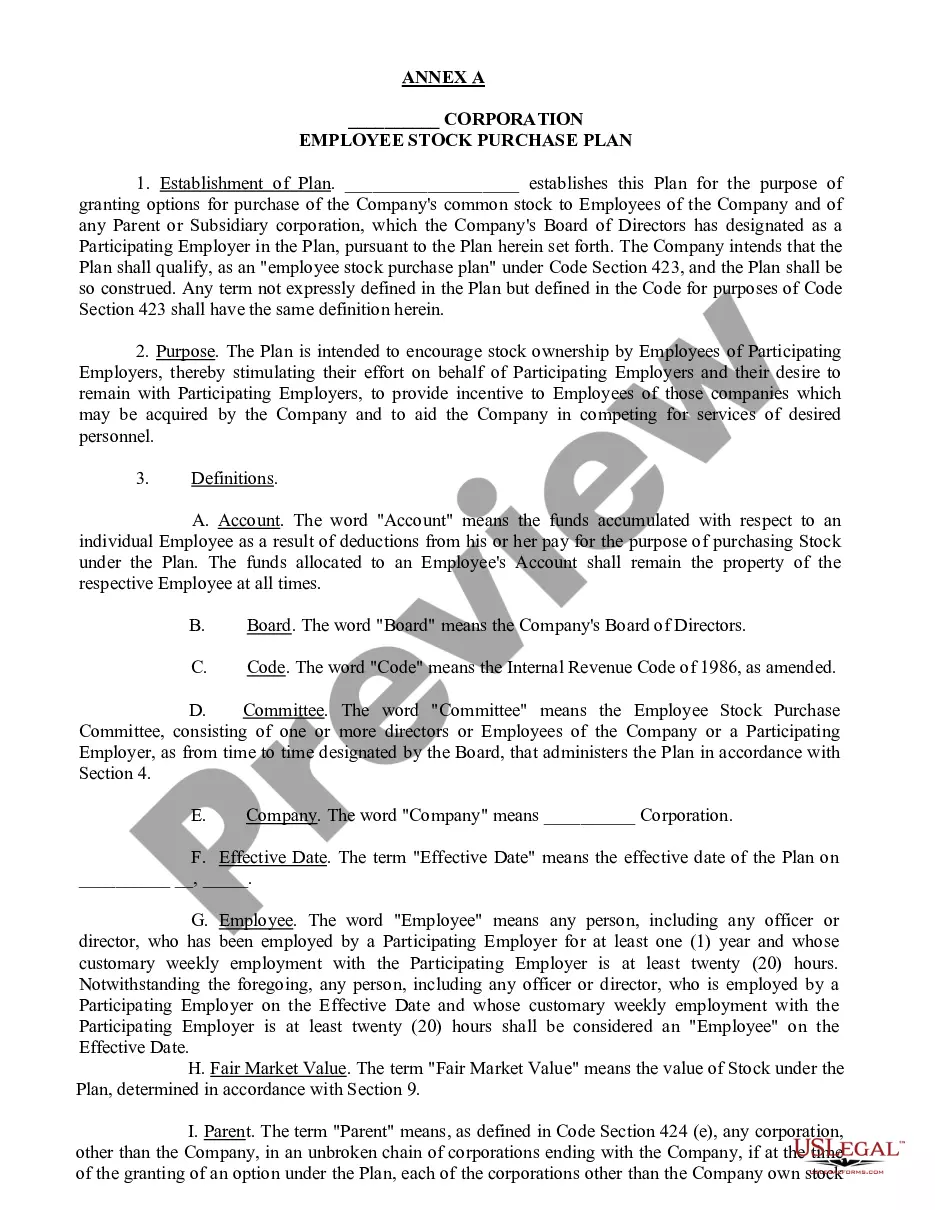
The Employee Stock Option Prospectus is a document used to inform employees about their rights and obligations concerning stock options offered by their employer. This prospectus outlines the terms of exercising stock options, which allows employees to purchase shares of the company's common stock. It provides key information on how the plan works, tax implications, and the company's performance, distinguishing itself from other stock-related documents by focusing specifically on the employee's participation and responsibilities within the stock option plan.
Key parts of this document
- Introduction to the Stock Option Plan, including its purpose and benefits.
- Details regarding the rights and obligations of employees related to stock options.
- Information on company performance and required disclosures under federal securities laws.
- Explanation of tax implications concerning the exercise of stock options.
- Contact information for inquiries about the plan and related documents.
- Restrictions on the transfer of shares upon exercising stock options.








When to use this document
This form should be used when an employer plans to implement an employee stock option plan that requires employees to understand their rights to purchase shares, the conditions for exercising these options, and the associated tax responsibilities. It is typically provided to employees being granted stock options as part of their compensation package.
Intended users of this form
- Employers offering stock options as part of employee compensation.
- Employees who are granted stock options and need to understand the terms and conditions of their options.
- Human resources and legal departments involved in administering stock option plans.
- Shareholders who seek clarity on the company's stock option offerings.
Instructions for completing this form
- Identify the company and the specific stock option plan being referenced.
- Review the key terms outlined in the prospectus, including your rights and obligations.
- Complete any required agreement forms related to accepting the stock options.
- Consult with a tax advisor to understand potential tax implications from exercising options.
- Submit any required documentation to the designated company representative by the stated deadline.
Notarization requirements for this form
This form does not typically require notarization unless specified by local law. It may, however, require signatures from both the employee and a representative of the company to be legally effective.
Get your form ready online
Our built-in tools help you complete, sign, share, and store your documents in one place.
Make edits, fill in missing information, and update formatting in US Legal Forms—just like you would in MS Word.
Download a copy, print it, send it by email, or mail it via USPS—whatever works best for your next step.
Sign and collect signatures with our SignNow integration. Send to multiple recipients, set reminders, and more. Go Premium to unlock E-Sign.
If this form requires notarization, complete it online through a secure video call—no need to meet a notary in person or wait for an appointment.
We protect your documents and personal data by following strict security and privacy standards.

Make edits, fill in missing information, and update formatting in US Legal Forms—just like you would in MS Word.

Download a copy, print it, send it by email, or mail it via USPS—whatever works best for your next step.

Sign and collect signatures with our SignNow integration. Send to multiple recipients, set reminders, and more. Go Premium to unlock E-Sign.

If this form requires notarization, complete it online through a secure video call—no need to meet a notary in person or wait for an appointment.

We protect your documents and personal data by following strict security and privacy standards.
Mistakes to watch out for
- Failing to read the entire prospectus before signing any documents.
- Overlooking tax implications associated with exercising stock options.
- Not consulting a tax advisor about individual circumstances.
- Missing deadlines for submitting agreements or exercising options.
Advantages of online completion
- Convenience: Download and review the form at your convenience without needing to visit an office.
- Editability: Easily fill out and adjust information as needed before submission.
- Reliability: Access accurate and comprehensive legal information provided by licensed attorneys.
Looking for another form?






Form popularity
FAQ
Stock Option Journal Entries Year 1 The stock option compensation is an expense of the business and is represented by the debit to the expense account in the income statement. The other side of the entry is to the additional paid in capital account (APIC) which is part of the total equity of the business.
Any compensation income received from your employer in the current year is included on Form W-2 in Box 1. If you sold any stock units to cover taxes, this information is included on Form W-2 as well. Review Boxes 12 and 14 as they list any income included on Form W-2 related to your employee stock options.
However, when you sell an optionor the stock you acquired by exercising the optionyou must report the profit or loss on Schedule D of your Form 1040. If you've held the stock or option for less than one year, your sale will result in a short-term gain or loss, which will either add to or reduce your ordinary income.
Since you'll have to exercise your option through your employer, your employer will usually report the amount of your income on line 1 of your Form W-2 as ordinary wages or salary and the income will be included when you file your tax return.
Start with Form 8949, Part I, Short-Term Capital Gains and Losses. Check Box C since you did not receive a Form 1099. On Line 1, Column A, Description of Property, enter the name of the company or its symbol, and after that write "call options" and the number of call options you sold.
The stock option compensation is an expense of the business and is represented by the debit to the expense account in the income statement. The other side of the entry is to the additional paid in capital account (APIC) which is part of the total equity of the business.
The future value of your employee stock options will depend on two factors: the performance of the underlying stock and the strike price of your options. For example, if the stock is worth $30 and your option's strike price is $25, your options will be worth $5 per share.
Non-qualified stock options (NSOs) are granted to employees, advisors, and consultants; incentive stock options (ISOs) are for employees only. With NSOs, you pay ordinary income taxes when you exercise the options, and capital gains taxes when you sell the shares.