South Carolina Hypothecation Agreement
Understanding this form
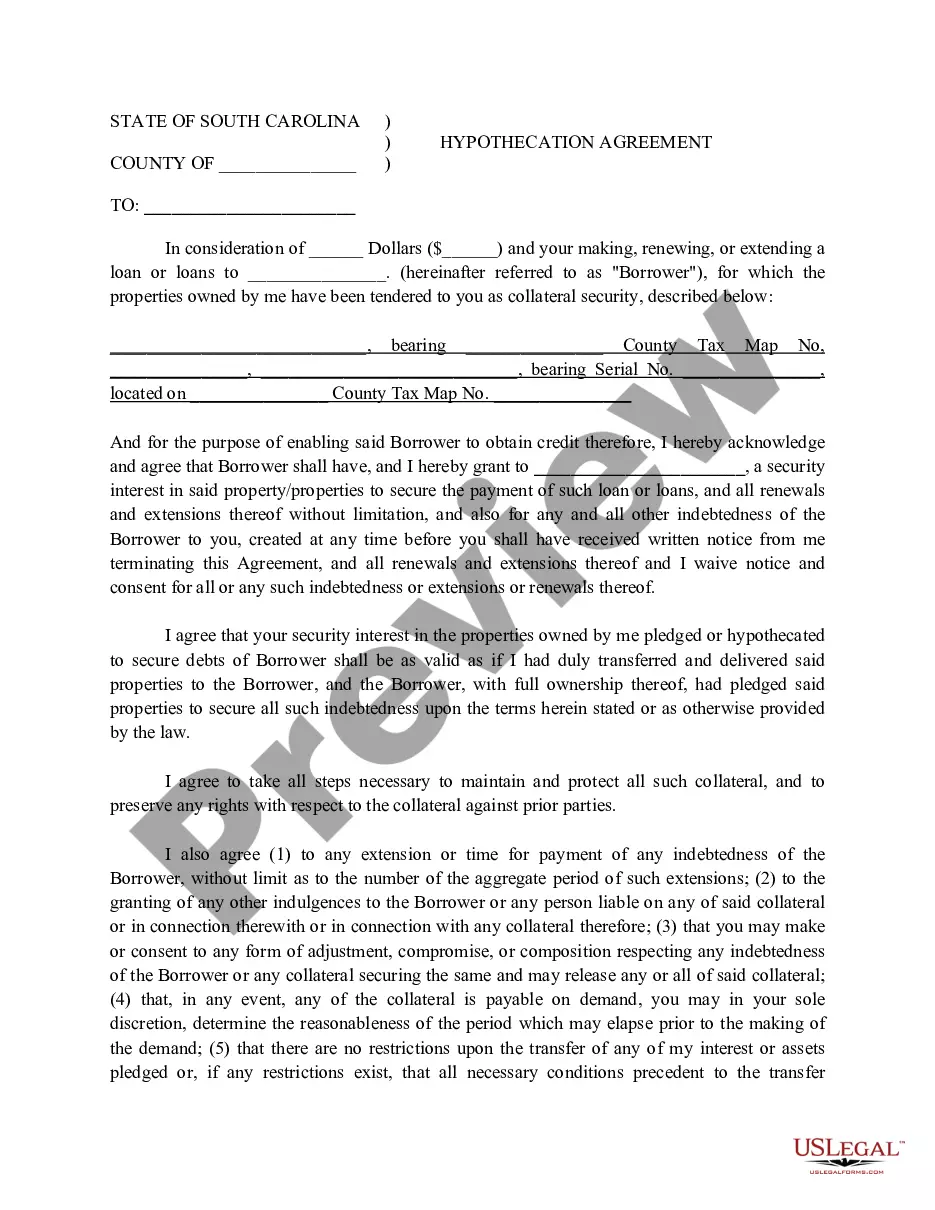
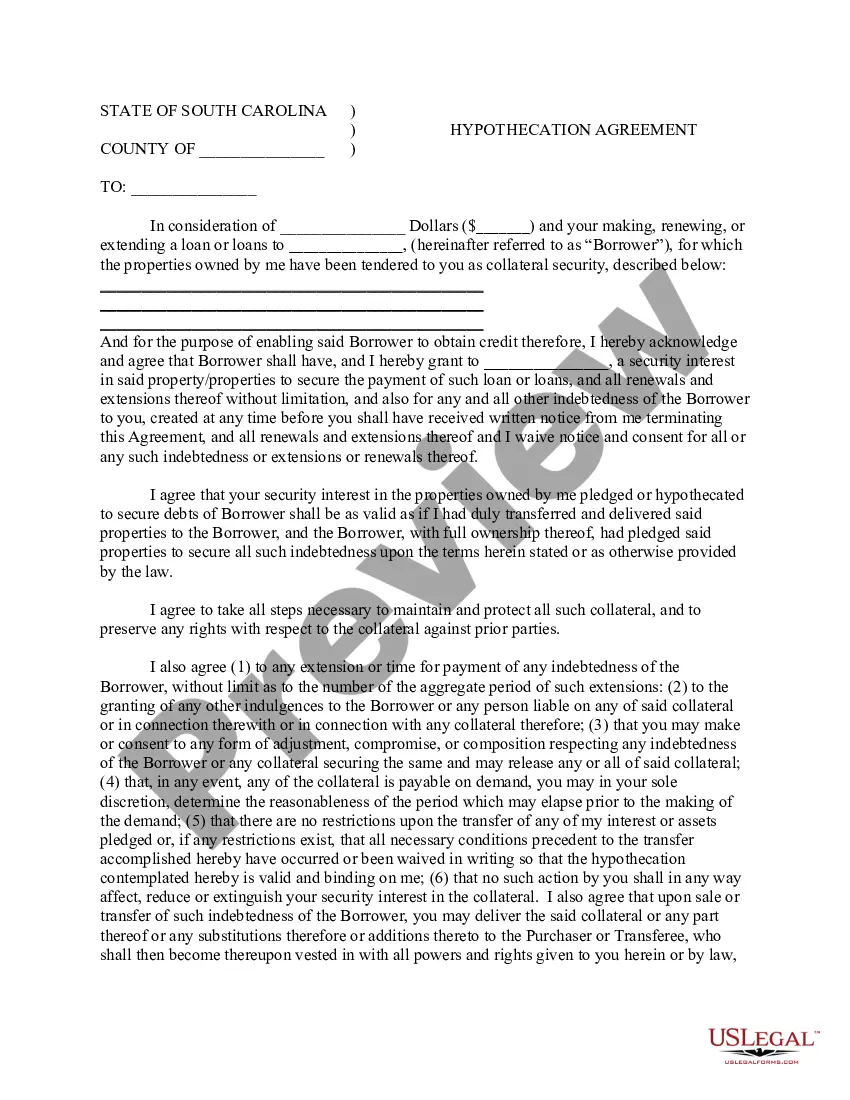
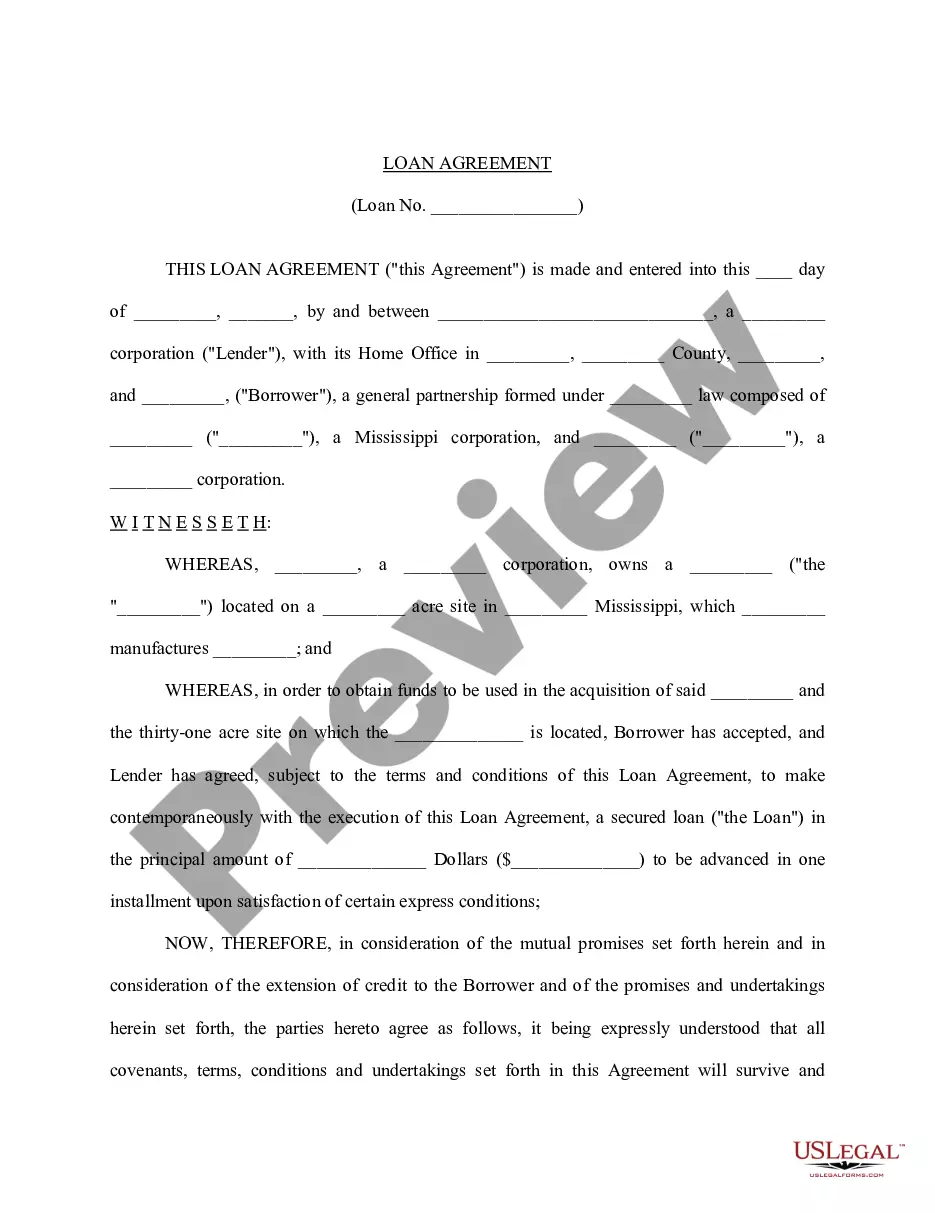
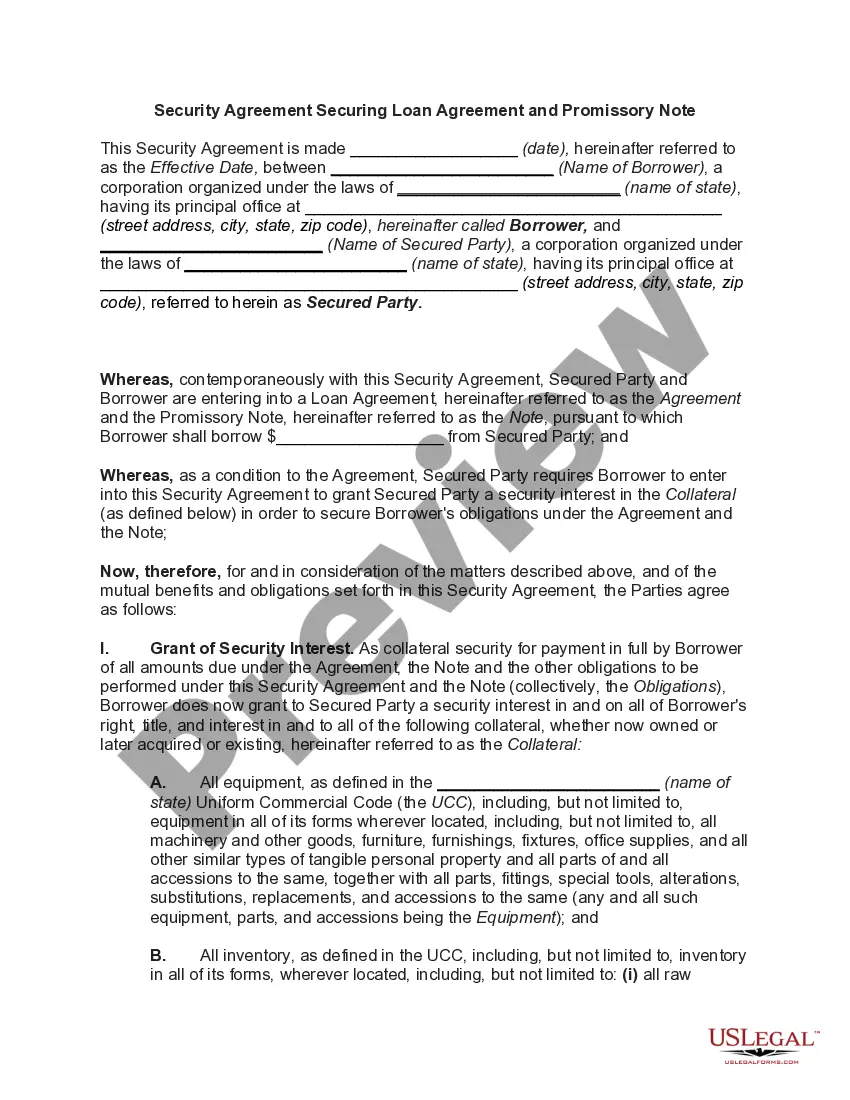
The Hypothecation Agreement is a legal document used to pledge collateral to secure a loan while retaining ownership rights to that collateral. Unlike a traditional loan agreement, this form specifies the terms of the hypothecation arrangement and outlines the lender's legal recourse in case of default by the borrower. This agreement is essential for lenders to ensure they have a claim to the collateral without taking actual possession of it.
Form components explained
- Identification of the parties involved, including the borrower and lender.
- Details of the collateral being offered, including descriptions and tax map or serial numbers.
- Terms and conditions of the loan and any associated renewals.
- Information regarding rights and obligations of all parties concerning the collateral.
- Provisions for modifications and extensions of the agreement.
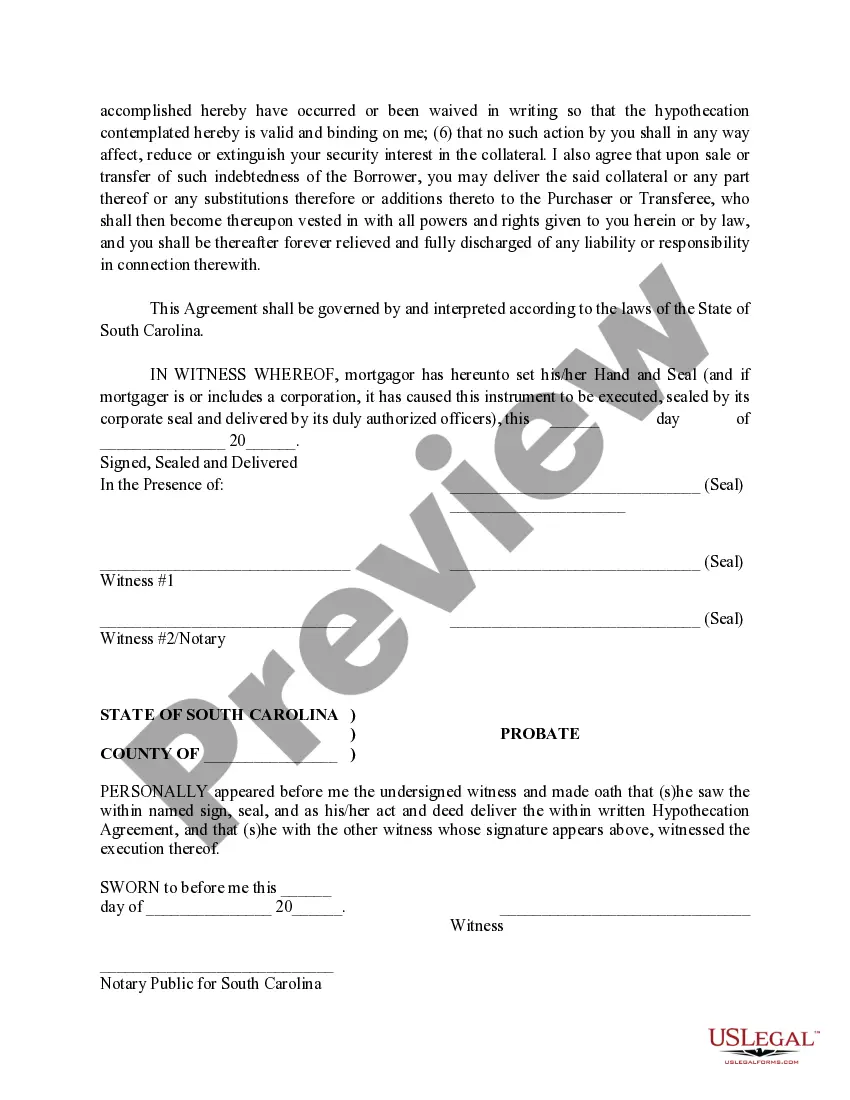
- Signatures and notarization requirements to validate the agreement.

Situations where this form applies
This form is used when a borrower seeks a loan and wishes to offer collateral to secure that loan. It is particularly useful in situations where the borrower retains ownership of the collateral, such as real estate or vehicles, while providing assurance to the lender about repayment. This agreement can be utilized in personal loans, business loans, or any situation where collateralization of a loan is necessary.
Who should use this form
This form is suitable for the following parties:
- Lenders seeking security for loans, including banks and private lenders.
- Borrowers who want to secure a loan using their property as collateral.
- Individuals or entities in South Carolina wishing to establish clear terms in a hypothecation arrangement.
- Legal professionals drafting loan agreements that involve collateral.
How to complete this form
- Identify the parties: Fill in the names of the borrower and lender.
- Specify the loan amount: Enter the amount of the loan being secured.
- Describe the collateral: Provide detailed descriptions and identification numbers for the collateral being hypothecated.
- Sign and date the document: Ensure all parties acknowledge the agreement by signing and dating it.
- Seek notarization: Have the signatures notarized to validate the agreement.
Does this document require notarization?
Yes, this form must be notarized to be legally valid. US Legal Forms provides integrated online notarization, allowing you to complete the process securely via video call, 24/7, without the need to travel.
Get your form ready online
Our built-in tools help you complete, sign, share, and store your documents in one place.
Make edits, fill in missing information, and update formatting in US Legal Forms—just like you would in MS Word.
Download a copy, print it, send it by email, or mail it via USPS—whatever works best for your next step.
Sign and collect signatures with our SignNow integration. Send to multiple recipients, set reminders, and more. Go Premium to unlock E-Sign.
If this form requires notarization, complete it online through a secure video call—no need to meet a notary in person or wait for an appointment.
We protect your documents and personal data by following strict security and privacy standards.

Make edits, fill in missing information, and update formatting in US Legal Forms—just like you would in MS Word.

Download a copy, print it, send it by email, or mail it via USPS—whatever works best for your next step.

Sign and collect signatures with our SignNow integration. Send to multiple recipients, set reminders, and more. Go Premium to unlock E-Sign.

If this form requires notarization, complete it online through a secure video call—no need to meet a notary in person or wait for an appointment.

We protect your documents and personal data by following strict security and privacy standards.
Common mistakes to avoid
- Failing to clearly identify the collateral, which can lead to disputes later.
- Not signing the document in the presence of a notary, rendering it potentially unenforceable.
- Omitting important terms and conditions regarding the debt obligations.
- Not keeping a copy of the signed agreement for personal records.
Why complete this form online
- Convenience: Download and complete the form from anywhere at any time.
- Editability: Customize the form easily to suit your specific agreement details.
- Reliability: Access legally vetted templates to ensure compliance with state laws.
Looking for another form?
Form popularity
FAQ
States that follow the Race-Notice statute: Alaska, Arkansas, California, Colorado, District of Columbia, Georgia, Hawaii, Idaho, Indiana, Maryland, Michigan, Minnesota, Mississippi, Montana, Nebraska, Nevada, New Jersey, New York, North Dakota, Ohio (regarding mortgages, OH follows the Race statute), Oregon,
Race-Notice Jurisdiction: A jurisdiction whose rule allows a subsequent bona-fide purchaser to prevail over an earlier purchaser if, and only if, the subsequent purchaser did not know of the earlier transfer and the subsequent purchaser's deed was recorded before the first purchaser's deed.
A recording act that gives priority of title to the party that records first, but only if the party also lacked notice of prior unrecorded claims on the same property. See Notice statute and Race statute. PROPERTY. property & real estate law. wex definitions.
South Carolina is a race-notice jurisdiction. In 1958 the recording statute was amended to require a subsequent lien creditor without notice to file the instrument evidencing his lien in order to claim under the statute.
An original, wet signed document. Signature of the Party of the First Part. Two witnesses to the signature. A South Carolina Probate or Acknowledgement. A property description to include a recorded plat reference or metes and bounds description.
In South Carolina, the lender must sue the borrower and prove the lender is entitled to foreclose. The homeowner (defendant) has the right to defend the foreclosure by conducting discovery, raising defenses, and filing counterclaims (that is, suing the lender under various causes of action).