Leave of Absence Salary Clarification
About this form
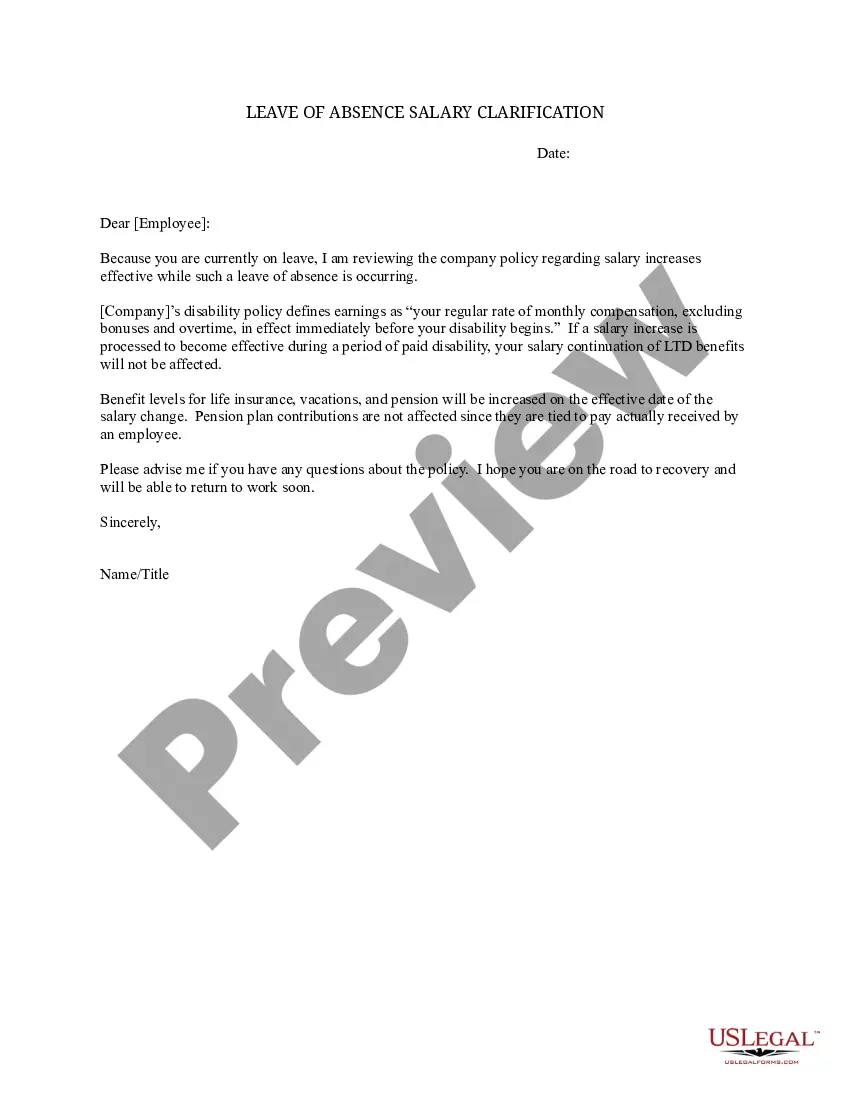
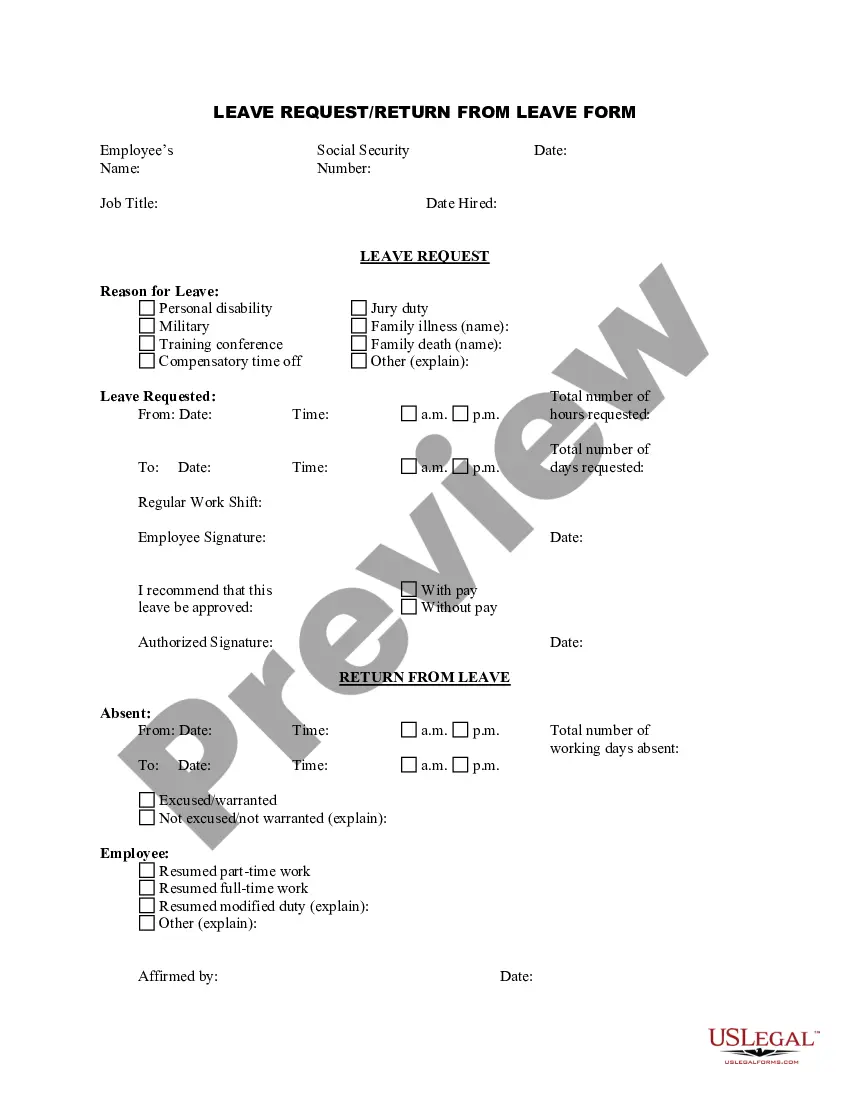
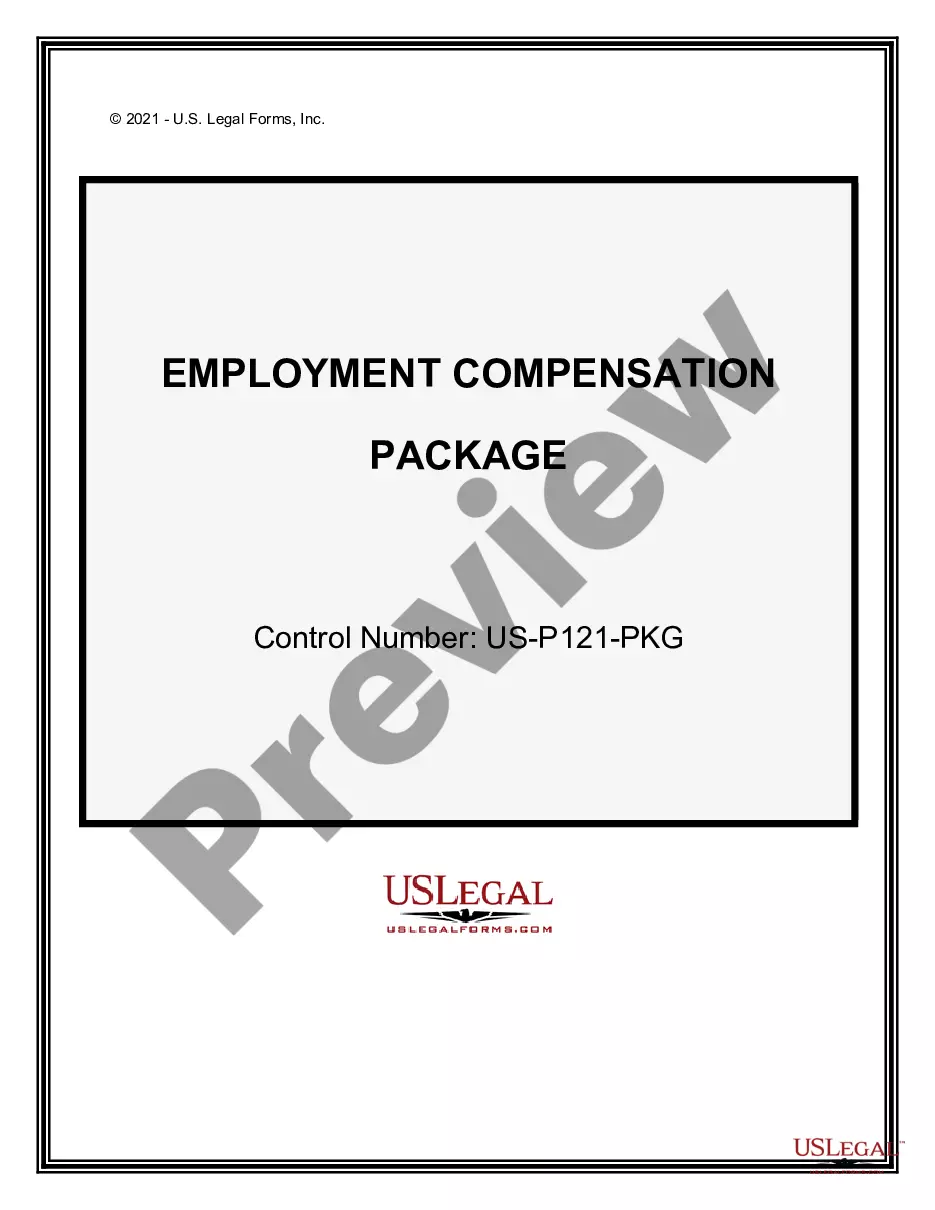
The Leave of Absence Salary Clarification form is designed for employees who are on a leave of absence and need to clarify the implications of their company's salary policies during that time. This form helps employees understand whether any salary increases will be reflected during their absence and ensures transparent communication regarding company policy changes while they are away from work.
What’s included in this form
- Date of the letter
- Employee's name and designation
- Company's name
- Policy statement regarding salary increases during leave
- Benefits affected by salary changes
- Space for additional questions or comments

When to use this document
This form should be used when an employee is currently on a leave of absence and wants to confirm how their salary will be affected by company policies during that time. It applies in situations where salary changes are being considered or have taken place while the employee is unable to work.
Who can use this document
- Employees on leave who want to clarify their salary status
- HR representatives managing leave of absence inquiries
- Managers overseeing employees who are on leave
How to prepare this document
- Enter the date of the letter at the top of the form.
- Fill in the employee's name and title in the designated fields.
- Specify the company's name in the appropriate area.
- Clearly state the company's policies regarding salary adjustments during the leave of absence.
- Provide any additional information regarding benefits affected by salary changes.
- Sign the form with the sender's name and title.
Does this document require notarization?
This form does not typically require notarization unless specified by local law.
Get your form ready online
Our built-in tools help you complete, sign, share, and store your documents in one place.
Make edits, fill in missing information, and update formatting in US Legal Forms—just like you would in MS Word.
Download a copy, print it, send it by email, or mail it via USPS—whatever works best for your next step.
Sign and collect signatures with our SignNow integration. Send to multiple recipients, set reminders, and more. Go Premium to unlock E-Sign.
If this form requires notarization, complete it online through a secure video call—no need to meet a notary in person or wait for an appointment.
We protect your documents and personal data by following strict security and privacy standards.

Make edits, fill in missing information, and update formatting in US Legal Forms—just like you would in MS Word.

Download a copy, print it, send it by email, or mail it via USPS—whatever works best for your next step.

Sign and collect signatures with our SignNow integration. Send to multiple recipients, set reminders, and more. Go Premium to unlock E-Sign.

If this form requires notarization, complete it online through a secure video call—no need to meet a notary in person or wait for an appointment.

We protect your documents and personal data by following strict security and privacy standards.
Common mistakes to avoid
- Failing to include the employeeâs correct name or title.
- Not updating or specifying the correct date of the letter.
- Missing key details about salary policies or benefit changes.
Benefits of completing this form online
- Ease of access to a standardized format for salary clarification.
- Ability to quickly edit details and personalize the form as needed.
- Reliable source of legal forms drafted by licensed attorneys.
Legal use & context
- The form is legally recognized to clarify salary policies between employers and employees on leave.
- It serves to protect the rights of employees regarding salary adjustments during their absence.
Quick recap
- The Leave of Absence Salary Clarification form is essential for employees on leave.
- It helps facilitate clear communication regarding salary policies during an employeeâs absence.
- Providing accurate information on this form is crucial to avoid misunderstandings.
Looking for another form?
Form popularity
FAQ
Childbirth, adoption and foster care. Serious health condition. Caring for a family member with a serious health condition. Certain military reasons (including care of a service member)
If their absence is not protected by the Family and Medical Leave Act (FMLA), then it's considered a non-FMLA medical leave. However, their leave may still be protected under the ADA and ADA Amendments Act (ADAAA). In this case, your employees' jobs and wages are still protected by law.
In the subject line of the email put the reason, (Leave of Absence Request, Request for Leave of Absence) followed by your full name. In the body of the email, begin with the salutation and the addressee's name. Explain the leave of absence request. Include a closing. Include your name.
A leave of absence is an extended period of time off work that is excused by your employer. During this designated time away, the individual retains his or her employment status but may or may not receive pay or usual benefits. At the end of the leave, an employee may resume their regular duties.
A leave of absence may be paid or unpaid. Some laws cover certain instances of leave, such as jury duty and military service. It's best to give an employer as much notice as possible if you intend to take a leave of absence.
How long can you take a leave of absence? Under the EFMLA, employees may take leave in order to recover from COVID-19 or take care of a family member who has the virus. According to the FMLA, your employees can take up to 12 weeks off in a 12-month period if they have already worked for 1,250 hours.
When an employee takes a leave of absence from work, it can be either paid or unpaid. A personal leave of absence will likely be unpaid. In some cases, employers can determine if a leave of absence is paid or unpaid.
At some point, you may need to request a leave of absence from work. It could be for one of a variety of reasons: personal or family health problems, the birth or adoption of a child, relief from excessive job stress, the loss of a loved one, or the desire to travel or pursue a hobby.