Hawaii Notice of Default for Past Due Payments in connection with Contract for Deed
About this form
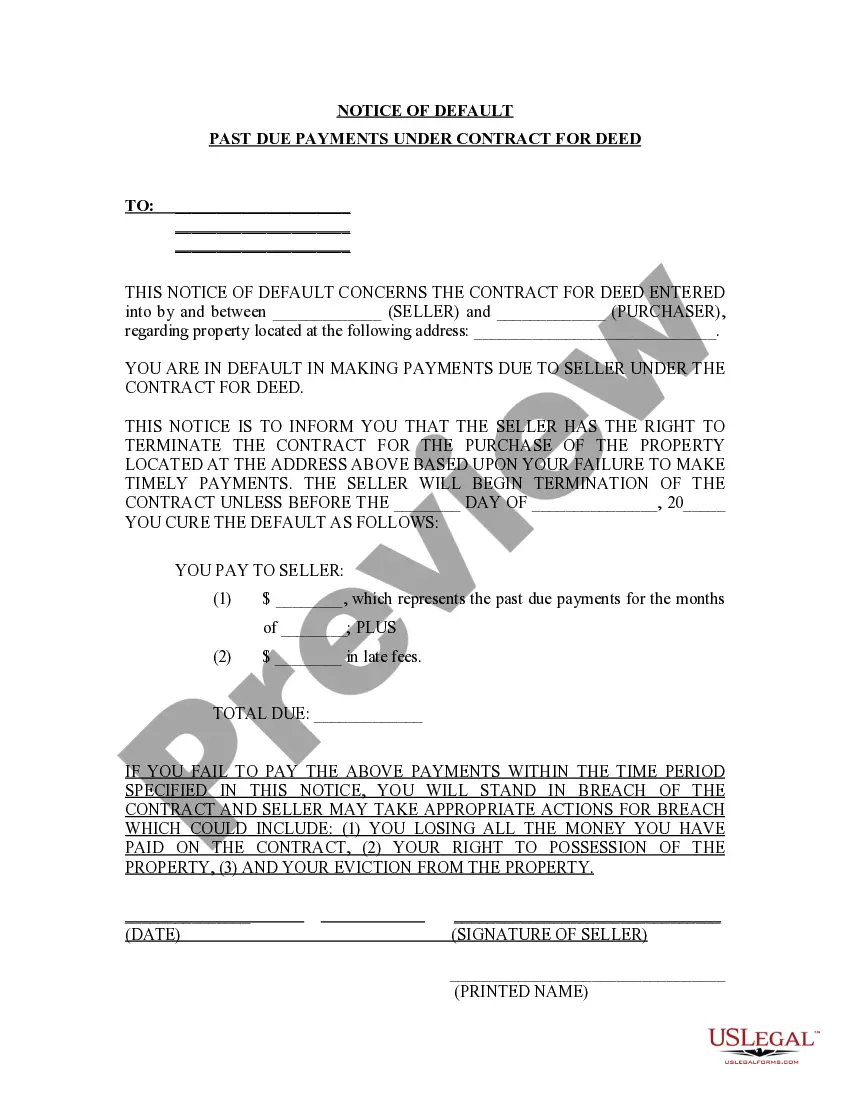
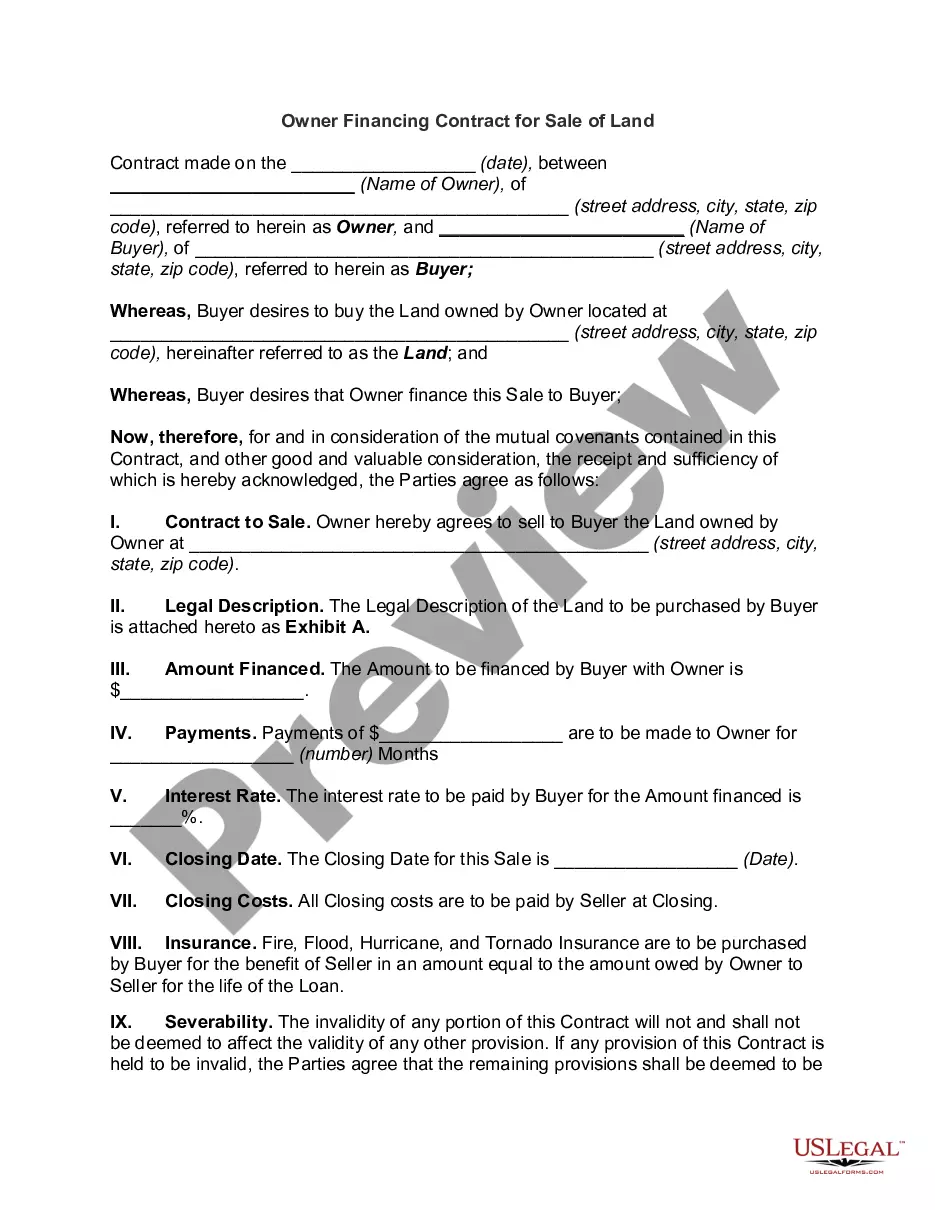
The Notice of Default for Past Due Payments related to a Contract for Deed is a critical document that serves as a formal notification from the seller to the purchaser about missed payments on a property purchase. This form clearly outlines the buyer's failure to comply with payment terms, marking the initial step before any further legal action may occur. It's essential for those involved in a Contract for Deed arrangement to understand this form's importance and to use it correctly, as it differs from general late payment notices by being specific to the contract terms outlined at the time of sale.
Key parts of this document
- Identification of the seller and purchaser involved in the contract.
- Details regarding the specific property covered under the Contract for Deed.
- Reference to the payment terms as outlined in the original contract.
- Deadline for the purchaser to rectify the missed payments.
- Consequences of failing to comply with the notice.
Situations where this form applies
This form should be used when a purchaser falls behind on their payments under a Contract for Deed. If the seller has not received the agreed payments and needs to formally notify the purchaser, this document is essential. It is an important step to take before proceeding with further actions, such as pursuing a legal remedy for breach of contract.
Who should use this form
This notice is intended for:
- Property sellers who have entered into a Contract for Deed and have not received timely payments.
- Purchasers who are behind on payments and need to understand the implications of their non-compliance.
- Real estate professionals assisting sellers in enforcing contract terms.
How to prepare this document
- Identify the seller and purchaser in the header of the document.
- Specify the address and description of the property involved in the Contract for Deed.
- Refer to the specific payment terms and conditions from the original contract.
- Clearly outline the amount of payment overdue and the deadline for payment.
- Sign and date the notice to finalize it before delivering it to the purchaser.
Does this document require notarization?
This form does not typically require notarization unless specified by local law. However, having it notarized can enhance its validity and may be advisable for record-keeping purposes.
Get your form ready online
Our built-in tools help you complete, sign, share, and store your documents in one place.
Make edits, fill in missing information, and update formatting in US Legal Forms—just like you would in MS Word.
Download a copy, print it, send it by email, or mail it via USPS—whatever works best for your next step.
Sign and collect signatures with our SignNow integration. Send to multiple recipients, set reminders, and more. Go Premium to unlock E-Sign.
If this form requires notarization, complete it online through a secure video call—no need to meet a notary in person or wait for an appointment.
We protect your documents and personal data by following strict security and privacy standards.

Make edits, fill in missing information, and update formatting in US Legal Forms—just like you would in MS Word.

Download a copy, print it, send it by email, or mail it via USPS—whatever works best for your next step.

Sign and collect signatures with our SignNow integration. Send to multiple recipients, set reminders, and more. Go Premium to unlock E-Sign.

If this form requires notarization, complete it online through a secure video call—no need to meet a notary in person or wait for an appointment.

We protect your documents and personal data by following strict security and privacy standards.
Typical mistakes to avoid
- Not specifying the exact amount overdue, which can lead to confusion.
- Failing to include the deadline for rectifying the missed payments.
- Using vague language that does not reference the specific contract terms.
Benefits of completing this form online
- Convenient access to download and fill out the form as needed.
- Editability allows sellers to customize the form to their specific situation.
- Reliable templates drafted by licensed attorneys to ensure legal compliance.
Looking for another form?
Form popularity
FAQ
A Hawaii Notice of Default for Past Due Payments does not technically expire, but its implications can change over time. If the borrower does not resolve the default, the lender may take further actions, such as initiating foreclosure. Therefore, it's crucial to address the notice promptly to avoid escalation.
To find properties with a Hawaii Notice of Default for Past Due Payments, you can check local county recorder’s offices or utilize online databases that track foreclosure listings. Additionally, some real estate platforms provide alerts on properties in default. Keeping a close watch on these listings could present investment opportunities or help you understand the marketplace better.
Yes, a Hawaii Notice of Default for Past Due Payments in connection with Contract for Deed is considered a public record. This means anyone can access the information through public records databases. Knowing this can be important for potential buyers or investors interested in a property that is under default, so it is vital to take timely action to address a default.
When you receive a Hawaii Notice of Default for Past Due Payments in connection with Contract for Deed, your first step is to carefully review the notice. Understand the grounds for default and the timeline for response. It is advisable to communicate with your lender or servicer to discuss your situation and negotiate a possible resolution. You may also want to seek legal advice to ensure that your rights are protected.
The 120-day rule for foreclosure in Hawaii requires lenders to wait 120 days following a missed mortgage payment before starting foreclosure proceedings. This rule allows homeowners time to resolve any payment issues, thus reducing the number of forced sales. Understanding this rule is essential for anyone facing a Hawaii Notice of Default for Past Due Payments in connection with Contract for Deed. Utilizing platforms like USLegalForms can assist in navigating this process effectively.
Foreclosure actions typically involve five key stages: pre-foreclosure, notice of default, auction, redemption period, and post-foreclosure. Initially, the lender sends a notice of default to the borrower, marking the start of the foreclosure process. Following this, the property may be auctioned off, providing an opportunity for buyers. Awareness of these stages is vital when dealing with a Hawaii Notice of Default for Past Due Payments in connection with Contract for Deed.
The 120-day rule in Hawaii mandates that lenders must wait for 120 days after a borrower misses a payment before initiating foreclosure proceedings. This rule provides the borrower with time to address past due balances and potentially avoid losing their home. The waiting period is designed to facilitate communication and resolution between the lender and borrower. Knowing this can help individuals facing a Hawaii Notice of Default for Past Due Payments in connection with Contract for Deed.
In Hawaii, certain situations allow for exceptions to the 120-day rule related to foreclosure actions. For instance, if the borrower commits fraud, or if the property is abandoned, the lender may bypass this waiting period. Additionally, cases involving a reverse mortgage also do not adhere to the 120-day timeline. Understanding these exceptions is crucial for anyone dealing with a Hawaii Notice of Default for Past Due Payments in connection with Contract for Deed.
If you are three months behind on your mortgage, you will likely receive a notice of default from your lender. This situation can lead to serious consequences like foreclosure if not addressed quickly. Taking immediate action, such as seeking professional help, can help you understand your options and mitigate risks in your Contract for Deed.
A deed in lieu of foreclosure example involves a homeowner transferring the ownership of their home to the bank to avoid foreclosure. This process can sometimes help the borrower avoid the negative effects of foreclosure on their credit score. Always consult legal resources and guides, such as those from USLegalForms, for comprehensive documentation.