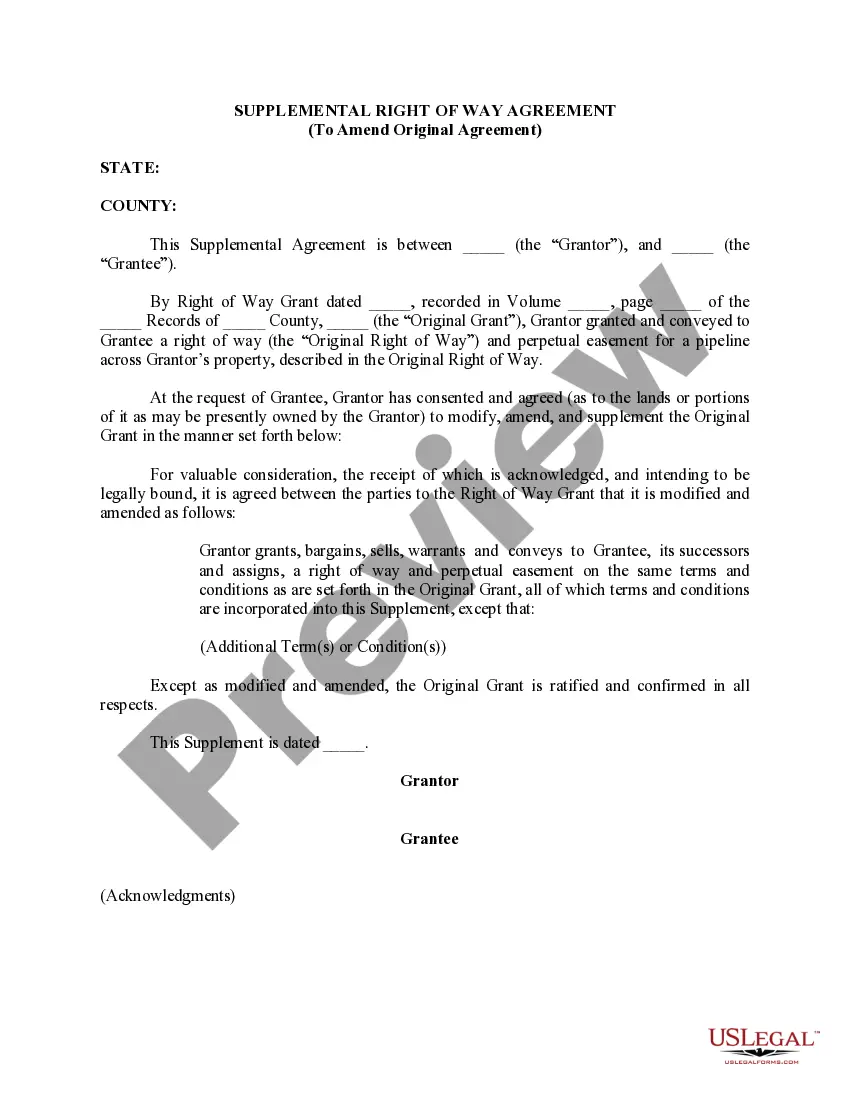
Arbitration Agreement - Existing Dispute
What this document covers
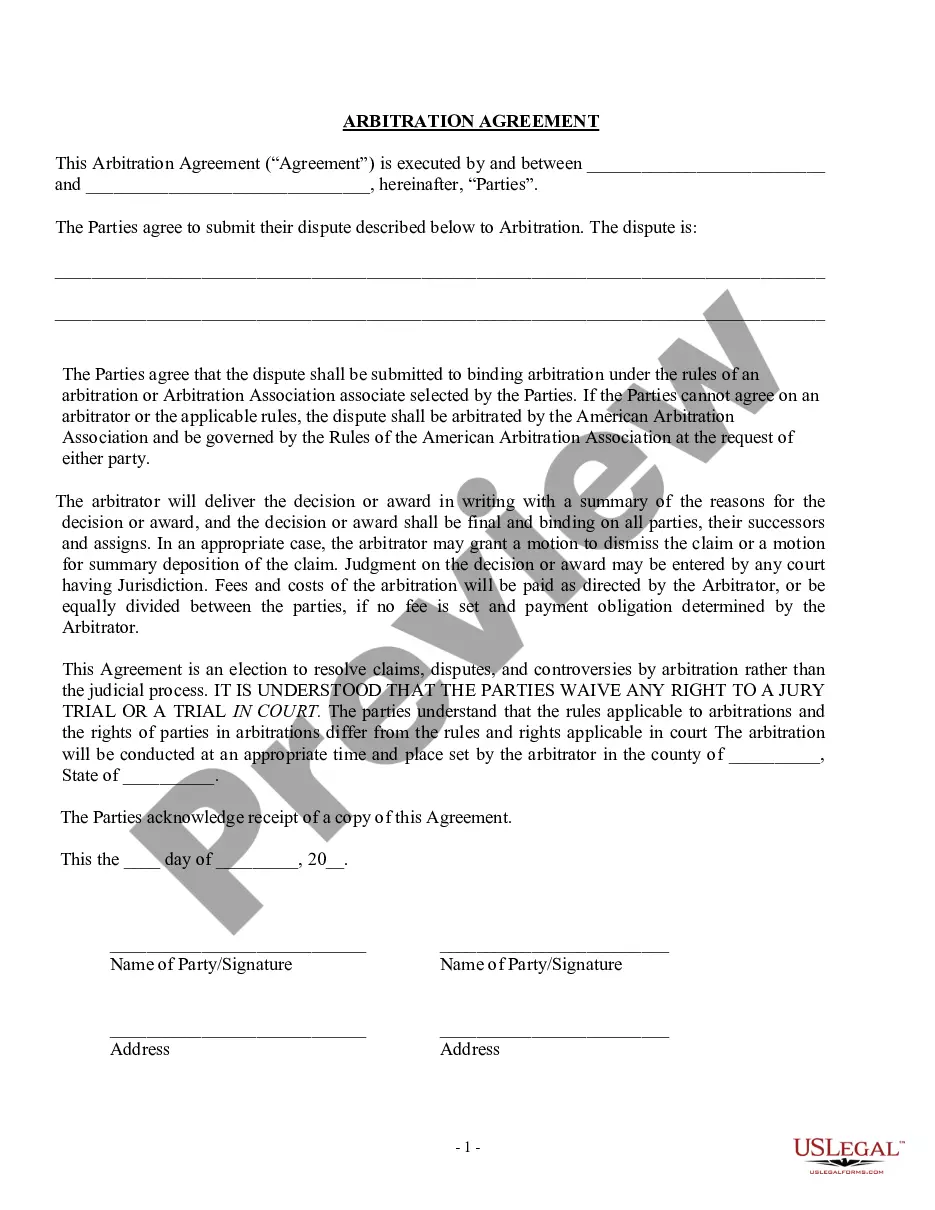
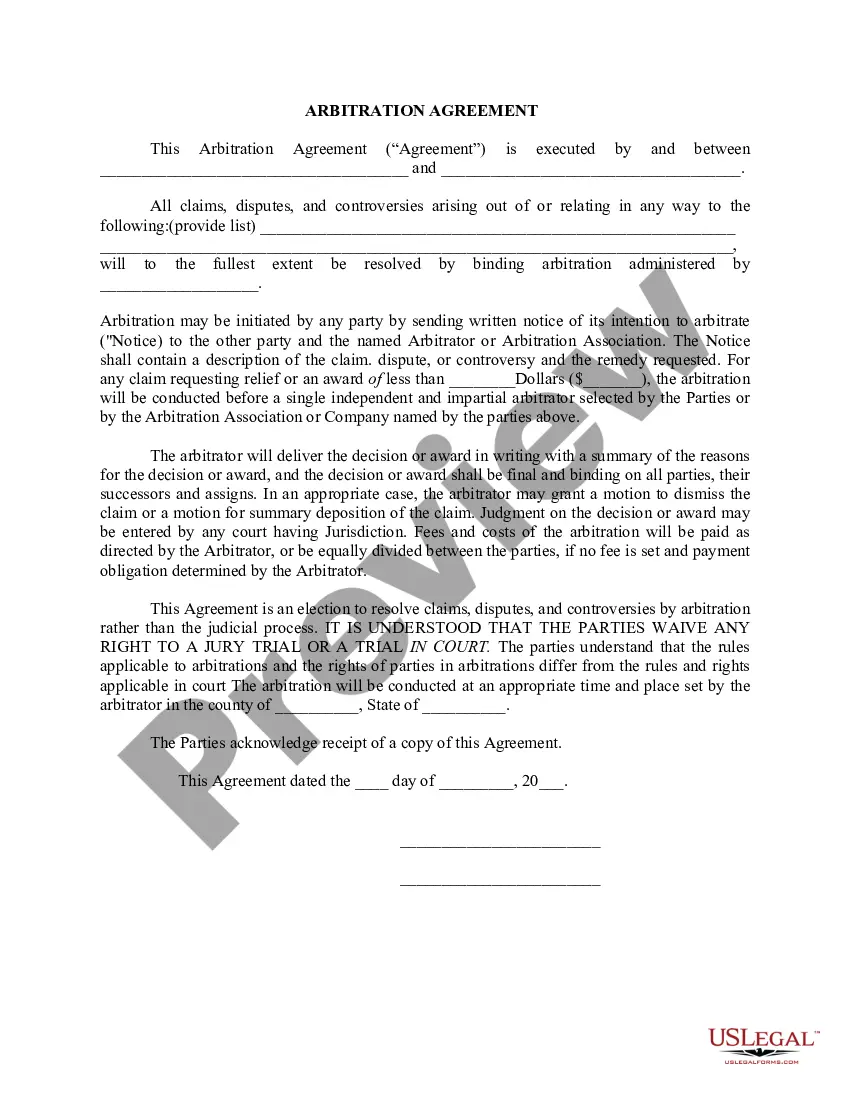
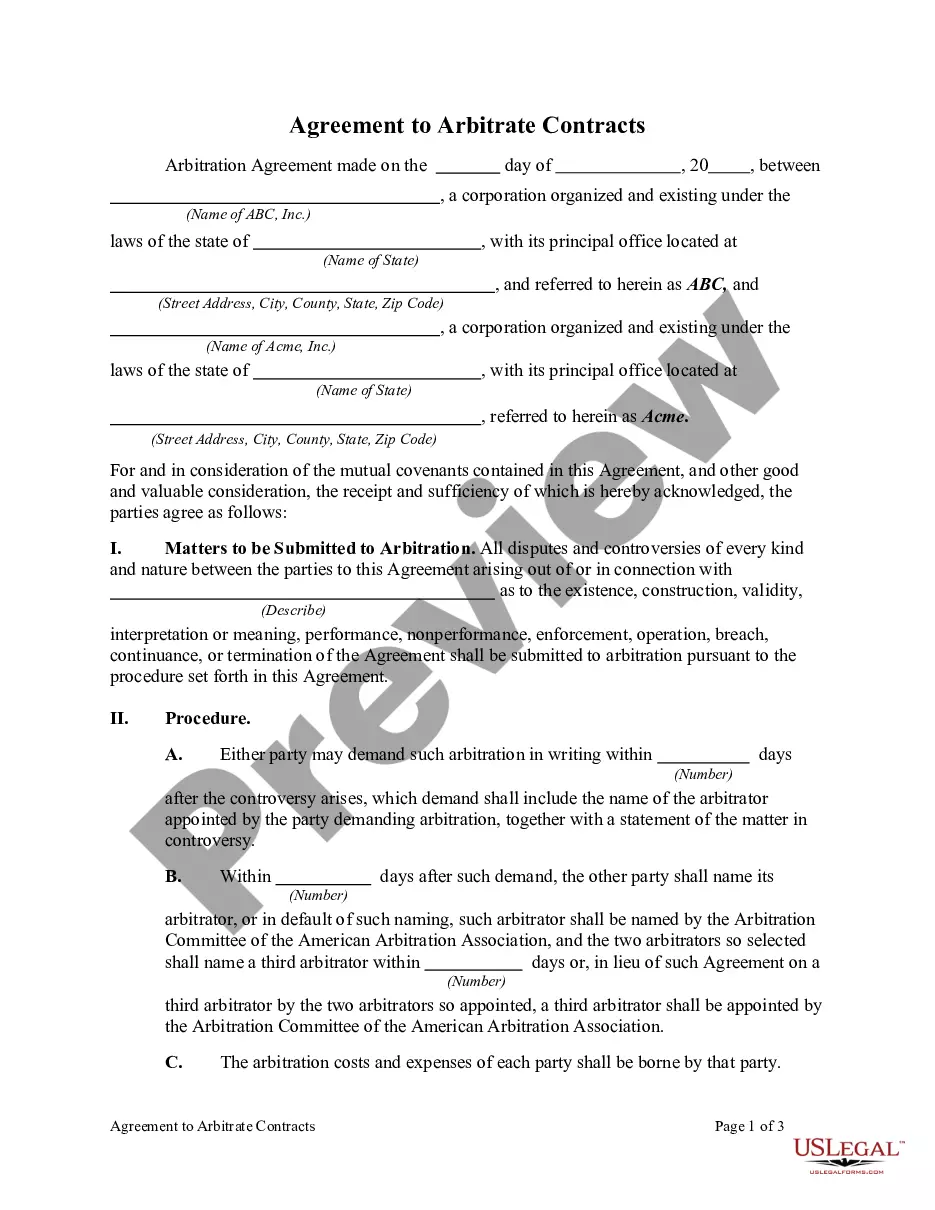
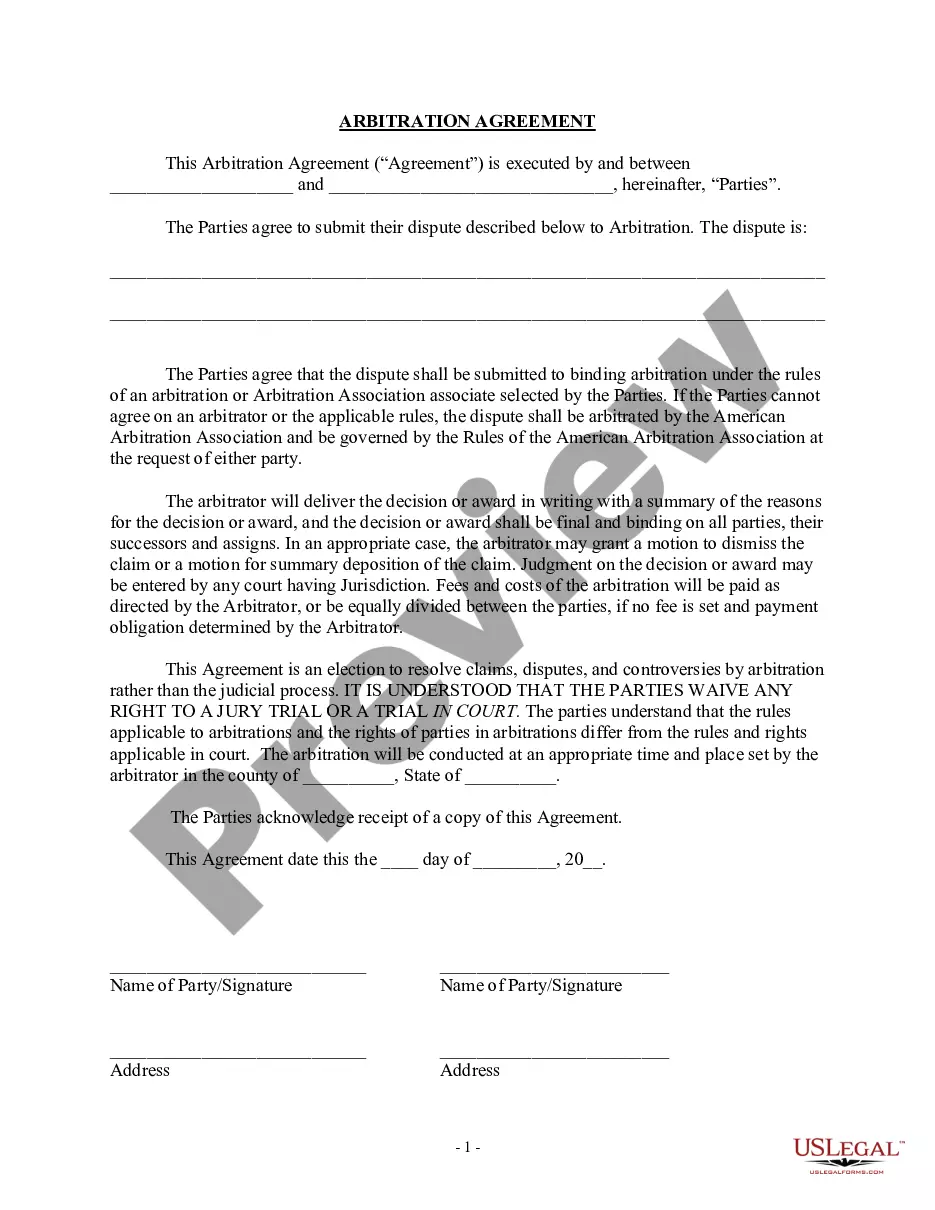
The Arbitration Agreement - Existing Dispute is a legal document that establishes a framework for resolving disputes between parties through arbitration rather than court proceedings. This binding arbitration agreement is specifically designed for situations where a conflict has already arisen and enables parties to agree on how their dispute will be handled by an arbitrator. By choosing this route, parties waive their rights to a jury trial or a court trial, ensuring a more streamlined and private resolution process.
Main sections of this form
- Identification of the parties involved in the dispute
- Description of the dispute being submitted for arbitration
- Agreement on the selection of an arbitrator and applicable arbitration rules
- Details regarding the arbitration venue
- Provisions on the finality of the arbitratorâs decision
- Information on the allocation of arbitration costs and fees

When to use this document
This arbitration agreement is appropriate for parties who are in a pre-existing dispute and wish to resolve it without resorting to litigation. Common situations include disagreements in business contracts, disputes between employers and employees, or conflicts in real estate transactions. If both parties prefer a confidential resolution and want to avoid the lengthy and public nature of court trials, this form is a suitable choice.
Who needs this form
- Individuals or businesses involved in a dispute who wish to resolve the matter through arbitration
- Parties seeking to avoid the costs and time associated with court proceedings
- Anyone interested in establishing clear rules for how their dispute will be arbitrated
Steps to complete this form
- Identify the parties involved by clearly stating their names.
- Describe the specific dispute to be resolved in the arbitration.
- Select an arbitrator or agree on the method for selecting one.
- Indicate the location where the arbitration will take place.
- Provide signatures from all parties, along with their contact information.
Is notarization required?
This form does not typically require notarization to be legally valid. However, some jurisdictions or document types may still require it. US Legal Forms provides secure online notarization powered by Notarize, available 24/7 for added convenience.
Get your form ready online
Our built-in tools help you complete, sign, share, and store your documents in one place.
Make edits, fill in missing information, and update formatting in US Legal Forms—just like you would in MS Word.
Download a copy, print it, send it by email, or mail it via USPS—whatever works best for your next step.
Sign and collect signatures with our SignNow integration. Send to multiple recipients, set reminders, and more. Go Premium to unlock E-Sign.
If this form requires notarization, complete it online through a secure video call—no need to meet a notary in person or wait for an appointment.
We protect your documents and personal data by following strict security and privacy standards.

Make edits, fill in missing information, and update formatting in US Legal Forms—just like you would in MS Word.

Download a copy, print it, send it by email, or mail it via USPS—whatever works best for your next step.

Sign and collect signatures with our SignNow integration. Send to multiple recipients, set reminders, and more. Go Premium to unlock E-Sign.

If this form requires notarization, complete it online through a secure video call—no need to meet a notary in person or wait for an appointment.

We protect your documents and personal data by following strict security and privacy standards.
Common mistakes
- Failure to clearly describe the dispute, which can lead to misunderstandings.
- Not specifying the arbitration rules, which may cause confusion later.
- Leaving out signatures or required contact information, making the agreement invalid.
Why complete this form online
- Easy access to the form allows for quick completion and submission.
- Convenient downloadable format enables users to fill it out at their own pace.
- Reliability, as forms are drafted by licensed attorneys to meet legal standards.
Legal use & context
- This arbitration agreement is legally enforceable as long as it complies with state laws governing arbitration.
- It allows the parties to create a private resolution process that is often faster than court litigation.
- Understanding that the agreement waives rights to trial is crucial for all parties involved.
Summary of main points
- The Arbitration Agreement - Existing Dispute facilitates the resolution of pre-existing disputes through arbitration.
- It is essential to clearly outline the dispute and the arbitration process selected.
- Both parties must agree to the terms and provide their signatures for the agreement to be valid.
Looking for another form?


Form popularity
FAQ
Arbitration is one form of what is commonly known as Alternative Dispute Resolution. It's a process where both sides come together and agree to follow and respect the decision of the arbitrator. This is one route you can try instead of filing a lawsuit and going to court to resolve a dispute.
Arbitration is a procedure in which a dispute is submitted, by agreement of the parties, to one or more arbitrators who make a binding decision on the dispute. In choosing arbitration, the parties opt for a private dispute resolution procedure instead of going to court.
An example of an arbitration would be when two people who are divorcing cannot agree on terms and allow a third party to come in to help them negotiate.
Arbitration is a private process where disputing parties agree that one or several individuals can make a decision about the dispute after receiving evidence and hearing arguments.When arbitration is binding, the decision is final, can be enforced by a court, and can only be appealed on very narrow grounds.
An arbitration hearing is similar to a small claims trial. The participants present evidence and make arguments supporting their positions. After the hearing, the arbitrator decides in favor of one side or the other.An arbitrator is more like a judge, who hears the evidence and makes a ruling.
No, you can't sue your employer in court if you signed an arbitration agreement.Arbitration is one of the alternative dispute resolution techniques that serve as an alternative to filing a lawsuit. It often has many different implications than a full-blown case before a judge or jury.
What can be learned from this decision is that the California Supreme Court continues to support binding arbitration of employment disputes whether based in contract or in tort (discrimination, harassment and other injuries not based on a contract).
Unconscionable Arbitration Agreements Will Not Be EnforcedYou can also escape an arbitration agreement by demonstrating that the terms of the agreement itself are inherently unequal in favor of the employer. Courts require both of the aforementioned methods to show the agreement is unconscionable, thus unenforceable.
The conditions for an arbitration agreement to be valid are: - The dispute must arise out of a legal relationship. - The subject-matter of the dispute must be arbitrable. (The relationship between arbitrability and public policy will be discussed later.)