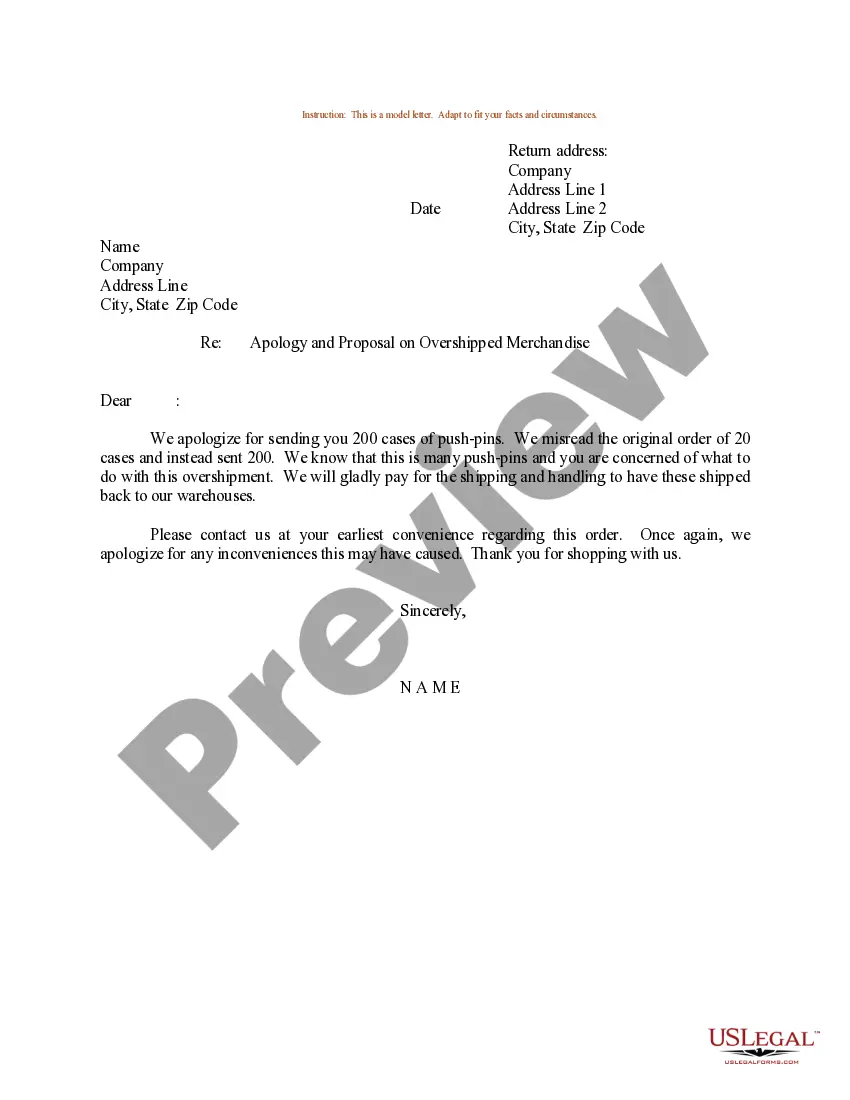
Sample Letter for Apology and Proposal on Overshipped Merchandise
Understanding this form
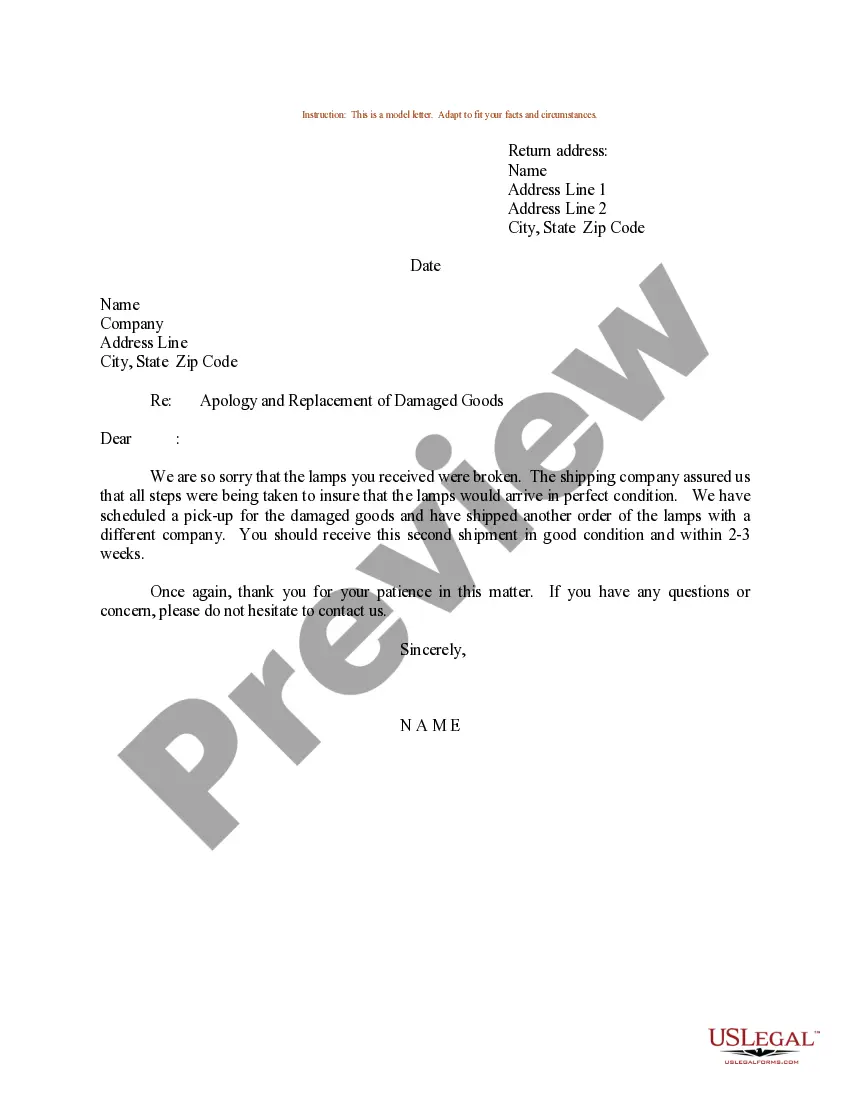
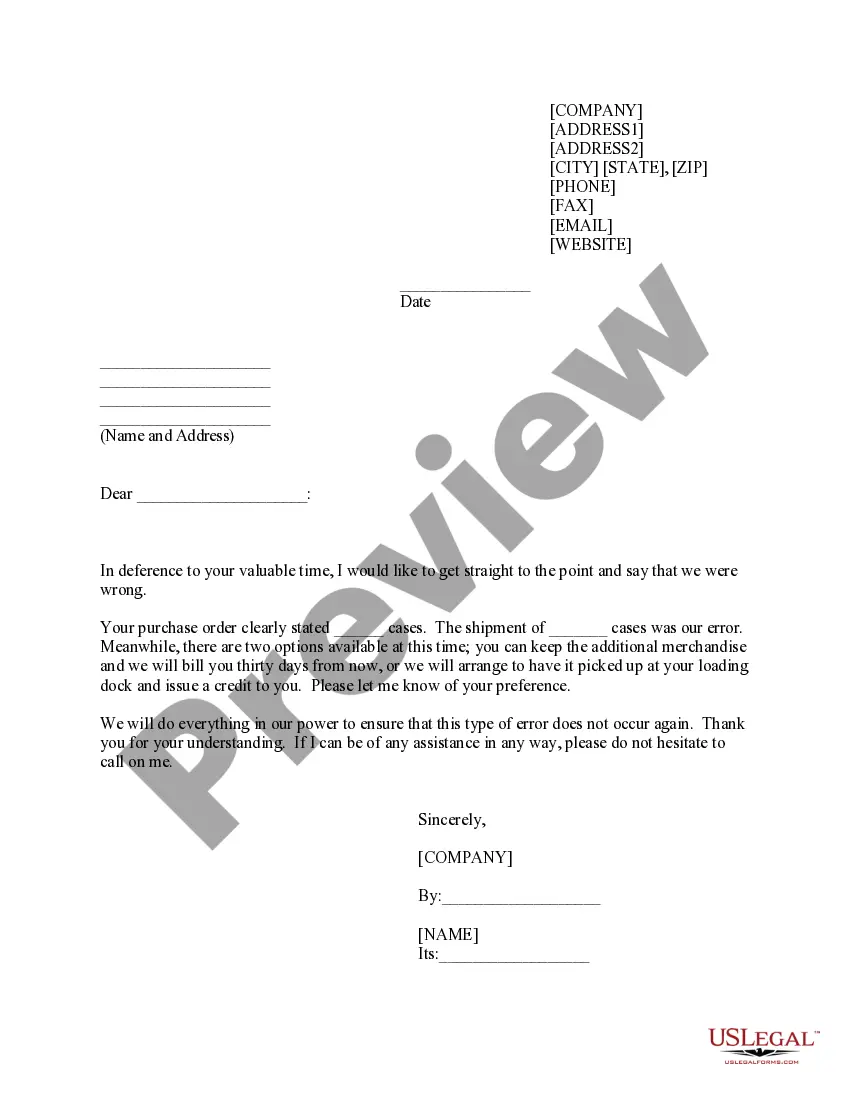
This Sample Letter for Apology and Proposal on Overshipped Merchandise serves as a template for businesses to formally apologize to customers for receiving more merchandise than ordered. It assists in communicating effectively while also proposing a resolution for the oversight. This form differs from general complaint letters as it is specifically tailored for situations involving overages in merchandise shipments.
Key components of this form
- Return address: Includes the sender's company details.
- Date: The date when the letter is written.
- Recipient details: Name and company of the customer.
- Subject line: Clearly states the purpose of the letter.
- Apology message: Acknowledge the inconvenience caused by overshipping.
- Contact invitation: Encourages the recipient to reach out for further discussion.
When this form is needed
This form should be used when a business inadvertently ships more items to a customer than what was originally ordered. It is essential for maintaining good customer relations by addressing the mistake promptly and professionally. Use this letter to offer a resolution or clarify the next steps for the customer, which may include returns or adjustments to the order.
Intended users of this form
- Business owners who need to address shipping errors with customers.
- Customer service representatives responsible for client communications.
- Employees tasked with managing client relations for their organization.
How to prepare this document
- Identify the sender's return address and complete the necessary fields.
- Enter the date on which the letter is written.
- Fill in the recipient's name and company details accurately.
- Clearly state the subject as "Apology and Proposal on Overshipped Merchandise."
- Write a sincere apology addressing the overshipment issue.
- Close the letter by thanking the customer and inviting them to contact the business.
Is notarization required?
Notarization is not commonly needed for this form. However, certain documents or local rules may make it necessary. Our notarization service, powered by Notarize, allows you to finalize it securely online anytime, day or night.
Get your form ready online
Our built-in tools help you complete, sign, share, and store your documents in one place.
Make edits, fill in missing information, and update formatting in US Legal Forms—just like you would in MS Word.
Download a copy, print it, send it by email, or mail it via USPS—whatever works best for your next step.
Sign and collect signatures with our SignNow integration. Send to multiple recipients, set reminders, and more. Go Premium to unlock E-Sign.
If this form requires notarization, complete it online through a secure video call—no need to meet a notary in person or wait for an appointment.
We protect your documents and personal data by following strict security and privacy standards.

Make edits, fill in missing information, and update formatting in US Legal Forms—just like you would in MS Word.

Download a copy, print it, send it by email, or mail it via USPS—whatever works best for your next step.

Sign and collect signatures with our SignNow integration. Send to multiple recipients, set reminders, and more. Go Premium to unlock E-Sign.

If this form requires notarization, complete it online through a secure video call—no need to meet a notary in person or wait for an appointment.

We protect your documents and personal data by following strict security and privacy standards.
Mistakes to watch out for
- Failing to personalize the letter with the recipient's name.
- Not including a clear action plan for resolving the overshipment.
- Using vague language that does not acknowledge the customer's inconvenience.
Why use this form online
- Immediate access to a professionally drafted letter template.
- Editability allows for customization to meet specific needs.
- Convenience of downloading and printing at any time.
Legal use & context
- This letter serves as a formal acknowledgment of overshipping, which is important for legal records and customer relations.
- While this letter is not a legally binding agreement, it can help maintain goodwill and potentially prevent disputes.
What to keep in mind
- This letter is essential for businesses dealing with over shipments to maintain customer satisfaction.
- Personalization and clarity are crucial to effectively communicating with the customer.
- Using a standardized template saves time and ensures consistency in communications.
Looking for another form?



Form popularity
FAQ
A short shipment is when cargo is listed on a shipping list but not included in a shipment, or not received by the recipient. Notably, when the quantity received is less than the quantity listed.
A partial shipment is when you deliver a single order in multiple shipments. Partial shipments are necessary when: One item or another in an order is on backorder. An item at a certain warehouse is delayed in delivery.
Also known as Overage Conversely, shortages, or "short" denotes shipments that contain a lower than reported quantity.
All short. The destination service center is reporting the shipment as all short because it has not arrived there as scheduled. 15. Appointment required at destination. The shipment is being held at the destination service center until an appointment for delivery has been set or met at the request of the recipient.
Coversely, shortages, or "short" denotes shipments that contain a lower than reported quantity. Damaged product may be obvious or concealed, with "concealed" in this instance meaning that part or all of the shipment was not visible for inspection during transport.
Description. Code. All short. The destination service center is reporting the shipment as all short because it has not arrived there as scheduled.
To put it as simply as possible: shipping is the date the product will leave the supplier's warehouse while delivery is the date the package will make it to the customer's doorstep. The terms are often confusing for customers; however, you can avoid this by providing two dates: the shipping date and delivery date.
A situation when only a part of the entire cargo has arrived at the destination, even though the whole shipment was loaded/shipped together, is known as short land. This forces it to be left onboard the shipping vessel.