Vermont Excavation Contractor Package
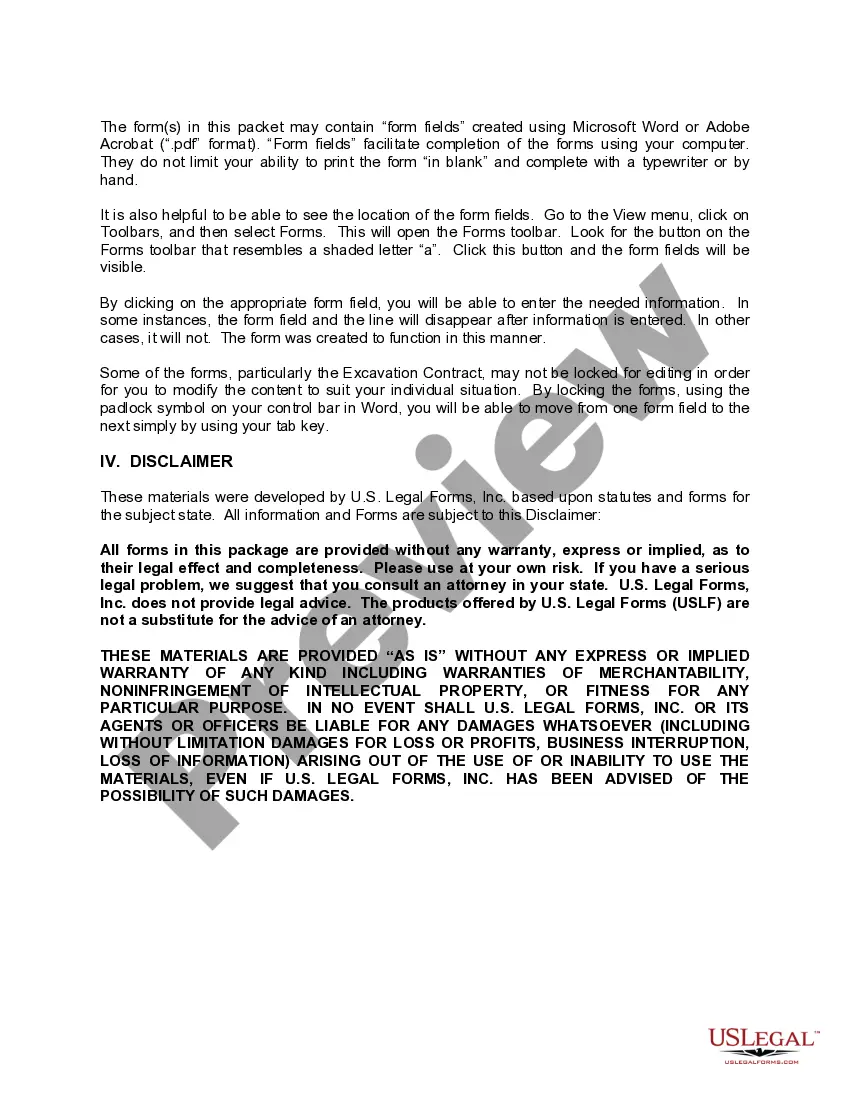
Understanding this form package
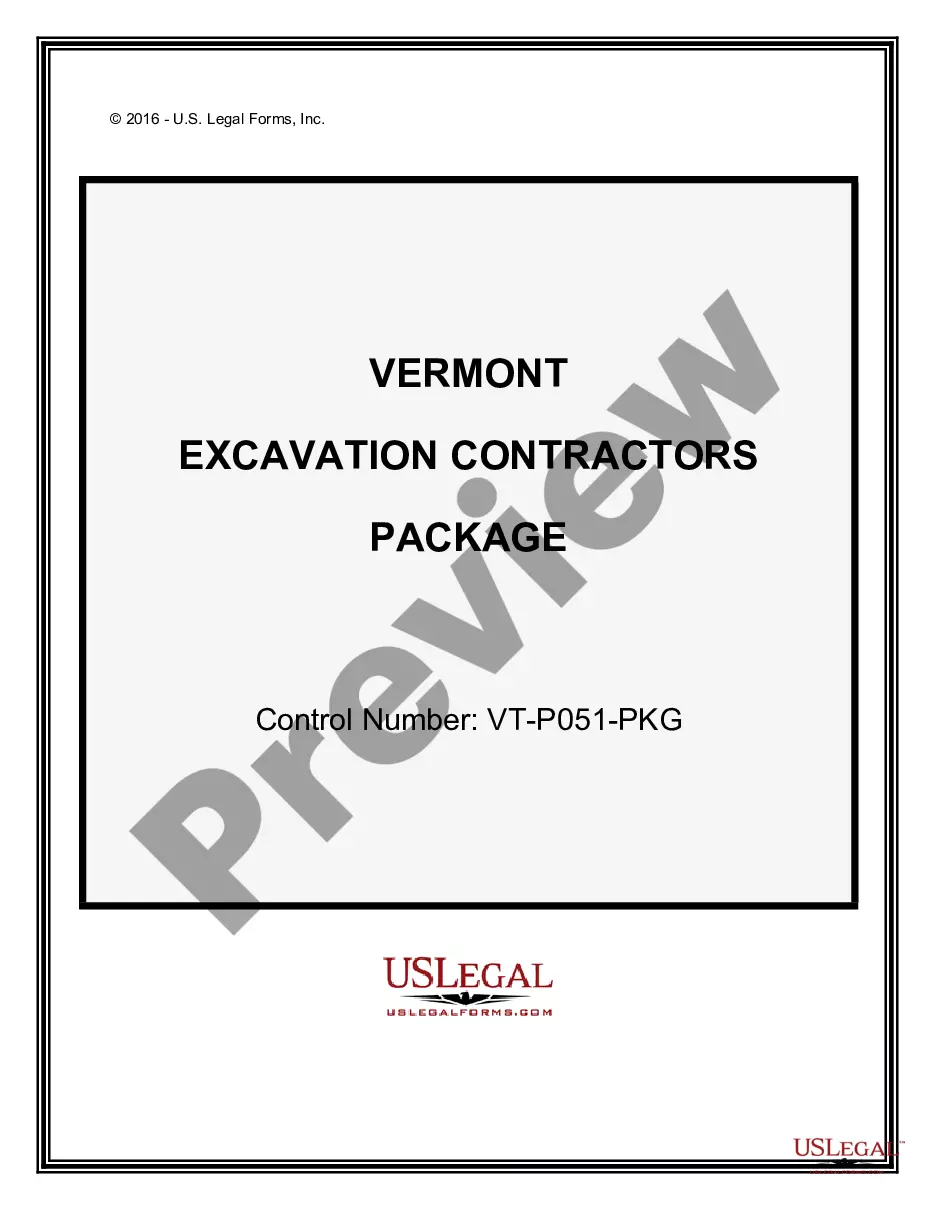
The Vermont Excavation Contractor Package provides essential legal documents specifically designed for excavation contractors. This comprehensive form package helps contractors assert their legal rights and address various legal issues related to residential excavation, backfill, grading, and hauling projects. The standout feature of this package is the excavation contract, which adheres to Vermont state law, ensuring compliance and protection for contractors in their transactions.
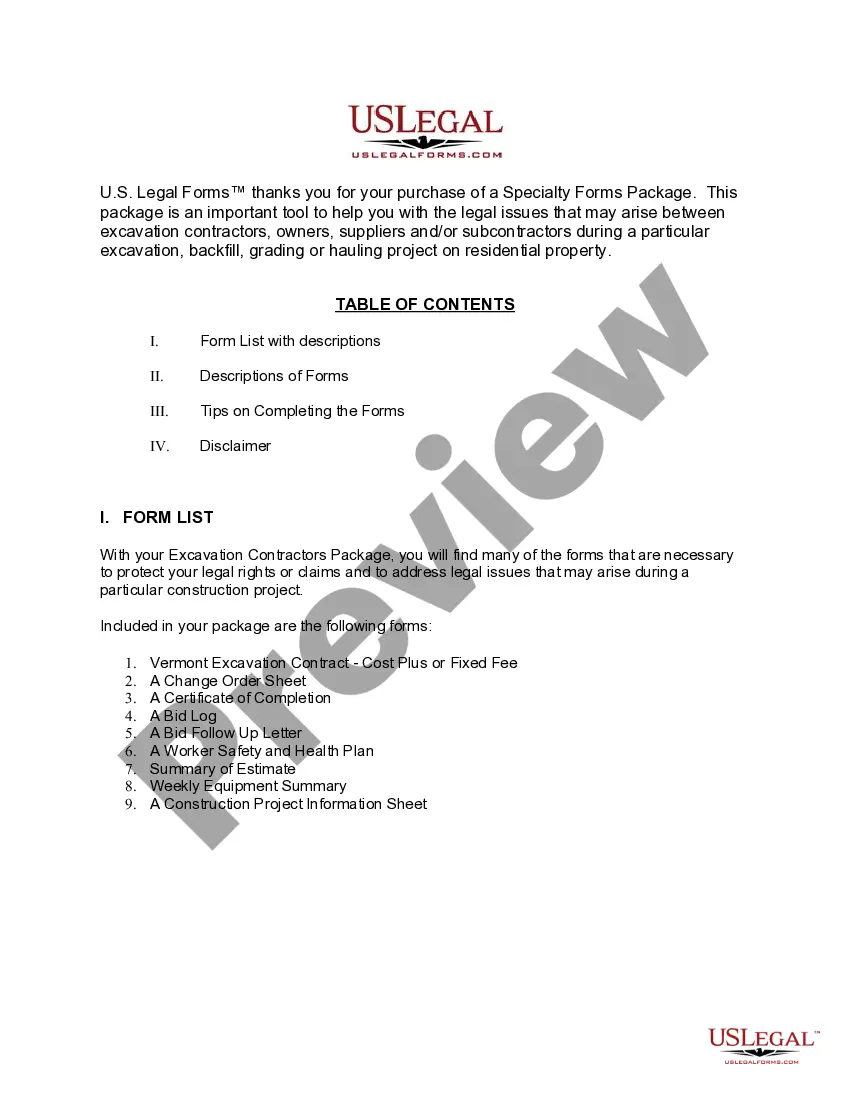
Forms you’ll find in this package
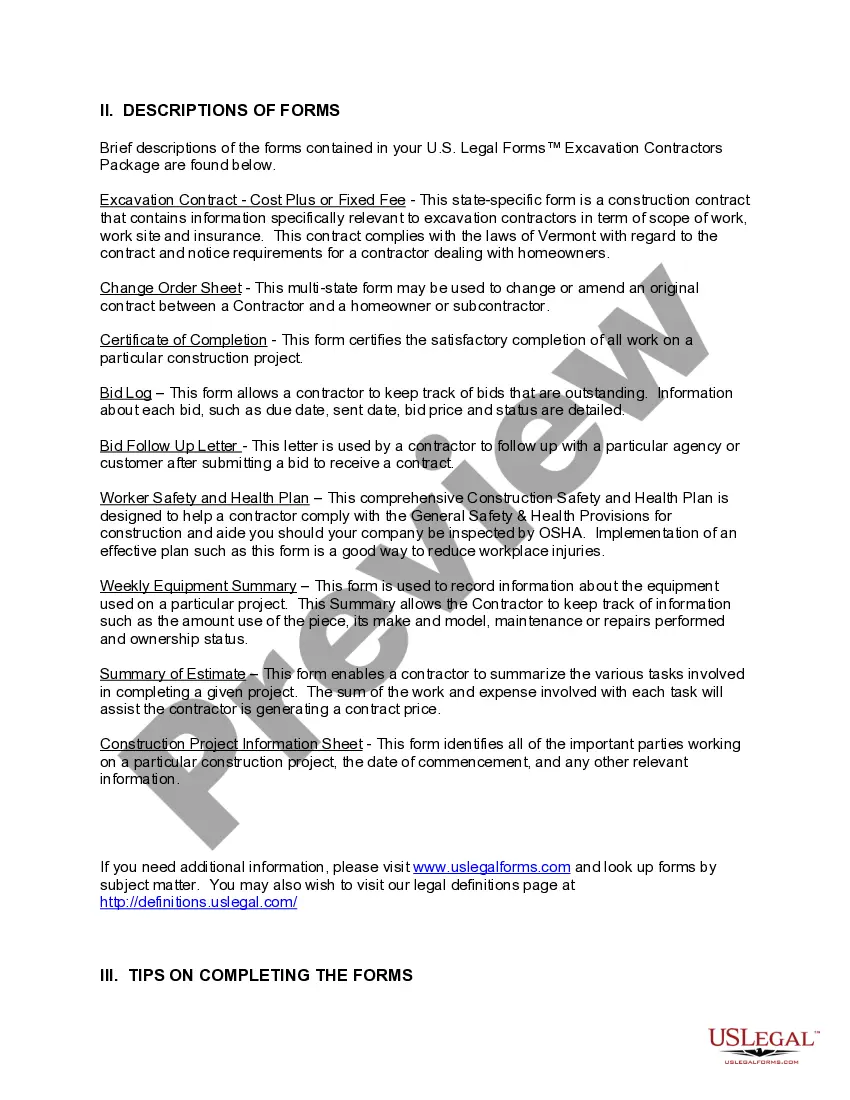
- Excavator Contract for Contractor
- Contractor's Weekly Equipment Summary
- Contractor's Bid Log
- Contractor's Bid Follow Up Letter
- Contractor's Summary of an Estimate
- Construction Safety and Health Plan
- Change Order for Construction or Repairs by Contractor
- Certification of Completion by Contractor
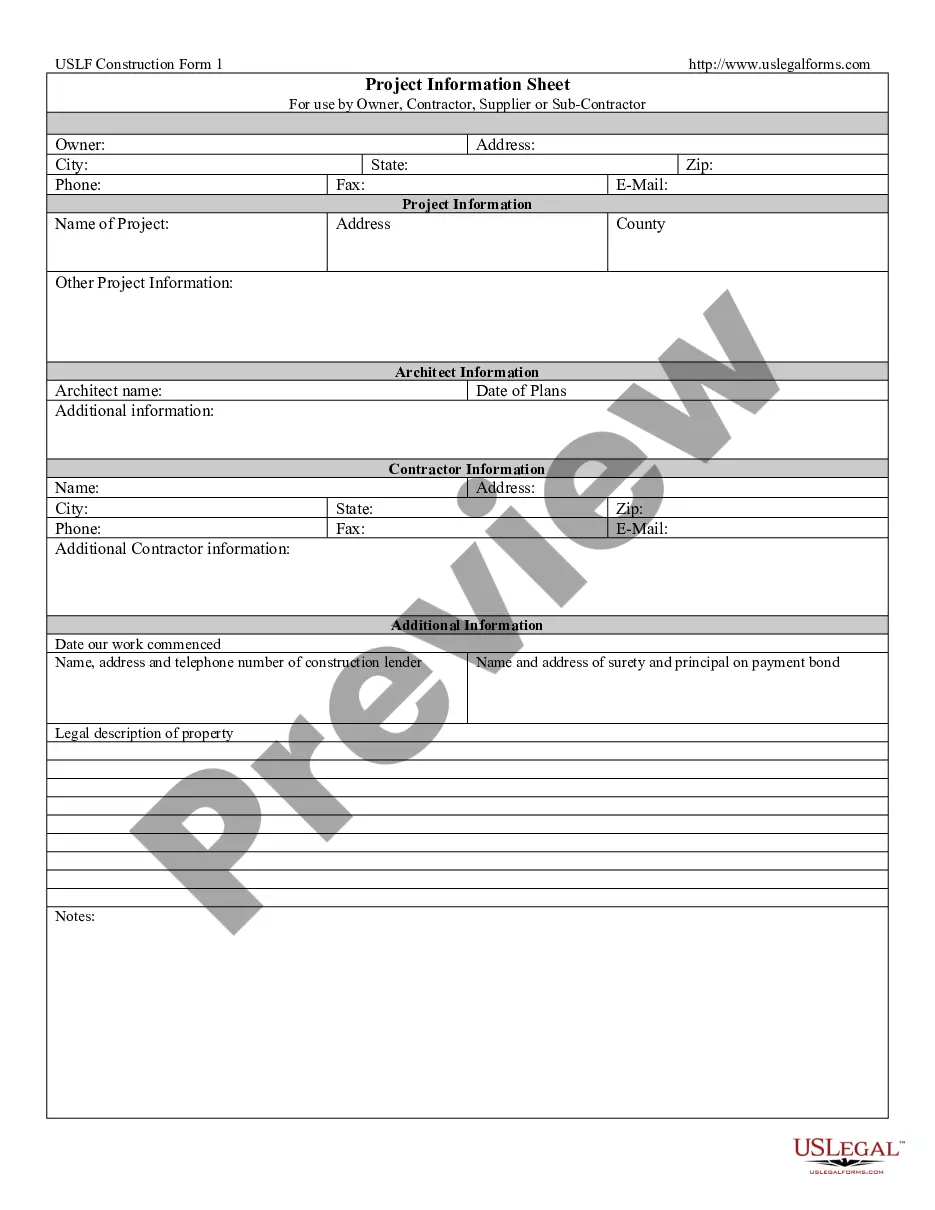
- Construction Project Information Sheet
When this form package is needed
This package is ideal for use in the following scenarios:
- When entering into an excavation contract with a homeowner or subcontractor
- To document changes or amendments to existing contracts
- When completing projects to certify the satisfactory completion of work
- To maintain accurate records of equipment usage and worker safety on job sites
Who needs this form package
- Excavation contractors operating in Vermont
- Subcontractors involved in excavation-related projects
- Homeowners who require contracts for excavation work
- Construction managers overseeing excavation or grading operations
Completing these forms step by step
- Review included forms to understand their purpose and requirements.
- Identify all parties involved in the excavation project.
- Fill out the Excavation Contract with accurate details regarding fees and scope of work.
- Utilize the Change Order Sheet to document any modifications to the contract.
- Complete the Certificate of Completion upon finishing the work.
- Sign and date all forms where indicated and keep copies for your records.
Do documents in this package require notarization?
Forms in this package typically do not require notarization. However, certain states or document types may still need it. US Legal Forms provides online notarization powered by Notarize, available 24/7 for your convenience.
Get your form ready online
Our built-in tools help you complete, sign, share, and store your documents in one place.
Make edits, fill in missing information, and update formatting in US Legal Forms—just like you would in MS Word.
Download a copy, print it, send it by email, or mail it via USPS—whatever works best for your next step.
Sign and collect signatures with our SignNow integration. Send to multiple recipients, set reminders, and more. Go Premium to unlock E-Sign.
If this form requires notarization, complete it online through a secure video call—no need to meet a notary in person or wait for an appointment.
We protect your documents and personal data by following strict security and privacy standards.

Make edits, fill in missing information, and update formatting in US Legal Forms—just like you would in MS Word.

Download a copy, print it, send it by email, or mail it via USPS—whatever works best for your next step.

Sign and collect signatures with our SignNow integration. Send to multiple recipients, set reminders, and more. Go Premium to unlock E-Sign.

If this form requires notarization, complete it online through a secure video call—no need to meet a notary in person or wait for an appointment.

We protect your documents and personal data by following strict security and privacy standards.
Avoid these common issues
- Not updating the Change Order Sheet when changes occur.
- Failing to fill out the Certificate of Completion after project finalization.
- Inaccurately documenting equipment usage on the Weekly Equipment Summary.
- Leaving out signatures on critical documents like contracts and change orders.
Benefits of using this package online
- Convenience of immediate access to forms that can be downloaded and used at your discretion.
- Editability allows for personalizing contracts and documents to fit specific project requirements.
- Cost-effective option, saving more than 50% compared to purchasing forms separately.
- Reliability of documents drafted by licensed attorneys, ensuring legal compliance.
Legal use & context
- The forms are designed to be compliant with Vermont law and protect your legal rights.
- Using these forms can help clarify agreements and avoid disputes with clients or subcontractors.
- Failure to utilize proper documentation may result in legal challenges or enforcement issues.
Quick recap
- The Vermont Excavation Contractor Package is essential for contractors looking to formalize their projects legally.
- Understanding when and how to use each form is critical to avoid common pitfalls.
- This package is specifically tailored to adhere to Vermont state laws, ensuring compliance.
Looking for another form?
Form popularity
FAQ
A certified contractor passed the state licensing examination. Certified contractors can work anywhere within the state in which they are licensed. A registered contractor is registered by a local county or municipality and receives a certificate of competency from the Electrical Contractors' Licensing Board.
According to the home construction website ProMatcher, the average cost of building a new home in Vermont is $148.23 per square foot for basic construction.
Since Vermont does not require a general contractors license at the state level, you need to understand your local county and city requirements. In many cases, experience and examination will be needed to obtain your license for plumbing, electrical, and specialty trades mentioned above.
A general contractor's focus is executing the construction of project plans, which are often created by outside specialists (i.e. architects). A general contractor handles many types of projects, but they don't typically specialize in building custom homes.
To become a general contractor, you need at least a high school diploma, but there is an increase in a need for a bachelor's degree or at least an associate degree, plus years of construction industry experience. Regardless of education though, experience in the industry is the most important requirement.
What Tradesmen Are Needed To Build A House? Bricklayer: The bricklayer is the one who carefully constructs the house brick by brick. Electrician: You cannot have a home without power. Groundworkers: these are the ones who prepare the ground for the installation of the foundations before construction begins.
Electrician. So many things in our homes run on electricity, so making sure that the wiring is done properly in your house can be a matter of life and death. Carpenter. This tradesperson is one of the most important in the process of building your house. Brick Layer. Painter. Roof Tiler. Dry Waller. Plasterer.
Be your own general contractor. Plan and plan and plan before you start building anything. Go shopping2026. Buy your supplies separate from your labor 2026 Give yourself plenty of time. Learn how to negotiate prices. Hire the right people.
Architects. Civil Engineers. Electrical Engineers. Master Plumber. Contractors. Painters and Drywallers. Mason and Roofers.