5.07 PRESENCE/ACTIVITY/ASSOCIATION
Understanding this form
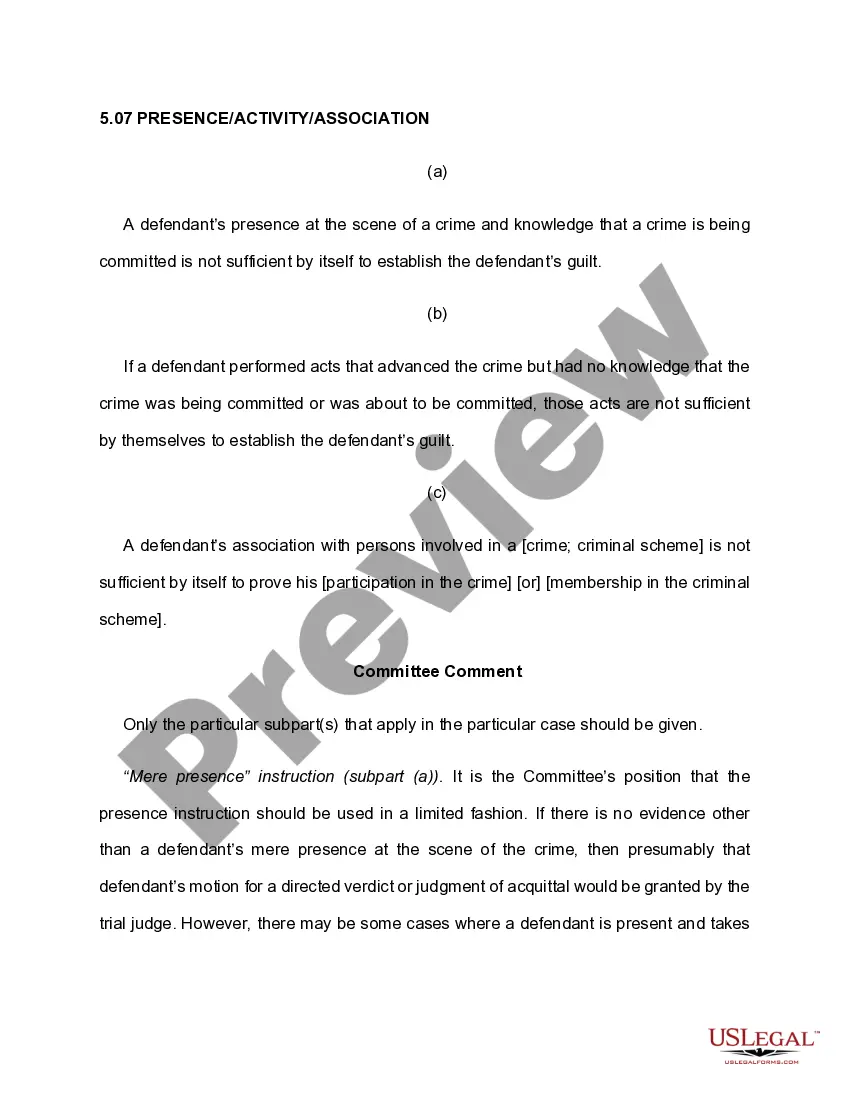
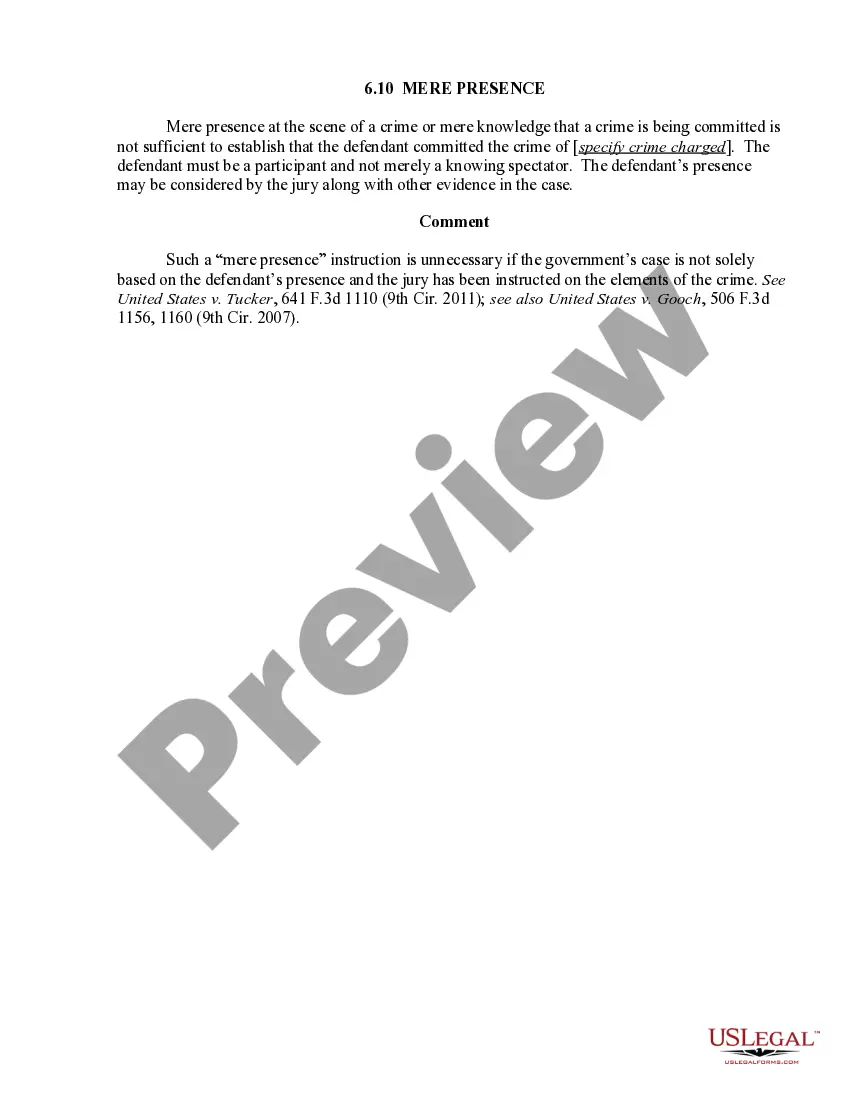
The 5.07 Presence/Activity/Association form is a legal instruction used in court to clarify that a defendant's mere presence at a crime scene does not automatically equate to guilt. This instruction is important in defining the limits of liability when a defendant is connected to a crime by their actions or associations. It is particularly relevant in cases involving conspiracy or aiding and abetting where mere presence is insufficient to establish participation or membership in criminal activities.
Key parts of this document
- Presence at crime scene: Clarifies that being present does not imply guilt.
- Acts that advance a crime: States that actions taken without knowledge of a crime do not establish guilt.
- Association with criminals: Indicates that simply knowing or being associated with criminals does not prove involvement in a crime.
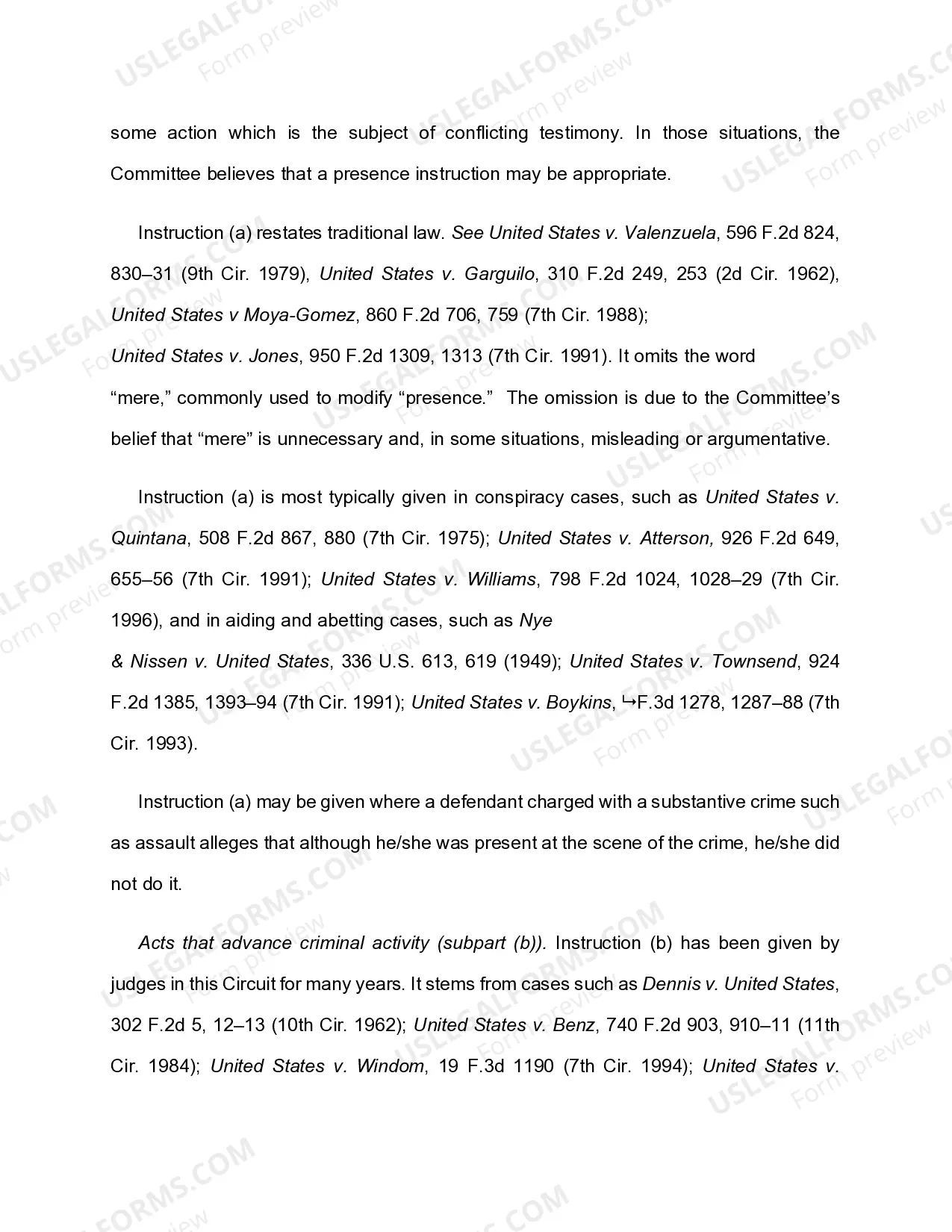
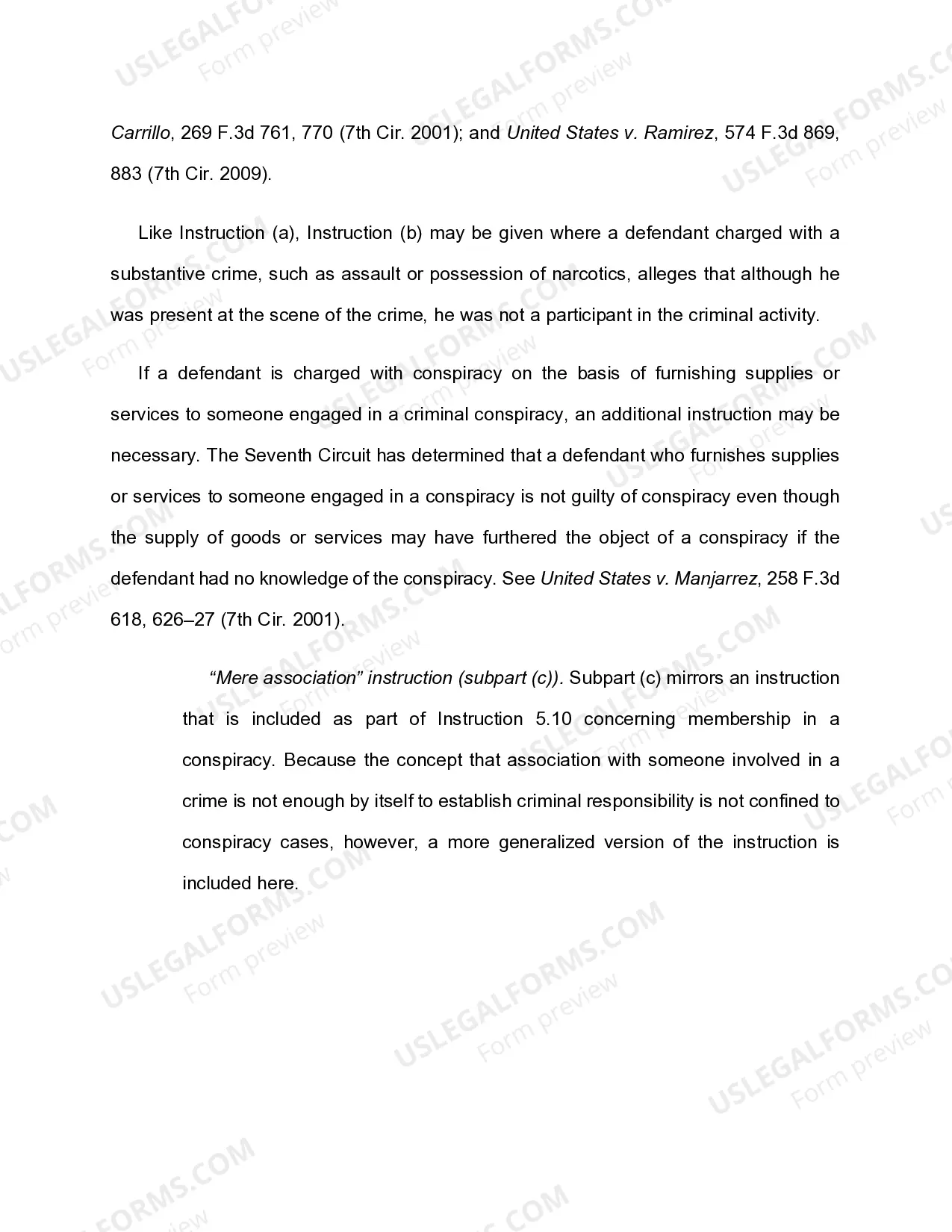
- Judicial guidance: Offers context for how these instructions have been applied in previous court cases.
When this form is needed
This form is used in criminal trials to instruct juries on the limitations of establishing guilt based on a defendant's presence, actions, or associations. It is particularly applicable in cases where the prosecution must demonstrate active participation in a crime rather than relying solely on circumstantial evidence of presence or associations with known criminals.
Intended users of this form
- Defense attorneys representing clients accused of crimes.
- Prosecutors who wish to clarify jury instructions related to presence and association.
- Judges presiding over criminal cases where the defendant's presence is a critical factor.
How to complete this form
- Determine the aspects of the case related to the defendant's presence at the crime scene.
- Identify any actions taken by the defendant that may or may not suggest involvement in a crime.
- Consider the defendant's associations and clarify that these alone do not imply guilt.
- Consult relevant legal precedents to appropriately instruct the jury based on the specific case.
Does this form need to be notarized?
Notarization is not commonly needed for this form. However, certain documents or local rules may make it necessary. Our notarization service, powered by Notarize, allows you to finalize it securely online anytime, day or night.
Get your form ready online
Our built-in tools help you complete, sign, share, and store your documents in one place.
Make edits, fill in missing information, and update formatting in US Legal Forms—just like you would in MS Word.
Download a copy, print it, send it by email, or mail it via USPS—whatever works best for your next step.
Sign and collect signatures with our SignNow integration. Send to multiple recipients, set reminders, and more. Go Premium to unlock E-Sign.
If this form requires notarization, complete it online through a secure video call—no need to meet a notary in person or wait for an appointment.
We protect your documents and personal data by following strict security and privacy standards.

Make edits, fill in missing information, and update formatting in US Legal Forms—just like you would in MS Word.

Download a copy, print it, send it by email, or mail it via USPS—whatever works best for your next step.

Sign and collect signatures with our SignNow integration. Send to multiple recipients, set reminders, and more. Go Premium to unlock E-Sign.

If this form requires notarization, complete it online through a secure video call—no need to meet a notary in person or wait for an appointment.

We protect your documents and personal data by following strict security and privacy standards.
Common mistakes
- Assuming presence alone proves guilt without considering the context.
- Failing to distinguish between actual involvement and mere association with criminals.
- Overlooking the necessity of demonstrating active participation in a crime.
Advantages of online completion
- Convenient access to legal instructions at any time.
- Easy editing and customization of content to fit specific case needs.
- Reliable source of updated legal forms drafted by licensed attorneys.
Legal use & context
- This form is supported by legal precedents to provide a clear legal framework.
- It helps in safeguarding defendants against wrongful guilt based solely on presence.
- Applicable in scenarios of conspiracy and aiding and abetting but requires careful application to specific facts.
Looking for another form?
Form popularity
FAQ
Proof beyond a reasonable doubt is proof that leaves you firmly convinced the defendant is guilty. It is not required that the government prove guilt beyond all possible doubt. A reasonable doubt is a doubt based upon reason and common sense and is not based purely on speculation.
Reasonable doubt is defined in the California Jury Instructions (CALCRIM) and the Penal Code. The trial judge will inform the jury that: The fact that a criminal charge has been filed against the defendant is not evidence that the charge is true.
An example of this would be a trial for manslaughter in which the prosecution was only able to convince the jury panel that you had a 75% chance of committing the crime. Because the jury is 25% uncertain, the prosecution was not successful in proving beyond a reasonable doubt that you are guilty.
Presumption of Innocence; Proof Beyond a Reasonable Doubt. It is a cardinal principle of our system of justice that every person accused of a crime is presumed to be innocent unless and until his or her guilt is established beyond a reasonable doubt.
Before you can return a verdict of guilty, the evidence must satisfy you beyond a reasonable doubt that the defendant is guilty. If you can reconcile the evidence upon any reasonable hypothesis consistent with the defendant's innocence,2 you should do so and return a verdict of not guilty.
There are thirteen courts of appeals: eleven numbered circuits (First through Eleventh), the United States Court of Appeals for the District of Columbia Circuit and the United States Court of Appeals for the Federal Circuit. Not all circuits have published jury instructions: the Second and Fourth Circuits do not.