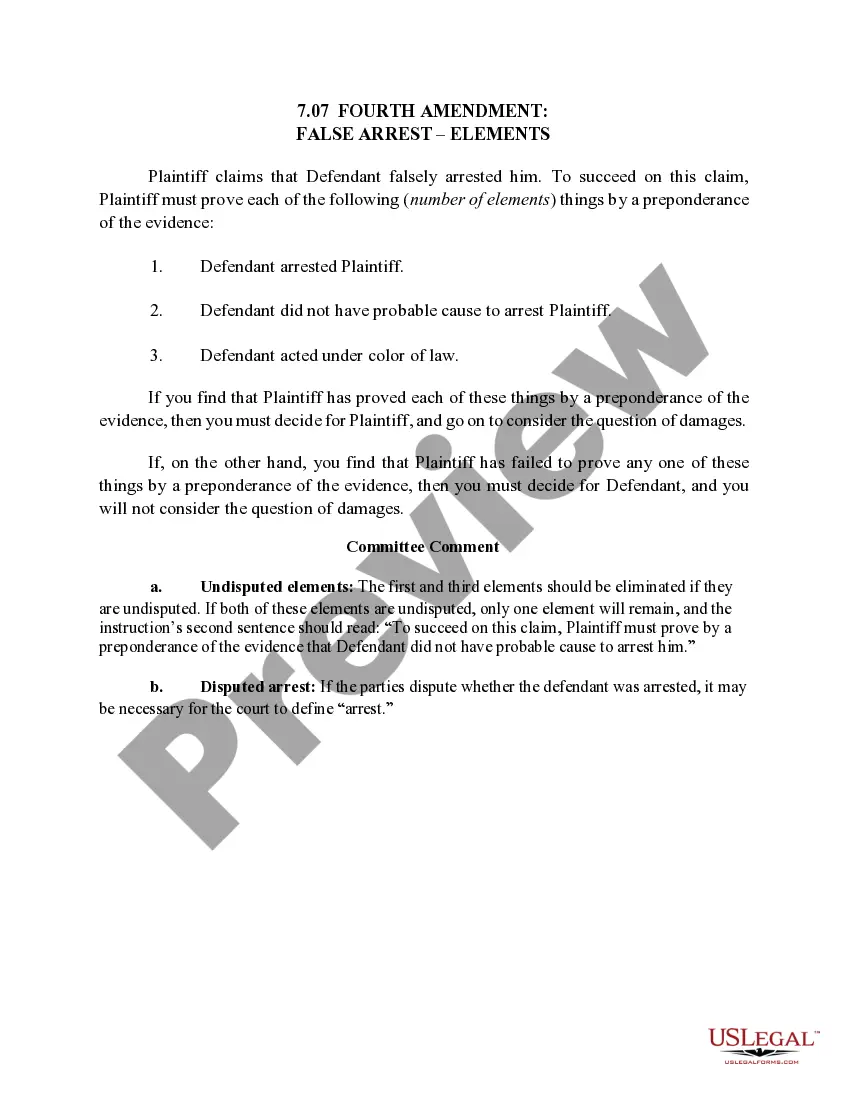
7.07 Fourth Amendment: False Arrest - Elements .
About this form
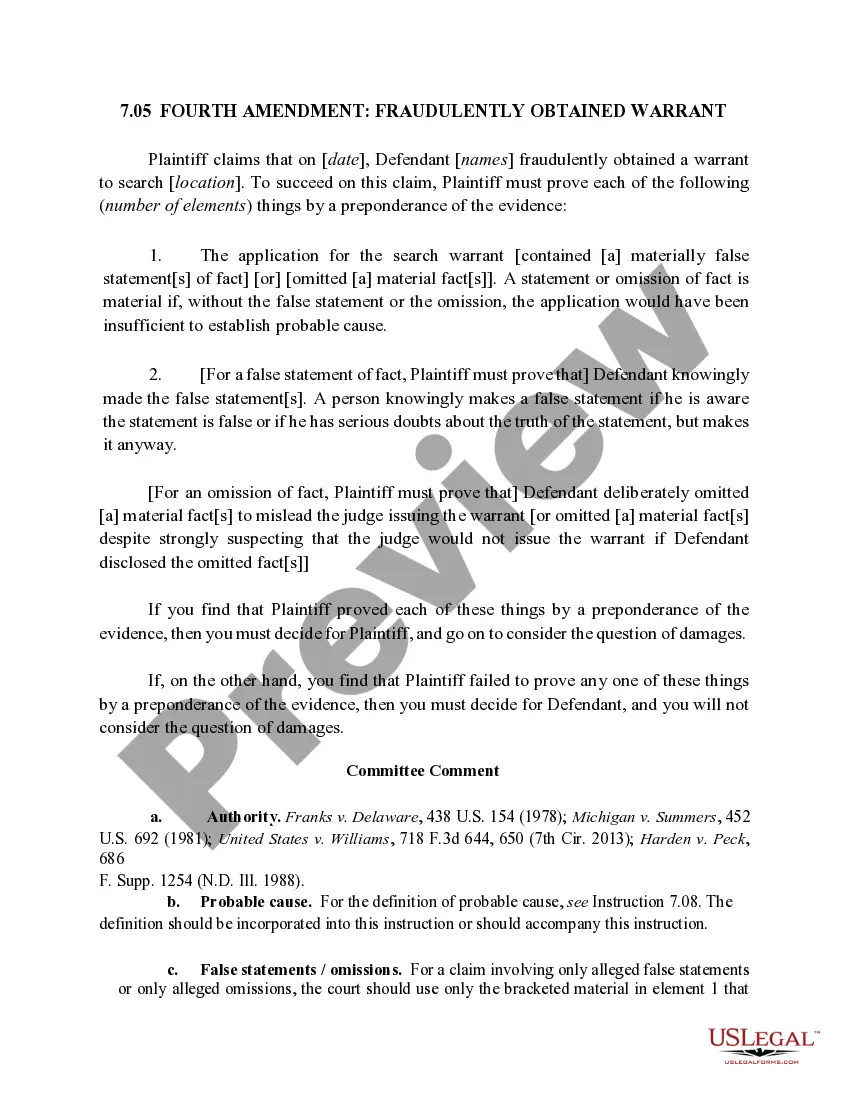
The Fourth Amendment: False Arrest - Elements form provides a legal framework for plaintiffs claiming false arrest. This form outlines the necessary elements that must be proven in such cases, distinguishing it from other legal forms related to wrongful arrest. It focuses on what constitutes false arrest under the law, specifically required to show by a preponderance of the evidence.
Key parts of this document
- Defining the arrest: Establishes whether the plaintiff was arrested.
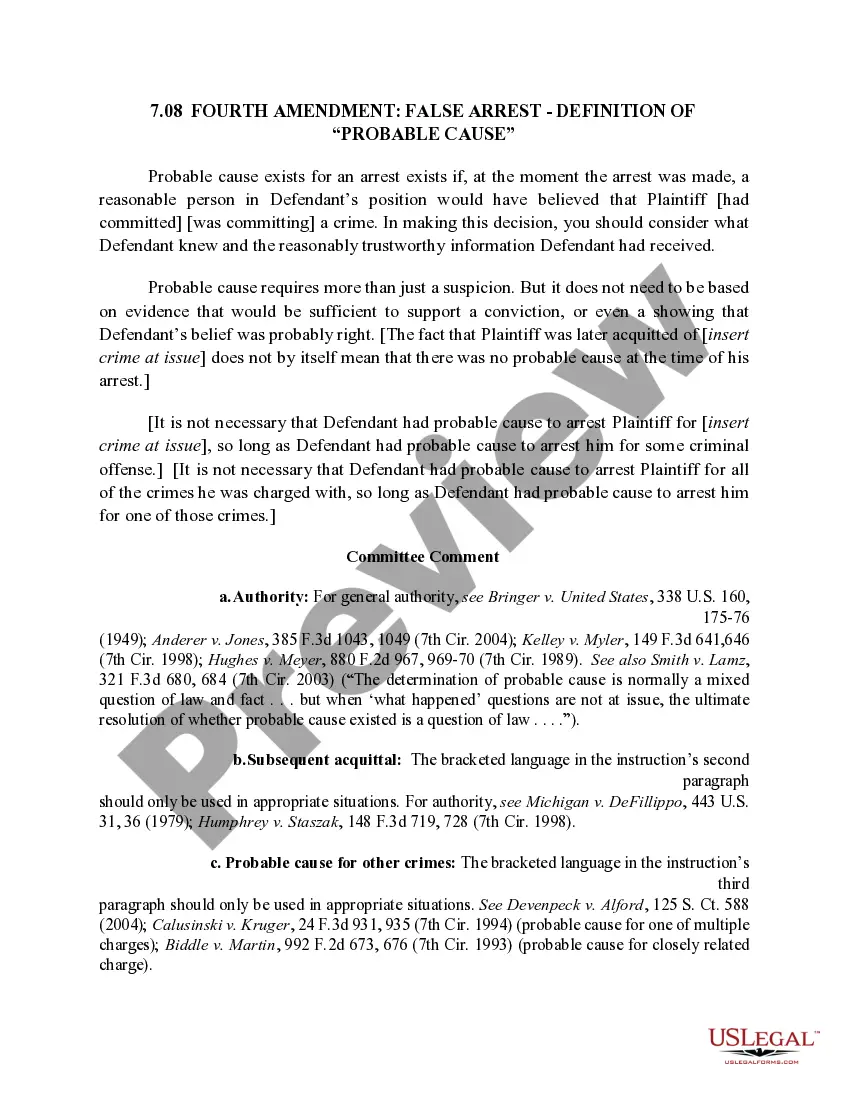
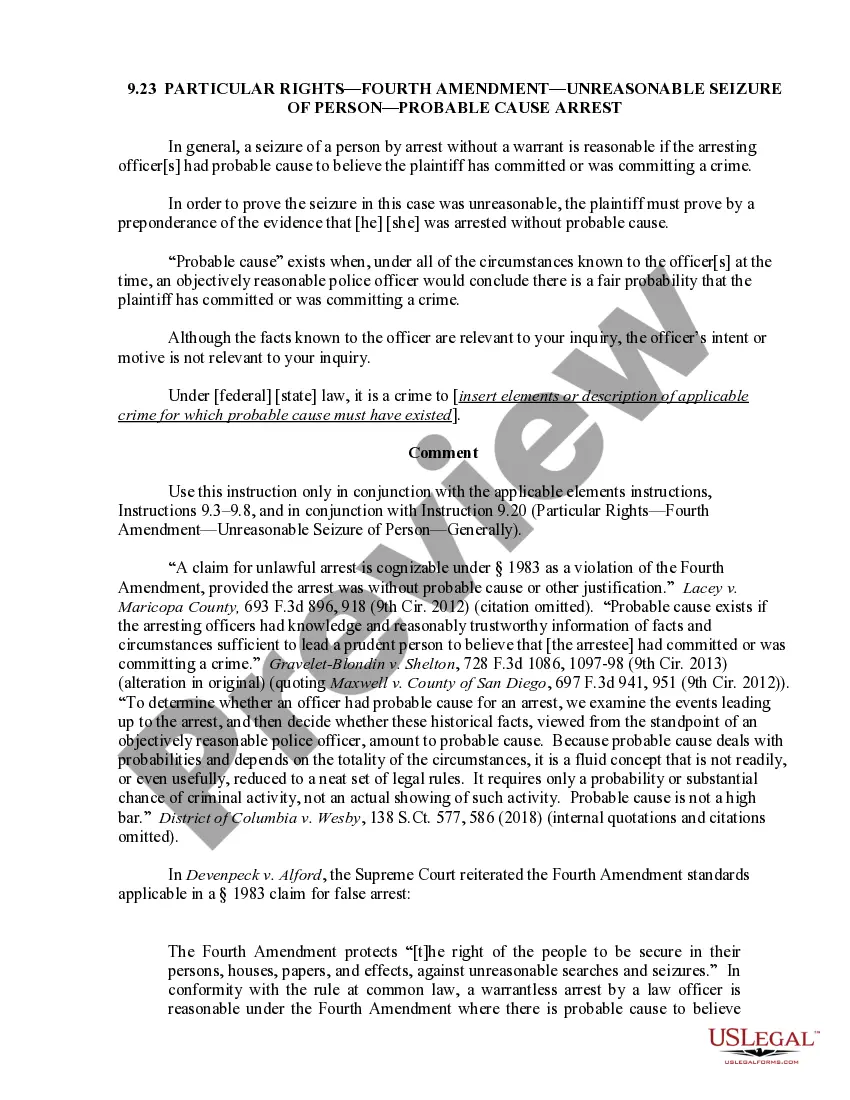
- Probable cause: Requires proof that the defendant lacked probable cause for the arrest.
- Under color of law: Specifies that the defendant must have acted under legal authority.
- Decision criteria: Outlines how to proceed based on the evidence regarding the three elements.
- Commentary: Includes notes on undisputed elements and the definition of arrest if contested.
When this form is needed
This form should be used when an individual believes they have been falsely arrested. It is relevant in civil cases where the plaintiff seeks to hold the defendant accountable for unlawful detention. Anyone who feels that they were detained without probable cause may utilize this form to guide their legal proceedings.
Who can use this document
- Individuals claiming to be victims of false arrest.
- Legal representatives or attorneys assisting clients with false arrest claims.
- Persons seeking to understand their rights under the Fourth Amendment related to arrest.
Steps to complete this form
- Identify the parties involved: Clearly state the plaintiff and defendant.
- Outline the arrest claim: Describe the circumstances of the alleged false arrest.
- Specify the lack of probable cause: Provide evidence and details supporting this assertion.
- Indicate that the defendant acted under color of law: Confirm the defendant's authority during the arrest.
- Review the elements and evidence: Ensure all necessary components are sufficiently supported.
Is notarization required?
In most cases, this form does not require notarization. However, some jurisdictions or signing circumstances might. US Legal Forms offers online notarization powered by Notarize, accessible 24/7 for a quick, remote process.
Get your form ready online
Our built-in tools help you complete, sign, share, and store your documents in one place.
Make edits, fill in missing information, and update formatting in US Legal Forms—just like you would in MS Word.
Download a copy, print it, send it by email, or mail it via USPS—whatever works best for your next step.
Sign and collect signatures with our SignNow integration. Send to multiple recipients, set reminders, and more. Go Premium to unlock E-Sign.
If this form requires notarization, complete it online through a secure video call—no need to meet a notary in person or wait for an appointment.
We protect your documents and personal data by following strict security and privacy standards.

Make edits, fill in missing information, and update formatting in US Legal Forms—just like you would in MS Word.

Download a copy, print it, send it by email, or mail it via USPS—whatever works best for your next step.

Sign and collect signatures with our SignNow integration. Send to multiple recipients, set reminders, and more. Go Premium to unlock E-Sign.

If this form requires notarization, complete it online through a secure video call—no need to meet a notary in person or wait for an appointment.

We protect your documents and personal data by following strict security and privacy standards.
Typical mistakes to avoid
- Failing to provide clear evidence of lack of probable cause.
- Not adequately defining the circumstances of the arrest.
- Overlooking the importance of proving that the defendant acted under legal authority.
Why use this form online
- Convenience of downloading and completing the form from any location.
- Editability allows users to fill out the form at their own pace.
- Access to legally drafted templates ensures reliability and accuracy in content.
Legal use & context
- This form is designed for civil cases regarding false arrest claims under the Fourth Amendment.
- It provides the necessary legal standards that need to be met for a successful claim.
- Understanding these elements is critical for both plaintiffs and legal representatives in court proceedings.
What to keep in mind
- The form is essential for those claiming false arrest under the Fourth Amendment.
- Understanding the elements required for a claim is crucial for success.
- The form can be used across multiple jurisdictions, with attention to local laws.
Looking for another form?



Form popularity
FAQ
A false arrest is the restraint or detention by one person of another without lawful justification (probable cause or a valid arrest warrant) under an asserted legal authority to enforce the process of the law. False arrest is also referred to as false imprisonment and is generally considered a misdemeanor offense.
Examples of Unlawful Arrest Being forced or coerced by an officer to admit to a crime you didn't commit. Having drugs or other contraband planted on you. You annoyed an officer but didn't break any law. There's no reason to search your car, but the officer does so after placing handcuffs on you.
California Penal Code 236 PC defines false imprisonment as the unlawful violation of the personal liberty of someone else. To violate someone's person's liberty means a sustained restriction of their freedom using violence, duress, fraud, deceit.
These are: an accused had the legal authority to restrain a person (e.g., the defendant was acting in his capacity as a police officer), so therefore the accused committed no criminal activity, the alleged ?victim? consented to the restraint or the detention, and. the defendant acted out of self-defense.
What Constitutes a "False Arrest?" Someone who intentionally and wrongfully limits or restricts another person's personal freedoms, against the victim's consent, commits the crime of false arrest or false imprisonment. For example, keeping someone locked in your home against that person's will is false arrest.
The essential elements of false imprisonment are: Willful detention; Without consent; and. Without authority of law.
Overview. A person commits false imprisonment when they engage in the act of restraint on another person which confines that person in a restricted area. False imprisonment is an act punishable under criminal law as well as under tort law. Under tort law, it is classified as an intentional tort.
False Imprisonment Situations Physically restraining a person from leaving an area. Locking the doors of a room to prevent escape. Store owner detaining a suspected theft for an unreasonable amount of time. A robber enters a store, waves his gun and tells people not to leave.