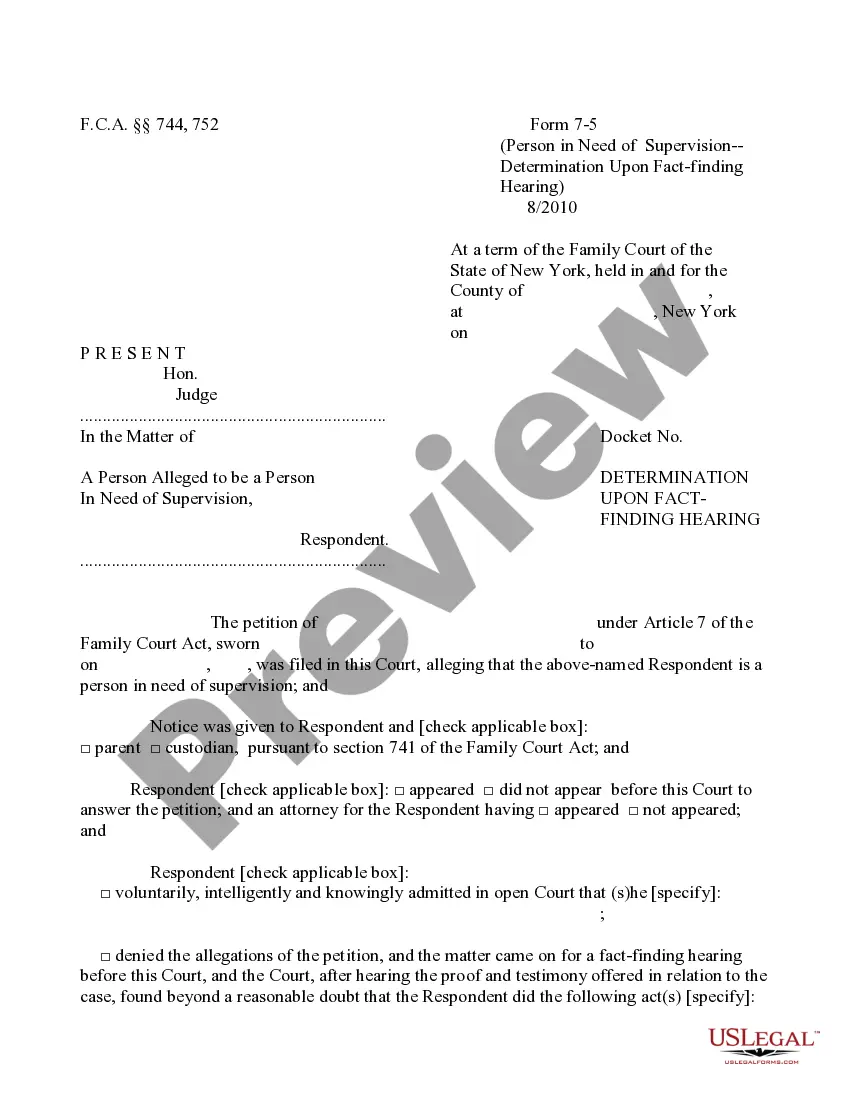
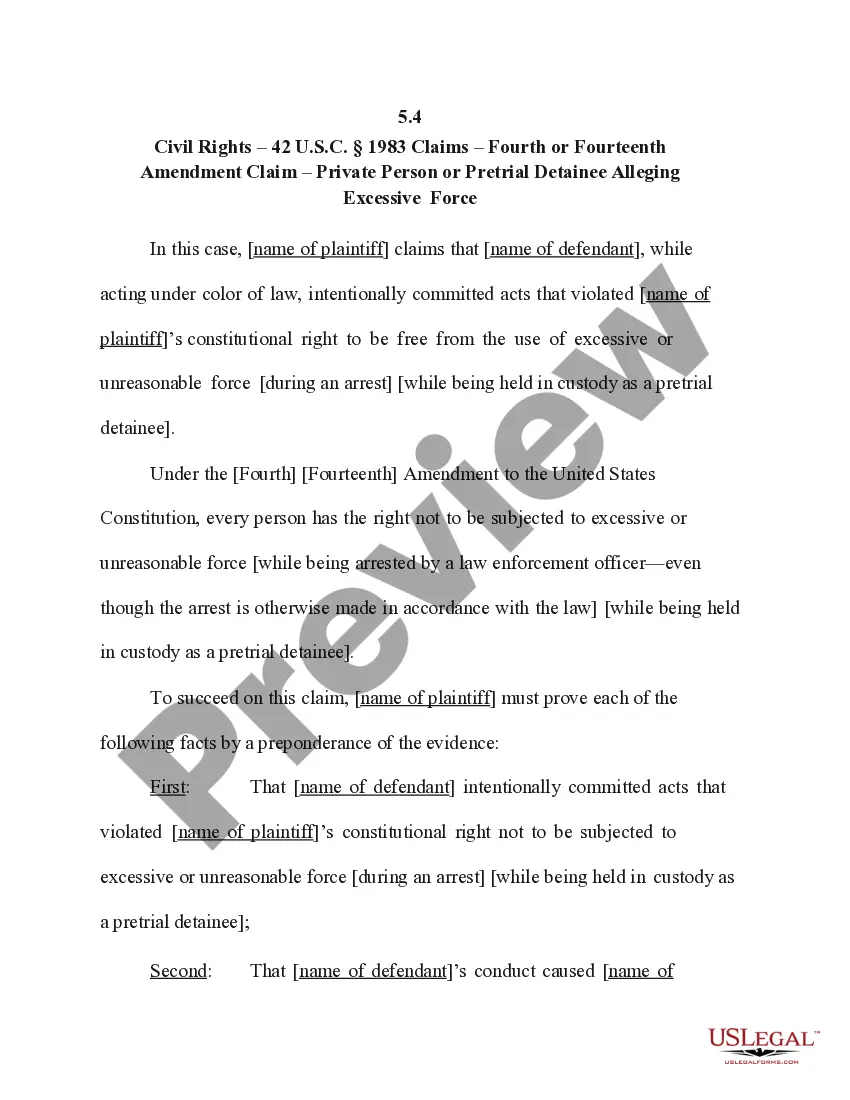
7.09 Fourth Amendment and Fourteenth Amendment: Against Arrestee or Detainee - Elements
What is this form?
The 7.09 Fourth Amendment and Fourteenth Amendment: Against Arrestee or Detainee form is a legal document used in cases where a plaintiff claims that an officer or law enforcement agent has used excessive force during an arrest or detention. This form outlines the elements that must be proven to establish such a claim, distinguishing it from other excessive force claims related to convicted prisoners. It serves to clarify the standards for proving excessive force in accordance with constitutional rights.
Key parts of this document
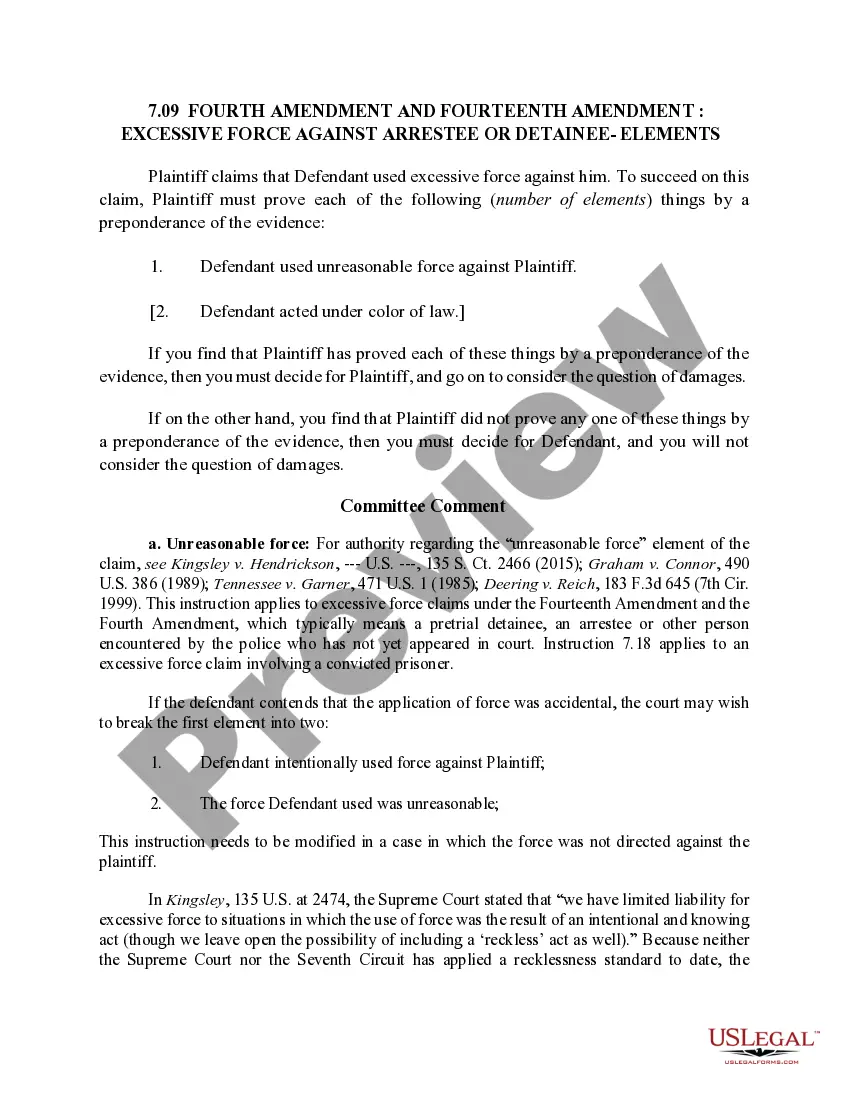
- Definition of unreasonable force and its relation to constitutional rights.
- Requirement for the plaintiff to prove that the defendant acted under color of law.
- Instructions regarding the burden of proof and elements needed for a successful claim.
- Comments on case law that inform the interpretation of excessive force.
- Guidelines for modifying instructions when the use of force is disputed.

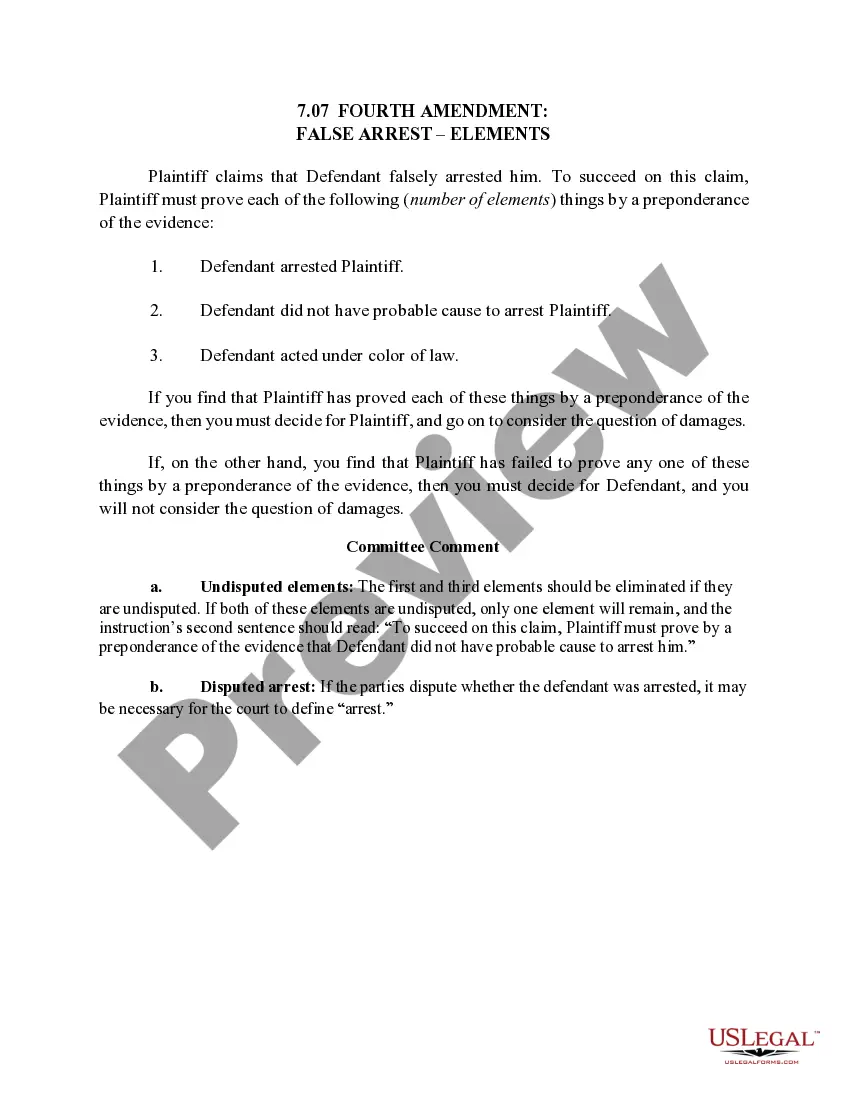
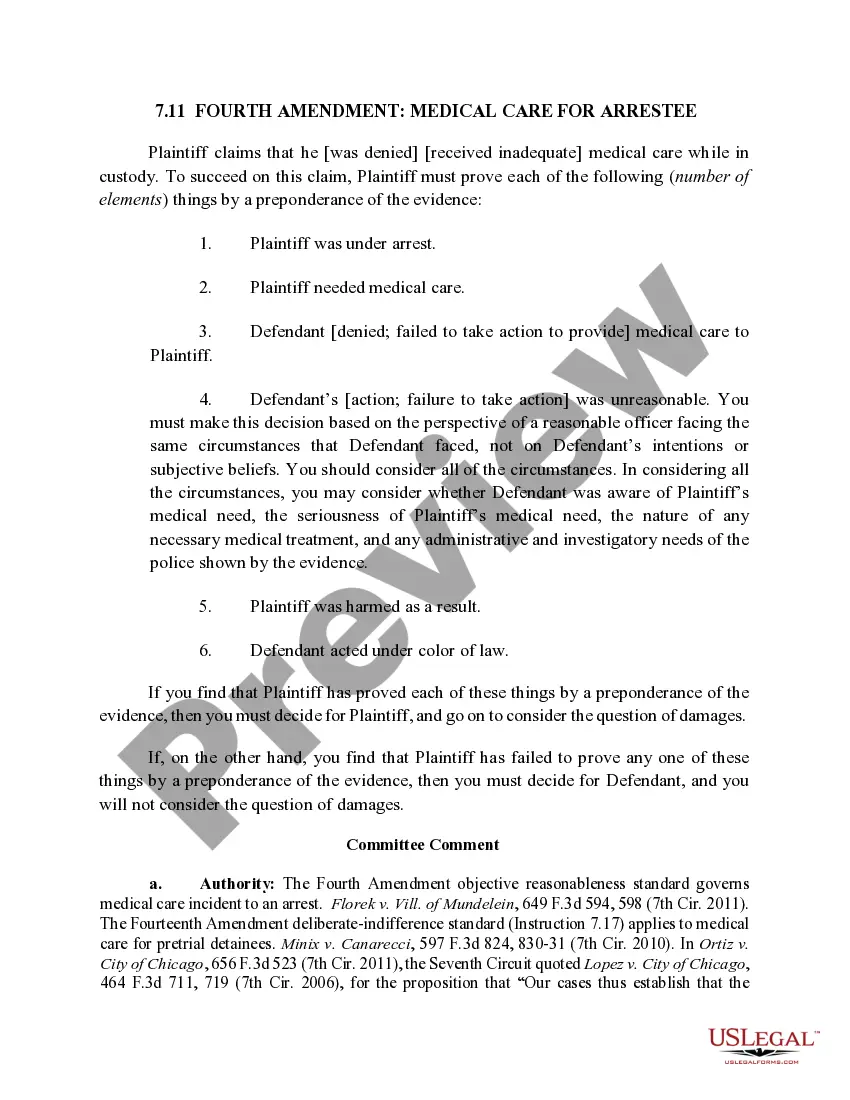
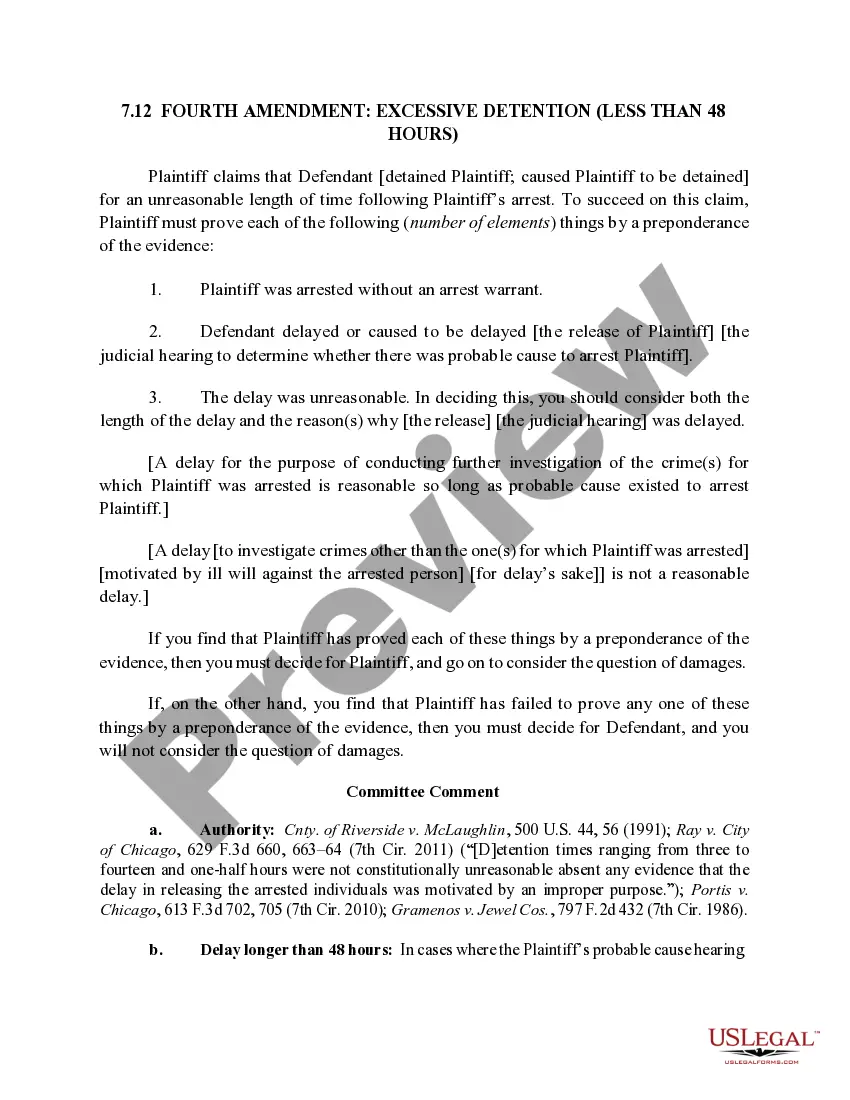
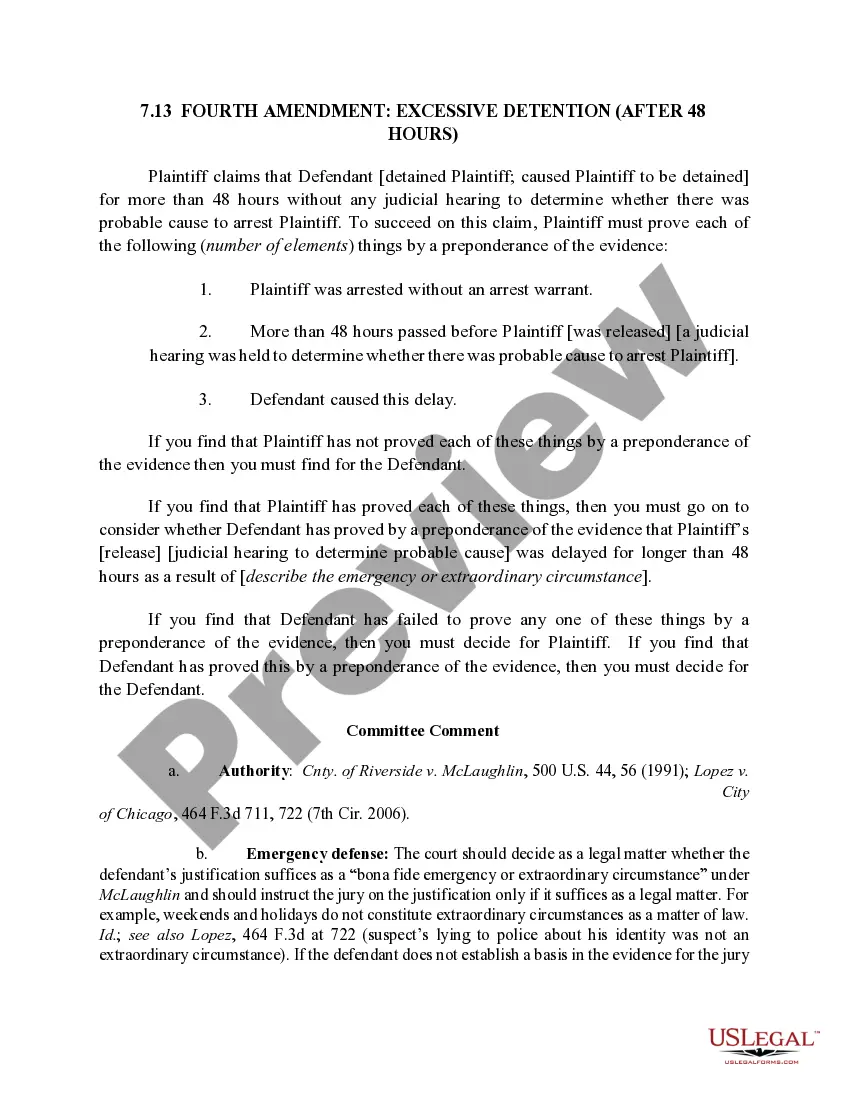
When to use this document
This form is typically used in civil litigation cases where individuals allege that law enforcement officers have applied excessive force during an arrest. It may be utilized when an arrestee or detainee seeks to challenge the actions of the police in court to seek justice or compensation for injuries sustained as a result of such actions.
Intended users of this form
This form is intended for use by:
- Individuals who have been arrested and believe they have experienced excessive force.
- Attorneys representing plaintiffs in civil rights cases against law enforcement.
- Legal professionals seeking to understand the elements of excessive force claims under the Fourth and Fourteenth Amendments.
Steps to complete this form
- Identify the parties involved: the plaintiff (the individual claiming excessive force) and the defendant (the officer or law enforcement agent).
- Clearly state the claim regarding the use of force and the circumstances of the arrest or detention.
- Provide evidence or references to support the claim of unreasonable force.
- Discuss the "color of law" element if there is a dispute regarding this aspect.
- Gather and present any relevant case law that supports the claim, such as Kingsley v. Hendrickson, to validate the argument.
Notarization requirements for this form
Notarization is generally not required for this form. However, certain states or situations might demand it. You can complete notarization online through US Legal Forms, powered by Notarize, using a verified video call available anytime.
Get your form ready online
Our built-in tools help you complete, sign, share, and store your documents in one place.
Make edits, fill in missing information, and update formatting in US Legal Forms—just like you would in MS Word.
Download a copy, print it, send it by email, or mail it via USPS—whatever works best for your next step.
Sign and collect signatures with our SignNow integration. Send to multiple recipients, set reminders, and more. Go Premium to unlock E-Sign.
If this form requires notarization, complete it online through a secure video call—no need to meet a notary in person or wait for an appointment.
We protect your documents and personal data by following strict security and privacy standards.

Make edits, fill in missing information, and update formatting in US Legal Forms—just like you would in MS Word.

Download a copy, print it, send it by email, or mail it via USPS—whatever works best for your next step.

Sign and collect signatures with our SignNow integration. Send to multiple recipients, set reminders, and more. Go Premium to unlock E-Sign.

If this form requires notarization, complete it online through a secure video call—no need to meet a notary in person or wait for an appointment.

We protect your documents and personal data by following strict security and privacy standards.
Typical mistakes to avoid
- Failing to clearly demonstrate how force was used by the defendant.
- Neglecting to prove that the force was unreasonable based on established legal standards.
- Not addressing the "color of law" requirement if contested.
- Overlooking relevant case law that may bolster the argument.
Why use this form online
- Convenient access to downloadable legal form templates created by licensed attorneys.
- Flexibility to edit and customize the form as needed before finalizing.
- Reliable resource for up-to-date legal instructions and requirements.
Legal use & context
- The form is based on federal law regarding excessive force claims under the Fourth and Fourteenth Amendments.
- It provides a legal basis for plaintiffs to seek redress when they believe their rights have been violated during arrests.
- Understanding the elements of the claim is crucial for successful legal arguments in court.
Key takeaways
- This form is vital for asserting claims of excessive force by law enforcement.
- Proving each element, such as unreasonable force and color of law, is necessary for a successful claim.
- Understanding applicable case law can greatly impact the outcome of a legal challenge.
Looking for another form?
Form popularity
FAQ
All searches and seizures under the Fourth Amendment must be reasonable and no excessive force shall be used. Reasonableness is the ultimate measure of the constitutionality of a search or seizure. Searches and seizures with the warrant must also satisfy the reasonableness requirement.
The Fourth Amendment to the U.S. Constitution protects personal privacy and every citizen's right to be free from unreasonable government intrusion into their persons, homes, businesses, and property -- whether through police stops of citizens on the street, arrests, or searches of homes and businesses.
For those facing criminal charges or investigation by law enforcement, few civil rights are as important as the Fourth Amendment. The Fourth Amendment extends the protection against unreasonable searches and seizures. How does this protect you when you get arrested or police officers suspect your involvement in crime?
It prohibits unreasonable searches and seizures. In addition, it sets requirements for issuing warrants: warrants must be issued by a judge or magistrate, justified by probable cause, supported by oath or affirmation, and must particularly describe the place to be searched and the persons or things to be seized.
For those facing criminal charges or investigation by law enforcement, few civil rights are as important as the Fourth Amendment. The Fourth Amendment extends the protection against unreasonable searches and seizures.
The Constitution, through the Fourth Amendment, protects people from unreasonable searches and seizures by the government.
The Constitution, through the Fourth Amendment, protects people from unreasonable searches and seizures by the government. The Fourth Amendment, however, is not a guarantee against all searches and seizures, but only those that are deemed unreasonable under the law.
The Fourth Amendment prohibits the United States government from conducting ?unreasonable searches and seizures." In general, this means police cannot search a person or their property without a warrant or probable cause. It also applies to arrests and the collection of evidence.