7.11 Fourth Amendment: Medical Care for Arrestee .
Overview of this form
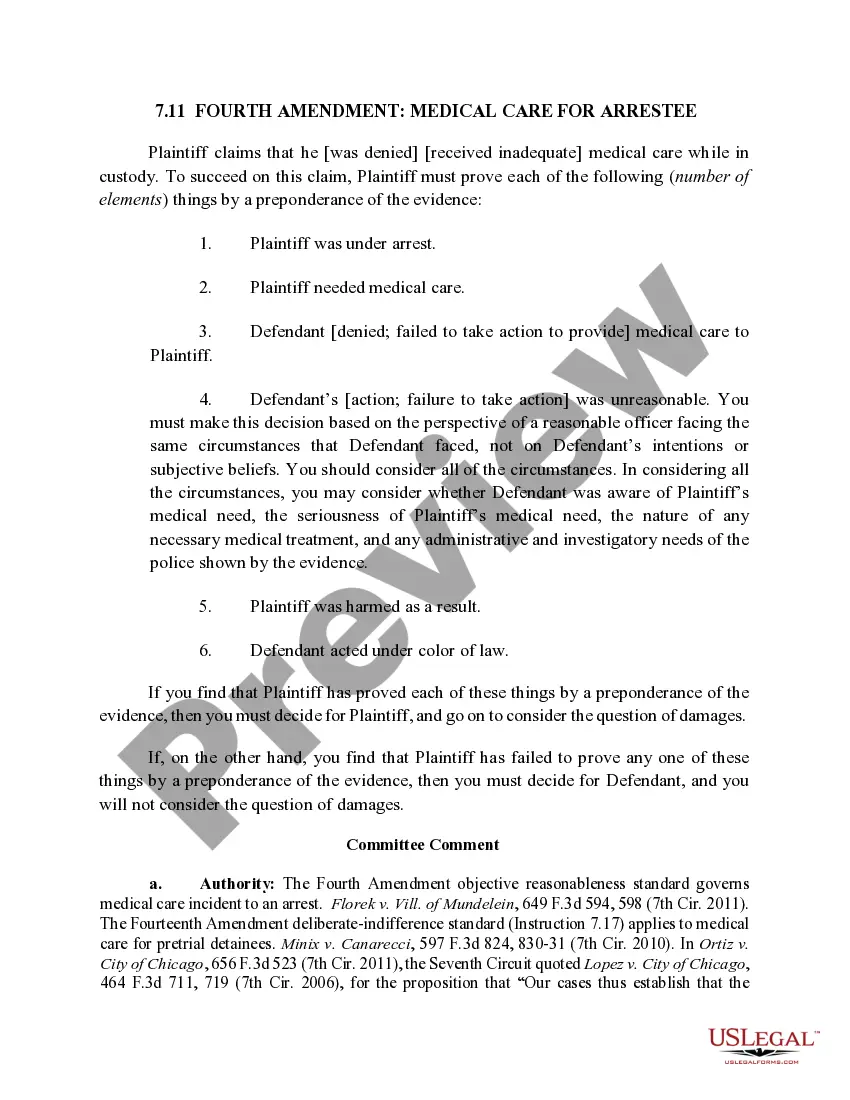
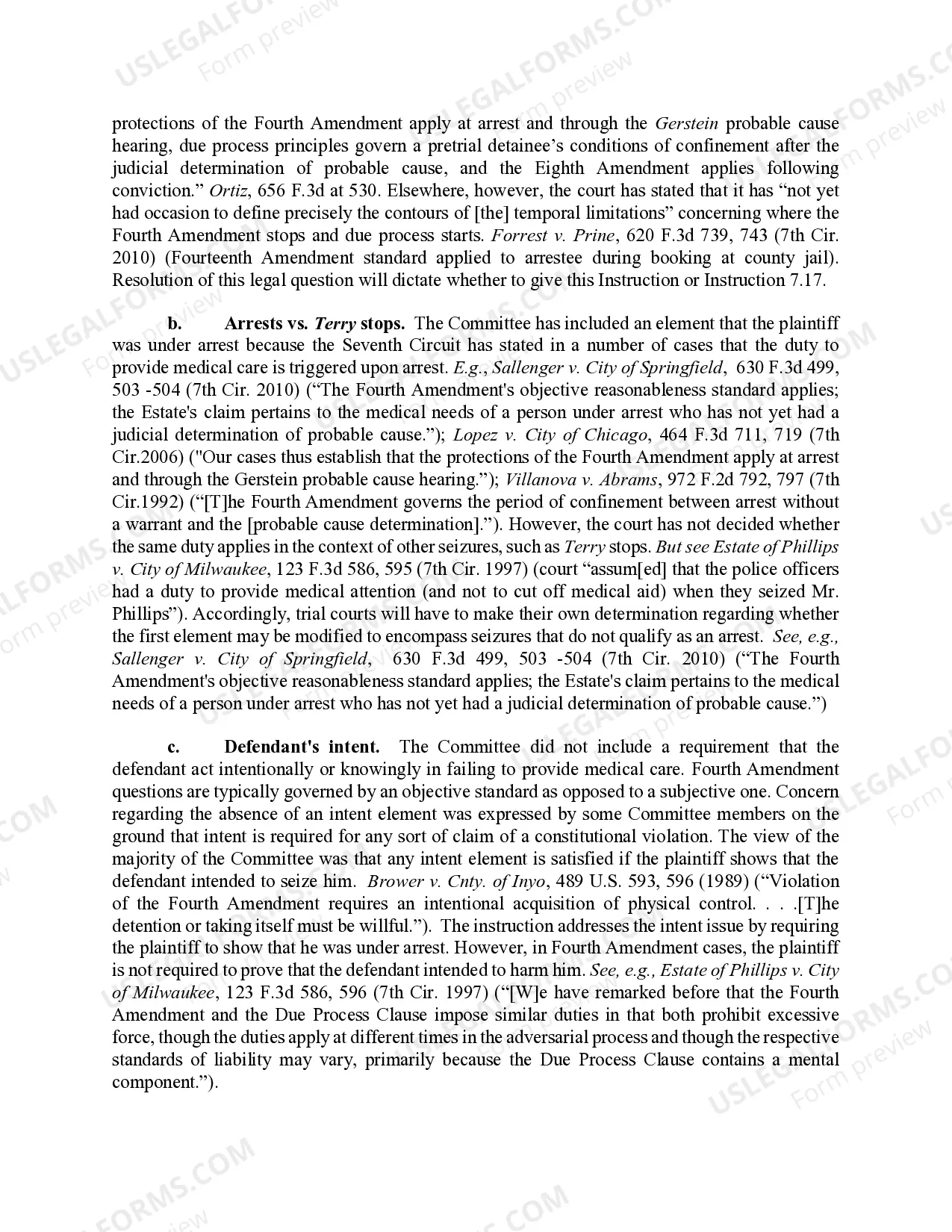
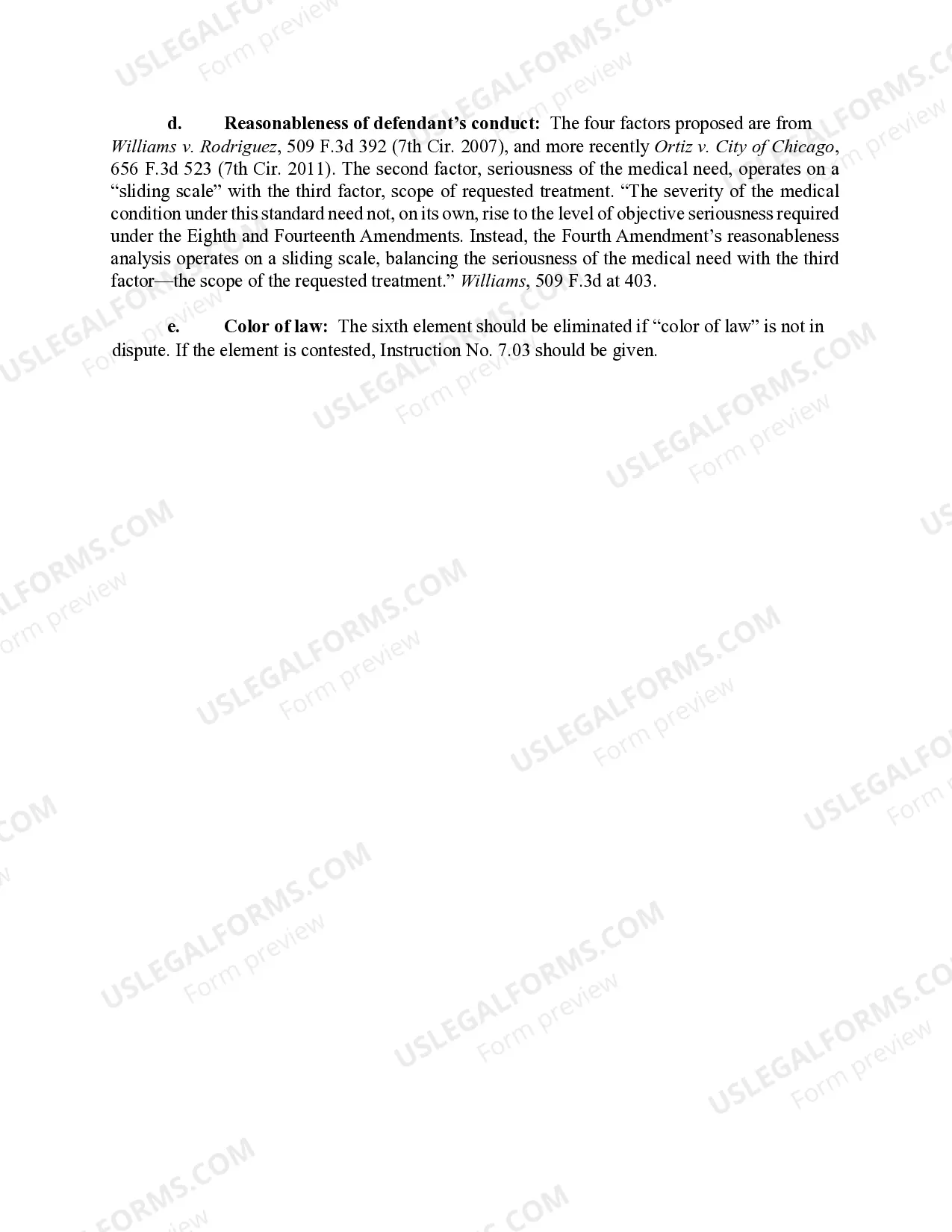
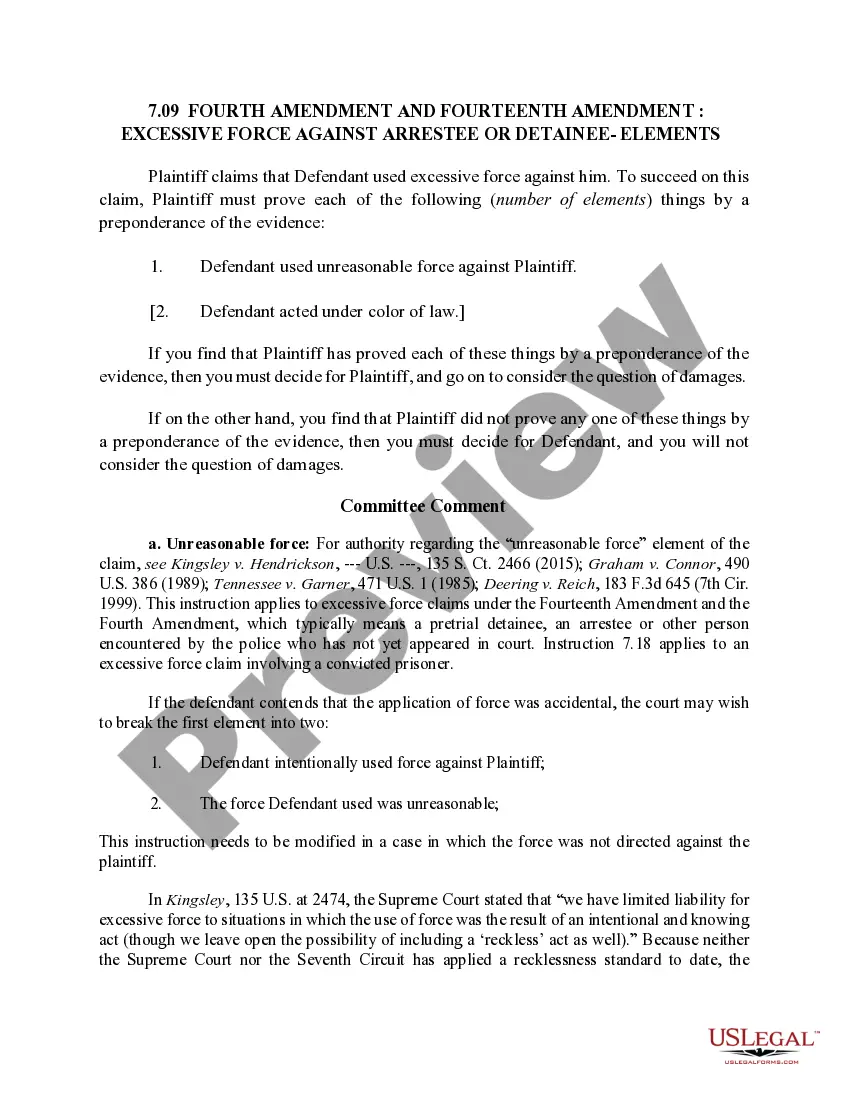
The Fourth Amendment: Medical Care for Arrestee form addresses claims regarding the denial or inadequacy of medical care for individuals in custody. This form differentiates itself by focusing on the legal standards set under the Fourth Amendment, which governs the treatment of arrestees. It outlines the necessary elements a plaintiff must prove to establish their claim against a defendant, typically law enforcement, regarding medical care during custody.
Key parts of this document
- Claim of medical care denial or inadequacy by the arrestee.
- Requirement to prove that the individual was arrested.
- Establishment of a medical need while in custody.
- Defendant's unreasonable actions or inactions regarding medical care.
- Proof of harm resulting from the medical negligence.
- Confirmation that the defendant acted under color of law.
Common use cases
This form should be used in legal cases where an individual claims to have been denied adequate medical care while under arrest. It is applicable in situations where an arrestee exhibits clear medical needs that were not met, potentially leading to harm or deterioration of their condition while in custody.
Who needs this form
- Individuals who believe they have been denied medical treatment while in police custody.
- Legal representatives acting on behalf of clients pursuing claims related to medical care during arrest.
- Law enforcement agencies seeking to understand the legal standards surrounding medical care for arrestees.
Completing this form step by step
- Identify the parties involved: Plaintiff (the arrestee) and Defendant (the law enforcement personnel).
- Specify the details of the arrest and the circumstances leading to the medical care claim.
- Clearly articulate the medical needs that were allegedly not addressed during custody.
- Provide evidence or supporting facts showing how the Defendant acted unreasonably in their duty to provide care.
- Document any harm suffered as a result of the Defendant's actions or lack thereof.
Is notarization required?
This form usually doesn’t need to be notarized. However, local laws or specific transactions may require it. Our online notarization service, powered by Notarize, lets you complete it remotely through a secure video session, available 24/7.
Get your form ready online
Our built-in tools help you complete, sign, share, and store your documents in one place.
Make edits, fill in missing information, and update formatting in US Legal Forms—just like you would in MS Word.
Download a copy, print it, send it by email, or mail it via USPS—whatever works best for your next step.
Sign and collect signatures with our SignNow integration. Send to multiple recipients, set reminders, and more. Go Premium to unlock E-Sign.
If this form requires notarization, complete it online through a secure video call—no need to meet a notary in person or wait for an appointment.
We protect your documents and personal data by following strict security and privacy standards.

Make edits, fill in missing information, and update formatting in US Legal Forms—just like you would in MS Word.

Download a copy, print it, send it by email, or mail it via USPS—whatever works best for your next step.

Sign and collect signatures with our SignNow integration. Send to multiple recipients, set reminders, and more. Go Premium to unlock E-Sign.

If this form requires notarization, complete it online through a secure video call—no need to meet a notary in person or wait for an appointment.

We protect your documents and personal data by following strict security and privacy standards.
Mistakes to watch out for
- Failing to provide sufficient evidence of the medical need.
- Not specifying how the Defendant's actions were unreasonable.
- Omitting details about the harm suffered during custody.
- Assuming color of law is not a factor; clarity in this aspect is essential.
Advantages of online completion
- Convenient access to necessary legal documentation from anywhere.
- Editability allows for personalized details to fit specific situations.
- Reliable templates drafted by licensed attorneys ensure accuracy and compliance with legal standards.
Legal use & context
- This form is based on the Fourth Amendment's requirement for reasonable medical care for arrestees.
- It provides a framework for the legal claims concerning medical inadequacy during police custody.
- Understanding the legal precedents cited in the form can strengthen a plaintiff's case.
What to keep in mind
- This form serves to establish a claim for inadequate medical care while under arrest.
- Key elements must be proven, including the need for medical care and the defendant's unreasonable actions.
- This legal framework protects the rights of individuals in custody and ensures necessary medical attention is provided.
Looking for another form?

Form popularity
FAQ
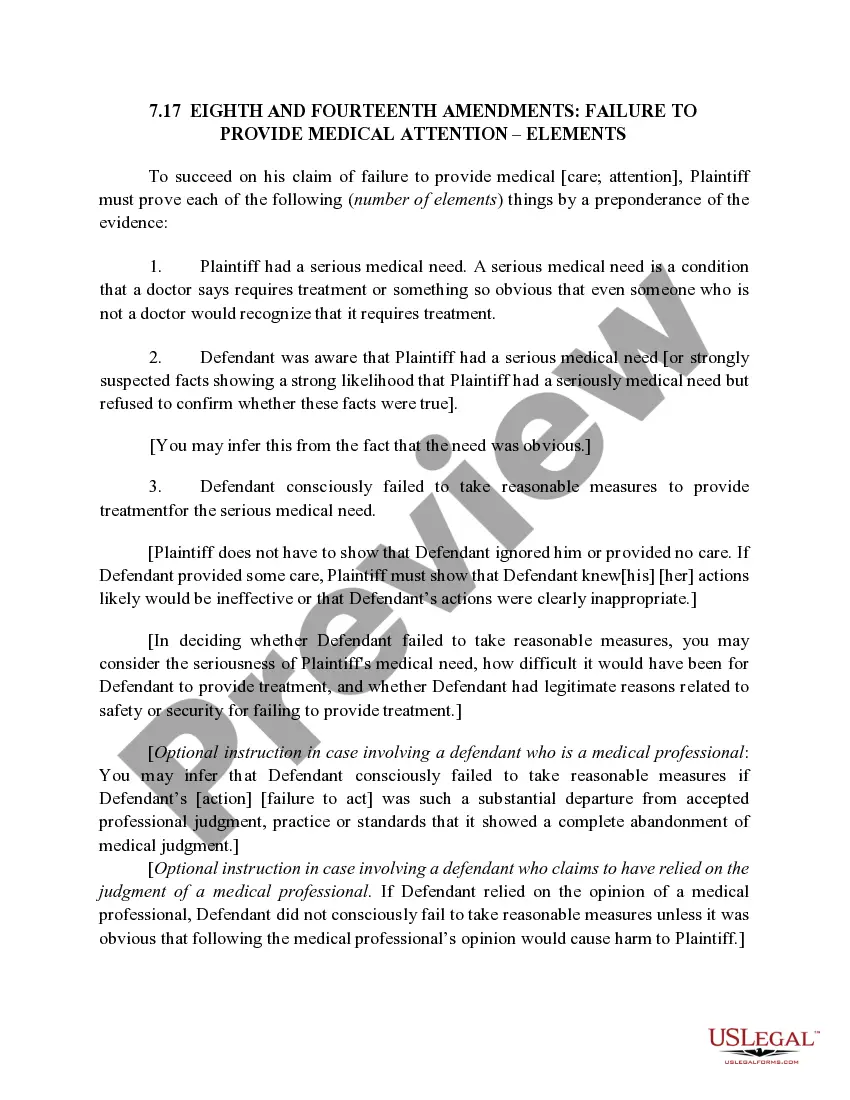
The Supreme Court has held that the Eighth Amendment's prohibition against cruel and unusual punishment requires the government to provide health care to prisoners,2 but has clarified that officials may be held liable for failing to provide adequate health care only if they are aware of, yet disregard, a ?substantial
The Constitution, through the Fourth Amendment, protects people from unreasonable searches and seizures by the government.
The Fourteenth Amendment provides that no State shall "deprive any person of life, liberty, or property, without due process of law." The principle that a competent person has a constitutionally protected liberty interest in refusing unwanted medical treatment may be inferred from our prior decisions.
For example, consider the following scenarios: An arrest is found to violate the Fourth Amendment because it was not supported by probable cause or a valid warrant. Any evidence obtained through that unlawful arrest, such as a confession, will be kept out of the case.
The Health Care for All Amendment (H.J. Res. 17) states: "Health care, including care to prevent and treat illness, is the right of the people and necessary to ensure the strength of the Nation.
The earlier judgment found that deliberately withholding treatment from prisoners with serious medical needs amounted to ?cruel and unusual punishment? under the Constitution's Eighth Amendment.
Excessive bail shall not be required, nor excessive fines imposed, nor cruel and unusual punishments inflicted.
The Constitution protects a person's freedom of choice in medical care, including the right to refuse unwanted medical treatment and rights preserving the doctor-patient relationship.