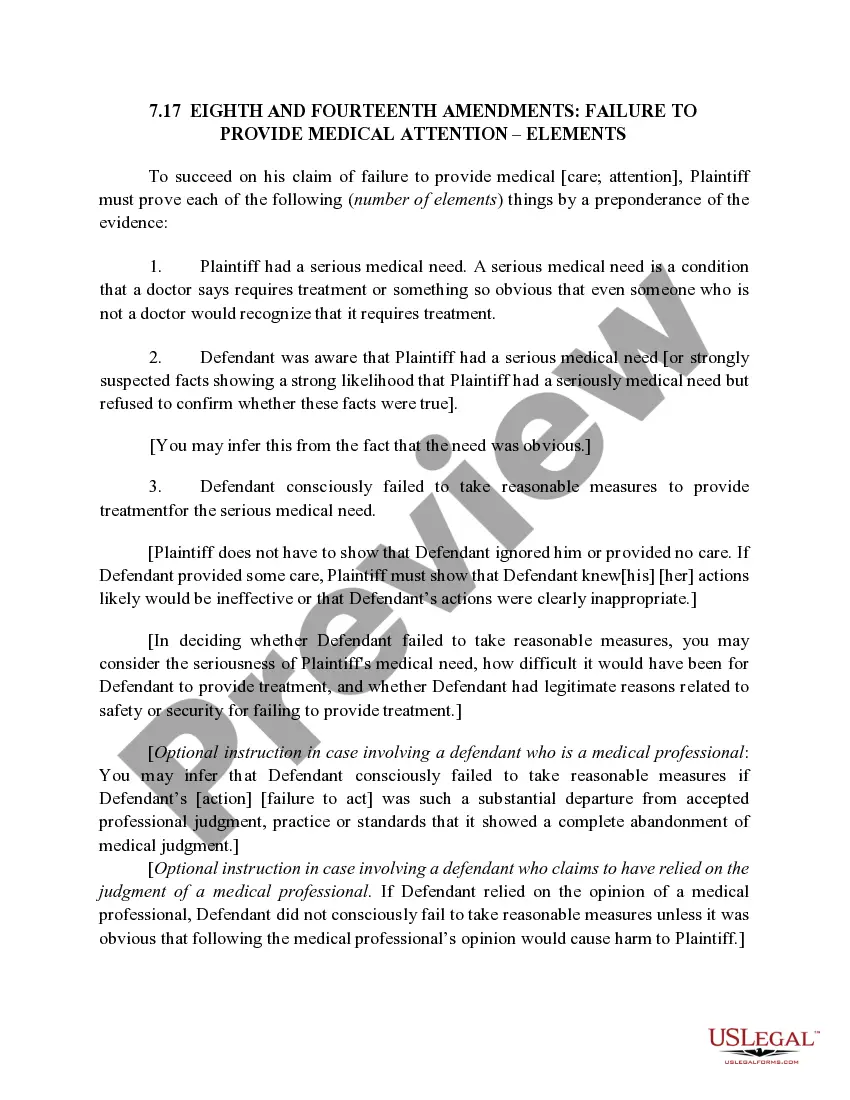
7.17 Eighth and Fourteenth Amendments: Failure to Provide Medical Attention - Elements
Overview of this form
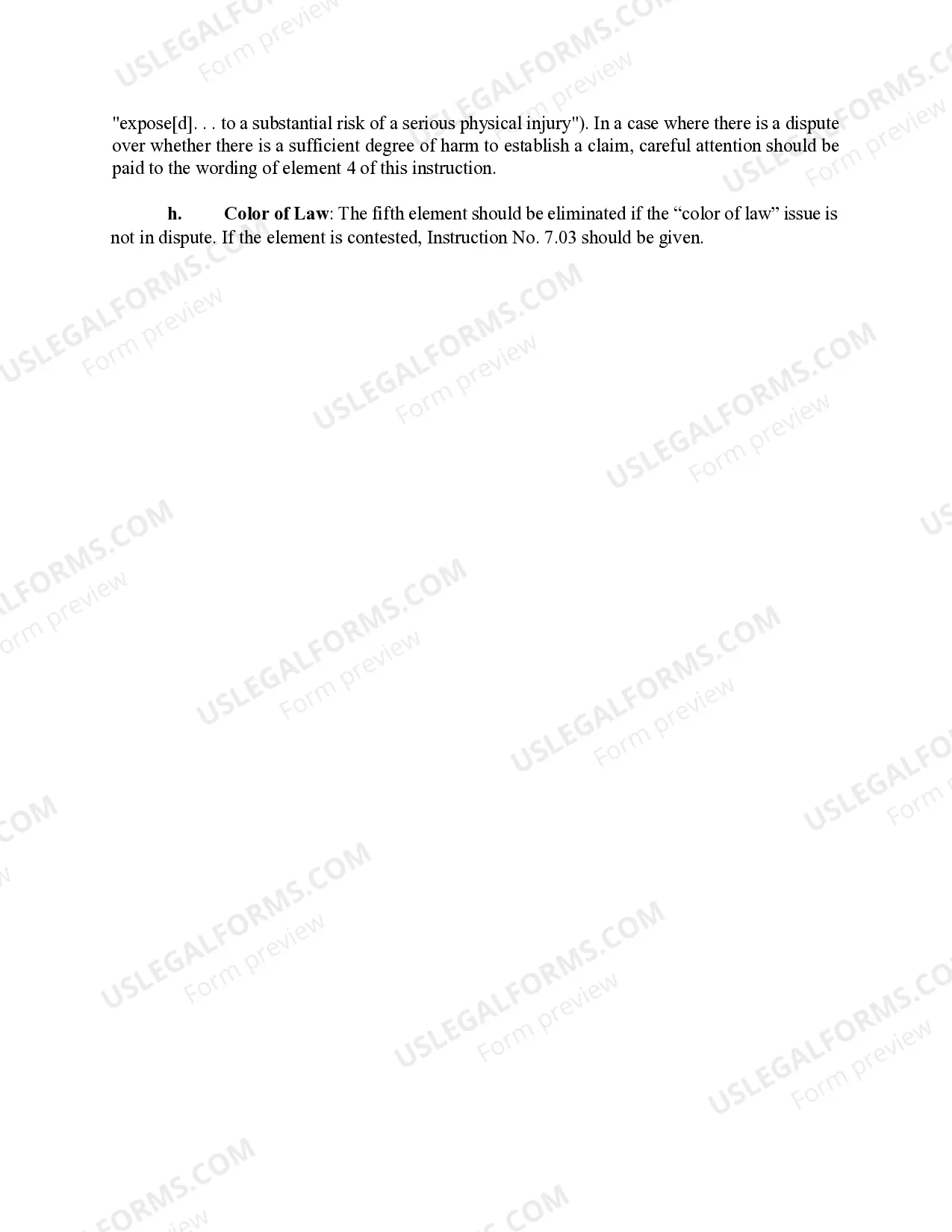
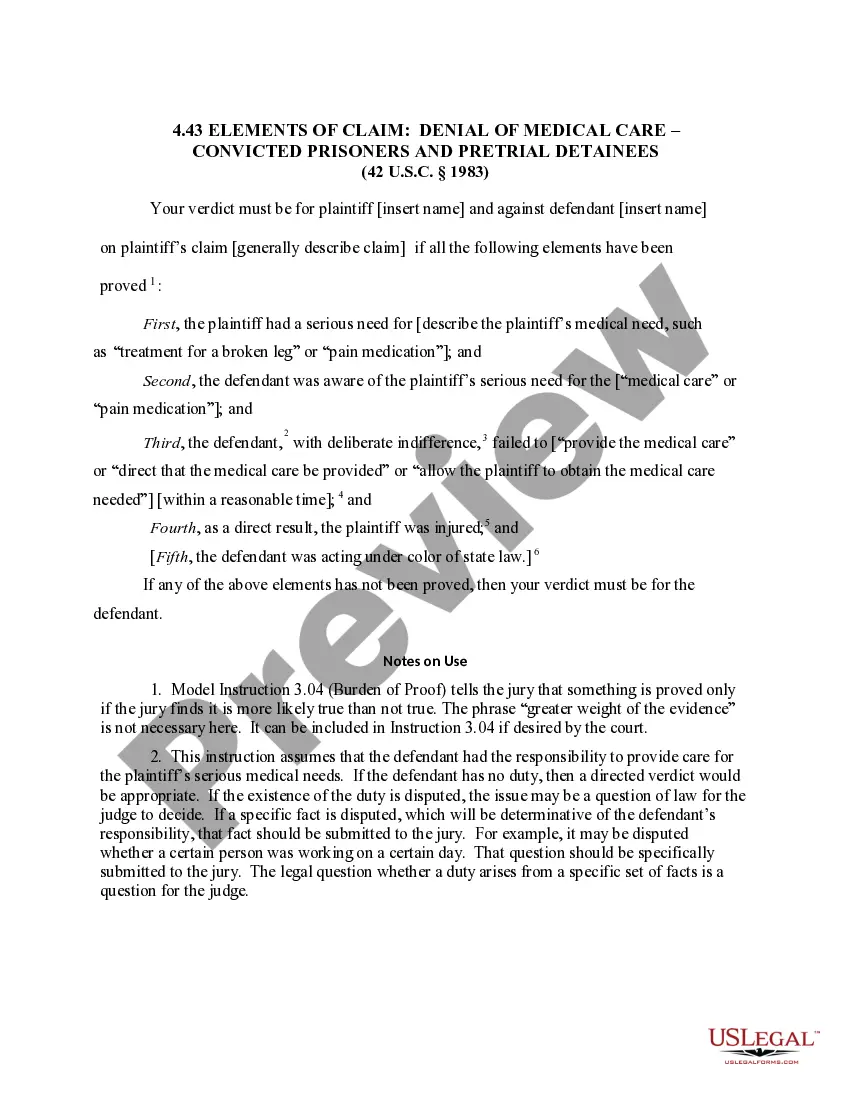
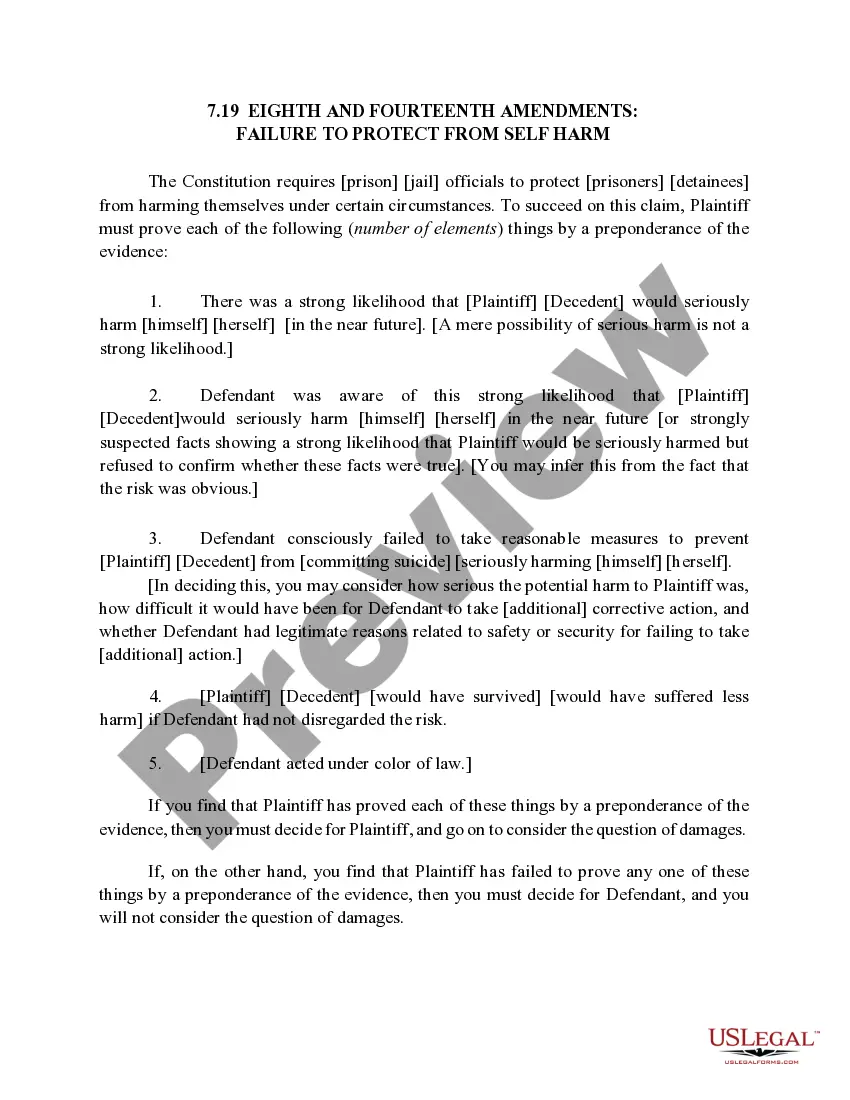
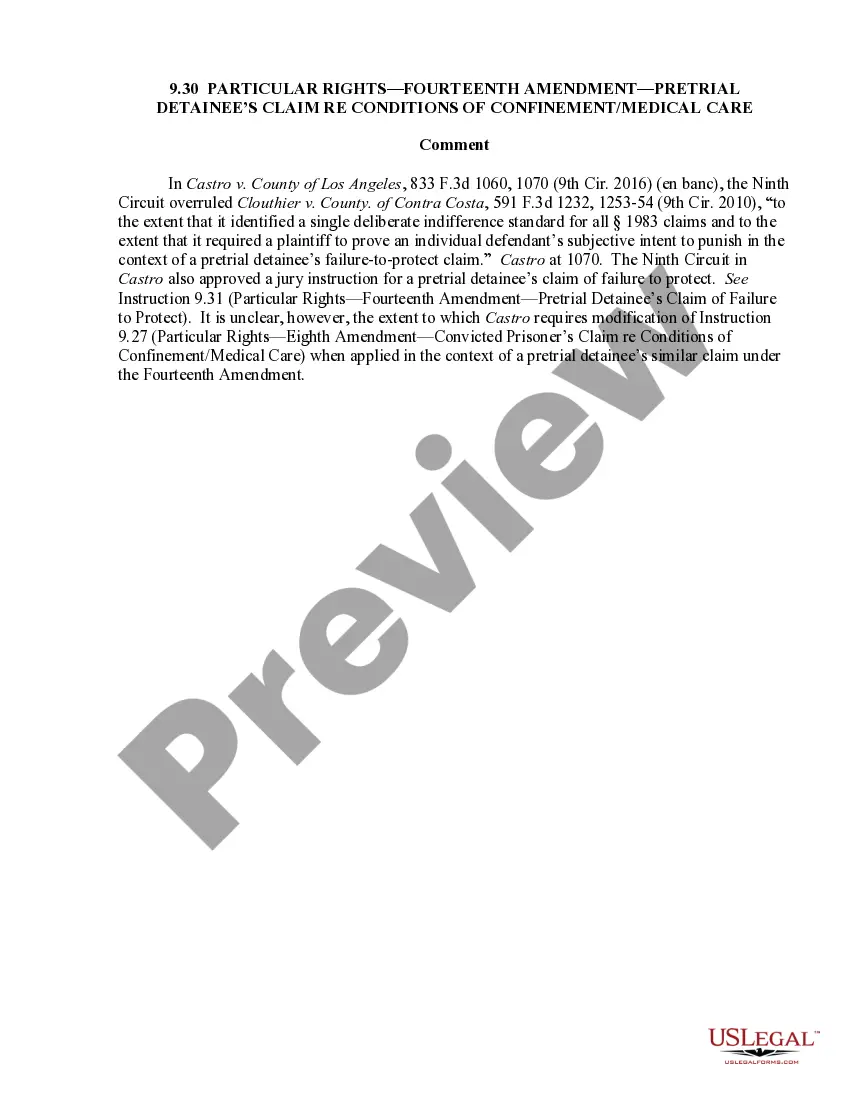
The "Eighth and Fourteenth Amendments: Failure to Provide Medical Attention - Elements" form is designed to guide the jury in determining whether a defendant was deliberately indifferent to a plaintiff's serious medical needs. This form outlines the required elements to establish a claim under both the Eighth and Fourteenth Amendments, which protect individuals in custody from inadequate medical care. It helps users understand the legal standards applicable to these claims, differentiating it from other legal documents related to healthcare and civil rights in corrections.
Key parts of this document
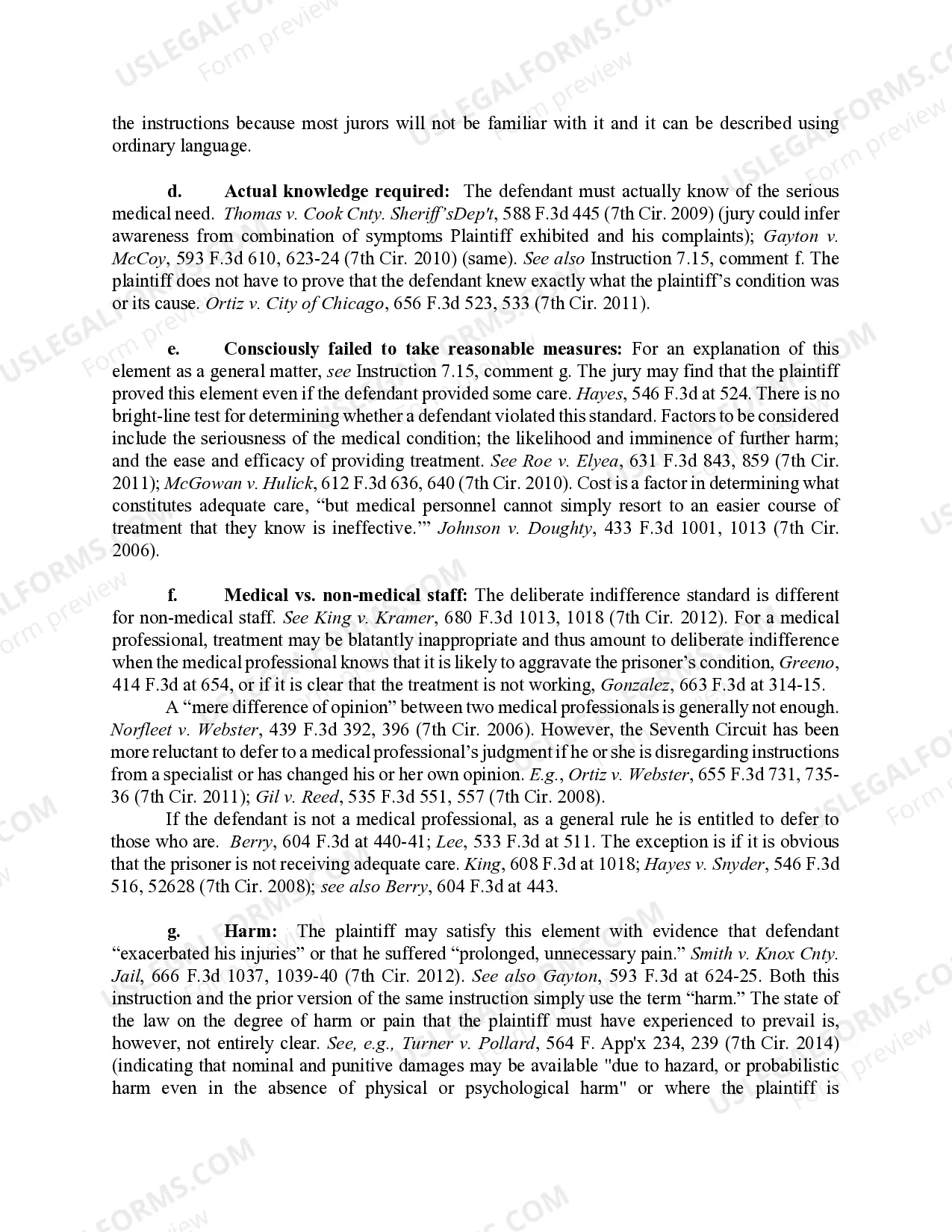
- Definition of serious medical need, including factors for assessment.
- Requirements for establishing the defendant's awareness of the medical need.
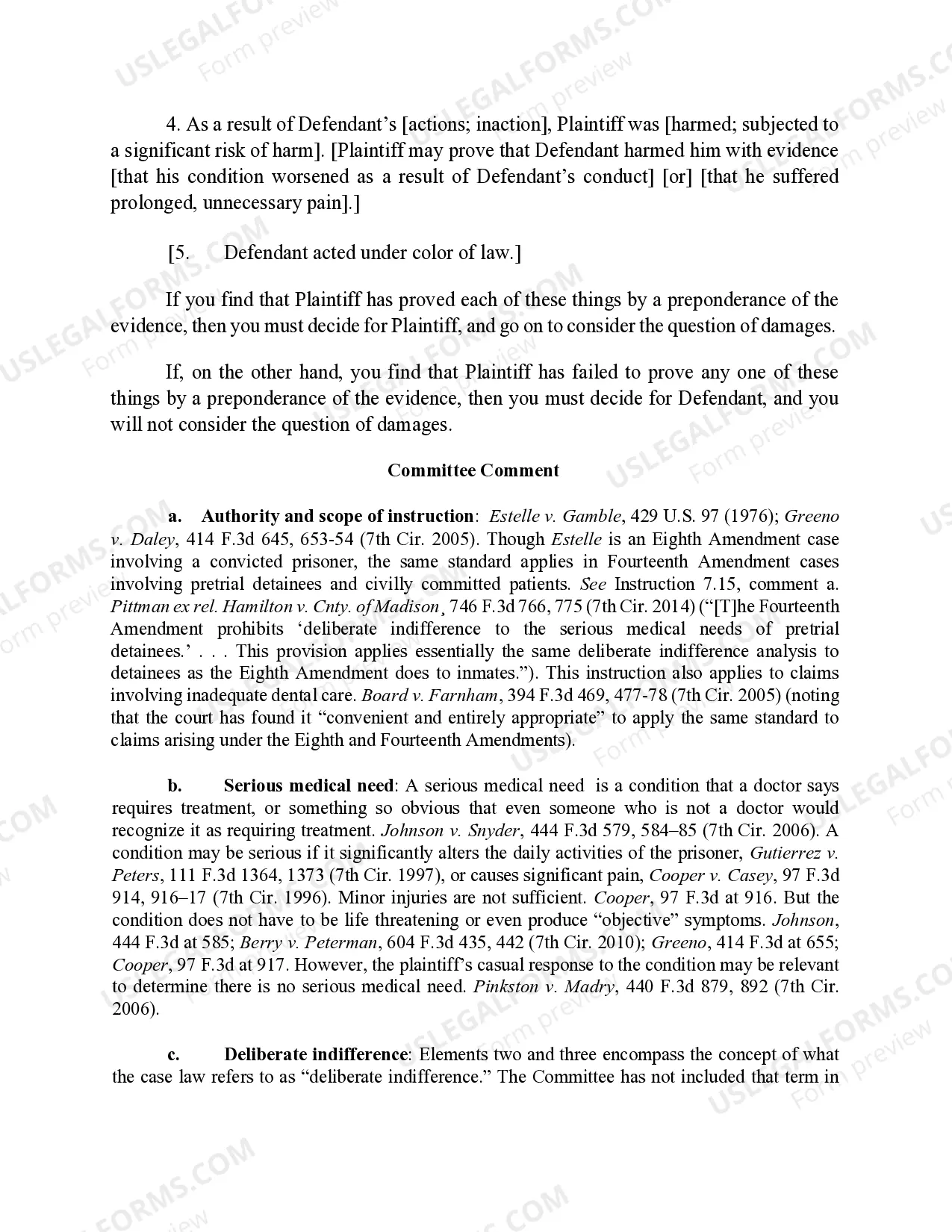
- Standards for evaluating the reasonableness of the defendantâs actions or inactions.
- Clarifications related to professional medical judgment applicable to medical staff.
- Criteria for demonstrating harm resulting from the defendant's actions or inactions.
- Consideration of whether the defendant acted under color of law.
When to use this form
This form is used in cases where individuals claim their constitutional rights have been violated due to a lack of necessary medical care while in correctional facilities. It is applicable in lawsuits against prison officials or medical personnel when a plaintiff suffered harm due to ineffective medical treatment or neglect. Use this form when pursuing civil rights cases asserting deliberate indifference to serious medical needs under the Eighth or Fourteenth Amendments.
Who should use this form
- Individuals incarcerated or detained in correctional facilities who believe their medical needs were ignored.
- Lawyers representing clients in civil rights litigations concerning prison conditions.
- Advocacy groups focused on the rights of prisoners and detainees seeking to understand the legal definitions and requirements for medical negligence claims.
How to prepare this document
- Identify the plaintiff's serious medical need based on the applicable legal definitions.
- Gather evidence to establish the defendantâs awareness of the medical need.
- Assess and document the actions or inactions of the defendant regarding the medical need.
- Compile information to demonstrate any harm suffered by the plaintiff as a result of the defendant's actions.
- Clarify whether the defendant acted under color of law, if contested.
Notarization requirements for this form
This form usually doesn’t need to be notarized. However, local laws or specific transactions may require it. Our online notarization service, powered by Notarize, lets you complete it remotely through a secure video session, available 24/7.
Get your form ready online
Our built-in tools help you complete, sign, share, and store your documents in one place.
Make edits, fill in missing information, and update formatting in US Legal Forms—just like you would in MS Word.
Download a copy, print it, send it by email, or mail it via USPS—whatever works best for your next step.
Sign and collect signatures with our SignNow integration. Send to multiple recipients, set reminders, and more. Go Premium to unlock E-Sign.
If this form requires notarization, complete it online through a secure video call—no need to meet a notary in person or wait for an appointment.
We protect your documents and personal data by following strict security and privacy standards.

Make edits, fill in missing information, and update formatting in US Legal Forms—just like you would in MS Word.

Download a copy, print it, send it by email, or mail it via USPS—whatever works best for your next step.

Sign and collect signatures with our SignNow integration. Send to multiple recipients, set reminders, and more. Go Premium to unlock E-Sign.

If this form requires notarization, complete it online through a secure video call—no need to meet a notary in person or wait for an appointment.

We protect your documents and personal data by following strict security and privacy standards.
Mistakes to watch out for
- Failing to properly establish the seriousness of the medical need as defined by the law.
- Not providing sufficient evidence of the defendantâs awareness of the medical issue.
- Neglecting to document the specific harm suffered, which is essential for the claim.
- Confusing the standards for medical professionals versus non-medical staff in terms of liability.
Why use this form online
- Convenience of obtaining a legally compliant form with defined content.
- Editability allows for customization to fit specific case details.
- Access to reliable information reviewed by legal professionals.
- Streamlined process for managing legal documentation from home.
Legal use & context
- This form provides a structured approach for jury instructions related to medical neglect claims.
- It reflects established precedents and the relevant legal standards required for claims under the Eighth and Fourteenth Amendments.
- Users must ensure they understand the implications of each element to effectively utilize this form for legal proceedings.
Key takeaways
- Understanding serious medical needs is crucial for filing a claim.
- Defendants must be aware of and respond to medical needs appropriately.
- The relationship between the defendant's actions and the resulting harm is essential for a successful claim.
- This form serves as a guiding document for pursuing justice for inadequate medical care in custody.
Looking for another form?
Form popularity
FAQ
Additionally, the death penalty cannot be imposed on minors, defendants with intellectual disabilities, or on defendants who committed crimes that do not warrant the death penalty as an appropriate form of punishment.
Atkins v. Virginia. A case in which the Court found that sentencing a mentally disabled person to death is a violation of the Eighth Amendment's Cruel and Unusual Punishment Clause.
The Supreme Court has held that the Eighth Amendment's prohibition against cruel and unusual punishment requires the government to provide health care to prisoners,2 but has clarified that officials may be held liable for failing to provide adequate health care only if they are aware of, yet disregard, a ?substantial
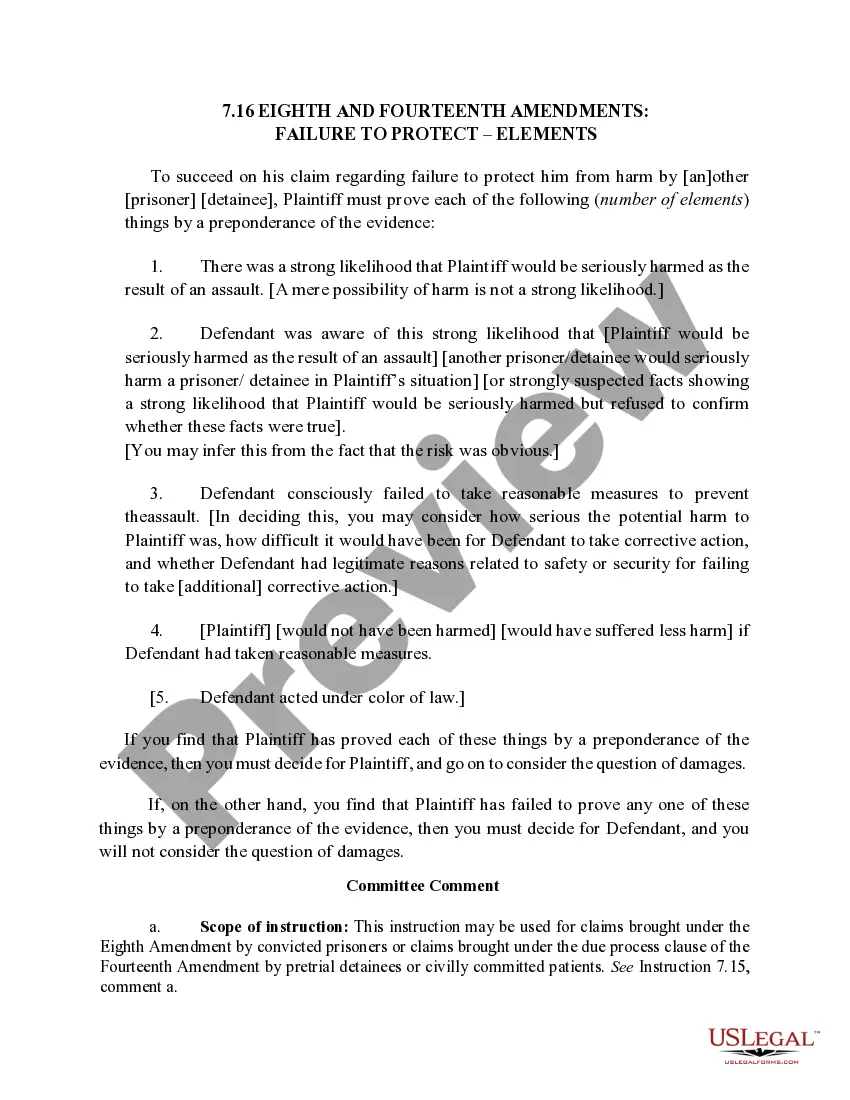
?The Eighth Amendment imposes a duty on prison officials to protect inmates from violence at the hands of other inmates. A prison official violates this duty when two requirements are met. First, objectively viewed, the prison official's act or omission must cause a substantial risk of serious harm.
The Eighth Amendment to the United States Constitution states: ?Excessive bail shall not be required, nor excessive fines imposed, nor cruel and unusual punishments inflicted.? This amendment prohibits the federal government from imposing unduly harsh penalties on criminal defendants, either as the price for obtaining
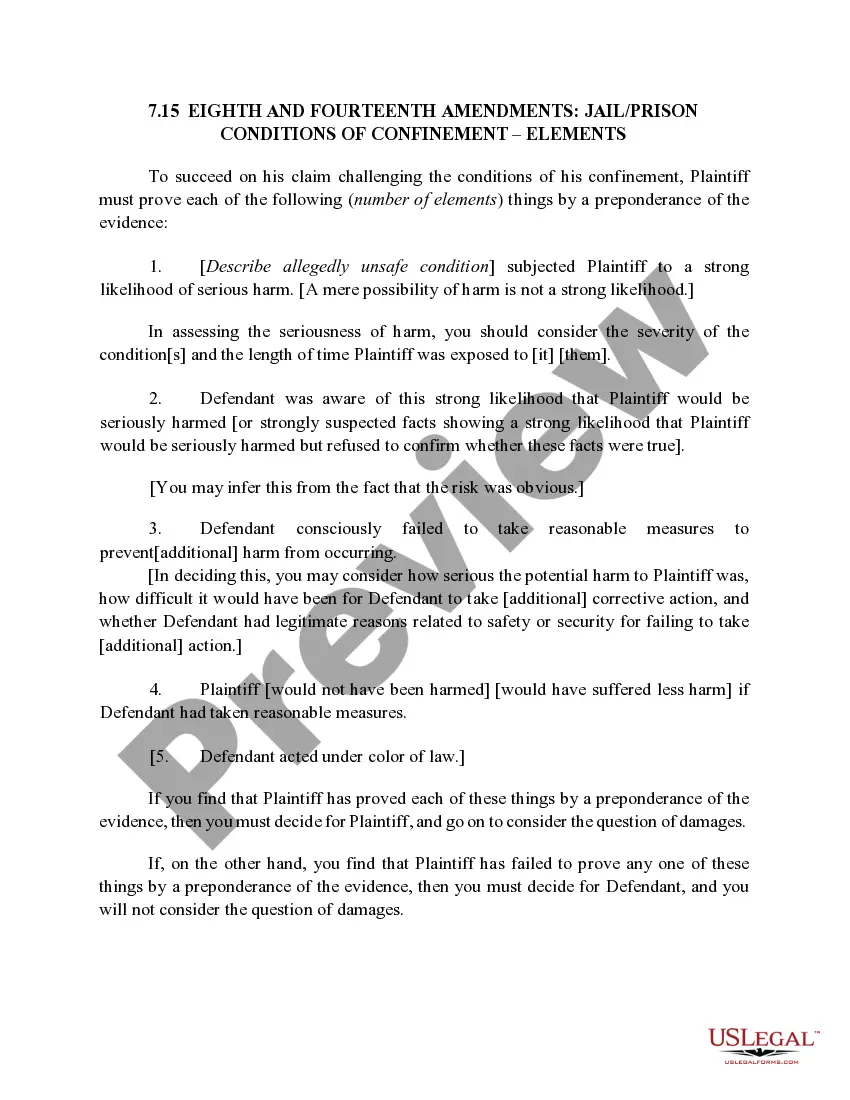
Prison officials may be violating the Eighth Amendment if they knew about a risk of assault by other prisoners but failed to respond, or if prison conditions or practices create an unreasonable risk of assault (for example, not having enough officers on the unit, not having cell doors that lock properly, etc.).
(in order to find a violation of the Eighth Amendment, two requirements must be met: (1) viewed objectively, a deprivation must be ?sufficiently serious? to result in the denial of ?the minimal civilized measure of life's necessities?; and (2) prison officials must have a ?sufficiently culpable state of mind?, one of ?
Eighth Amendment Cruel and Unusual Punishment Excessive bail shall not be required, nor excessive fines imposed, nor cruel and unusual punishments inflicted.