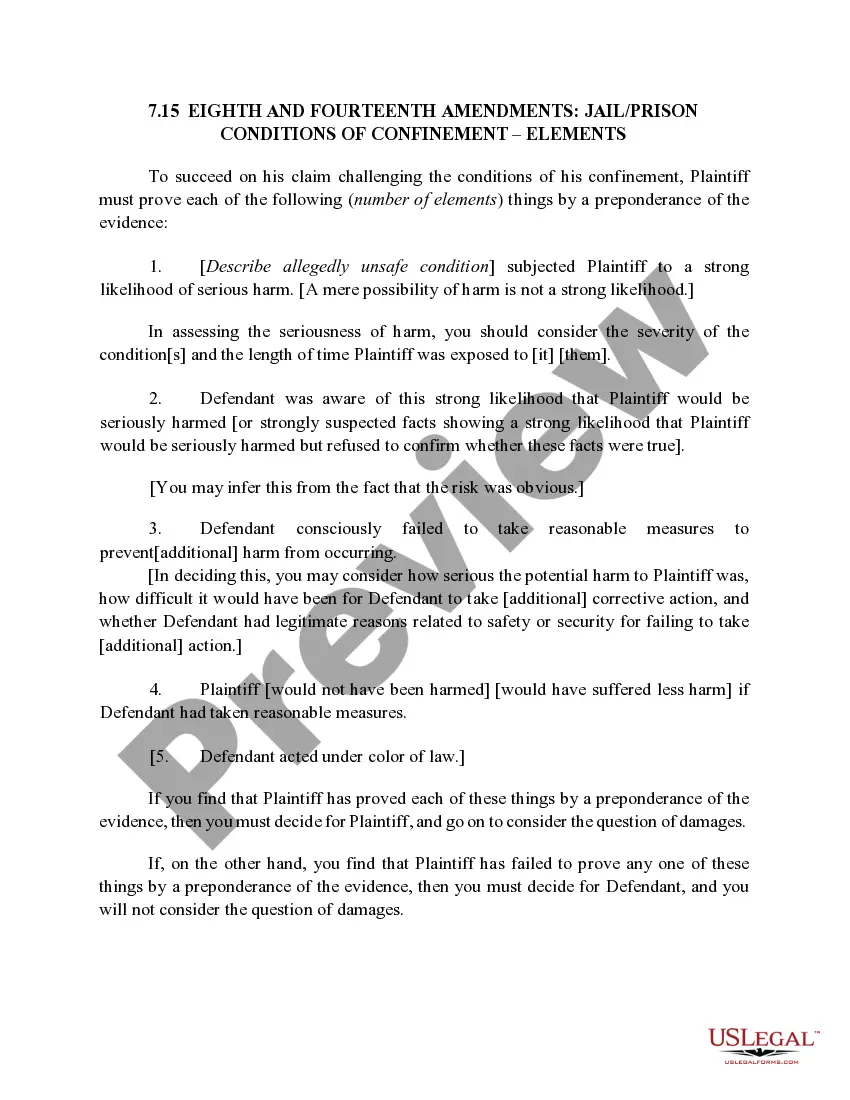
7.15 Eighth and Fourteenth Amendments: Jail/prison Conditions of Confinement - Elements
What this document covers
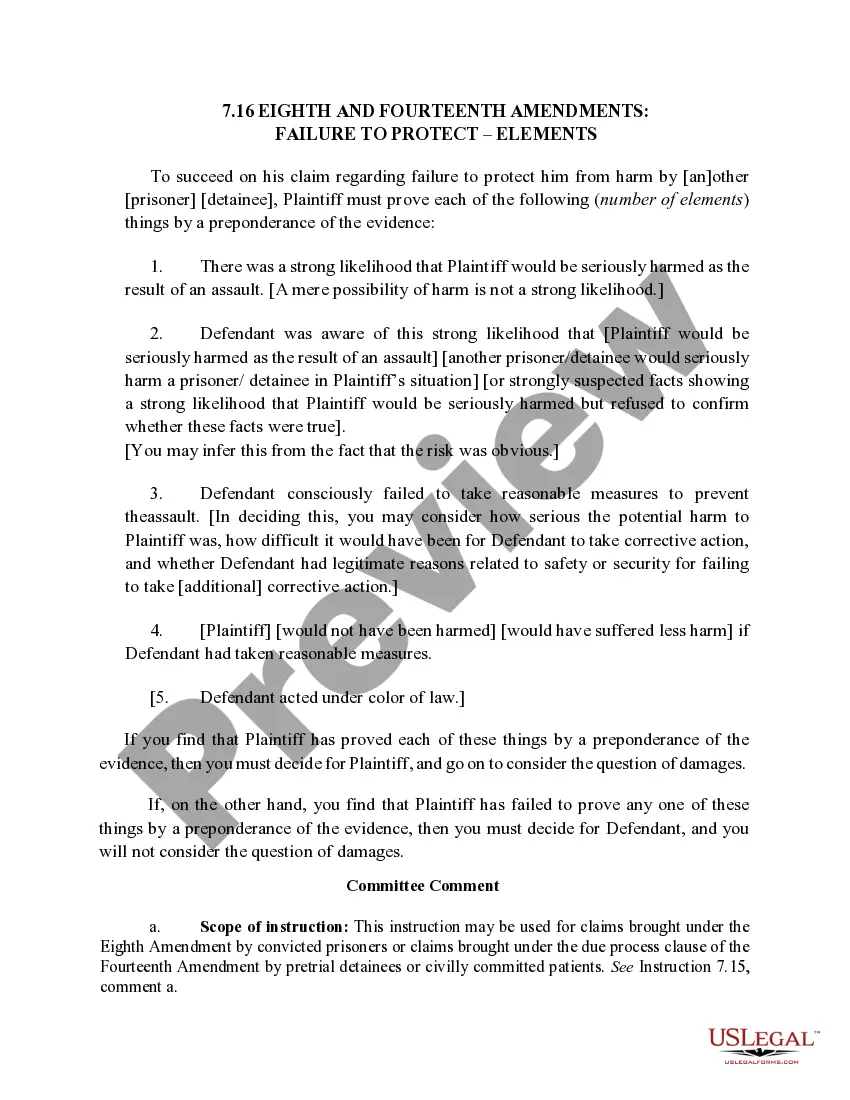
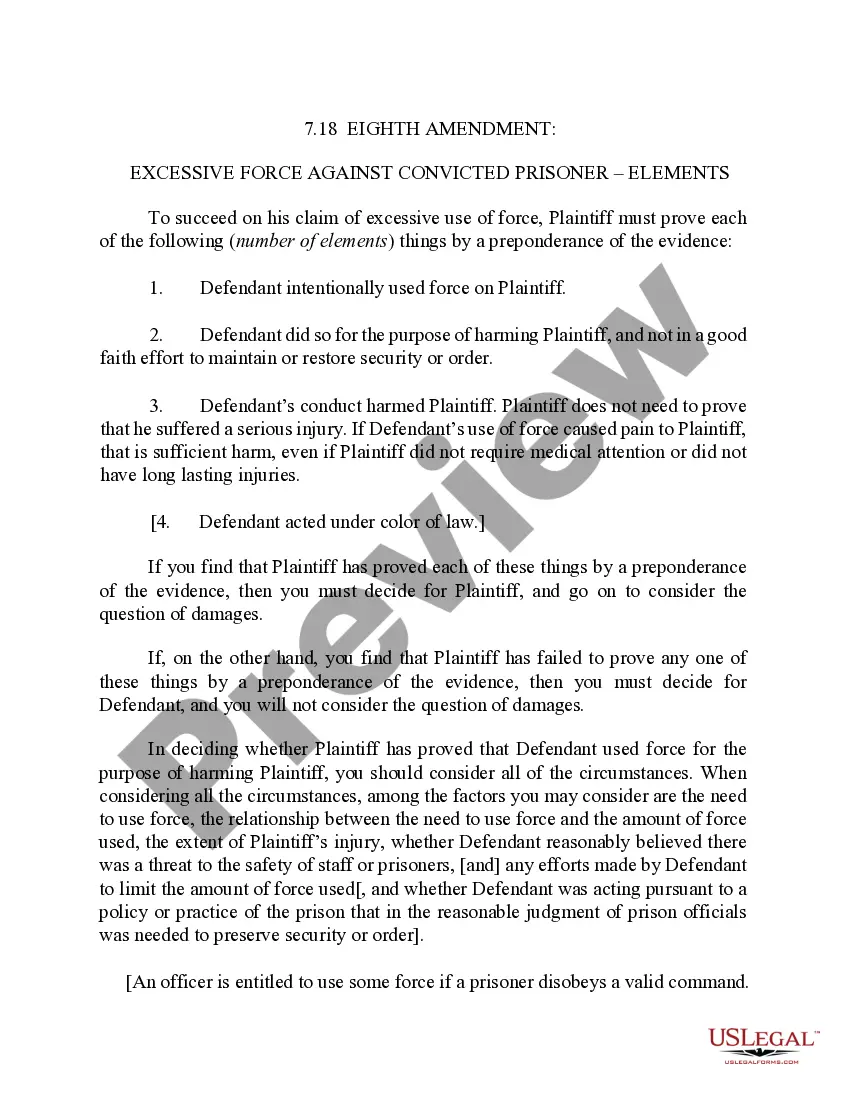
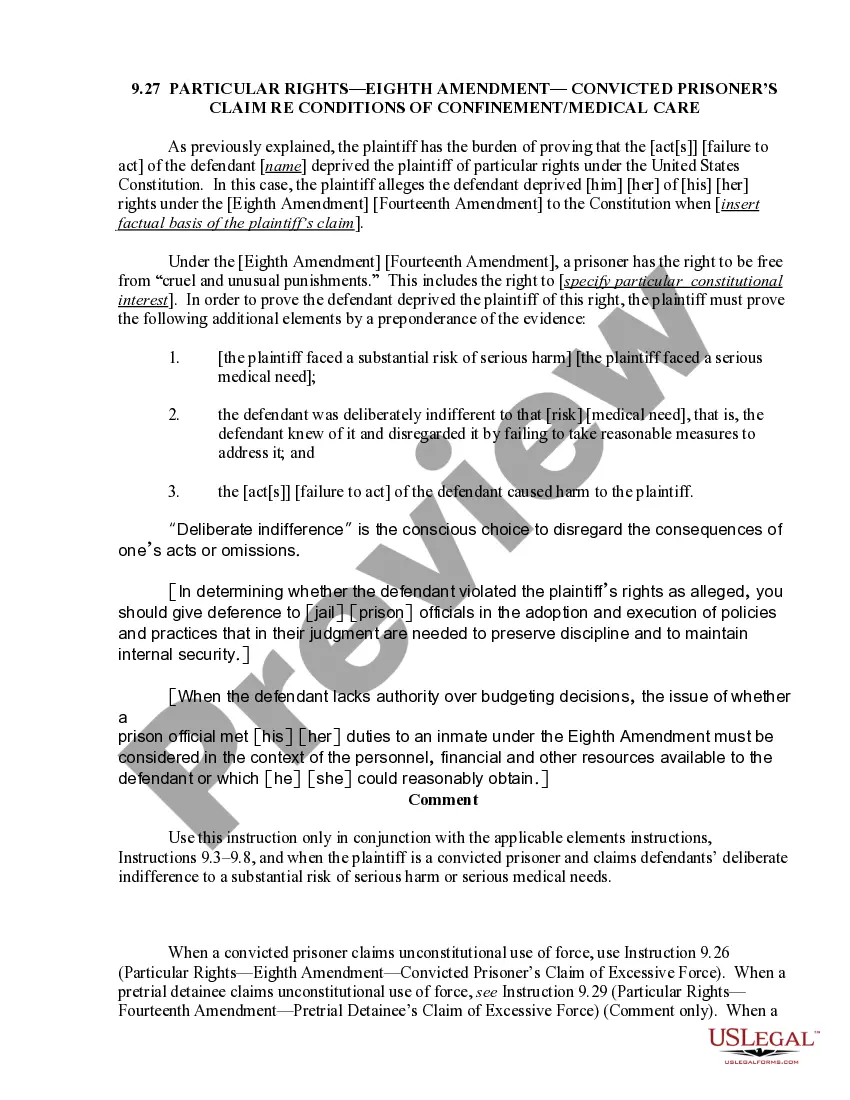
The 7.15 Eighth and Fourteenth Amendments: Jail/Prison Conditions of Confinement - Elements form is an essential legal tool for individuals challenging their treatment while incarcerated. This form outlines the criteria necessary for plaintiffs to demonstrate when filing claims related to unsafe jail or prison conditions. It provides clear instructions on the legal standards derived from the Eighth and Fourteenth Amendments, distinguishing itself from standard tort claims by focusing specifically on unconstitutional conditions of confinement.
Key components of this form
- Criteria for proving a claim related to unsafe conditions, including the likelihood of serious harm.
- Assessment of the defendant's knowledge regarding the risk of harm to the plaintiff.
- Requirements for demonstrating the defendant's failure to act on evident risks.
- Consideration of whether reasonable measures could have been taken to prevent harm.
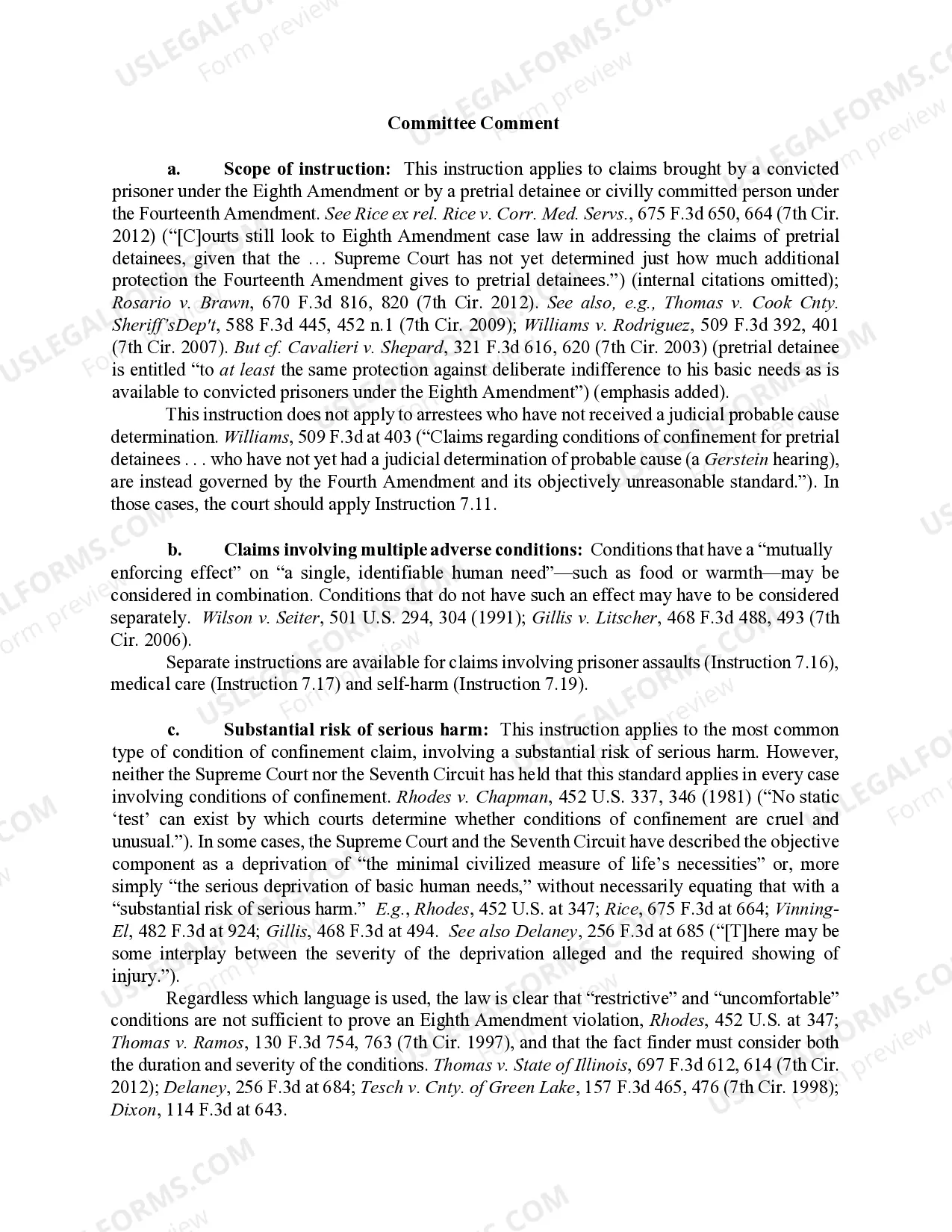
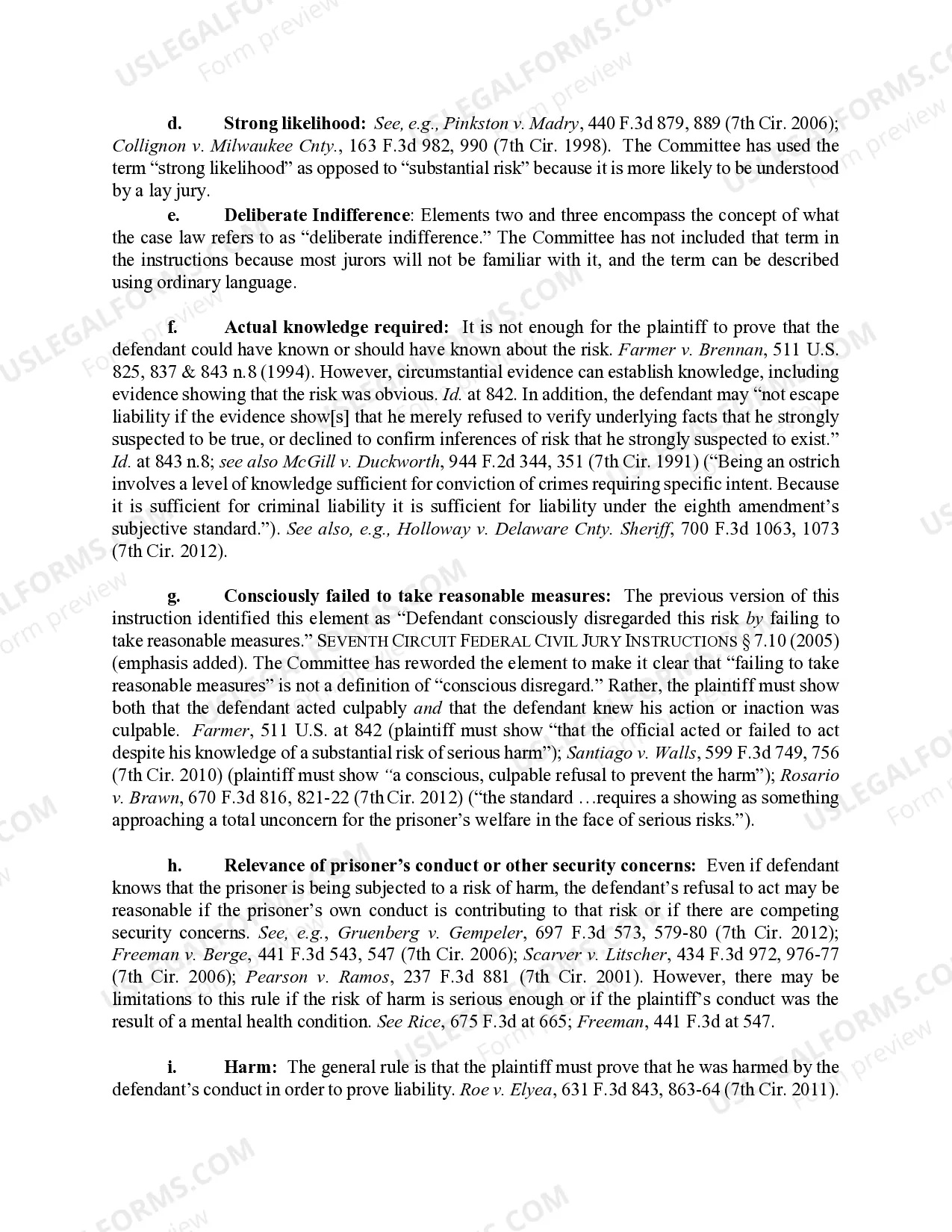
- Explanation of legal standards applicable under both the Eighth and Fourteenth Amendments.
When to use this document
This form should be used when an incarcerated individual believes they have experienced unconstitutional conditions while in jail or prison. Specific situations may include exposure to unsafe environments, inadequate medical care, or excessive use of force, which may have led to serious harm. It is crucial for individuals wishing to file a lawsuit based on these grounds to establish the elements outlined in this form to support their claims effectively.
Who this form is for
This form is intended for:
- Convicted prisoners seeking to challenge unsafe conditions under the Eighth Amendment.
- Pretrial detainees or civilly committed individuals asserting claims under the Fourteenth Amendment.
- Legal representatives of incarcerated individuals pursuing claims regarding prison conditions.
How to complete this form
To complete this form, follow these steps:
- Identify the unsafe condition experienced during confinement.
- Gather evidence demonstrating the likelihood of serious harm resulting from this condition.
- Document any awareness the defendant had regarding these risks.
- Outline the reasonable measures that could have been taken to mitigate the harm.
- Provide details of how the plaintiff's situation would have improved with reasonable action from the defendant.
Does this form need to be notarized?
In most cases, this form does not require notarization. However, some jurisdictions or signing circumstances might. US Legal Forms offers online notarization powered by Notarize, accessible 24/7 for a quick, remote process.
Get your form ready online
Our built-in tools help you complete, sign, share, and store your documents in one place.
Make edits, fill in missing information, and update formatting in US Legal Forms—just like you would in MS Word.
Download a copy, print it, send it by email, or mail it via USPS—whatever works best for your next step.
Sign and collect signatures with our SignNow integration. Send to multiple recipients, set reminders, and more. Go Premium to unlock E-Sign.
If this form requires notarization, complete it online through a secure video call—no need to meet a notary in person or wait for an appointment.
We protect your documents and personal data by following strict security and privacy standards.

Make edits, fill in missing information, and update formatting in US Legal Forms—just like you would in MS Word.

Download a copy, print it, send it by email, or mail it via USPS—whatever works best for your next step.

Sign and collect signatures with our SignNow integration. Send to multiple recipients, set reminders, and more. Go Premium to unlock E-Sign.

If this form requires notarization, complete it online through a secure video call—no need to meet a notary in person or wait for an appointment.

We protect your documents and personal data by following strict security and privacy standards.
Mistakes to watch out for
- Failing to provide sufficient evidence of the unsafe condition and its effects.
- Overlooking the importance of demonstrating the defendant's knowledge of the risks involved.
- Not clearly showing how the defendant's actions or inactions directly caused harm.
Benefits of completing this form online
- Convenience of accessing legal forms online without the need for in-person visits.
- Editable format allows tailored responses to specific situations and claims.
- Reliable legal instructions guided by principles established in federal court.
- This form is based on case law from the Seventh Circuit Court regarding conditions of confinement.
- Claims must be substantiated with evidence demonstrating the conditions constituted a substantial risk of serious harm.
- Legal representation is encouraged for individuals unfamiliar with the complexities of civil rights litigation.
Quick recap
- The form outlines essential elements for claims regarding prison conditions under the Eighth and Fourteenth Amendments.
- You must prove each element by a preponderance of the evidence to support your claim.
- Understanding the legal context is crucial for successfully navigating claims related to prison conditions.
Looking for another form?
Form popularity
FAQ
9.28 Particular Rights?Eighth Amendment?Convicted Prisoner's Claim of Failure to Protect the defendant made an intentional decision with respect to the conditions under which the plaintiff.those conditions put the plaintiff at substantial risk of suffering serious harm;
The eighth amendment provides prisoners with limited rights of protection against cruel and unusual punishment during the course of confinement. These rights extend to the existence of humane living conditions, adequate medical care, and protection from violence by other inmates.
Excessive bail shall not be required, nor excessive fines imposed, nor cruel and unusual punishments inflicted.
The Eighth Amendment imposes certain duties on prison officials: (1) to provide humane conditions of confinement; (2) to ensure that inmates receive adequate food, clothing, shelter and medical care; and (3) to ?take reasonable measures to guarantee the safety of the inmates.? Farmer v.
(in order to find a violation of the Eighth Amendment, two requirements must be met: (1) viewed objectively, a deprivation must be ?sufficiently serious? to result in the denial of ?the minimal civilized measure of life's necessities?; and (2) prison officials must have a ?sufficiently culpable state of mind?, one of ?
In performing its proportionality analysis, the Supreme Court looks to the following three factors: A consideration of the offense's gravity and the stringency of the penalty; A consideration of how the jurisdiction punishes its other criminals; And a consideration of how other jurisdictions punish the same crime.
Here are some punishments that courts have found cruel and unusual: execution of those who are insane. a 56-year term for forging checks totaling less than $500. handcuffing a prisoner to a horizontal bar exposed to the sun for several hours, and.
The Fourteenth Amendment provides pretrial detainees with the right to be protected from attack by other inmates while they are incarcerated, but before they have been convicted of a crime.