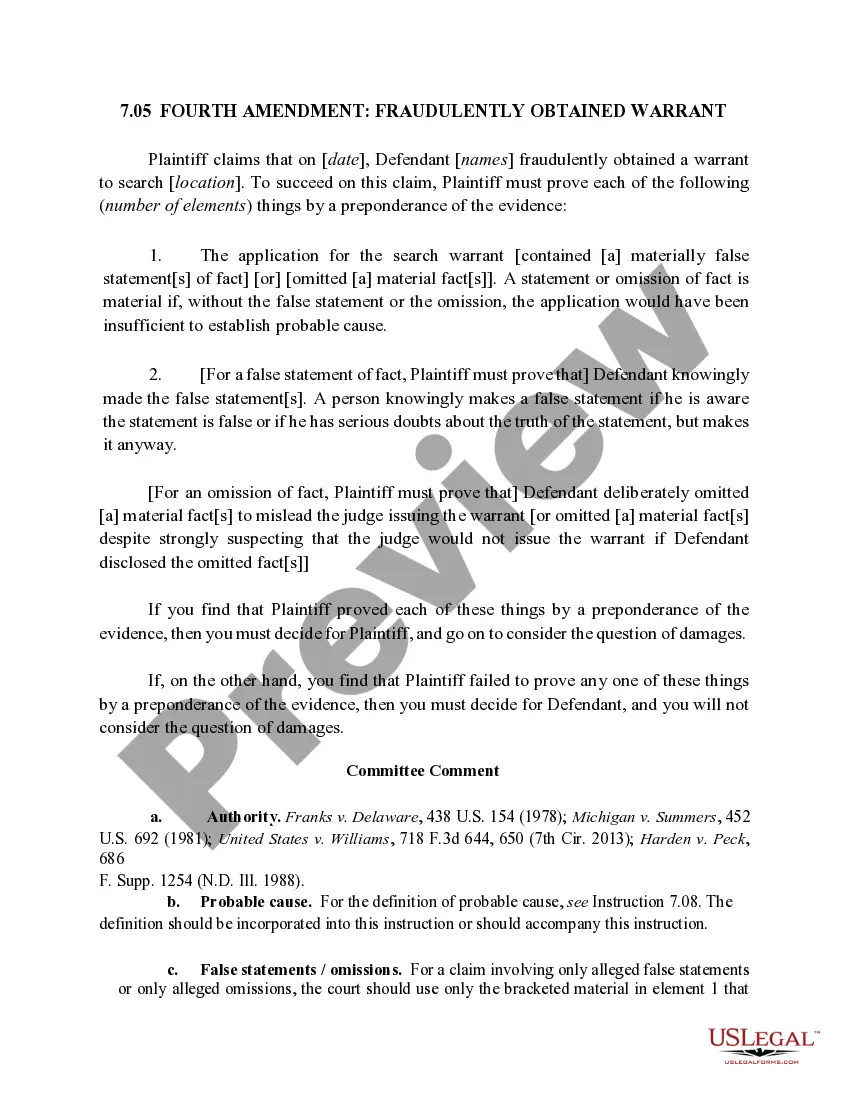
7.05 Fourth Amendment: Fraudulently Obtained Warrant
What this document covers
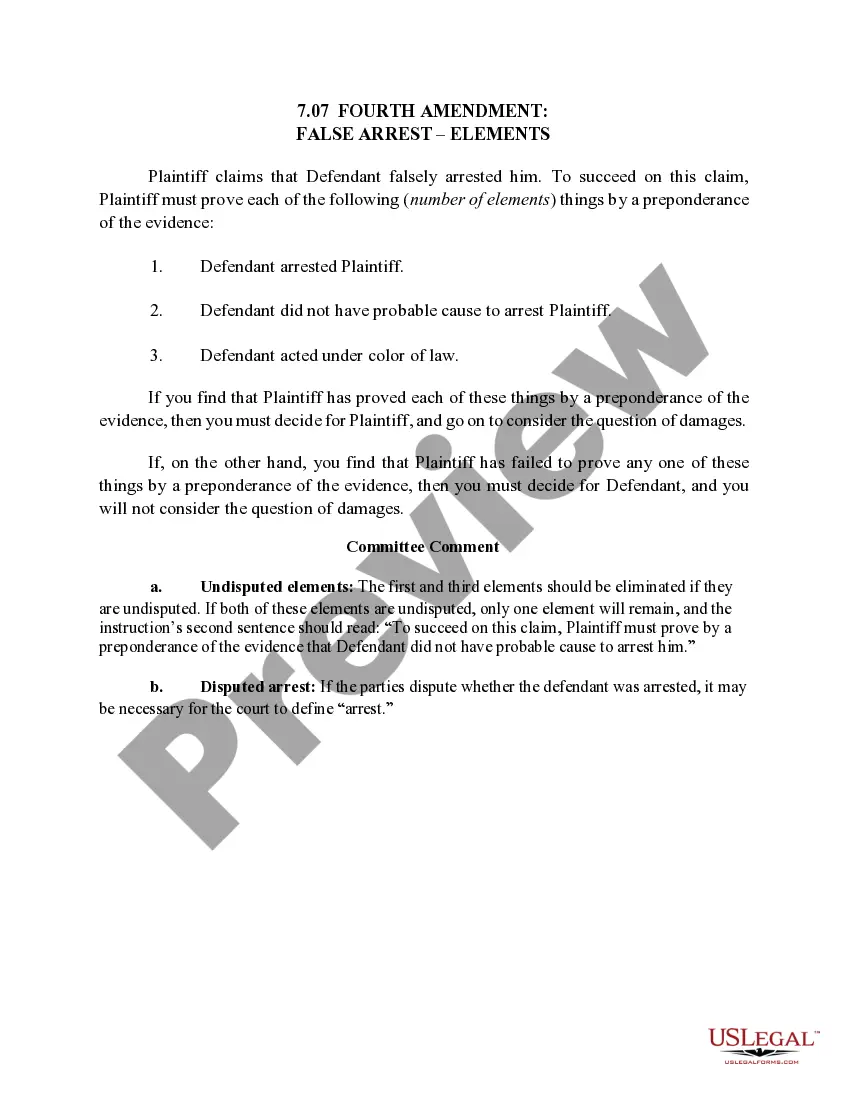
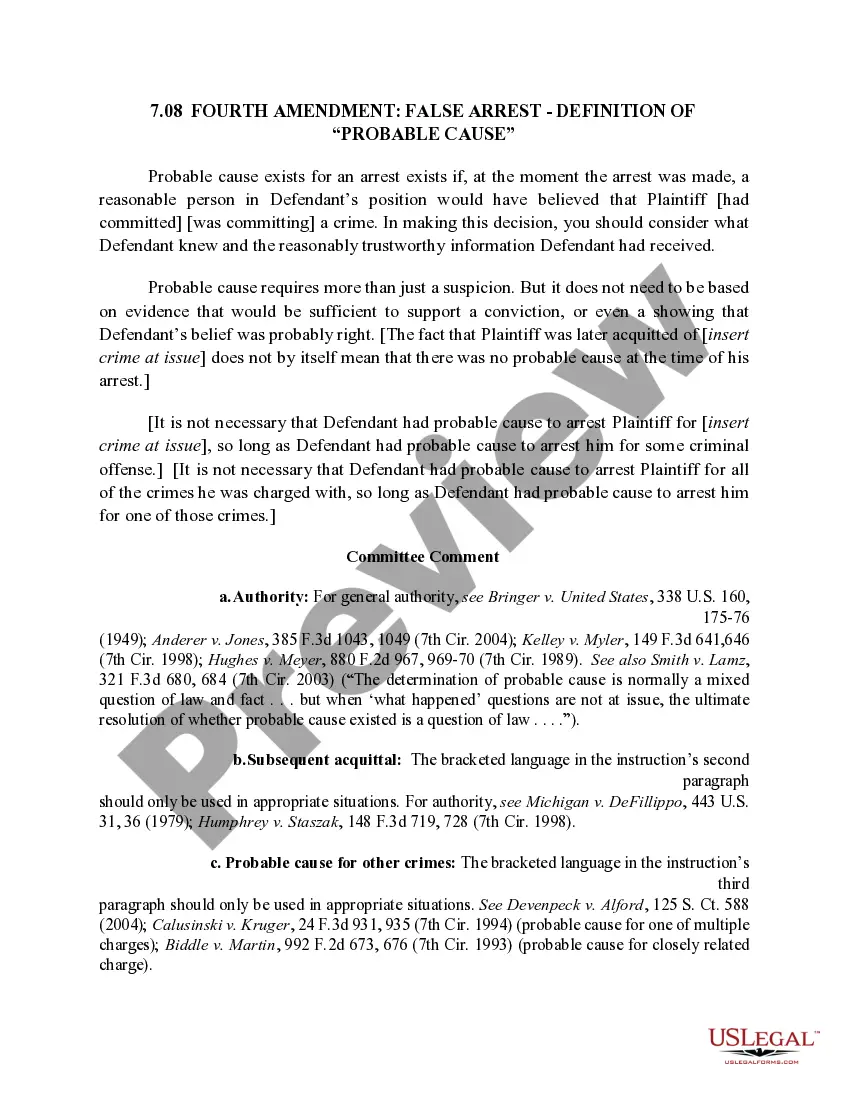
The Fourth Amendment: Fraudulently Obtained Warrant form is a legal document used in civil cases where a plaintiff claims that a defendant obtained a search warrant through fraudulent means. This form outlines the necessary elements that must be proven to assert such a claim, including false statements and omissions that misled the judge. It is distinct from other legal forms related to search warrants, as it specifically addresses the issue of fraud in the warrant procurement process.
Main sections of this form
- Claim details including the date and names of the involved parties.
- Assertion of materially false statements in the warrant application.
- Requirements for proving knowingly false statements or intentional omissions.
- Establishment of damages if the claim is proven.
- References to relevant case law that supports the form's instructions.

Situations where this form applies
This form should be used when a plaintiff believes that a search warrant was obtained based on false information or critical omissions. Real-world scenarios may include cases where law enforcement misrepresented facts to acquire a warrant, or withheld evidence that could have influenced the judge's decision. Proper use of this form can help individuals seek recourse for violations of their Fourth Amendment rights.
Who can use this document
- Individuals who believe they have been wrongfully searched based on a fraudulent warrant.
- Attorneys representing clients in civil cases involving Fourth Amendment claims.
- Parties involved in legal disputes related to search and seizure issues.
Instructions for completing this form
- Identify and enter the names of the plaintiff and defendant, along with relevant dates.
- Describe the location that was searched under the allegedly fraudulent warrant.
- Clearly outline the materially false statements or omissions made by the defendant.
- Establish evidence supporting the claims that the defendant knowingly misled the court.
- Conclude with a statement regarding damages if the claim is upheld.
Notarization requirements for this form
Notarization is not commonly needed for this form. However, certain documents or local rules may make it necessary. Our notarization service, powered by Notarize, allows you to finalize it securely online anytime, day or night.
Get your form ready online
Our built-in tools help you complete, sign, share, and store your documents in one place.
Make edits, fill in missing information, and update formatting in US Legal Forms—just like you would in MS Word.
Download a copy, print it, send it by email, or mail it via USPS—whatever works best for your next step.
Sign and collect signatures with our SignNow integration. Send to multiple recipients, set reminders, and more. Go Premium to unlock E-Sign.
If this form requires notarization, complete it online through a secure video call—no need to meet a notary in person or wait for an appointment.
We protect your documents and personal data by following strict security and privacy standards.

Make edits, fill in missing information, and update formatting in US Legal Forms—just like you would in MS Word.

Download a copy, print it, send it by email, or mail it via USPS—whatever works best for your next step.

Sign and collect signatures with our SignNow integration. Send to multiple recipients, set reminders, and more. Go Premium to unlock E-Sign.

If this form requires notarization, complete it online through a secure video call—no need to meet a notary in person or wait for an appointment.

We protect your documents and personal data by following strict security and privacy standards.
Common mistakes
- Failing to clearly specify the false statements or omissions.
- Not providing sufficient evidence to support the claims of fraud.
- Neglecting to check state-specific legal standards related to search warrants.
Benefits of using this form online
- Convenience of downloading and accessing the form anytime.
- Editability to customize the form to fit specific case details easily.
- Reliability, as the form is drafted by licensed attorneys, ensuring legal compliance.
Legal use & context
- This form is based on judicial standards set forth in relevant case law.
- Users must prove their claims by a preponderance of the evidence.
- The form directly addresses issues related to the Fourth Amendment rights regarding unreasonable searches and seizures.
Summary of main points
- The form is essential for claiming damages from a fraudulent search warrant.
- Understanding the elements of fraud in warrant acquisition is crucial for successful claims.
- Properly completing the form requires detailed information and evidence.
Looking for another form?
Form popularity
FAQ
The exclusionary rule prevents the government from using most evidence gathered in violation of the United States Constitution. The decision in Mapp v. Ohio established that the exclusionary rule applies to evidence gained from an unreasonable search or seizure in violation of the Fourth Amendment.
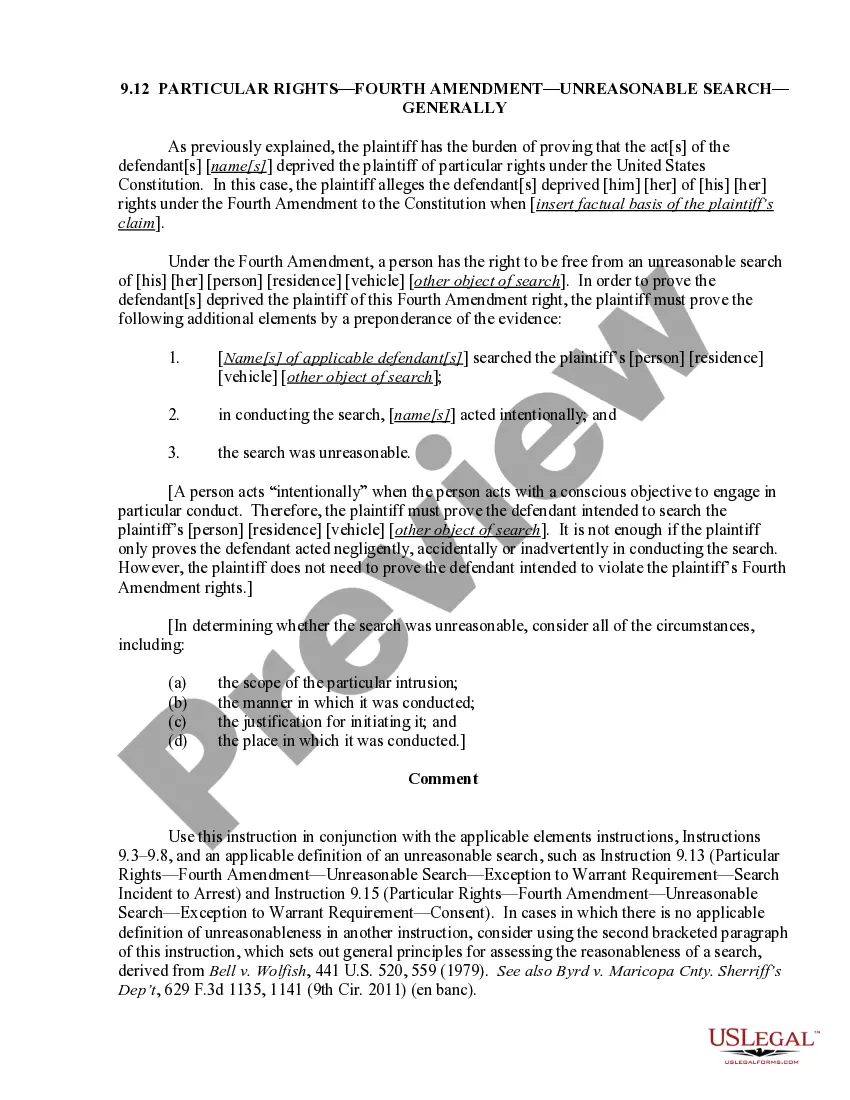
The Fourth Amendment prohibits the United States government from conducting ?unreasonable searches and seizures." In general, this means police cannot search a person or their property without a warrant or probable cause. It also applies to arrests and the collection of evidence.
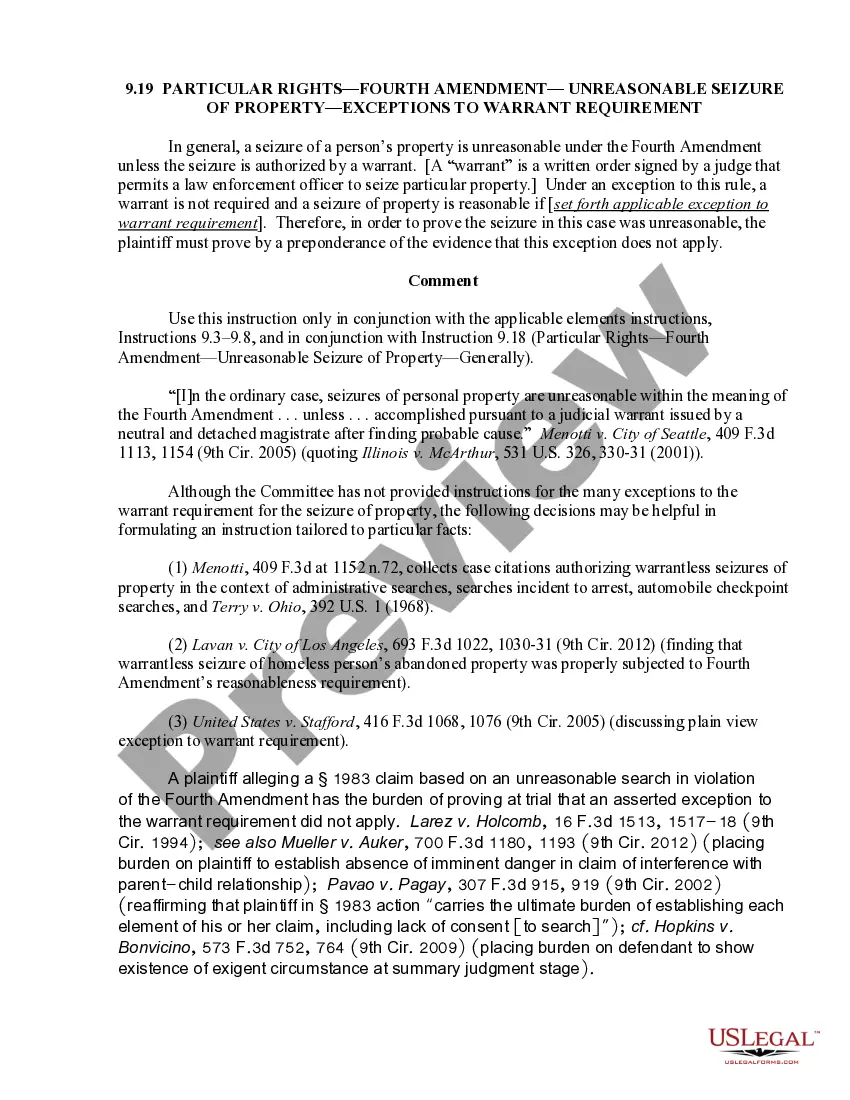
Searches and seizures inside a home without a warrant are presumptively unreasonable. Payton v. New York, 445 U.S. 573 (1980).
Under the exigent circumstances exception to the fourth amendment warrant requirement, the courts have recognized three threats as providing justification for warrantless action. These include danger to life, danger of escape, and danger of destruction or removal of evidence.
The right of the people to be secure in their persons, houses, papers, and effects, against unreasonable searches and seizures, shall not be violated, and no Warrants shall issue, but upon probable cause, supported by Oath or affirmation, and particularly describing the place to be searched, and the persons or things
For example, consider the following scenarios: An arrest is found to violate the Fourth Amendment because it was not supported by probable cause or a valid warrant. Any evidence obtained through that unlawful arrest, such as a confession, will be kept out of the case.
The warrant clause of the Fourth Amendment has its origins in British law and events of the American colonial period, but recent United States Supreme Court decisions have narrowed the privacy rights that the framers of the Constitution sought to protect.