Rhode Island Demand For Direct Payment - Corporation
Overview of this form
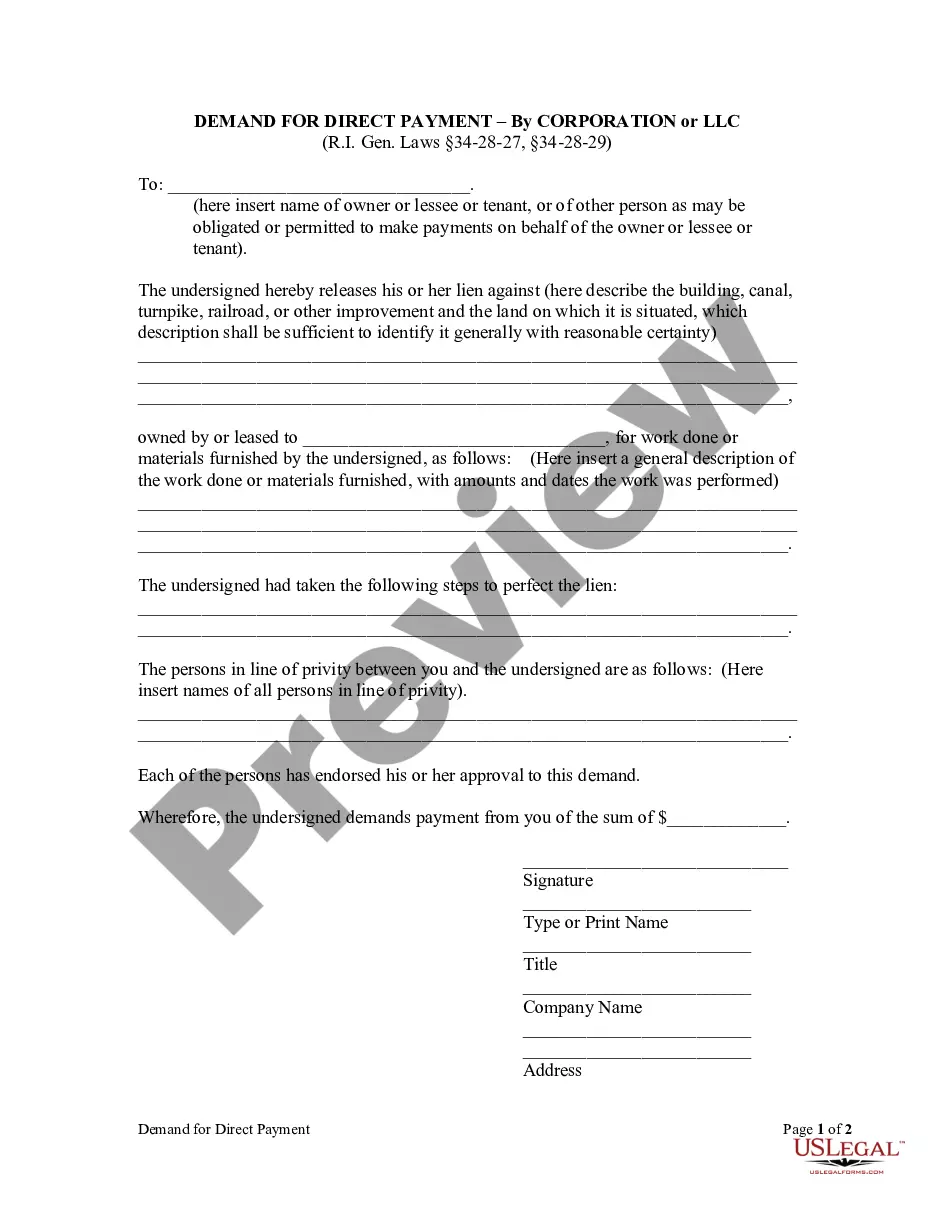
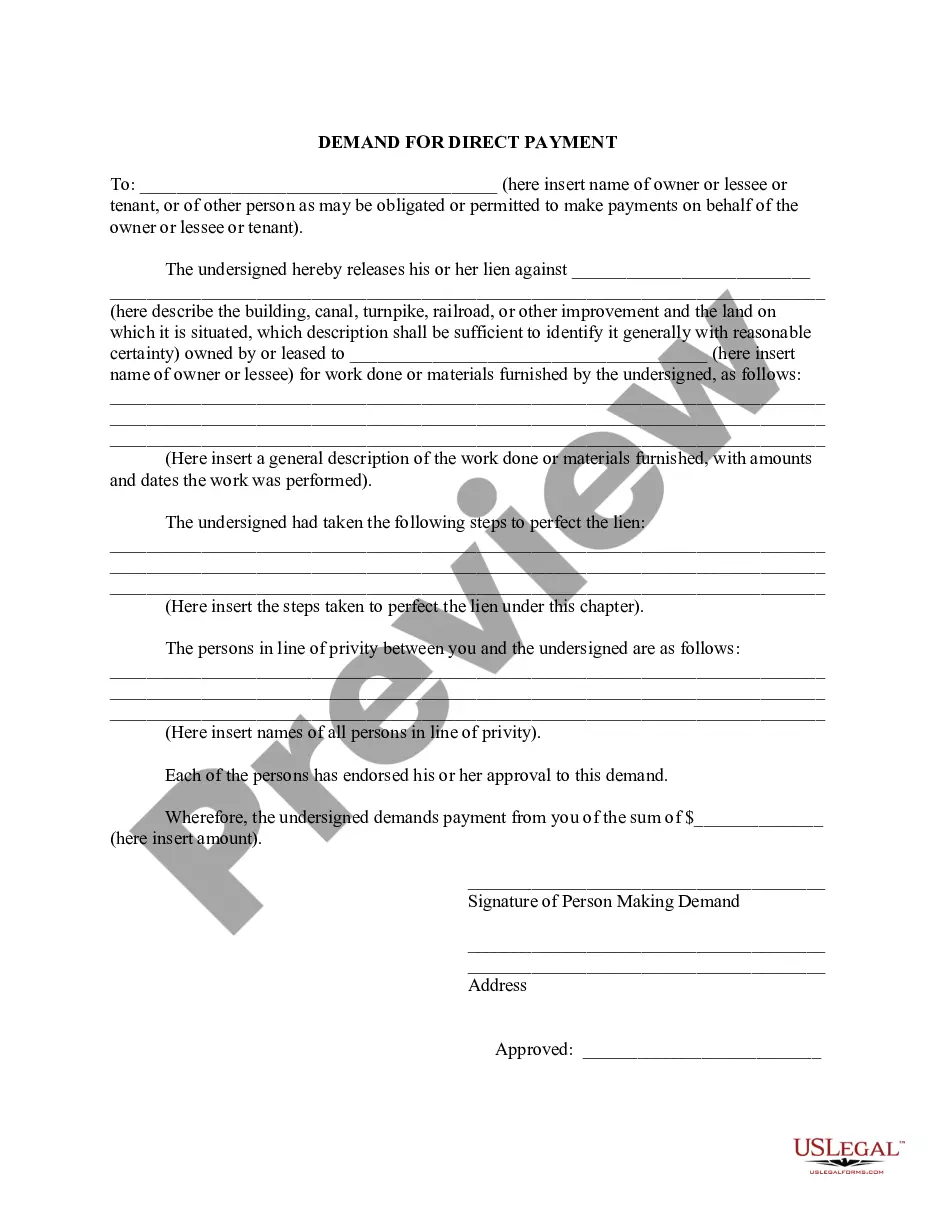
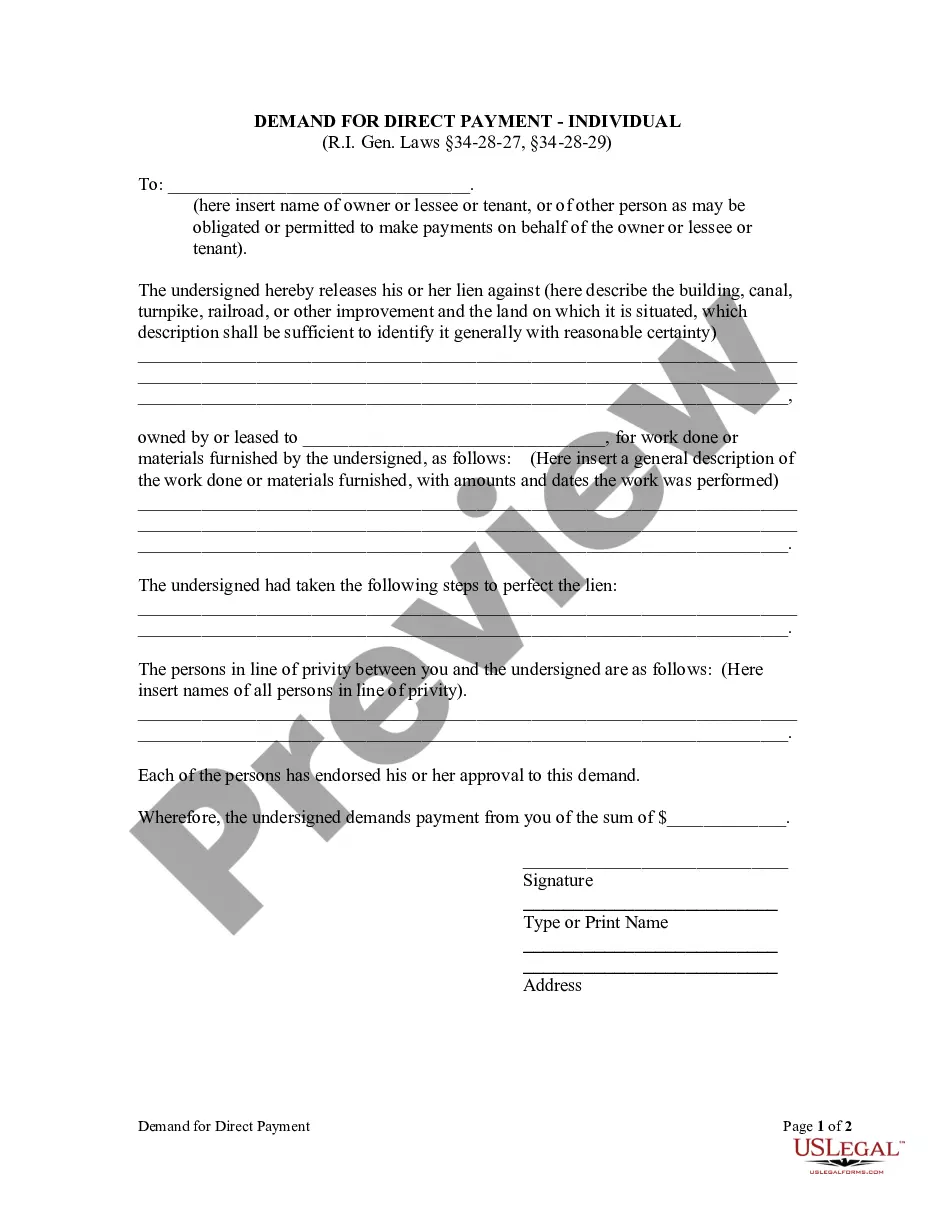
The Demand for Direct Payment - Corporation is a legal document used by individuals or entities with a potential lien against a property. This form allows them to formally request payment for work done or materials supplied after releasing the lien. Essentially, it ensures that stakeholders, such as contractors or suppliers, can demand direct payment from the property owner or lessee, following proper notification and consent procedures. This form is distinct from other lien-related documents, as it specifically addresses the release of a lien in exchange for payment.
Key parts of this document
- Identification of the lien claimant and their relationship to the project.
- Description of the property in question and the improvements made.
- Details of the work done or materials provided, including amounts and dates.
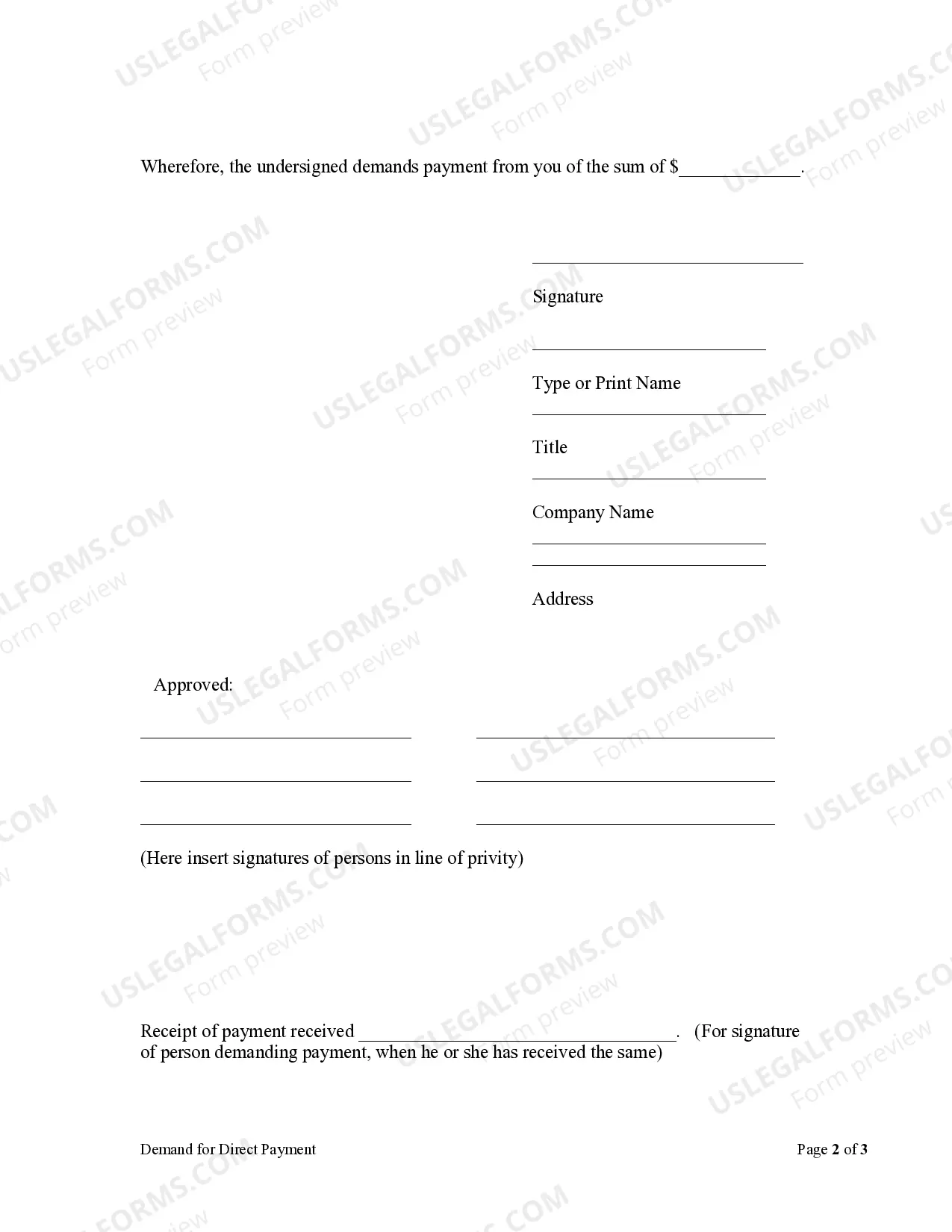
- Disclosure of individuals in the line of privity who must consent to the demand.
- Signature fields for both the claimant and the parties in privity.

When to use this document
This form should be used when a contractor or supplier has provided services or materials to a property but has not yet received payment. Particularly, if the contractor has consented to release their lien on the property, they can utilize this document to formally demand payment from the property owner, lessee, or other responsible parties. This situation often arises in construction and renovation contexts.
Who needs this form
- Contractors who have completed work on a property and are seeking payment.
- Suppliers of materials who have not yet been compensated for their contributions.
- Any individuals or corporations entitled to a lien looking to formalize a payment request.
Instructions for completing this form
- Identify the owner, lessee, or tenant responsible for the payment.
- Describe the property, ensuring that it is identifiable with reasonable certainty.
- Provide a detailed account of the work performed or materials provided, including dates and amounts.
- List all individuals in the line of privity and obtain their written consent.
- Sign and date the form, ensuring that all necessary fields are filled out completely.
Is notarization required?
Notarization is not commonly needed for this form. However, certain documents or local rules may make it necessary. Our notarization service, powered by Notarize, allows you to finalize it securely online anytime, day or night.
Get your form ready online
Our built-in tools help you complete, sign, share, and store your documents in one place.
Make edits, fill in missing information, and update formatting in US Legal Forms—just like you would in MS Word.
Download a copy, print it, send it by email, or mail it via USPS—whatever works best for your next step.
Sign and collect signatures with our SignNow integration. Send to multiple recipients, set reminders, and more. Go Premium to unlock E-Sign.
If this form requires notarization, complete it online through a secure video call—no need to meet a notary in person or wait for an appointment.
We protect your documents and personal data by following strict security and privacy standards.

Make edits, fill in missing information, and update formatting in US Legal Forms—just like you would in MS Word.

Download a copy, print it, send it by email, or mail it via USPS—whatever works best for your next step.

Sign and collect signatures with our SignNow integration. Send to multiple recipients, set reminders, and more. Go Premium to unlock E-Sign.

If this form requires notarization, complete it online through a secure video call—no need to meet a notary in person or wait for an appointment.

We protect your documents and personal data by following strict security and privacy standards.
Common mistakes to avoid
- Failing to include a precise property description, leading to potential disputes.
- Not obtaining consent from all parties in the line of privity.
- Leaving signature or date fields blank, which can invalidate the form.
Benefits of completing this form online
- Immediate access to a legally vetted template that saves time and effort.
- Editability to customize your form as needed for your specific situation.
- Reliability in format and language, ensuring compliance with legal standards.
What to keep in mind
- The Demand For Direct Payment - Corporation is essential for lien holders to request payment directly from property owners.
- It helps in streamlining the process of securing payment after a lien release.
- Be thorough in filling out all required sections to avoid common mistakes.
- Understand your state's specific requirements to ensure compliance.
Looking for another form?

Form popularity
FAQ
Steps to Starting a Business in Rhode Island. Step 1: Choose a Business Idea. Step 2: Write a Business Plan. Step 3: Select a Business Entity. Step 4: Register a Business Name. Step 5: Get an EIN. Step 6: Open a Business Bank Account. Step 7: Apply for Business Licenses & Permits.
Step 1: Choose a Business Idea. Step 2: Write a Business Plan. Step 3: Select a Business Entity. Step 4: Register a Business Name. Step 5: Get an EIN. Step 6: Open a Business Bank Account. Step 7: Apply for Business Licenses & Permits. Step 8: Find Financing.
Forming an LLC in Rhode Island is simple. Search your Rhode Island LLC name in the state database and select your RI Resident Agent. Then file your Articles of Organization with the Rhode Island Secretary of State and wait for your LLC to be approved. You can file your LLC by mail, online, or walk-in filing.
Step 1: Choose a Business Idea. Step 2: Write a Business Plan. Step 3: Select a Business Entity. Step 4: Register a Business Name. Step 5: Get an EIN. Step 6: Open a Business Bank Account. Step 7: Apply for Business Licenses & Permits. Step 8: Find Financing.
Rhode Island Small Business Information. Get One or More Business Licenses. File Records For Your Form of Business. Obtain Professional Licensing. Register an Assumed or Fictitious Business Name.
C Corporations, S Corporations, and Partnerships - A federal extension obtained by filing Form 7004 with the Internal Revenue Service does not automatically extend the time to file the Rhode Island return.Form RI-7004 is on the main menu of the Rhode Island C Corp, S Corp, and Partnership returns.
Decide on a business name. Establish and publish a DBA (Fictitious Business Name) statement. Get a federal employer identification number (EIN). Determine if you need a permit or license for the type of business you have. Create a separate bank account for your business.
Decide on a name for your business. Assign a registered agent for service of process. Get an Employer Identification Number (EIN) from the IRS. Create an operating agreement. File for pass-through withholding tax.
Choose a business name. File an assumed business name with the city or town clerk. Obtain licenses, permits, and zoning clearance. Obtain an Employer Identification Number.