Mississippi Motion for Quash Subpoena Duces Tecum
Overview of this form
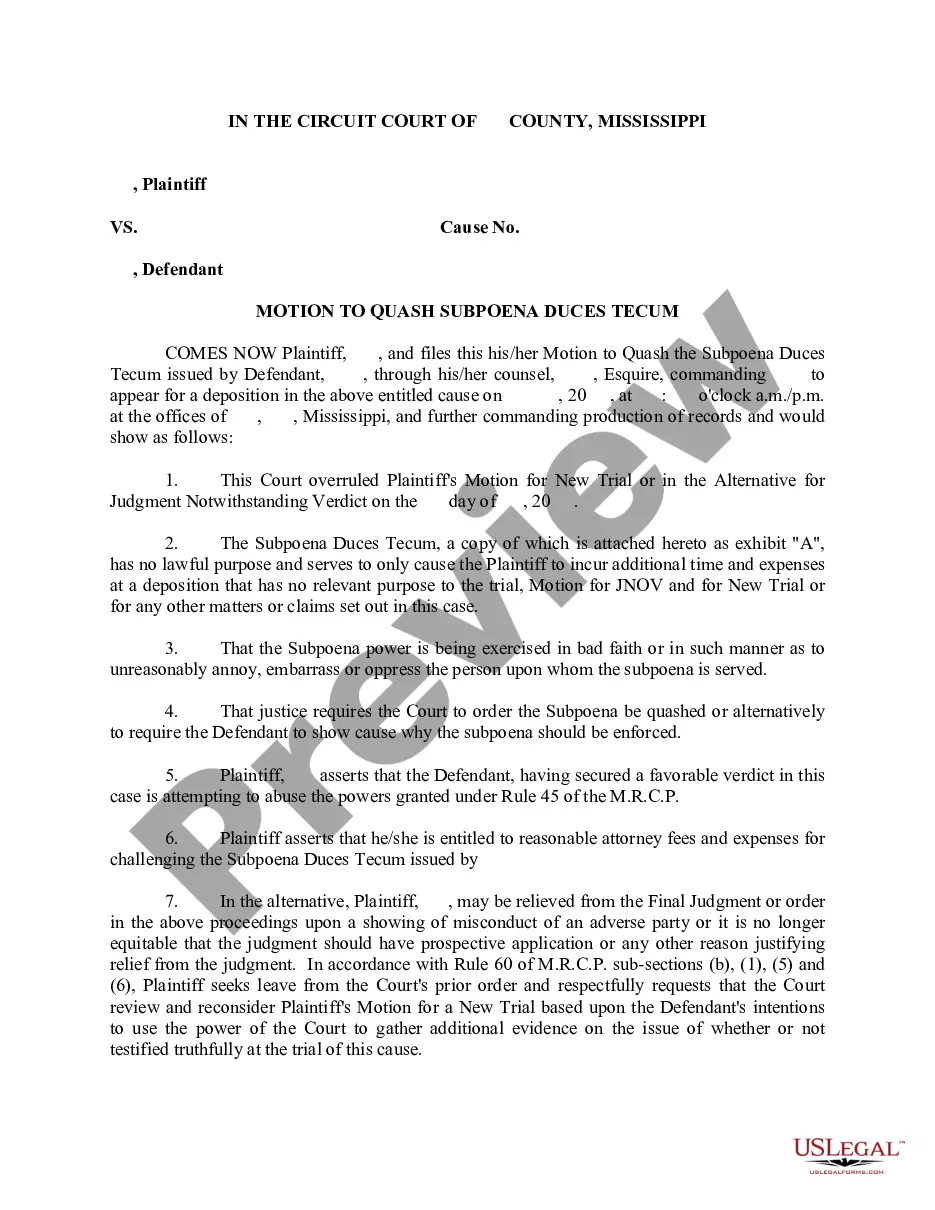
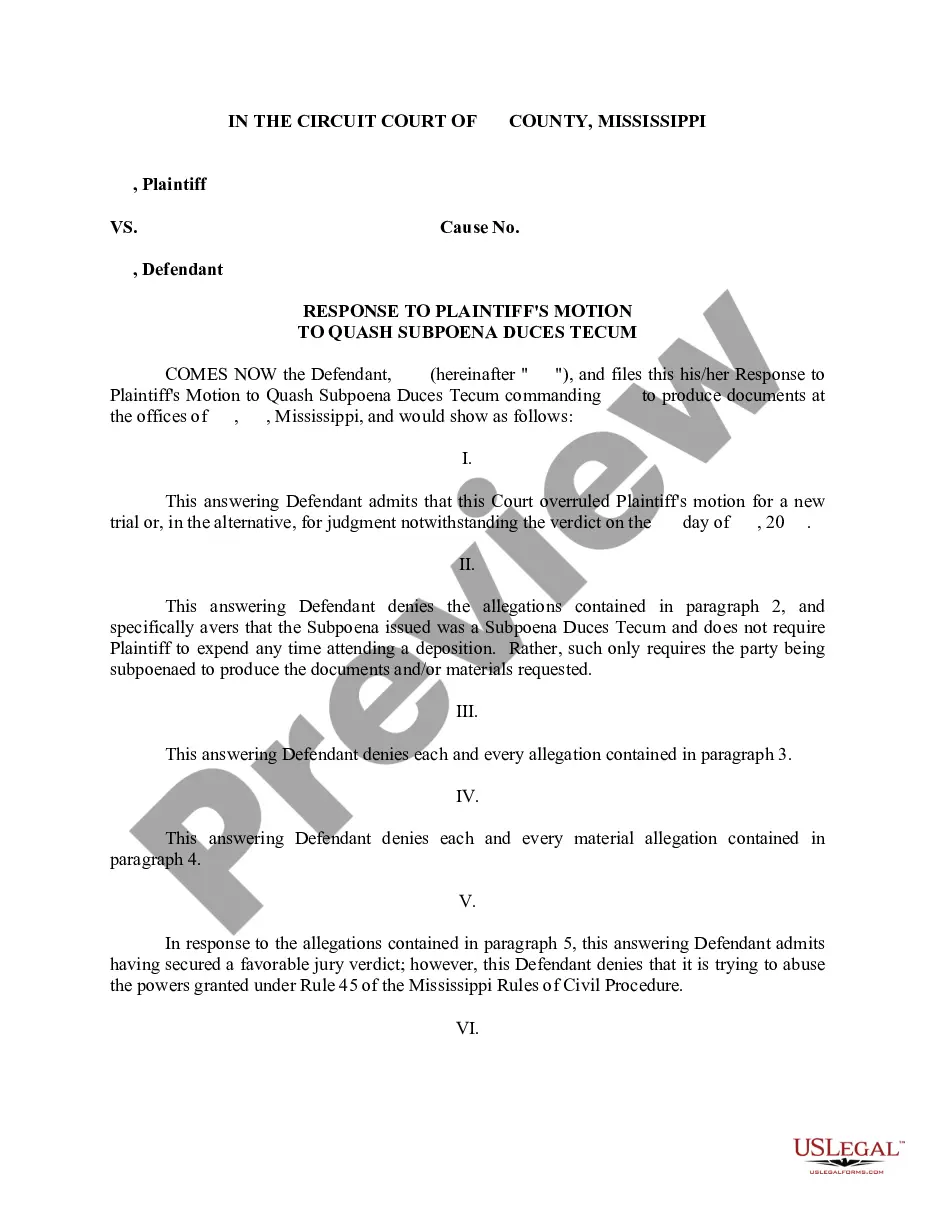
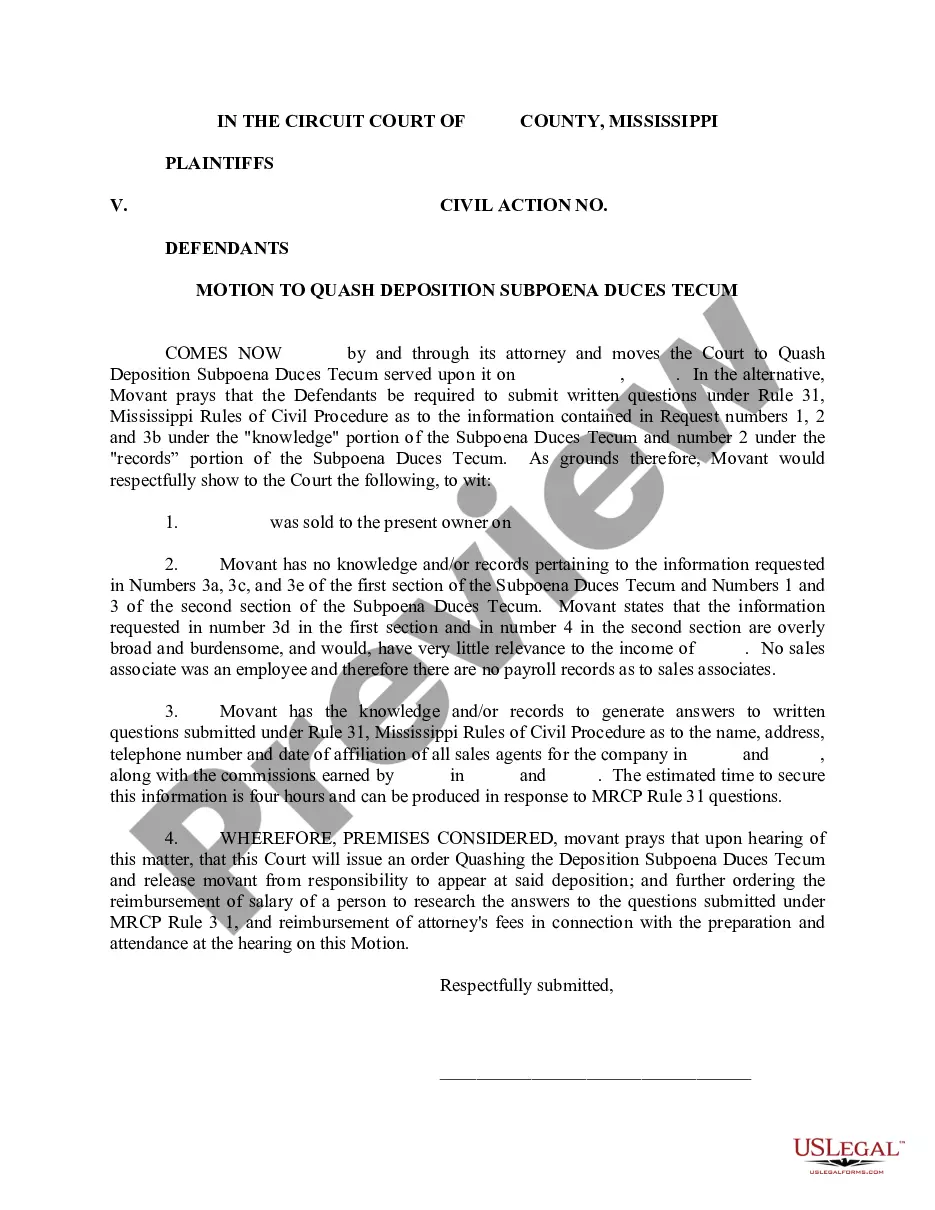
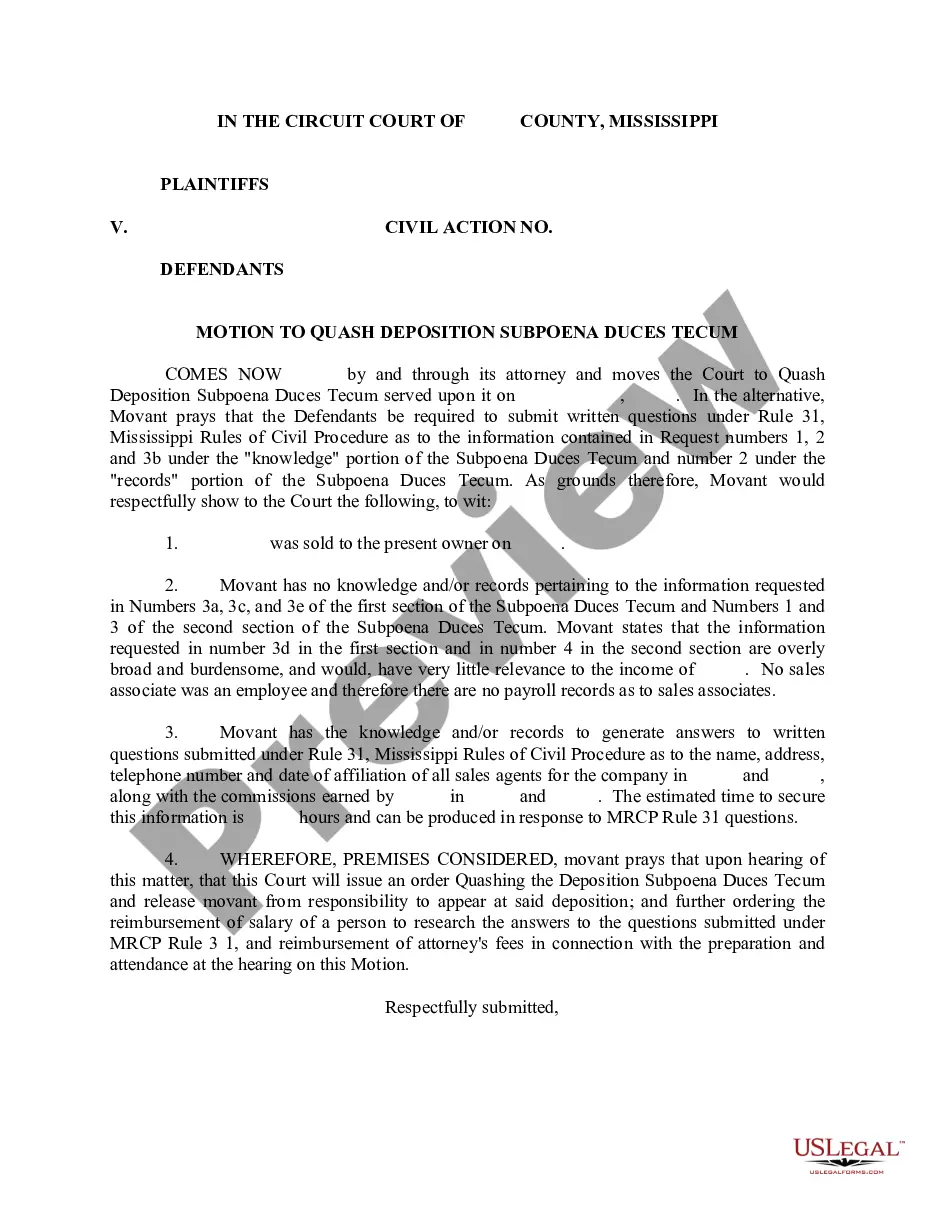
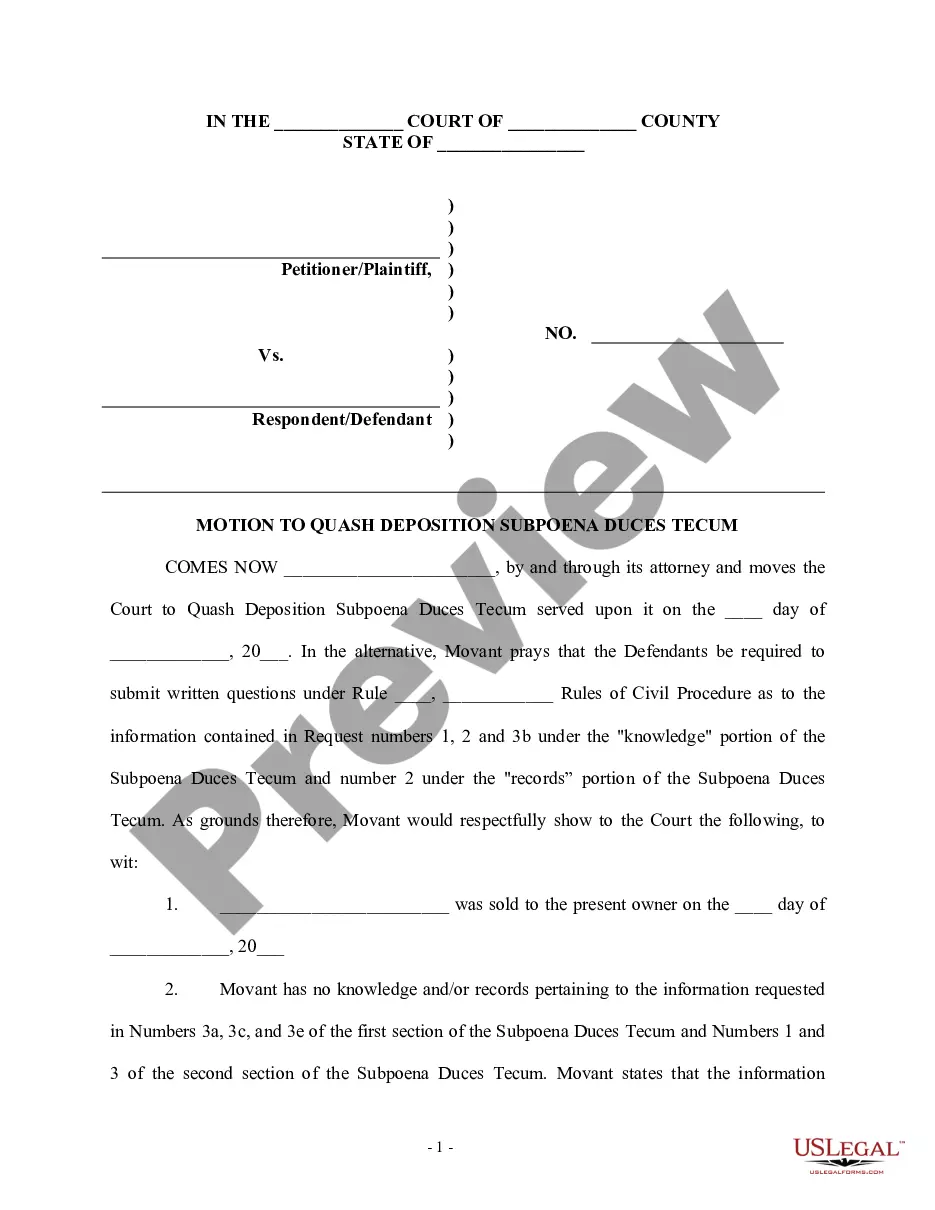
A Motion for Quash Subpoena Duces Tecum is a legal document used to request that a court nullify a subpoena requiring the production of documents or testimony. Unlike other motions, this form specifically addresses instances where the subpoena may be considered unreasonable, burdensome, or lacking lawful purpose. This motion is essential for protecting a party's interests in a legal proceeding when faced with potentially intrusive demands for information.
What’s included in this form
- Caption: Identifies the parties involved and the cause number.
- Motion introduction: Specifies the request to quash the subpoena.
- Supporting arguments: Lists the reasons the subpoena is deemed unreasonable or irrelevant.
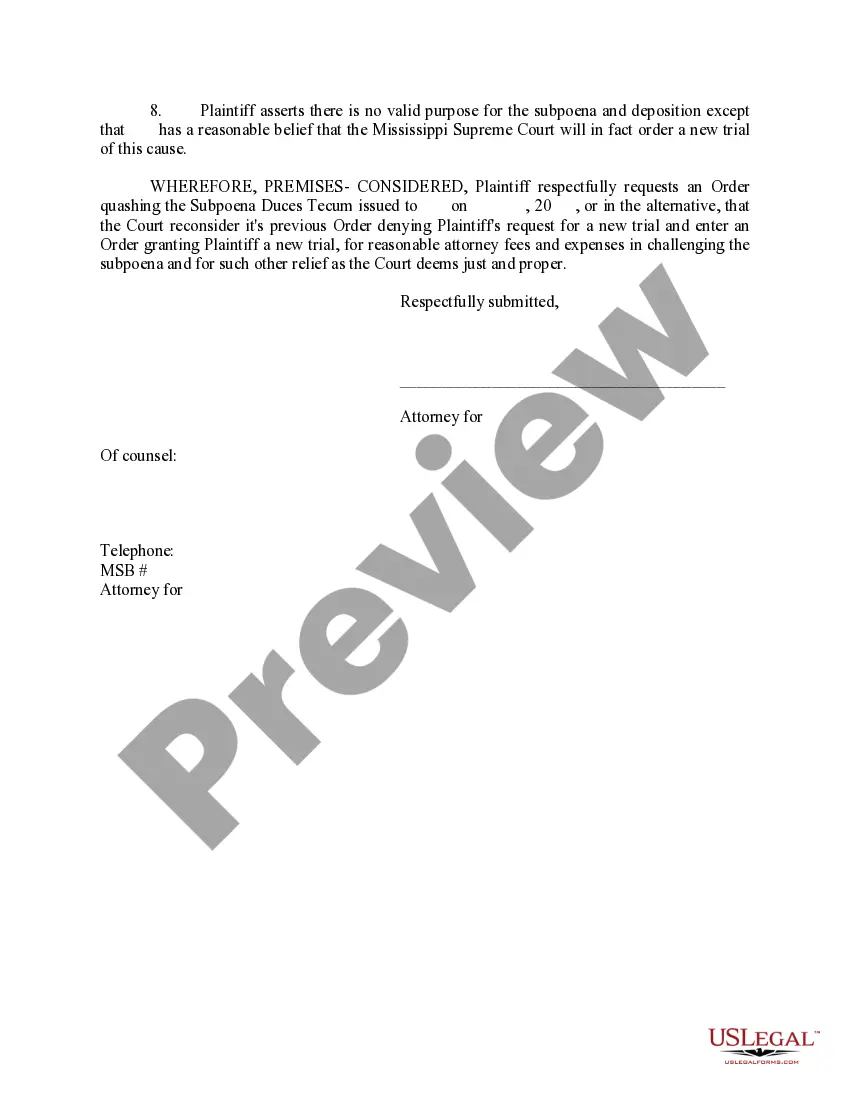
- Legal basis: References the applicable rules and grounds for quashing the subpoena.
- Prayer for relief: Indicates the specific outcomes the plaintiff seeks from the court.
When this form is needed
This form should be used when a party receives a subpoena that demands documents or testimony considered excessive or irrelevant to the case. Common scenarios include cases where the requesting party aims to gather unnecessary information, where the subpoena imposes undue burden, or where there is a belief that the information sought is not pertinent to any claims or defenses in the pending litigation.
Intended users of this form
- Parties involved in litigation as plaintiffs or defendants.
- Legal counsel representing clients responding to a subpoena for records or testimony.
- Individuals who believe a subpoena is being used in bad faith or for harassment.
- Any party wishing to protect their rights and interests in a legal matter.
Steps to complete this form
- Identify the parties: Fill in the names of the plaintiff and defendant, including their respective legal advisors.
- Specify the subpoena details: Include the date and time of the deposition required by the subpoena.
- State your arguments: Clearly outline the reasons for quashing the subpoena based on irrelevance or excessive burden.
- Request for relief: Indicate the outcomes you are seeking, such as the quashing of the subpoena or an award of attorney fees.
- Sign and date: Ensure the motion is signed by the attorney representing the plaintiff, along with their contact information.
Notarization requirements for this form
Notarization is not commonly needed for this form. However, certain documents or local rules may make it necessary. Our notarization service, powered by Notarize, allows you to finalize it securely online anytime, day or night.
Get your form ready online
Our built-in tools help you complete, sign, share, and store your documents in one place.
Make edits, fill in missing information, and update formatting in US Legal Forms—just like you would in MS Word.
Download a copy, print it, send it by email, or mail it via USPS—whatever works best for your next step.
Sign and collect signatures with our SignNow integration. Send to multiple recipients, set reminders, and more. Go Premium to unlock E-Sign.
If this form requires notarization, complete it online through a secure video call—no need to meet a notary in person or wait for an appointment.
We protect your documents and personal data by following strict security and privacy standards.

Make edits, fill in missing information, and update formatting in US Legal Forms—just like you would in MS Word.

Download a copy, print it, send it by email, or mail it via USPS—whatever works best for your next step.

Sign and collect signatures with our SignNow integration. Send to multiple recipients, set reminders, and more. Go Premium to unlock E-Sign.

If this form requires notarization, complete it online through a secure video call—no need to meet a notary in person or wait for an appointment.

We protect your documents and personal data by following strict security and privacy standards.
Common mistakes
- Failing to provide a copy of the subpoena as an exhibit.
- Not clearly articulating the relevance or burden imposed by the subpoena.
- Inadequate legal justification for quashing the subpoena.
- Missing signatures or improperly completed contact information.
Benefits of completing this form online
- Convenience of downloading and filling the document from anywhere.
- Editability allows customization to specific case facts.
- Access to forms drafted by licensed attorneys, ensuring legal compliance.
- Time-saving compared to traditional methods of obtaining legal documents.
Legal use & context
- This motion may affect the outcome of your case if successful in quashing the subpoena.
- Filing this motion timely is critical to avoid default compliance with the subpoena.
- Consulting with legal counsel is recommended to ensure best practices and adherence to procedural rules.
Main things to remember
- A Motion for Quash Subpoena Duces Tecum protects parties from unreasonable subpoenas.
- The form must clearly articulate why the subpoena should be quashed.
- It is essential to comply with local procedures and legal standards to increase the chance of success.
Looking for another form?

Form popularity
FAQ
A court will usually grant a motion and quash a subpoena if it (i) does not allow you a reasonable time to respond (depending on the jurisdiction, a minimum of 10-14 days); (ii) requires that you produce documents at a location more than 100 miles away; (iii) subjects you to undue burden (i.e., excessive time,
3. Any non-party who has been served with a business records subpoena may bring a motion to quash. Note, however, that some case law holds that a non-party may simply serve written objections and is not required to bring a motion to quash. The discovery rules do not discriminate against nonparty deponents.
A motion to quash must be based on valid grounds.If the court grants the motion, it may quash the subpoena entirely, modify it, or order that you comply with it on specified conditions. If the court denies the motion, you will usually have to comply with it as written.
Under HIPAA, any subpoena duces tecum that is not accompanied by a court order must contain a written statement and accompanying documentation demonstrating that the requesting party made reasonable efforts to (1) notify the patient whose records are being requested, or (2) secure a qualified protective order.
After the motion to quash is filed, the court will review the case and make its determination. For example, if the judge grants a motion to quash service, then the service on the defendant would be considered void. A motion to quash that is approved would also invalidate any applicable decisions from a lower court.
If you want to take the risk, save the money you would have spent on a motion to quash (lawyers often charge from $2,000 to more than $3,000) and instead use it to settle the case if: a) you are served a summons and complaint, or b) you are actually targeted in an individual lawsuit against you.
Any employee whose employment records are sought by a subpoena duces tecum may bring a motion to quash. Note that non-party employees may object to a subpoena by serving written objections. 3. Any non-party who has been served with a business records subpoena may bring a motion to quash.