Michigan New Resident Guide
What this document covers
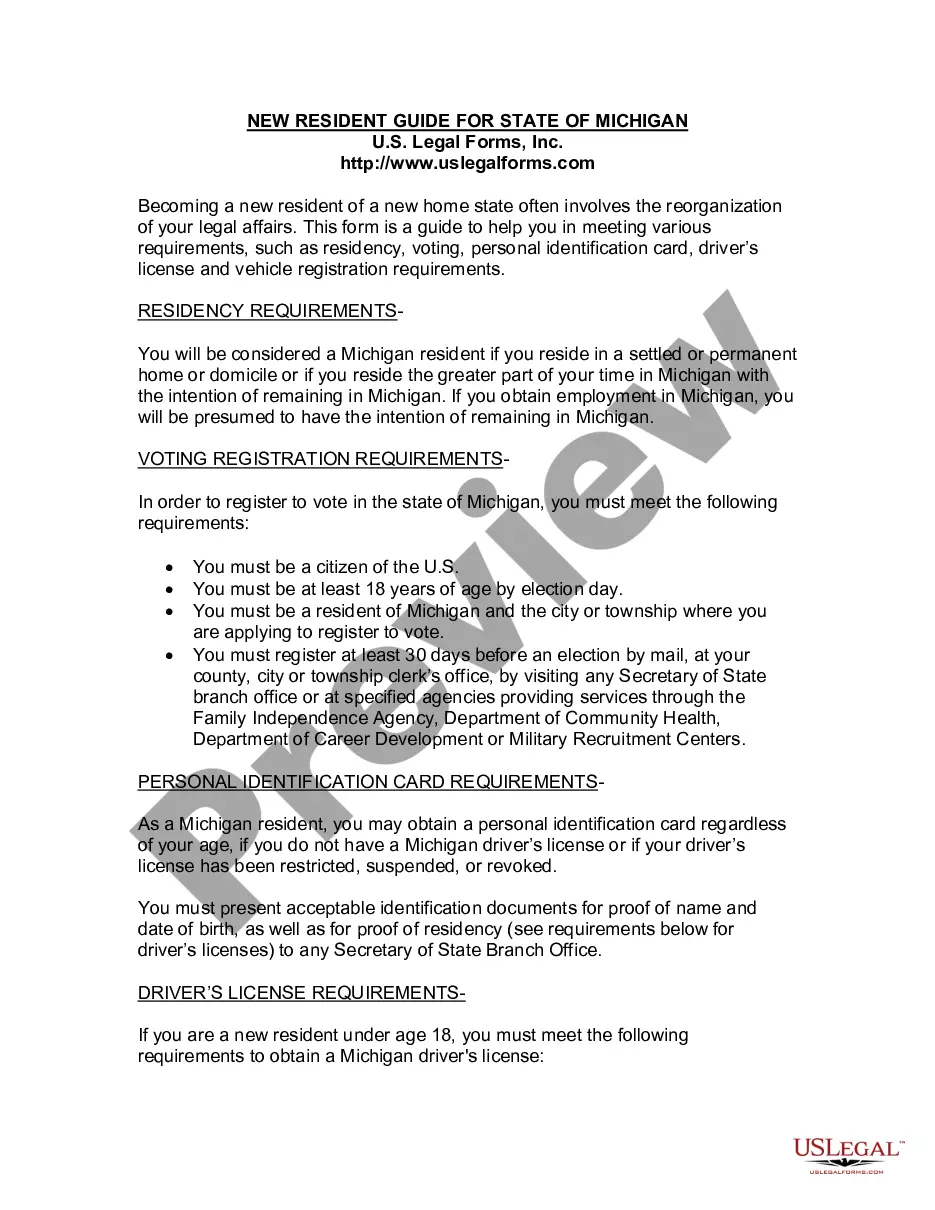
The New Resident Guide is an informational resource designed to assist individuals who are relocating to a new state. This guide provides essential details about the state-specific requirements for establishing residency, registering to vote, obtaining identification cards, acquiring a driverâs license, and registering vehicles. Unlike other forms or documents, this guide consolidates vital information to streamline your transition as a new resident.
Key parts of this document
- Residency requirements overview for new residents.
- Voter registration criteria and deadlines.
- Steps to obtain personal identification cards.
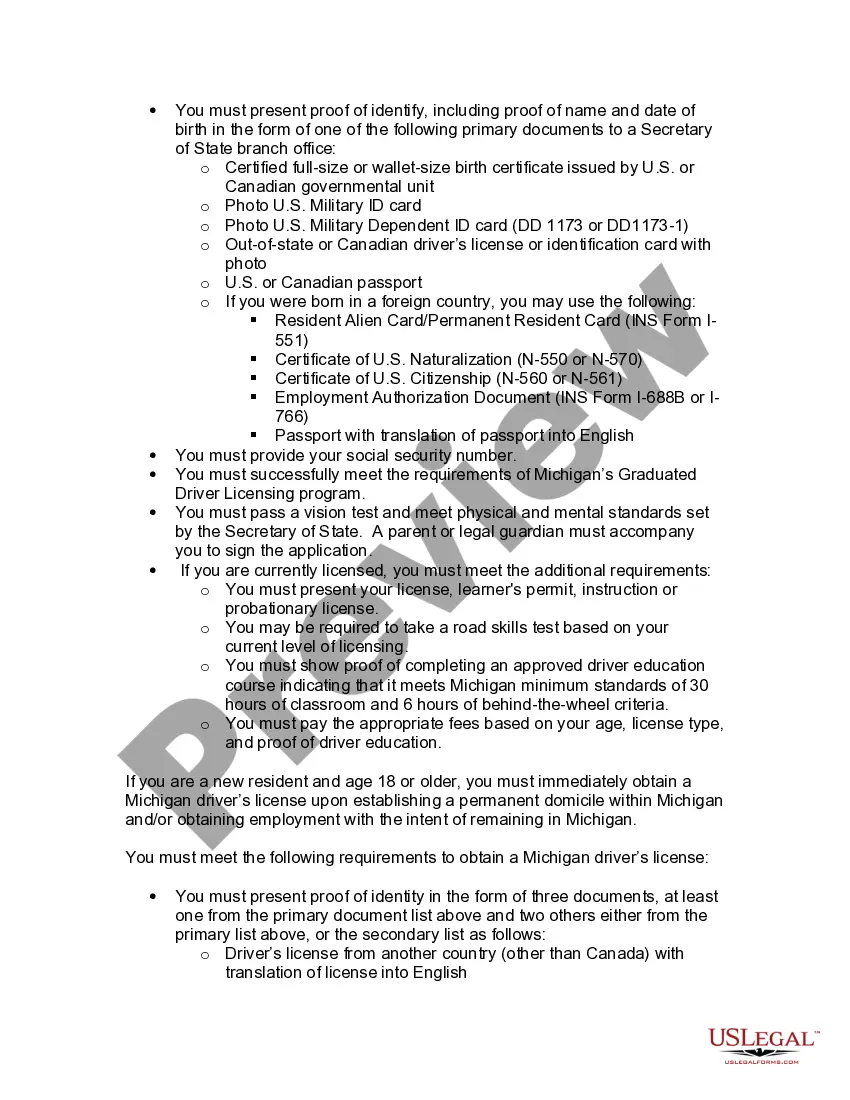
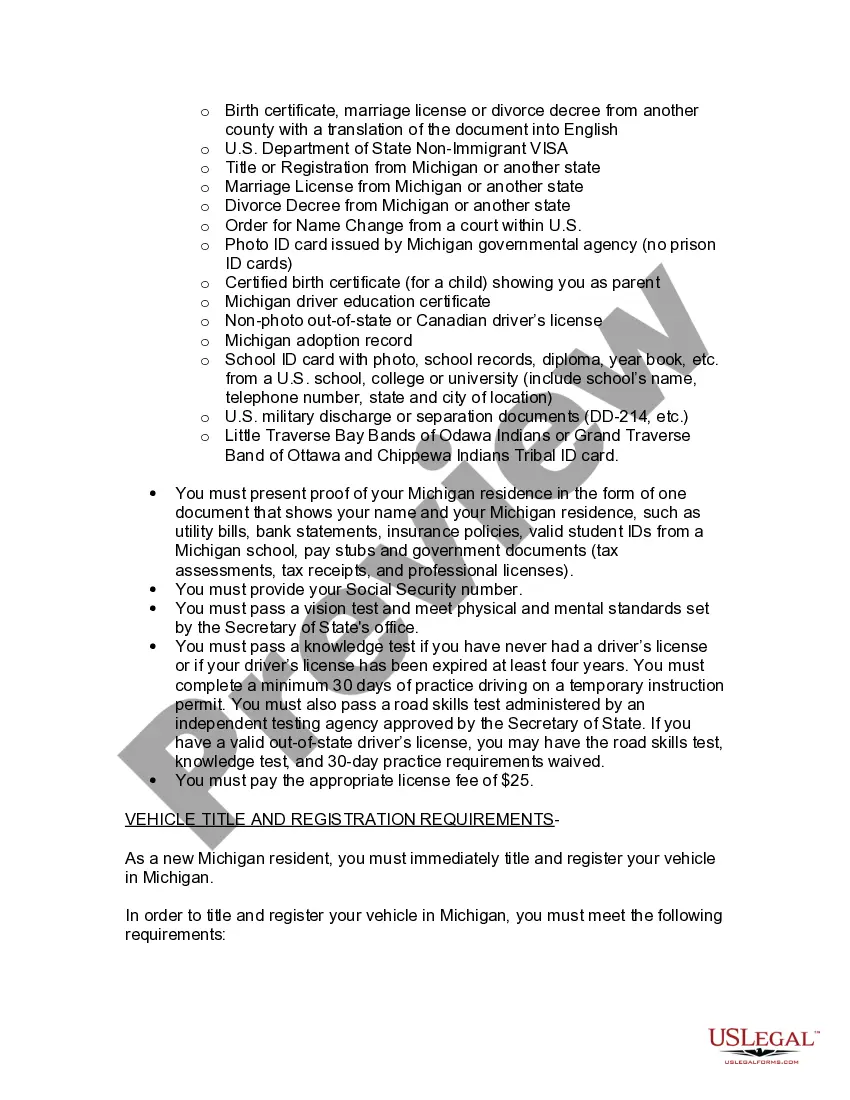
- Driver's license application processes and requirements.
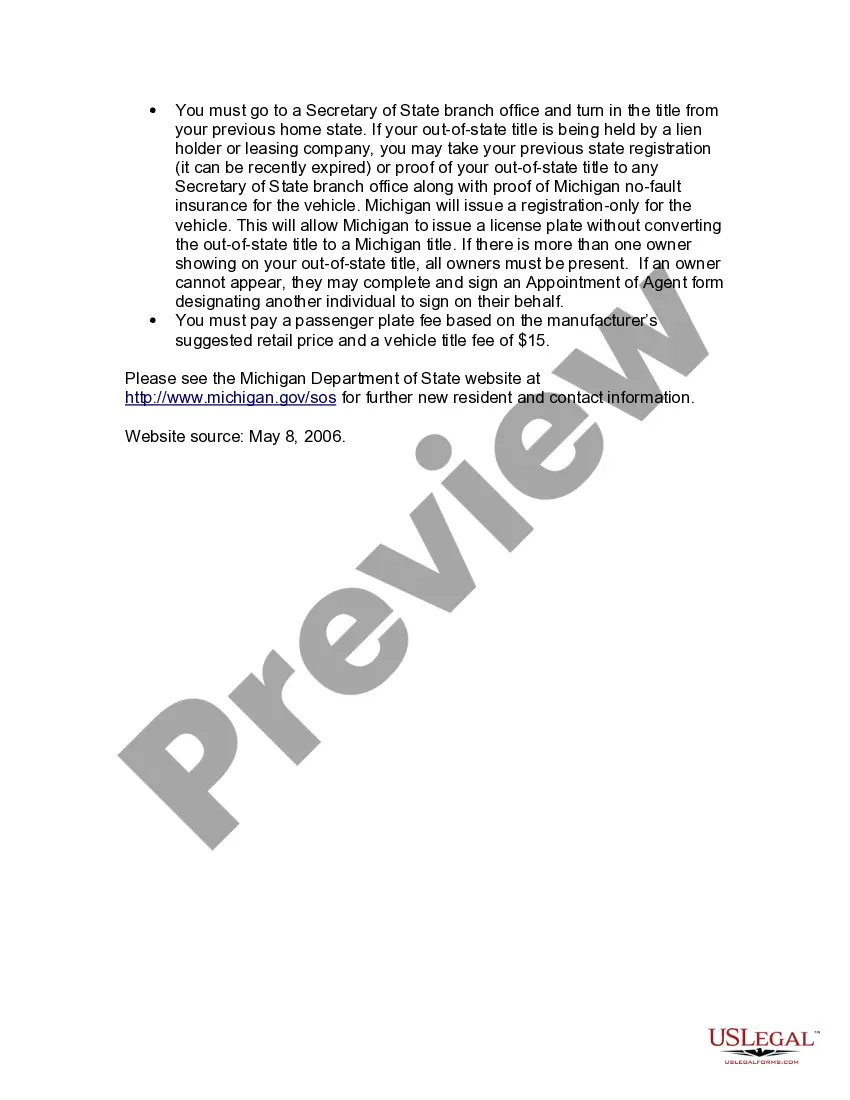
- Vehicle title and registration procedures in the new state.
When to use this document
This form should be used when you are moving to a new state and need guidance on complying with local laws. It is particularly useful when you need to establish residency, register to vote, obtain necessary identification, and ensure your vehicle is legally registered in the new state.
Who needs this form
- New residents of a state who are unfamiliar with local legal requirements.
- Individuals planning to vote in their new state.
- Drivers who need to apply for a new driver's license or personal identification card.
- Vehicle owners who need to transfer their vehicle registration to a new state.
Instructions for completing this form
- Identify your residency status and ensure you meet the requirements.
- Gather the necessary identification documents required for voter registration and obtaining a driver's license.
- Visit local government offices as needed to complete your voter registration and obtain your driver's license.
- Follow the process for titling and registering your vehicle, including submitting the appropriate documents and paying fees.
- Keep copies of all submitted documents for your records.
Is notarization required?
This form does not typically require notarization unless specified by local law. Please check specific state requirements for any additional notarization necessities.
Get your form ready online
Our built-in tools help you complete, sign, share, and store your documents in one place.
Make edits, fill in missing information, and update formatting in US Legal Forms—just like you would in MS Word.
Download a copy, print it, send it by email, or mail it via USPS—whatever works best for your next step.
Sign and collect signatures with our SignNow integration. Send to multiple recipients, set reminders, and more. Go Premium to unlock E-Sign.
If this form requires notarization, complete it online through a secure video call—no need to meet a notary in person or wait for an appointment.
We protect your documents and personal data by following strict security and privacy standards.

Make edits, fill in missing information, and update formatting in US Legal Forms—just like you would in MS Word.

Download a copy, print it, send it by email, or mail it via USPS—whatever works best for your next step.

Sign and collect signatures with our SignNow integration. Send to multiple recipients, set reminders, and more. Go Premium to unlock E-Sign.

If this form requires notarization, complete it online through a secure video call—no need to meet a notary in person or wait for an appointment.

We protect your documents and personal data by following strict security and privacy standards.
Mistakes to watch out for
- Failing to register to vote by the deadline.
- Not providing adequate proof of residency for vehicle registration.
- Overlooking specific identification requirements for a driverâs license application.
Why complete this form online
- Convenient access to comprehensive information from anywhere.
- Editable documents that can be tailored to your specific situation.
- Reliable guidance drafted by licensed attorneys.
Legal use & context
- The New Resident Guide serves as a legal reference for fulfilling state obligations.
- It is not a legally binding document but a helpful informational resource.
- Understanding legal requirements ensures compliance and avoids potential penalties.
Summary of main points
- The New Resident Guide assists with navigating state residency requirements.
- Understanding voter registration, identification, and vehicle registration in your new state is critical.
- Gather necessary documents to streamline your application processes.
Looking for another form?
Form popularity
FAQ
If an individual lives in this state at least 183 days during the tax year or more than 1/2 the days during a taxable year of less than 12 months he shall be deemed a resident individual domiciled in this state.
How do I convert my out-of-state driver's license to a Michigan license? Take your current out-of-state driver's license, proof of a valid Social Security number, U.S. citizenship or legal presence if not a U.S. citizen, identity and at least two documents establishing Michigan residency to a Secretary of State office.
All applicants applying for an original driver's license or personal identification card must provide two proofs of Michigan residency. Any item presented to establish proof of residency must include the applicant's name and a Michigan residence address (no P.O. boxes or Mailbox Plus addresses).
To convert your out-of-state license to Michigan, take all required documents to a local Secretary of State branch office the list of required documents is available. You do not need to take a written test. You will be given a vision test and your photo will be taken.
In most cases, if you have lived in the state of Michigan for at least six consecutive months before the first day of classes, you'll qualify as a Michigan resident.
Take your current out-of-state driver's license, proof of a valid Social Security number, U.S. citizenship or legal presence if not a U.S. citizen, identity and at least two documents establishing Michigan residency to a Secretary of State office.
How do I convert my out-of-state driver's license to a Michigan license? Take your current out-of-state driver's license, proof of a valid Social Security number, U.S. citizenship or legal presence if not a U.S. citizen, identity and at least two documents establishing Michigan residency to a Secretary of State office.
All applicants applying for an original driver's license or personal identification card must provide two proofs of Michigan residency. Any item presented to establish proof of residency must include the applicant's name and a Michigan residence address (no P.O. boxes or Mailbox Plus addresses).