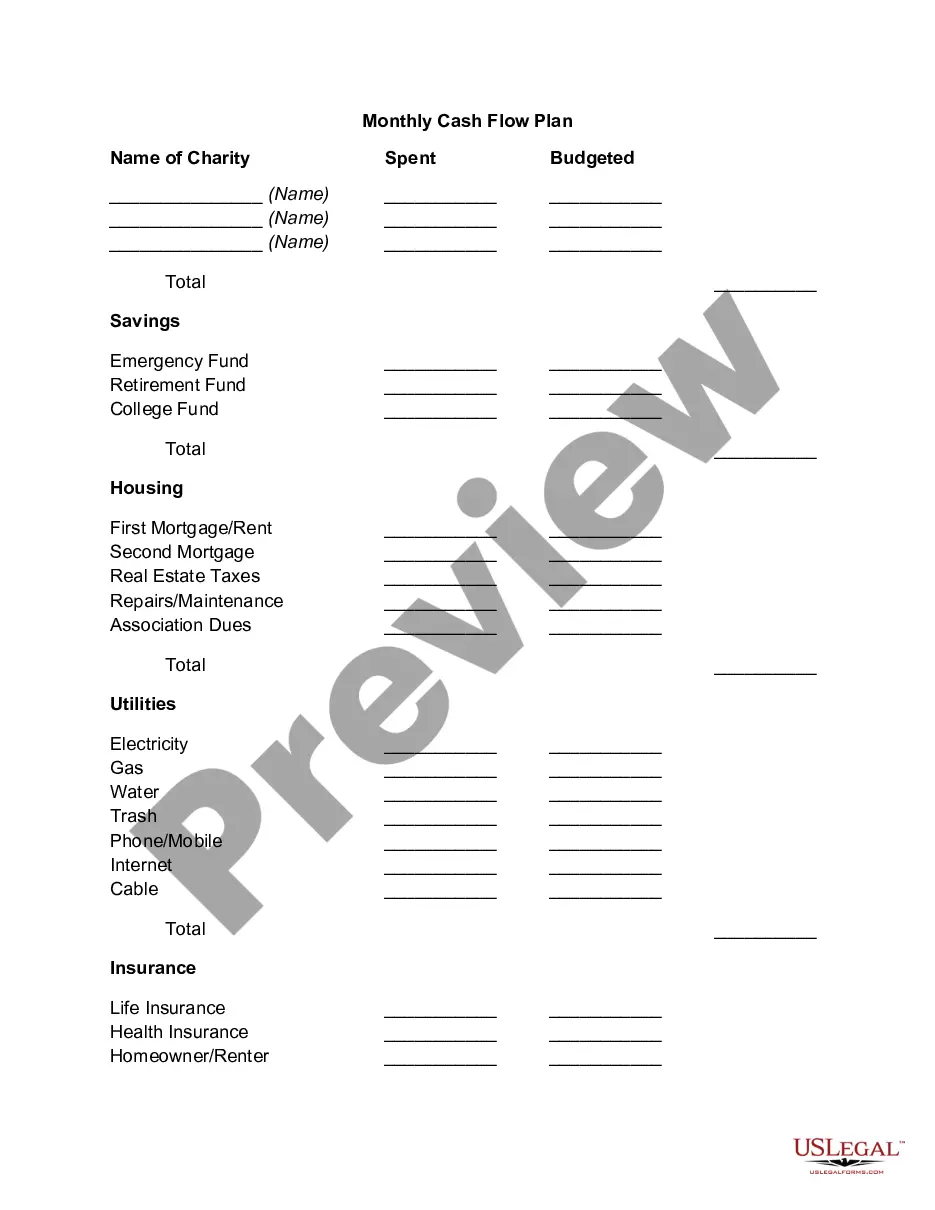
Monthly Cash Flow Plan
Overview of this form
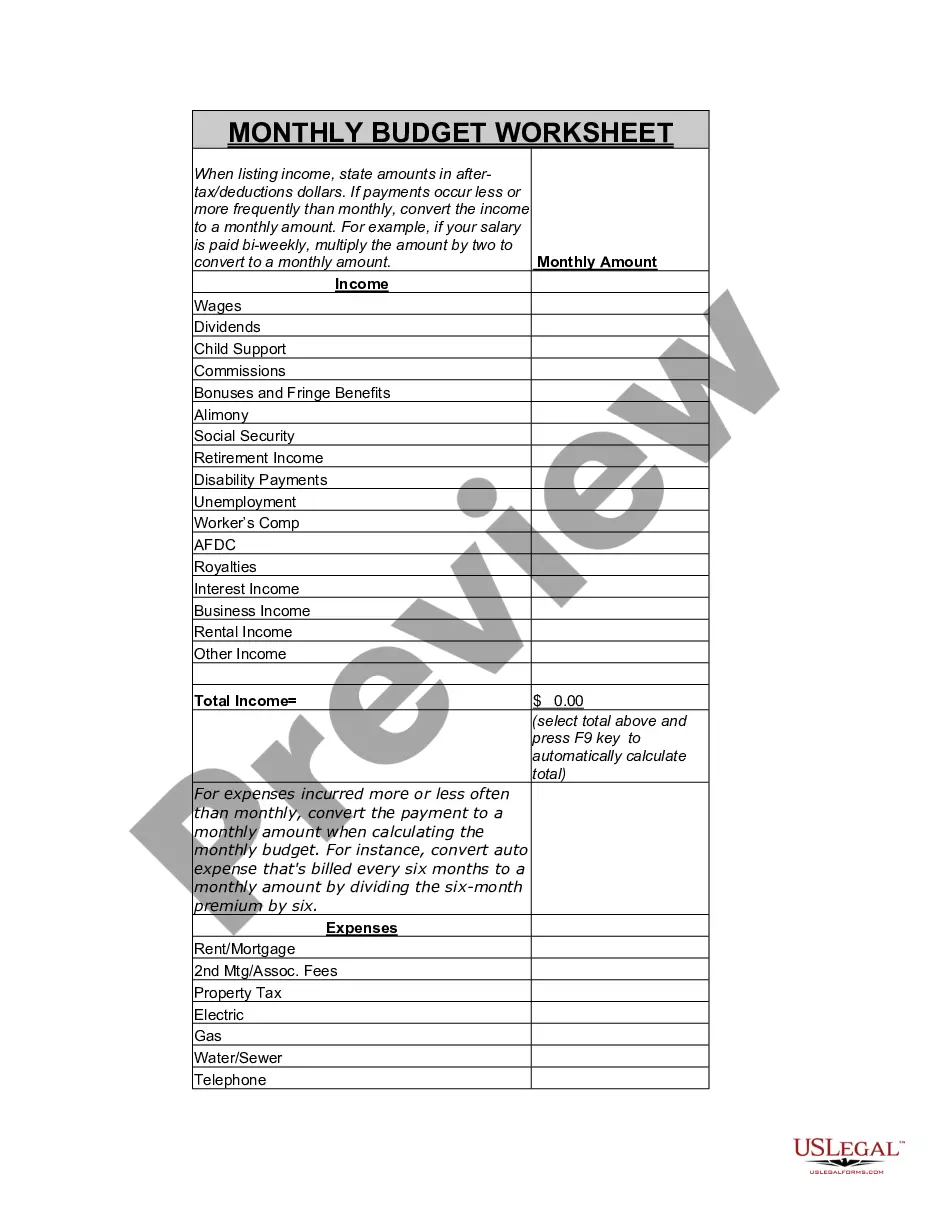
The Monthly Cash Flow Plan is a budgeting tool designed to help individuals or families manage their income and expenses effectively. This form allows you to track various categories of expenditures and savings, ensuring that you have a clear picture of your financial health. Unlike other budgeting tools, this form focuses on a monthly overview, making it easy to adjust your finances as needed to achieve your financial goals.
Key parts of this document
- Name of Charity: Section for tracking charitable donations.
- Savings and Emergency Fund: Areas to allocate money towards savings goals.
- Housing: Field to list mortgage or rent payments along with related housing expenses.
- Utilities: Section for tracking utility costs such as electricity, gas, and internet.
- Insurance: Place to specify various types of insurance premiums.
- Debts: Area to record payments for loans and credit cards.


When to use this form
This form is beneficial when you want to establish a clear plan for managing your monthly cash flow. It is especially useful for individuals who are looking to budget for personal expenses, save for future goals, or track debt repayment. Use this form during financial planning sessions or anytime you need a comprehensive overview of your monthly financial situation.
Who should use this form
Eligibility for this form includes:
- Individuals or families seeking to manage their finances effectively.
- Budget-conscious individuals looking to track spending and savings.
- Anyone who needs a structured approach to understanding their cash inflows and outflows.
How to prepare this document
- Identify your total monthly income and enter it in the designated field.
- List all your fixed and variable monthly expenses under the appropriate headings.
- Allocate funds for each category, ensuring to cover savings and necessary expenses.
- Calculate the total for each category to see your spending breakdown.
- Subtract total monthly expenses from total monthly income to determine your surplus or deficiency.
Does this document require notarization?
This form does not typically require notarization to be legally valid. However, some jurisdictions or document types may still require it. US Legal Forms provides secure online notarization powered by Notarize, available 24/7 for added convenience.
Get your form ready online
Our built-in tools help you complete, sign, share, and store your documents in one place.
Make edits, fill in missing information, and update formatting in US Legal Forms—just like you would in MS Word.
Download a copy, print it, send it by email, or mail it via USPS—whatever works best for your next step.
Sign and collect signatures with our SignNow integration. Send to multiple recipients, set reminders, and more. Go Premium to unlock E-Sign.
If this form requires notarization, complete it online through a secure video call—no need to meet a notary in person or wait for an appointment.
We protect your documents and personal data by following strict security and privacy standards.

Make edits, fill in missing information, and update formatting in US Legal Forms—just like you would in MS Word.

Download a copy, print it, send it by email, or mail it via USPS—whatever works best for your next step.

Sign and collect signatures with our SignNow integration. Send to multiple recipients, set reminders, and more. Go Premium to unlock E-Sign.

If this form requires notarization, complete it online through a secure video call—no need to meet a notary in person or wait for an appointment.

We protect your documents and personal data by following strict security and privacy standards.
Common mistakes
- Failing to include all sources of income in the total monthly income.
- Underestimating monthly expenses, especially variable costs like groceries and utilities.
- Not updating the plan regularly with actual expenses and income changes.
Benefits of using this form online
- Immediate access to a structured budgeting format that can be modified as needed.
- Easy downloading and printing options for offline use.
- Reliable templates drafted by licensed attorneys ensuring legal compliance.
Legal use & context
- This form serves as a personal budgeting tool and is not legally binding.
- It is meant for personal use and to facilitate better financial decision-making.
Looking for another form?


Form popularity
FAQ
Cash flow is the money that is moving (flowing) in and out of your business in a month.Cash is going out of your business in the form of payments for expenses, like rent or a mortgage, in monthly loan payments, and in payments for taxes and other accounts payable.
Add the balance in your operating activities, financing activities, and investing activities columns together. This amount is your monthly business cash flow. If you have a positive number, you have a positive cash flow. If the number is negative, your business spent more than it earned that month.
Enter Your Beginning Balance. For the first month, start your projection with the actual amount of cash your business will have in your bank account. Estimate Cash Coming In. Fill in all amounts you expect to take in during the month. Estimate Cash Going Out. Subtract Outlays From Income.
Prepare the income or sales for the business a sales forecast. Prepare detail on any other estimated cash inflows. Prepare detail on all estimated cash outflows and expenses. Prepare your cash flow forecast by putting all the gathered detail together.
Cash flow is a measurement of the amount of cash that comes into and out of your business in a particular period of time. When you have positive cash flow, you have more cash coming into your business than you have leaving itso you can pay your bills, and cover other expenses.
Step 1: PrepareGather Basic Documents and Data. Step 2: Calculate Changes in the Balance Sheet. Step 3: Put Each Change in B/S to the Statement of Cash Flows.
Cash Flow from Investing Activities is cash earned or spent from investments your company makes, such as purchasing equipment or investing in other companies. Cash Flow from Financing Activities is cash earned or spent in the course of financing your company with loans, lines of credit, or owner's equity.
A cash flow plan that assigns an expense to every dollar of your income, wherein the total income minus the total expenses equals zero.
Cash flow plans, in insurance, are plans that allow policyholders to use their own cash flow to finance their insurance premiums.However, cash flow plans can also relate to documents a company puts together to track cash flow, both cash inflows and outflows, over a period.