Massachusetts Small Business Accounting Package
Overview of this form package
The Massachusetts Small Business Accounting Package is a comprehensive set of essential business forms designed to streamline financial management for small businesses. It includes vital accounting forms, such as profit and loss statements, invoices, and expense reports, all drafted by licensed attorneys. This package differentiates itself by providing easy-to-adapt templates tailored for the unique requirements of Massachusetts businesses, helping you maintain accurate financial records and comply with state regulations.
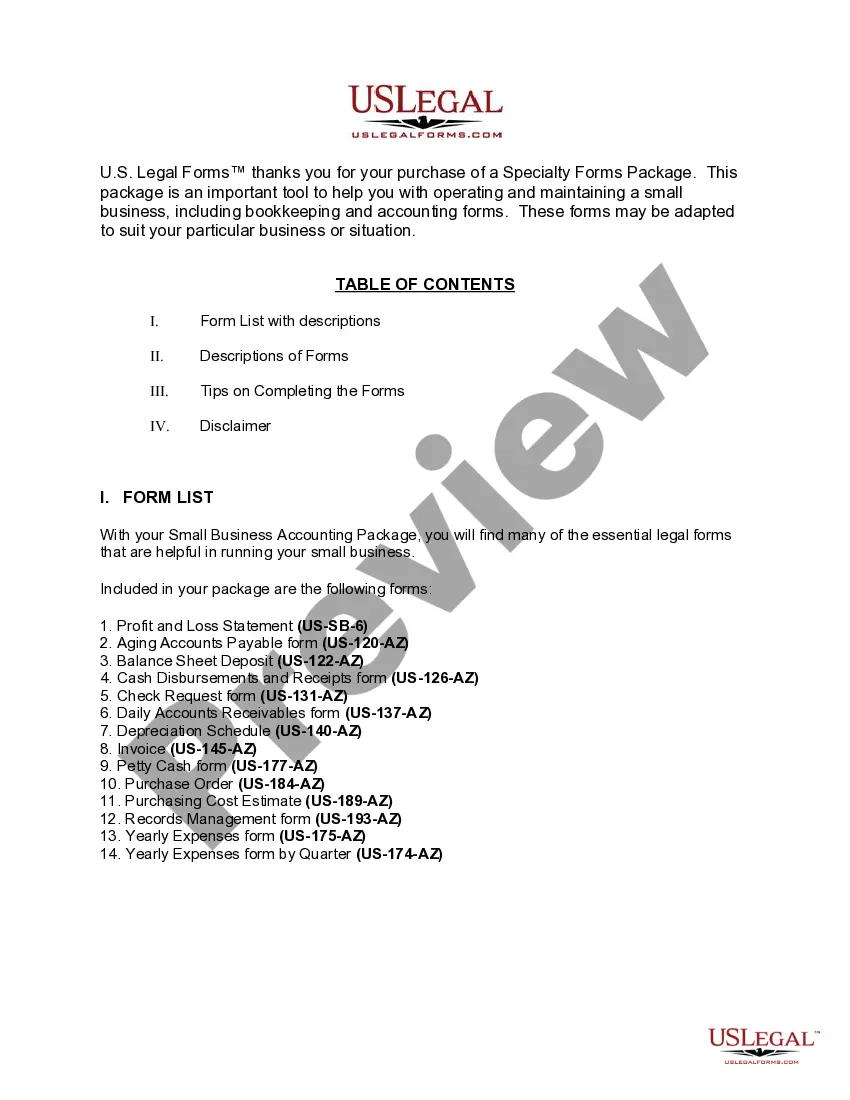
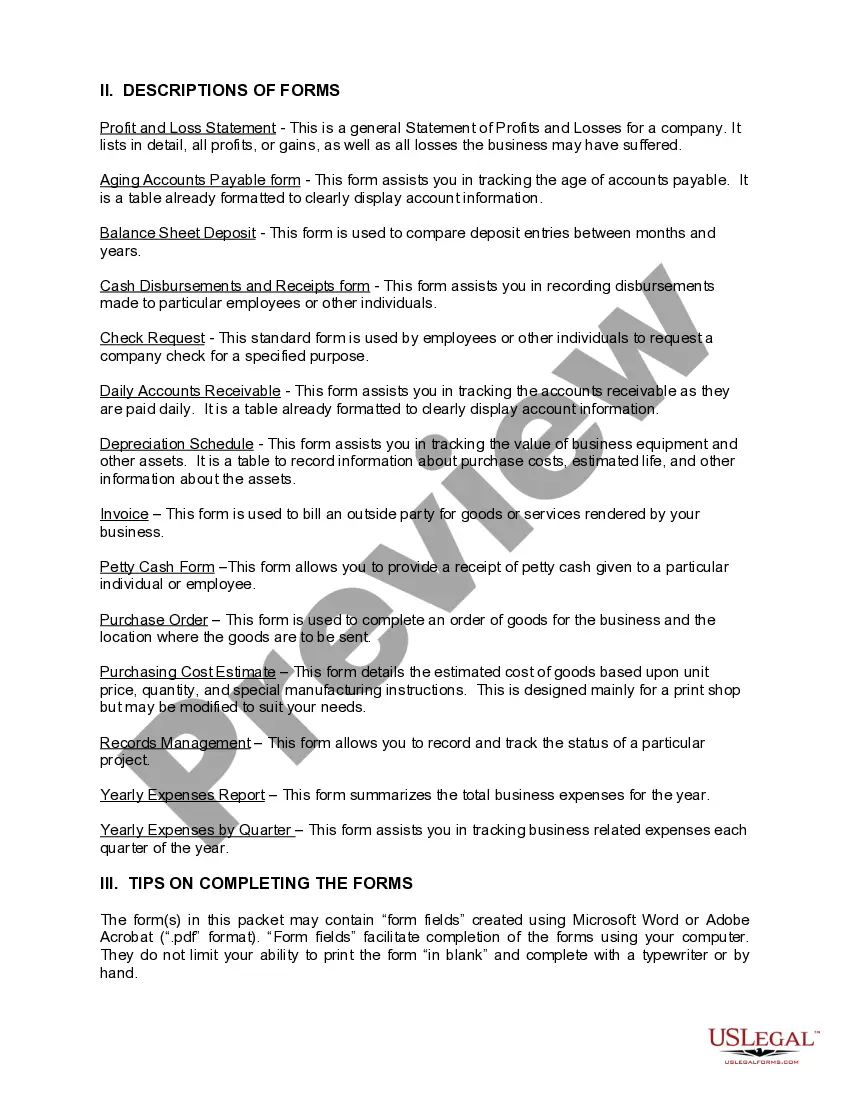
Forms included in this package
- Aging Accounts Payable
- Balance Sheet Deposits
- Cash Disbursements and Receipts
- Check Request
- Daily Accounts Receivable
- Depreciation Schedule
- Job Invoice - Short
- Yearly Expenses by Quarter
- Yearly Expenses
- Petty Cash Form
- Purchasing Cost Estimate
- Records Management
- Profit and Loss Statement
- Purchase Order for Invoice

When to use this form package
This form package is ideal for small business owners who need a reliable system for tracking their finances. Use it in the following scenarios:
- When starting a new small business and needing to set up an accounting system.
- To track income and expenses for tax preparation.
- When managing accounts payable and receivable to ensure timely payments.
- During financial reviews to evaluate profitability and make informed business decisions.
Who should use this form package
- Small business owners in Massachusetts.
- Entrepreneurs looking to establish clear accounting practices.
- Financial managers responsible for tracking business finances.
- Bookkeepers requiring standardized forms for their clients.
Steps to complete these forms
- Review the included forms to familiarize yourself with each type.
- Identify the specific forms you need based on your business operations.
- Fill out the forms accurately, ensuring all required information is included.
- Save digital copies of the completed forms for your records.
- Print and distribute hard copies as necessary, especially for invoicing and official records.
Do documents in this package require notarization?
Most forms in this package do not require notarization. However, local laws or specific situations may demand it. Our online notarization service, powered by Notarize, lets you complete the process through a verified video call, available anytime.
Get your form ready online
Our built-in tools help you complete, sign, share, and store your documents in one place.
Make edits, fill in missing information, and update formatting in US Legal Forms—just like you would in MS Word.
Download a copy, print it, send it by email, or mail it via USPS—whatever works best for your next step.
Sign and collect signatures with our SignNow integration. Send to multiple recipients, set reminders, and more. Go Premium to unlock E-Sign.
If this form requires notarization, complete it online through a secure video call—no need to meet a notary in person or wait for an appointment.
We protect your documents and personal data by following strict security and privacy standards.

Make edits, fill in missing information, and update formatting in US Legal Forms—just like you would in MS Word.

Download a copy, print it, send it by email, or mail it via USPS—whatever works best for your next step.

Sign and collect signatures with our SignNow integration. Send to multiple recipients, set reminders, and more. Go Premium to unlock E-Sign.

If this form requires notarization, complete it online through a secure video call—no need to meet a notary in person or wait for an appointment.

We protect your documents and personal data by following strict security and privacy standards.
Typical mistakes to avoid
- Failing to update financial information regularly.
- Incorrectly recording receipts or invoices, leading to inaccuracies.
- Not retaining copies of submitted forms for future reference.
- Overlooking the need for quarterly financial reviews.
Why use this package online
- Convenient access from any device at any time.
- Editable templates that can be customized to fit your needs easily.
- Reliability ensuring that forms are reviewed by licensed attorneys.
- Cost savings as this package offers up to fifty percent savings compared to purchasing forms individually.
Looking for another form?
Form popularity
FAQ
The typical accounting fees for small business fall between $1,000 to $5,000, according to the poll. If you're a new business owner, don't forget to factor accounting costs into your budget. If you're a veteran owner, it might be time to re-evaluate accounting costs.
Every business, no matter how small, needs a financial and tax advisor. But your business needs a Certified Public Accountant (CPA), not just an accountant or enrolled agent.
Pay Close Attention to Receivables. Keep a Pulse on Your Cash Flow. Log Expense Receipts. Record Cash Expenses. Know the Difference Between Invoices and Receipts. Keep Personal vs. Hire a Professional to Handle Your Taxes. Maintain Clear Communication with Your Accountant.
First of all, it is perfectly legal to run your business without an accountant and most companies are exempt from needing an audit (I think the threshold is around £10m a year turnover). That makes things a lot easier. There are two government bodies that care about our company: Companies House and HMRC.
Generally, a small business is not required to have a CPA or certified public accountant.Although most small businesses are not required to have a CPA involved, a small business may engage a CPA to review its internal controls, evaluate accounting software, obtain tax advice, and so on.
The average price of outsourcing your bookkeeping needs ranges from $500 to $2,500 a month depending on the number of transactions and complexity of services required. A key benefit of Outsourcing is it gives you the ability to customize the services you receive to your bookkeeping needs.
Business Bank Reconciliations. Credit Card Management. Accounts Receivable. Accounts Payable. Sales Tax. Payroll.
Because LLCs both make your accounting easier and provide you with some wonderful tax planning opportunities.If you've elected to have an LLC treated as an S corporation or as a C corporation, you probably should have a knowledgeable tax practitioner (a CPA, an enrolled agent or an attorney) prepare your tax return.
The typical accounting fees for small business fall between $1,000 to $5,000, according to the poll. If you're a new business owner, don't forget to factor accounting costs into your budget. If you're a veteran owner, it might be time to re-evaluate accounting costs.