Kansas Subcontractors Package
Understanding this form package
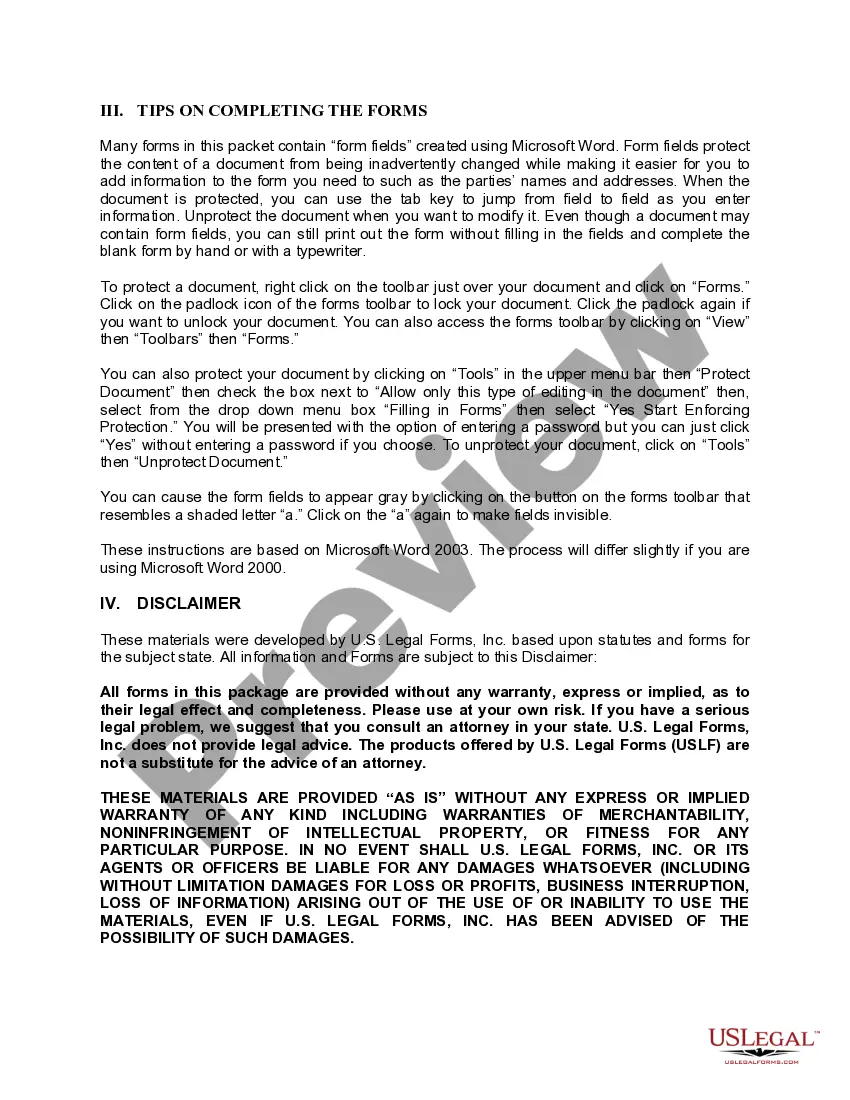
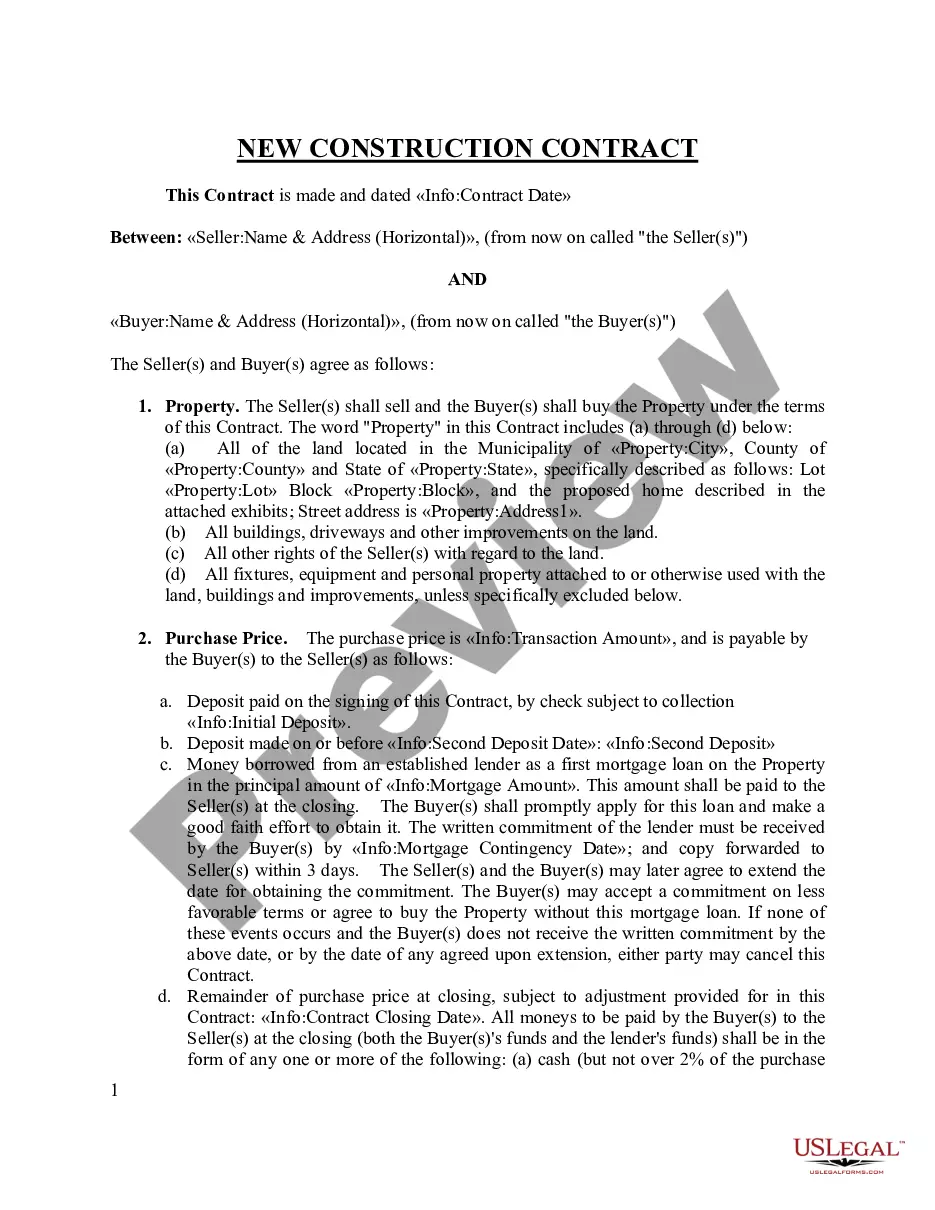
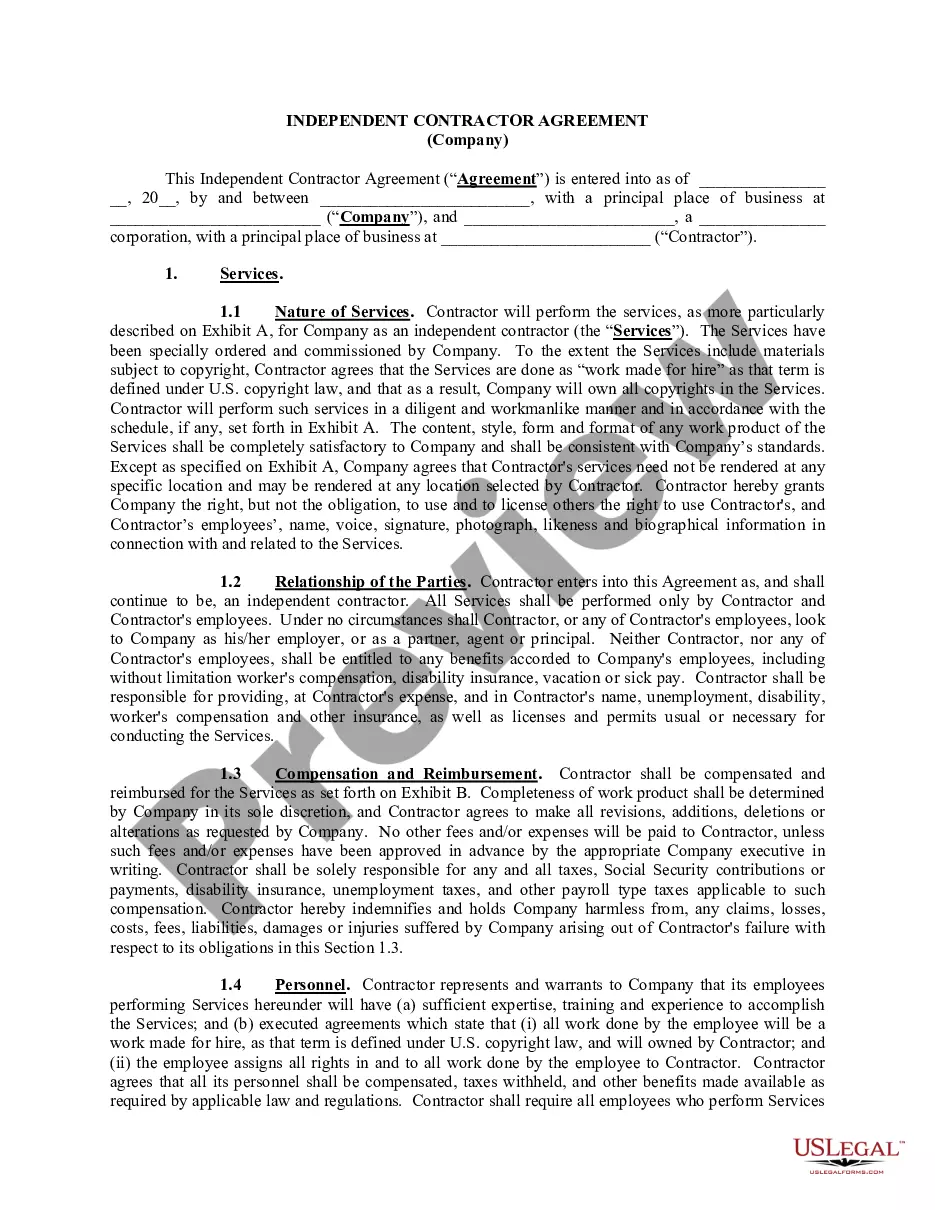
The Kansas Subcontractors Package is a collection of essential legal documents designed specifically for subcontractors involved in construction projects in Kansas. This package includes the key subcontractor's agreement and other important forms that comply with state law, helping you manage your project effectively and protect your legal rights. Unlike general construction form packages, this one is tailored to address the unique needs and regulations of subcontractors in Kansas.
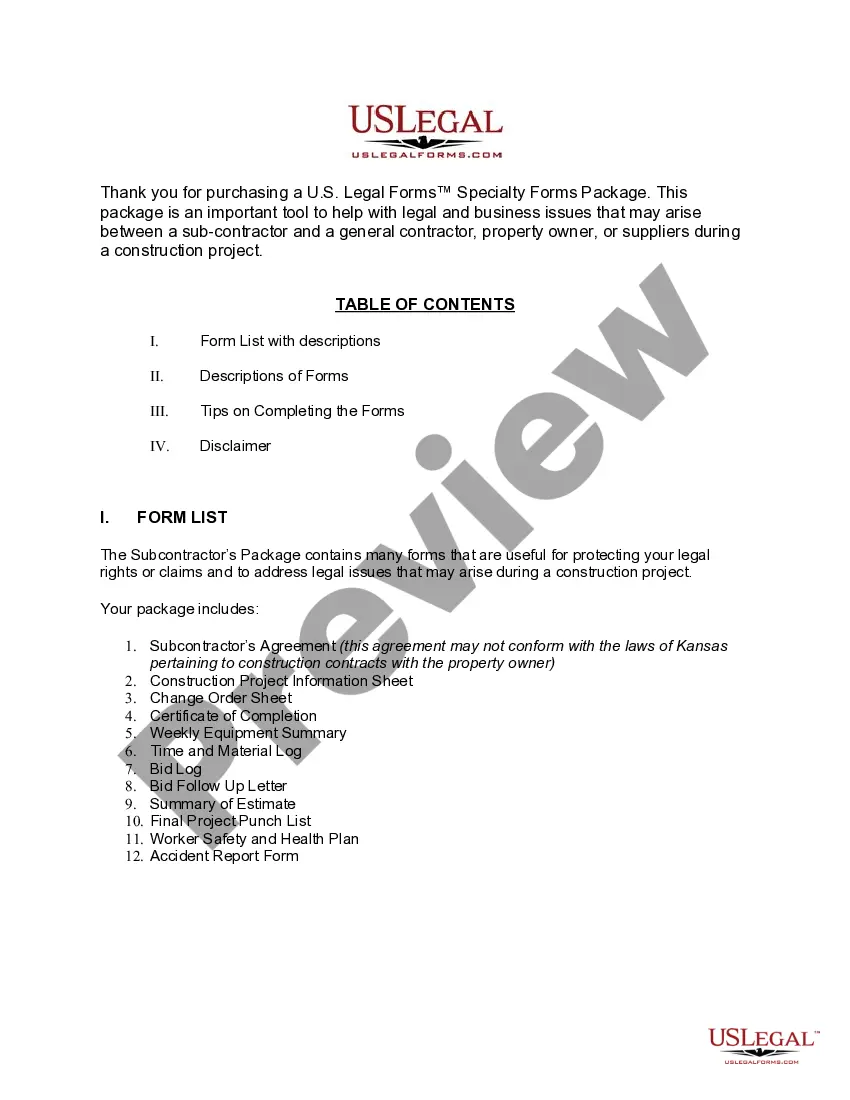
Forms included in this package
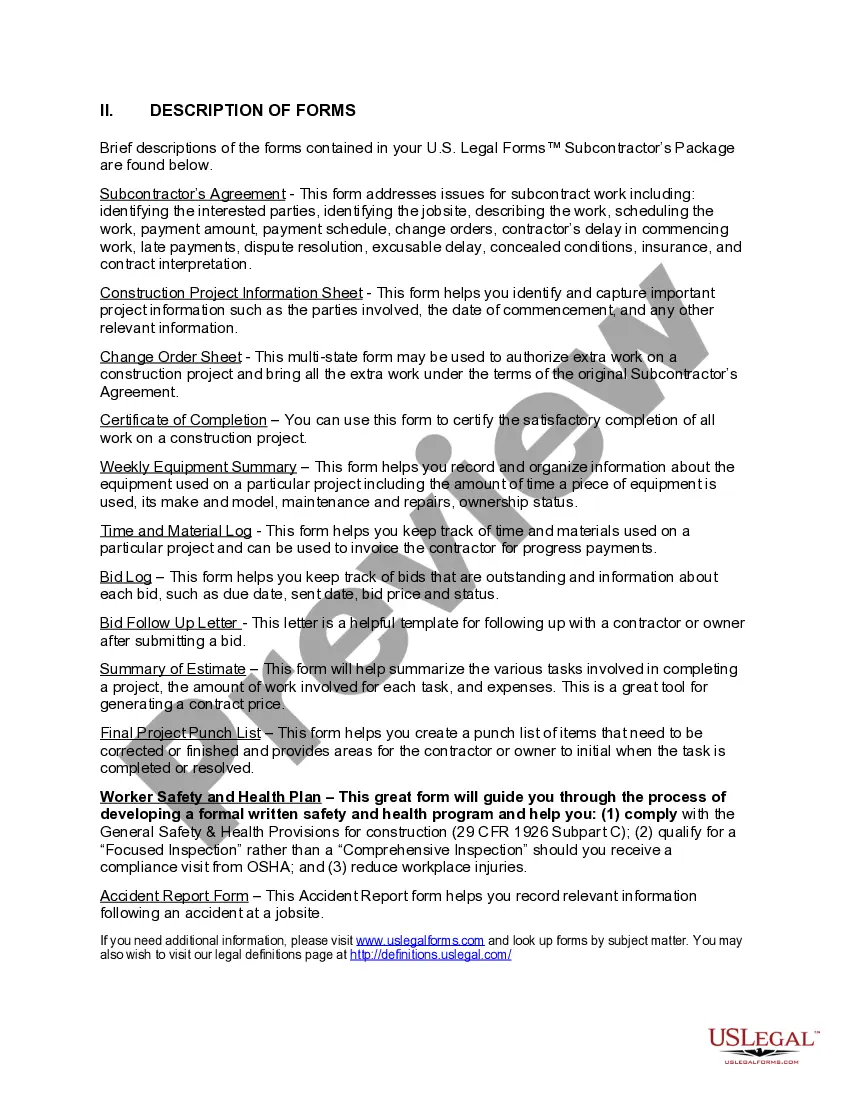
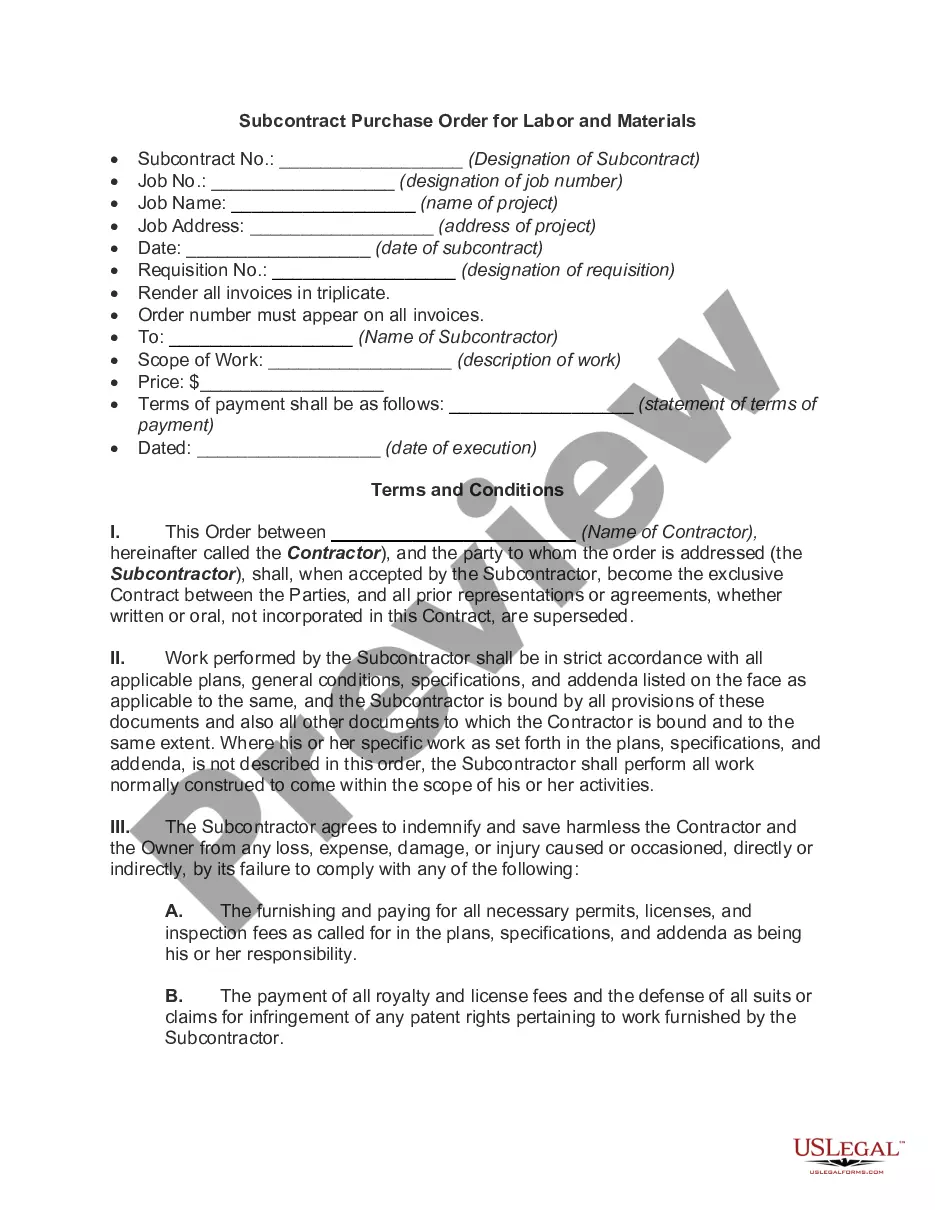
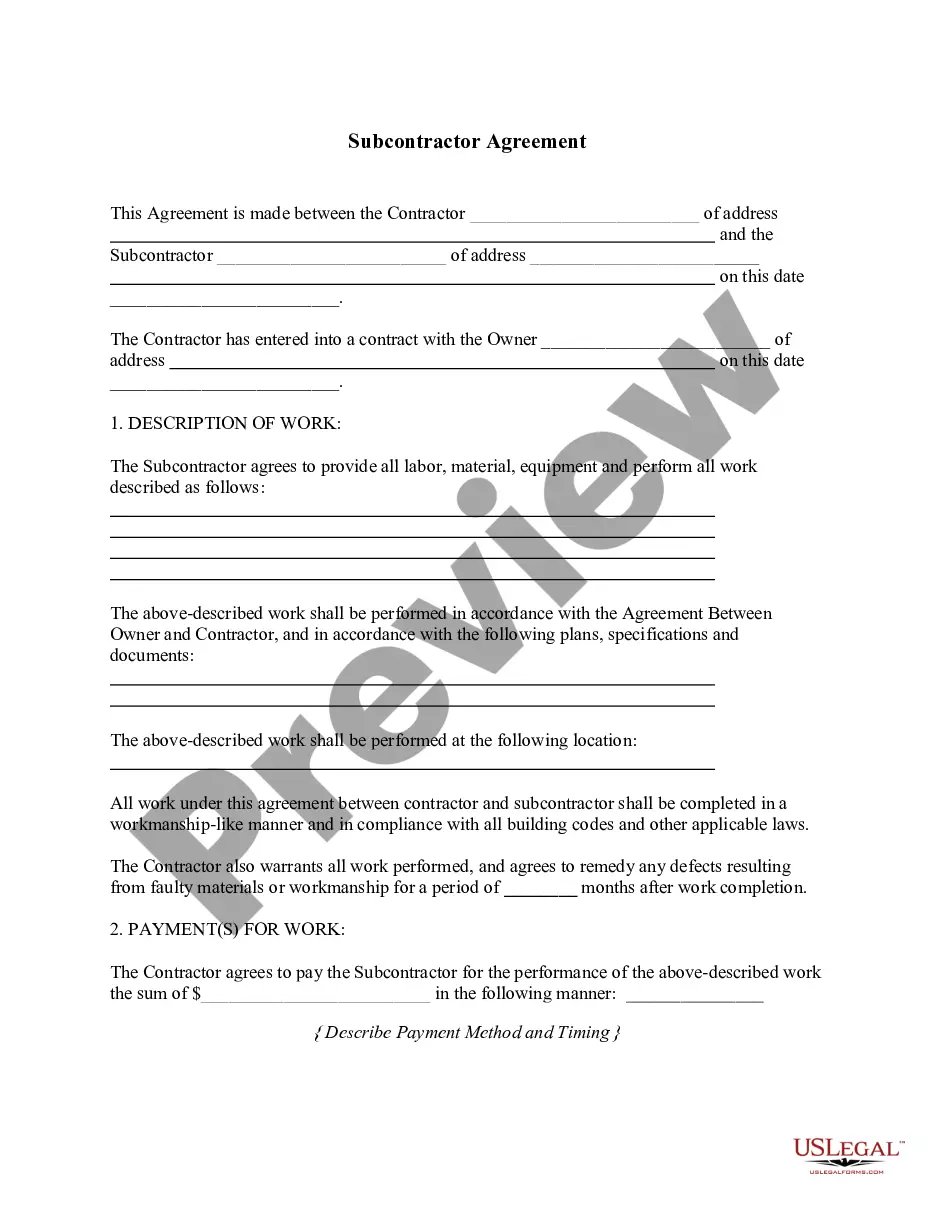
- Subcontractor's Agreement
- Contractor's Weekly Equipment Summary
- Contractor's Time and Materials Log
- Contractor's Bid Log
- Contractor's Bid Follow Up Letter
- Contractor's Summary of an Estimate
- Contractor's Final Punch List
- Construction Accident Report
- Construction Safety and Health Plan
- Change Order for Construction or Repairs by Contractor
- Certification of Completion by Contractor
- Construction Project Information Sheet

When this form package is needed
This form package is useful in various scenarios, including:
- When entering into agreements with general contractors or property owners.
- To document changes and adjustments in a construction project through change orders.
- To track progress and manage resources, including time and materials used.
- When ensuring compliance with legal safety standards and maintaining project documentation.
- To finalize and confirm project completion with necessary certificates.
Who needs this form package
- Subcontractors who are managing their construction projects.
- General contractors who hire subcontractors and need standard agreements.
- Construction business owners seeking to ensure compliance with Kansas law.
- Individuals with little legal experience wanting to document their construction contracts effectively.
- Construction professionals aiming to protect their legal rights and obligations.
How to complete these forms
- Review your construction project details and relevant legal requirements.
- Identify the parties involved and complete the subcontractor's agreement.
- Enter necessary information in the Construction Project Information Sheet.
- Document any changes to the project using the Change Order Sheet.
- Keep track of equipment and materials with the Weekly Equipment Summary and Time and Material Log.
- Ensure safety compliance by drafting the Worker Safety and Health Plan.
Notarization guidance for this package
Forms in this package usually don’t need notarization, but certain jurisdictions or signing circumstances may require it. US Legal Forms provides a secure online notarization option powered by Notarize, accessible 24/7 from anywhere.
Get your form ready online
Our built-in tools help you complete, sign, share, and store your documents in one place.
Make edits, fill in missing information, and update formatting in US Legal Forms—just like you would in MS Word.
Download a copy, print it, send it by email, or mail it via USPS—whatever works best for your next step.
Sign and collect signatures with our SignNow integration. Send to multiple recipients, set reminders, and more. Go Premium to unlock E-Sign.
If this form requires notarization, complete it online through a secure video call—no need to meet a notary in person or wait for an appointment.
We protect your documents and personal data by following strict security and privacy standards.

Make edits, fill in missing information, and update formatting in US Legal Forms—just like you would in MS Word.

Download a copy, print it, send it by email, or mail it via USPS—whatever works best for your next step.

Sign and collect signatures with our SignNow integration. Send to multiple recipients, set reminders, and more. Go Premium to unlock E-Sign.

If this form requires notarization, complete it online through a secure video call—no need to meet a notary in person or wait for an appointment.

We protect your documents and personal data by following strict security and privacy standards.
Avoid these common issues
- Failing to correctly fill out the subcontractor's agreement.
- Not documenting change orders, leading to disputes later.
- Neglecting to track time and materials accurately.
- Forgetting to finalize projects with the Certificate of Completion.
- Overlooking safety compliance documentation.
Benefits of completing this package online
- Convenience of downloading forms instantly without the need for physical paperwork.
- Editable templates that allow you to tailor documents to your specific project needs.
- Reliable forms drafted by licensed attorneys, ensuring compliance with legal standards.
Legal use & context
- The documents in this package support enforceability of subcontractor agreements under Kansas law.
- Use of these forms reduces the risk of legal disputes by clearly outlining rights and responsibilities.
- They help maintain proper documentation for accountability and regulatory compliance.
Summary of main points
- The Kansas Subcontractors Package provides essential legal documents for subcontractors.
- Use this package to manage construction projects effectively and protect your rights.
- Forms are tailored to comply with Kansas laws and regulations.
Looking for another form?
Form popularity
FAQ
Depending on state law and the type of contract, a subcontractor can place a mechanic's lien on the property and get payment from the owner. If you are unable to get satisfaction, you can foreclose on the property and obtain payment from the sale.
Subcontracting is the practice of assigning, or outsourcing, part of the obligations and tasks under a contract to another party known as a subcontractor. Subcontracting is especially prevalent in areas where complex projects are the norm, such as construction and information technology.
Subcontractor vs Independent contractor is a difference in an employment relationship with a laborer. Independent contractors are employed and paid directly by the employer while subcontractors are employed by an independent contractor and are paid by them.
N. a person or business which has a contract (as an "independent contractor" and not an employee) with a contractor to provide some portion of the work or services on a project which the contractor has agreed to perform.
If a general contractor refuses to pay his subcontractors, they can make a claim against the payment bond. The surety company will pay out the subcontractors for at least part of their money and take the contractor to court.
To avoid this additional tax, contractors must therefore ensure that all of their subcontractors are indeed subcontractors for tax purposes and not potentially an employee. Employees also have more rights such as minimum wage, pensions, holiday pay, sick pay.
A subcontractor agreement is a contract between contractors or project managers and subcontractors. This solidifies any agreement between the two parties and assures work. Subcontractors should read the subcontractor agreement and assure specifics to protect themselves from unfair risk.
A subcontractor is a worker who is not your employee. You give a Form 1099 to a subcontractor showing the amounts you paid him. The subcontractor is responsible for keeping his or her own records and paying his or her own income and self-employment taxes.
In short, someone who sets their wage, hours, and chooses the jobs they take on is a subcontractor, while someone whose employer specifies their wage, hours, and work tasks is an employee.